Showing posts with label women's history. Show all posts

Book List on Women, Gender, and Sex in American Religious History

Andrea L. Turpin
  
This fall I get to teach one of my favorite classes: my graduate course on Women, Gender, and Sex in American Religious History. One of the readings I assign for the first day is quite possibly my favorite historiographic essay of all time, Catherine Brekus's “Introduction: Searching for Women in Narratives of American Religious History,” in The Religious History of American Women: Reimagining the Past, ed. Brekus (North Carolina, 2007).

In this ten-year-old essay, Brekus examines why so many synthetic works of American religious history ignore women and why so many synthetic works of American women's history ignore religion. She makes a compelling case that the answer is not that scholarship on American women's religious history doesn't exist--and that both omissions leave our understanding of our collective past significantly impoverished.

Yet five years after the release of The Religious History of American Women, the December 2012 issue of the Journal of American History dedicated to a state-of-the-field analysis of American women's and gender history hardly mentioned religion at all. And as late as 2016 I was still seeing so many book lists for lay readers interested in American religious history that didn't include books by or about women that I was moved to write my first ever blog post on the subject.

But I am encouraged by my class, both the students in it and the books available to assign for it. The course has enrolled a large number of students, and roughly equal numbers of women and men are interested in the topic. (I wrote a guest post last year over at the Anxious Bench reflecting on my experience teaching an earlier version of this course to 6 men and 1 woman!) And even though I last taught the course only a year and half ago, I changed about one-third of the books on the syllabus because so much excellent work has been published in the last two years.

Each week the class reads one book and an additional article or book chapter on a complementary topic. In the readings for the course, I strive for diversity of multiple types: religious traditions, race and ethnicity, historical time period, styles of writing, and classic vs. recent works. In different years the course ends up having slightly different emphases depending on the interests of the students enrolled, my research at the time, what books have recently been published, and the directions in which the field is developing. 

Particularly noteworthy in this iteration is the recent expansion of scholarship on religion and sexuality. And it is a sign of the vitality of the field of women, gender, and sex in American religious history that there are so many excellent books that I could have included that did not make this particular semester's list. Judging from the books on this year's syllabus, shout out to the university presses of Oxford, North Carolina, and Cornell, who have all published multiple titles in this area.

Now without further ado, for your reading pleasure, here are the books for this year: 
 
Joan Wallach Scott, Sex and Secularism (Princeton, 2017) 

Carol F. Karlsen, The Devil in the Shape of a Woman: Witchcraft in Colonial New England (W.W. Norton, 1987)

Susan Juster, Disorderly Women: Sexual Politics & Evangelicalism in Revolutionary New England (Cornell, 1994)

Laurel Thatcher Ulrich, A House Full of Females: Plural Marriage and Women's Rights in Early Mormonism, 1835-1870 (Knopf, 2017)

Kathi Kern, Mrs. Stanton’s Bible (Cornell, 2001)

Andrea L. Turpin, A New Moral Vision: Gender, Religion, and the Changing Purposes of American Higher Education, 1837–1917 (Cornell, 2016)

*I offer the book to my students at my author's discount so I don't make a profit. We use this day to discuss not only the topic, but also the process of writing a dissertation and turning it into a book.

Sarah Imhoff, Masculinity and the Making of American Judaism (Indiana, 2017)

Kristin Kobes DuMez, A New Gospel for Women: Katharine Bushnell and the Challenge of Christian Feminism (Oxford, 2015)

Marie Griffith, Moral Combat: How Sex Divided American Christians and Fractured American Politics (Basic, 2017)

Heather R. White, Reforming Sodom: Protestants and the Rise of Gay Rights (North Carolina, 2015)

Daniel Williams, Defenders of the Unborn: The Pro-Life Movement before Roe v. Wade (Oxford, 2016)

Ula Yvette Taylor, The Promise of Patriarchy: Women and the Nation of Islam (North Carolina, 2017)

James M. Ault, Spirit and Flesh: Life in a Fundamentalist Baptist Church (Knopf, 2004)

As I mentioned earlier, in addition to these books, the class reads several standalone articles and book chapters. I want to highlight three 2018 edited volumes that make helpful contributions to the field and are the source of some of these chapters:

Eds. Gillian Frank, Bethany Moreton, & Heather R. White, Devotions and Desires: Histories of Sexuality and Religion in the United States (North Carolina, 2018)

Eds. Michele Lise Tarter & Catie Gill, New Critical Studies on Early Quaker Women, 1650-1800 (Oxford, 2018)

Eds. Leilah Danielson, Marian Mollin, & Doug Rossinow, The Religious Left in Modern America: Doorkeepers of a Radical Faith (Palgrave Macmillan, 2018)

I suspect next time I teach this course, several readers of this blog will have produced excellent new work in the field to include!

spacer

Paige Patterson, Beth Moore, and the History of Evangelical Women's Education

Andrea L. Turpin

Today over at The Conversation I was asked to share my reflections on what the history of evangelical women's education can tell us about Paige Patterson, Beth Moore, and the possible future of the Southern Baptist Convention.

Here is a taste:

Southern Baptist Convention leader Paige Patterson was asked to step down early Wednesday morning following a meeting of the board of trustees of Southwestern Baptist Theological Seminary, where he served as president. With a following of over 15 million, Southern Baptists are America's largest Protestant denomination. 

Trustees were responding to a petition by over 3,000 Southern Baptist women regarding what they called Patterson’s “unbiblical” remarks on womanhood, sexuality and domestic violence. In an audio recording from 2000 that surfaced recently, Patterson was heard counseling a woman to stay with her abusive husband. In another sermon, he commented on a 16-year-old girl's body. And even as the trustees met, news broke that Patterson allegedly advised a female seminary student not to report a rape to the police.

It would be easy to assume evangelical Christian educators like Patterson uniformly discriminate against women because they believe the Bible teaches women to submit to men. But, as a historian of women, religion, and higher education, I know that the story is not that simple: Evangelicals actually led in opening higher education to women.

Finish reading here.
spacer

Women's History/Catholic History: New Initiatives at the Cushwa Center

Benjamin J. Wetzel

Although women's history is inseparable (or should be!) from our national narratives, the month of March serves as a time to reflect specifically on women's contributions to American history.  Even more specifically, this month provides a special occasion to reflect on the history of women religious, and to announce some current and forthcoming scholarly initiatives from the Cushwa Center in this area.

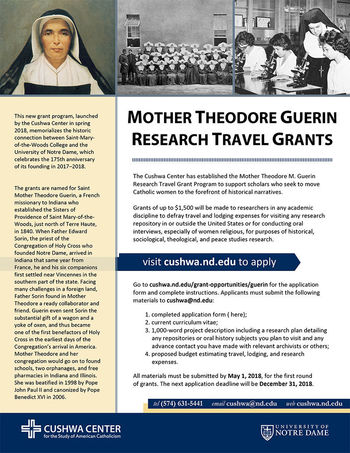
Theodore Guerin Travel Grant Flyer 05

1) The center has launched the Mother Theodore Guerin Research Travel Grant Program.  This program memorializes the historic connection between Saint Mary-of-the-Woods College and the University of Notre Dame by supporting researchers whose projects seek to feature Catholic women more prominently in stories of the past.  Grants of up to $1,500 will be made to scholars seeking to visit any repository in or outside the United States, or traveling to conduct oral interviews, especially of women religious.  An inaugural round of grants will be awarded in late spring 2018 (application deadline: May 1, 2018).  Thereafter, applications will be due December 31 each year for research in the subsequent calendar year.  More info here!

2) Please find a call for papers for the Eleventh Triennial Conference on the History of Women Religious here.  The conference theme is "Commemoration, Preservation, Celebration," and will take place June 23-26, 2019 at Saint Mary's College (Notre Dame, IN).  All details can be found here.  The deadline to submit a paper or panel proposal is June 1, 2018.

3) The Center recently concluded a conference at Kylemore Abbey, Ireland, entitled "A Pedagogy of Peace: The Theory and Practice of Catholic Women Religious in Migrant Education."  For more context on the history of Kylemore's Benedictine nuns, see this article by Jack Rooney.

4) Watch for a new edition of the American Catholic Studies Newsletter, to be published soon.  For now, here is a sneak peek at the most recent article in the series, "Why I Study Women Religious," by Marie Marmo Mullaney (Caldwell University).

Finally, the Cushwa Center will be hiring an in-residence postdoctoral research associate for academic year 2018-2019.  Find the job ad here!  Applications due April 15!
spacer

U.S. Women, Gender, & Sexuality Papers at the American Society of Church History

Andrea L. Turpin

I hope to see many readers at the annual conference of the American Society of Church History (ASCH) next week! This year the ASCH meets concurrently with the American Historical Association (AHA) in Washington, DC from Thursday, January 4 through Sunday, January 7. (Which is, as always, the day before our classes start at Baylor...) Specifically, ASCH panels meet at the Dupont Circle Hotel.


I am pleased to report that most time slots feature at least one paper on women, gender, and/or sexuality in U.S. religious history. Indeed, on Friday morning there are two entire panels on the subject that—unfortunately—conflict with each other. Nearly all the papers in this field this year focus on Protestants, but there are a large number that consider women and gender in American religion within an international context. Recurring themes include feminism and anti-feminism, the intersection of gender and race—and to a lesser extent class—women's religious thought (which makes my intellectual history heart happy), and, of course, women's roles within Christian communities. There are a few papers on masculinity and sexuality, and I would love to see even more in future years.

So, without further ado, I've listed below in bold the papers and panels explicitly featuring U.S. women, gender, and/or sexuality. Enjoy!

Friday, January 5, 8:30 AM – 10:00 AM
American Evangelical “Niche” Ministries and Religious Negotiation of the Postwar Era
Foxhall Ballroom (Ground Floor)

Chair: Darren Dochuk, University of Notre Dame
Papers: “‘Free on the Inside’: Evangelical Prison Ministry in the Age of Law and Order”
Aaron Griffith, Duke University Divinity School
“Piety, Pageants and Playing Indian: Gendered Identity at Summer Camps in the Postwar Era”
Rebecca A. Koerselman, Northwestern College

“‘There is talk of Black Power…it is time somebody talked about God Power’: Evangelical Sports Ministries and the Black Athlete in
the Long 1960s”
Paul Emory Putz, Baylor University
Comment: Neil J. Young, George Mason University

Friday, January 5, 10:30 AM – 12:00 PM
U.S. Protestant Women and Transatlantic Intellectual Cultures in
the Nineteenth Century
Dupont Ballroom B (Ground Floor)

Chair: Candy Gunther Brown, Indiana University
Papers: “Pious Mothers of the Early Church”: Antebellum Women
Historians and the Christian Past”
Paul Gutacker, Baylor University
“Southern Belle, Southern Metaphysician: German Thought and Augusta Jane Evans’s Gendered Apologetics”
Joel Iliff, Baylor University
“Seeing Farther: Mary Virginia Terhune Interprets Darwin for Her
Readers”
Sara S. Frear, Houston Baptist University
Comment: Margaret Bendroth, Congregational Library & Archives


Friday, January 5, 10:30 AM – 12:00 PM
Roundtable: White Protestant Women and the Feminist Movement: Critically Assessing Kristin Kobes Du Mez’s Katharine Bushnell
Georgetown Room (Second Floor)

Chair: Heath W. Carter, Valparaiso University
Papers: “‘The White Life for Two’: The Racial Origins of Sexual Purity”
Sara Moslener, Central Michigan University
“What is Feminism Outside a Mass Movement? ‘Evangelical Feminism’ and the Class-Conscious Feminist Movement It Rejected”
Janine Giordano Drake, University of Great Falls
“Katharine Bushnell, Pandita Ramabai, and the ‘World-Wide Sisterhood of Women’”
Anneke Stasson, Indiana Wesleyan University
“Contentious Women? The Response of Protestant Women’s Organizations to the Fundamentalist-Modernist Controversy”
Andrea L. Turpin, Baylor University
Comment: Kristin Kobes Du Mez, Calvin College


Friday, January 5, 1:30 PM – 3:00 PM
Feminism or Public Housekeeping? Liberal Protestant Women’s Work in the 20th Century
Dupont Ballroom A (Ground Floor)

Chair and Comment: Peter J. Thuesen, Indiana University-Purdue
University Indianapolis
Papers: “The Secularization of Women’s Role in Mid-Twentieth-Century Mainline Protestantism”
Margaret Bendroth, Congregational Library & Archives
“The Maternalist Theology of Margaret Mead”
Elesha J. Coffman, Baylor University
“Diaconal Maternalism”
Jenny Wiley Legath, Center for the Study of Religion


Friday, January 5, 3:30 PM – 5:00 PM
A Century of Activism in the Methodist Theological Tradition
Georgetown Room (Second Floor)

Chair and Comment: Morris Davis, Drew University
Papers: “The Worth of the Slave: Arguments for the Freedom of the Slave in Early Wesleyan Methodist Connection Poetry and Hymns”
Patrick Eby, Wesley Seminary, Indiana Wesleyan University
“Southern Methodist Women and the Social Gospel: Race Relations and Industrial Labor Activism in the Early Twentieth Century”
Chelsea Hodge, University of Arkansas
“The Methodist Episcopal Church and Birth Control”
Ashley B. Dreff, Hood Theological Seminary


Saturday, January 6, 10:30 AM – 12:00 PM
Making White Evangelicals: Racial Encounters and Religious
Identities in the Second Half of the Twentieth Century
Glover Park Ballroom (Ground Floor)

Chair and Comment: Randall Stephens, Northumbria University
Papers: “The Southernization of Evangelicalism: Religious Broadcasting and Massive Resistance in the 1960s”
Paul Matzko, Pennsylvania State University
“A Colorblind Campus? White Evangelical Colleges and Black Students in the Era of Civil Rights”
Jesse Curtis, Temple University
“‘That’s real manhood’: Promise Keepers, Racial Reconciliation, and Muscular Christianity”
Hunter Hampton, University of Missouri


Saturday, January 6, 1:30 PM – 3:00 PM
Foreign Missions, Domestic Consequences: A Roundtable
Glover Park Ballroom (Ground Floor)

Chair: Christine Heyrman, University of Delaware
Papers: “Missionaries Write the World: Reception of Foreign
Missionary Texts in 19th Century America”
Emily Conroy-Krutz, Michigan State University
“Ritualizing Human Rights: Protestant Churchwomen and the United Nations in the Postwar Era”
Gale L. Kenny, Barnard College

“World Disorder and American Protestant Political Mobilization in the 1940s”
Gene Zubovich, Washington University in St. Louis
“Heathen Resonances”
Kathryn Gin Lum, Stanford University

Saturday, January 6, 1:30 PM – 3:00 PM
The Body Social and Socialized Bodies in Puritan New England
Dupont Ballroom (Ground Floor)

Chair: Douglas Winiarski, University of Richmond
Papers: “The Haughty Daughters of Zion: Fashioning Early New
England”
Martha L. Finch, Missouri State University

“States in Motion: Social Justice, Distributive Justice, in Early New England”
Scott McDermott, Albany State University
“The freedom of this Body Politick”: Puritanism and the Problem of Godly Rule
Adrian Chastain Weimer, Providence College
Comment: James P. Byrd, Vanderbilt Divinity School


Saturday, January 6, 3:30 PM – 5:00 PM

Christian America and the Promise of Good Government
Foxhall Ballroom (Ground Floor)

Chair: Jennifer Graber, University of Texas, Austin
Papers: “I am FOR the ERA”: Faith, Feminism, and the Activist Politics of a Southern Baptist First Lady”
Elizabeth Flowers, Texas Christian University

“Nelle Morton, Southern Christian Activism, and Making the Best of Bad Government”
Alison Greene, Mississippi State University

“‘They thought the world had ended, and they thought it was their doom’: How Midwestern Christians Made Sense of the Crises of the
1930s and Came to Terms with Federal Aid.”
Randall Stephens, Northumbria University
“‘We the People of the Brawley Migratory Farm Labor Camp,’
Re-Constituting American Religions on the Margins of the Nation”
Jonathan Ebel, University of Illinois
Comment: Heather Curtis, Tufts University

Sunday, January 7, 11:00 AM – 12:30 PM
Mormonism and its Institutions
Georgetown Room (Second Floor)

Chair: Sonia Hazard, Franklin & Marshall College
Papers: “A Compromise to Save the University of Utah”
Brian Ricks, Independent Scholar
“Three Decades of Change in the Institutional Support of Mormon
Women’s History”
J. B. Haws, Brigham Young University

Comment: Audience

Sunday, January 7, 11:00 AM – 12:30 PM
Norms and Movements after World War II
Dupont Ballroom (Ground Floor)

Chair: Elizabeth Flowers, Texas Christian University
Papers: “‘For such a time as this’: The Esther Motif, Providence, and Evangelical Political Engagement after World War II”
Amber Thomas, University of Edinburgh

“‘Keeping the Lines of Communication Open’: The Malone Consultations and the Limits of Neighborliness in American Protestantism
in the Mid-Twentieth Century”
Devin C. Manzullo-Thomas, Messiah College
“The Catholic Church and the Discourse of Development, 1945-1967”
Joshua David Bishop, Fordham University
“‘Most Outstanding Pastor’s Wife’: Competition, Southern Baptists,
and Ideals of Femininity in the 1950s”
Adina Johnson, Baylor University

Comment: Audience

ADDENDUM: Here are some affiliate sessions on the topic that look excellent (and expand the field beyond Protestantism):

American Catholic Historical Association 12: American Catholic Sexual Revolution
Saturday, January 6, 2018: 8:30 AM-10:00 AM
Executive Room (Omni Shoreham, West Lobby)

Chair: Monica Mercado, Colgate University
Papers: "The Cultural Margin of Faith: Ingrid Bergman, Anna Magnani, and Alternative Portraits of Catholic Women in Postwar Film"
Anthony Smith, University of Dayton
"Sex, Catholic Style: The Sexual Revolution, Women’s Liberation, and Marriage Magazine, 1960–75"
Mary Henold, Roanoke College
"The Spiritual Side of the Gay Rights Struggle: The Case of Dignity/New York"
Thomas F. Rzeznik, Seton Hall University
Comment: Monica Mercado, Colgate University


Conference on Faith and History 2: Roundtable Discussion: Writing Women’s Religious Biography
Saturday, January 6, 2018: 10:30 AM-12:00 PM
Lincoln West (Washington Hilton, Concourse Level)

Chair: Heather Hartung Vacek, Pittsburgh Theological Seminary
Comment: Kristin Kobes Du Mez, Calvin College , David Holland, Harvard Divinity School , Nancy Koester, independent scholar and Matthew Avery Sutton, Washington State University


spacer

Crossings & Dwellings: Restored Jesuits, Women Religious, American Experience, 1814-2014 (book preview)

This post offers a very brief preview of a volume of essays on post-restoration Jesuits edited by Stephen Schloesser and Kyle Roberts of Loyola University and published with Brill.


As readers of this blog are well aware, the Jesuits were “restored” in 1814 by Pope Pius VII after being suppressed by Pope Clement XIV in 1773. The men who remained in the order went underground for over forty years. Historians have noted that the Society of Jesus that emerged from that crucible held a deep aversion towards liberalism and nationalism. Yet, for this reason and others, the essays in
Crossings and Dwellings: Restored Jesuits, Women Religion and American Experience make the case that a study of post-Restoration Jesuits (1814-1965) can provide historians a useful lens for studying American modernity.

Post-Restoration Jesuits inhabited a tension: they were loyal to the papacy and fierce critics of nationalism, yet they respected the separation of Church and State and built a range of institutions help Catholic immigrants become democratic citizens. How can this tension (one studied by John McGreevy in American Jesuits and the World) help historians to understand America between Jacksonian Democracy and the Great Society?


One of the innovative features of Crossings in Dwellings is an organization schema linked to Tom Tweed’s theory of religion. “Tweed offers a theory of religion,” the editors Kyle Roberts and Stephen Schloesser note, "that addresses the centrality of movement, the interdependence of relation, and the importance of position in understanding the religious life of transnational migrants. His formulation is well suited to the experience of thousands of Jesuits who have come to the United States from  Europe and around the world since the restoration."The first section, “Crossings I”, examines post-restoration Jesuits interactions with indigenous people and immigrants. Section two, “Dwellings I,” looks at a series of “urban hybrids” such as city religions, medical schools, and universities. “Dwellings II” then looks at the tension between the Jesuit’s appreciation for the nation and their continued critiques of the nation-state in college curricula, the work of Jesuit playwright Daniel Lord, and activist Daniel Berrigan. And “Crossings II” meditates on a series of borderlands and boundaries between institutions of higher learning, Jesuit John Ford and obliteration bombing, Native Americans, and ecumenism.

The essays offer an empirical grounding of the tension between critique and sympathy and Tweed's theory helps the reader to see these conflicts in a continuous push of crossing, dwelling, and bubbling. Jesuits not only traversed the Atlantic Ocean, they moved domestically between New York and New Orleans, Washington D.C. and Alaska. Along the way they interacted with women religious from a range of orders. They took trunks, bags, books, spoons, chalices, bibles, pens, paintings, and all sorts of other materialities with them wherever they went. The continued motion was matched with the continued conflict between nation and faith. Nineteenth century Jesuit hospitals insisted on maintaining a commitment to the early modern curricula even as they adapted their institutions to the new standards of professionalism. Orestes Brownson, the most important American Catholic intellectual of the nineteenth century, lambasted the Jesuits for their lack of enthusiasm about the Union. Holy Cross College had three goals for their students in the nineteenth century: (1) produce a devotional tendency focused on the pope; (2) help students embrace the liberalism of the constitution; and (3) foster a spirit of service to non-Catholics and even anti-Catholics. How would an undergraduate come to terms with those tensions? E. Boyd Barret SJ insisted on studying and teaching psychoanalysis at the start of the twentieth century, much to the growing dismay of his superiors. Yet, he was sent back and forth between London and New York for further studies of psychoanalysis. He eventually left the Jesuits in 1925.  Daniel Berrigan SJ, it is worth recalling, moved from a reverence towards the US to a deep critique of its violence as the twentieth century pressed on.  Crossings and Dwellings places these stories in the deeper context of the post-Reformation Society of Jesus.

How does the post-restoration Jesuit imaginary, a tension and a thing in motion, help us to understand American history in the nineteenth and twentieth centuries? As the essays show, American history has a cast of characters, the Jesuits – with a wide range of institutions at their disposal – who don’t see the nation-state as the end of history. In other words, the nation-state in American modernity is a contested entity, as we know, but it does not define the mental horizons of an important contingent of priests who were deeply transformed by the democratic revolutions of the late 18th century. They might be unique in their hesitation towards nationalism, one of the most important characteristics of modernity. Yet the Jesuits also show us, through the case studies, that the nation-state remained an important layer of reality. Jesuits developed institutions to help immigrants become citizens; to assist Catholics in accessing the corridors of power; and they created curricula to foster a connection between faith and nation. These essays give us a view into the tension-ridden worldview of American Jesuits. This should help historians of religion to think more clearly about the relationship between faith and nation.

spacer

RiAH @ 10: Celebrating Community

Monica L. Mercado

Finding community (at the Catholic
Summer School of America, 1897).
Where has the time gone? As July comes to an end, I've been catching up on the many tributes to our humble blog and blogmeister(s) during this tenth anniversary year, and coping with the waves of nostalgia that I feel looking at my very first RiAH blog post -- a summertime musing on a summertime history, that of the late nineteenth-century women of the Catholic Summer School of America. A few posts later, I remain grateful to this community for intellectual companionship and camaraderie, both online and off.

As a historian of women's religious and intellectual communities, it is perhaps no surprise that I first came to the blog seeking virtual community.

A Ph.D. student in a History department where very few students took religion seriously, I wondered what new work on women and gender in American religious history could look like, and years before I ever wrote for RiAH, I read and re-read and bookmarked posts like Kelly Baker's 2011 reflections on teaching religion and gender in American history and women's history month series (Introduction + Parts III, and III) -- a series that inspired Carol Faulkner's 2015 interviews with scholars on their favorite books about women in American religion. If you look at the "gender and religion" and "women's history" tags on this blog, some of my favorite posts of the last ten years pop up: from Janine Giordano's analysis of the Susan B. Anthony List to Laura Liebman's history of religion and cosmetics, Katie Lofton's thoughts on purity and soap opera sex, and Rachel Lindsey on boobs, just to name a few. In recent months, new contributor Andrea Turpin has continued to make RiAH a place I turn to for conversation partners in women's history. I'm proud to have added to the conversation, too, most recently "mapping the women" for this year's roundtable on Kyle Roberts' new book, Evangelical Gotham. (We are #amrelwomen, hear us roar.)

The attention to marginalized subjects such as women and gender doesn't just happen in a group blog,  it's a testament to the community of writers the editors have cultivated at this address. Better yet, RiAH has never had to be told that women also know history. So thank you to Paul Harvey, for your vision and virtual mentorship; to Heath Carter, who solicited my first guest post on those summer stories; and to Ed Blum who got me on the contributors roster in 2013 by telling Paul that I was "this ridiculously interesting U Chicago PhD student who is doing all this neat work." (May I someday live up to such potential!)  Happy birthday, Religion in American History.
spacer

Six Questions With Kyle Roberts: The Rise of Evangelical Gotham


Kyle Roberts is Associate Professor of public history and new media at Loyola University Chicago and director of the Jesuit Libraries Provence Project. I recently interviewed Kyle about his new book, Evangelical Gotham: Religion and the Making of New York City, 1783-1860 (University of Chicago Press).


PC: What happens to early American Religious History – and American history – if we locate evangelical revivals in New York City rather than at Cane Ridge? What should we rethink?

KR: In graduate school in the early 2000s, the scholarship that I found most engaging was about evangelicalism and urban religion. Yet the two rarely overlapped. Antebellum evangelicalism was often told as a rural story – more likely to focus on camp meetings on the frontier than on outpourings of the spirit in urban churches. We knew more about Cane Ridge in 1801 than Allen Street in 1832. Works of urban religion tended to be post-Civil War studies of religious groups moving into urban environments created by others and trying to make them their own. I wanted to know what role the religious played in building the modernizing city in the first place. No city grew at a more transformational rate than New York in the first half of the nineteenth century, so I thought I would look there.


New York City turned out to have played a significant role in the expansion American evangelicalism. It became a national, and later international, center for evangelical cultural production. The printing presses of the American Bible Society, the American Tract Society, the Methodist Book Concern and other evangelical ventures produced the materials that were read across the country. Every May, the leaders of these societies came together in the city to plot their strategies for the coming year. New York’s place as the nation’s commercial center opened up access to both funding and distribution routes that brought these works across the country and around the world. 

These institutions, while nationally supported, would not have existed without the growing evangelical community in New York. They provided the financial resources, wrote the tracts, and ensured the distribution of these works. As the writings of Michael Floy, Phoebe Palmer, and others show, urban revivals energized evangelical New Yorkers in their national – even international – project.

My hope in Evangelical Gotham is ultimately to recover the vibrancy (and the tensions) within New York’s urban religious community, but also to restore its place to the larger national and international story that we tell about the spread of evangelicalism.


PC: Your work brings a cast of fascinating characters to our attention: Isabella Marshall Graham (widow activist), Ezra Styles Ely (urban missionary and social reformer), Phoebe Palmer (theologian and missionary), and Michael Floy (prolific reader of urban evangelical texts). Tell the blog about your favorite character and explain how he or she illumines the broader story you tell in Evangelical Gotham.

KR: Phoebe Palmer was, perhaps, the story that surprised me the most. I remember going to major research libraries and finding so few of her works in their collections. How is it that someone who had such an impact on mid-nineteenth century evangelical theology been so forgotten? 

What fascinates me about Palmer’s story is the question of what happens when you get your wish. The post-revolutionary generation of evangelical New Yorkers had the chance to create in the city a world that certainly wasn’t there when they arrived from destinations around the Atlantic World following the American Revolution. Palmer represents the first real generation of native-born evangelical New Yorkers. She grew up in a world where evangelicals put into practice their ideals for promoting conversion and social activism. Yet rather than easing the course of their spiritual journeys, this world created new anxieties for the rising generation, especially about their inability to live up to what was expected of them. In Palmer’s case, it proved to be a remarkably productive tension, inspiring her to reach back to early generations to recover ideas about holiness that set the theological agenda for many evangelicals of her generation and those who followed.

There is far more to be written about the children of nineteenth-century evangelicals!

PC: In addition to a roundtable on your own book, the Religion in American History blog recently celebrated the twentieth anniversary of John T. McGreevy’s Parish Boundaries. Do the urban evangelicals you study have a “idiom” about space? Or are they defined by a constant crossing of space into other spaces?  How does evangelical theology clash or sync with urban spaces in a rapidly expanding city?

KR: Great question. On the one hand, I would argue that the evangelical approach to urban space was dynamic and flexible. Evangelicals thought very creatively about the ways in which secular urban spaces could be put to sacred uses. What made a space sacred was the preaching of the Word to a gathering of engaged people. All they need for that was a place for the preacher to stand and some benches. This allowed storefronts to become churches without much trouble. When they encountered a new kind of space, they thought about what it meant to the audiences that inhabited it. For example, when they preached on board a ship, they respected the meaning ascribed to different places on a deck and positioned people relative to them (see the illustration of the Bethel Meeting on the Receiving Ship Fulton in the New York Navy Yard). In boardinghouses, a different dynamic (and hence type of participation) unfolded. For urban evangelicals, spaces could move easily between sacred and secular uses and meanings.

On the other hand, evangelicals certainly understood the importance of branding and marking the landscape within the urban marketplace. The first John Street Methodist church in lower Manhattan (erected 1768; seen in the illustration here) is exemplary of what I call the evangelical vernacular that proliferated across not only New York, but much of the East Coast in the late eighteenth and early nineteenth-century. These structures are often three-bays wide, one-and-a-half stories tall, their gable ends face the street, and they purposely do not have steeples (although they might have a cupola).  This is an extraordinarily effective urban form, one that can be built as easily at the back of lots as on the corner of an intersection, as large or small, with as expensive or as cheap materials they could afford. But most of all, it all those unfamiliar with the city (which was most people in New York in the nineteenth-century) to quickly identify an evangelical congregation.

PC: One of the key areas where your book helps us to see the dynamism of the city in stoking religion is print culture. How did the city promote religious reading? How did the city help evangelicals as readers and producers of print? How does Evangelical Gotham fit in with the history of print culture in the early republic?

KR: Evangelical New Yorkers appreciated that they lived in a city that was competing with Philadelphia for supremacy in the growing nation. The race to be a national center for print production was one of many such competitions. At the turn of the nineteenth century, London evangelicals had suggested the efficacy of the organized production and distribution of religious print through associations like the Religious Tract Society and the British and Foreign Bible Society. Within a decade or so, New Yorkers followed their lead.

By the second quarter of the nineteenth century, evangelical print was being produced by non-denominational, denominational, and even commercial printers across New York. Non-denominational societies such as the American Tract Society and American Bible Society relocated to the city and made it their base of operations. Denominational publishing houses, such as the Methodist Book Concern, also set-up shop. Both sought to produce as much print and to make it as affordable as possible. Realizing the money to be made from the evangelical market, commercial publishers also began to publish a range of religious works. Harper Brothers, for example, was founded by four brothers who had grown up in the John Street Methodist Church. Commercial publishers kept their secular titles, but also profited from the religious ones they sold. Evangelicals made it very difficult to avoid their printed works; they even distributed tracts to every household in the city in 1835! 

Not only were evangelical New Yorkers surrounded by religious print, but they also had the opportunity to contribute their own voices to it. A small tract written by the nurseryman and Sunday school teacher Michael Floy was picked up and printed in the national Methodist magazine, The Christian Advocate and Journal, soon reaching audiences across the nation.  

I think we have underappreciated the extent to which evangelical adoption of new printing technologies, their experiments with the organization of wide scale production, and their innovative thinking about distribution not only benefited their own objectives, but also advanced printing more broadly in the city and nation.


PC: Explain for the blog what you meant on page 7 of the introduction: “Evangelicals did not just live in New York; they lived through it.”

KR: Early on I took to heart Robert Orsi’s admonition that urban religion was not simply religion that took place in cities, but religion that existed at the intersection of religion and the city. Taking seriously that intersection opens up the realization that the faith of evangelical New Yorkers was dependent, in both conscious and unconscious ways, on the city around them. Every walk through city streets, experience in the marketplace, and interaction in the workplace had the potential to be just as formative as services in their churches and Bible reading in the family parlor. 

As I note at the end of the first chapter, at some point in the construction of their spiritual autobiographies, evangelical New Yorkers invariably reflected on the place of New York in their journeys. For the Baptist preacher Charles Lahatt, New York was just one of many stops along a lifetime’s journey that began in the German states and ended as a missionary in western New York. Freed slave George White saw New York City as a land of deliverance, especially compared to the Virginia of his enslavement. And for Divie Bethune, New York was the Celestial City, to which the Lord had directed him “from that sink of iniquity, that blackness of darkness, Tobago” where he had been a clerk on a plantation. New York was many things to many people: a safe harbor in a storm, a conflicted land of deliverance, and even a heavenly reward. To tell the story of urban evangelicals we need to focus on both the urban and the evangelical.

PC: What’s next?

KR: I’m just back from a research trip across the Midwest to a variety of nineteenth-century Catholic settlements. My Loyola students and I have been working on the Jesuit Libraries Provenance Project (https://jesuitlibrariesprovenanceproject.com/) for several years now, and as I move towards writing a book about what we’ve uncovered, I feel the need to see their churches, communities, and homes. As you’ve noted in your questions about my focus on space, I find it difficult to write about a subject if I haven’t seen the physical place in which they lived, moved, and had their being. Writing about New York while a graduate student in Philadelphia and living in Boston was relatively easy: I could hop on a bus or train and be there in a few hours. The Catholic world of the Missouri, Mississippi, and Ohio River valleys is a much broader space.  Westphalia, Hermann, Perryville, and Teutopolis are a little more difficult for me to ordinarily reach from my academic home in Chicago. But it was worth it. Logging over 2000 miles in a rental car gave me plenty of time to reflect on how the landscape of the Midwest might shape not only the economic, political, and social worlds of Catholics, but also inform their spiritual worlds as I gear up to start writing about them.

spacer

Fun with Polygamy, or, "A House Full of Females" & the Benefits of Teaching Mormon History

Andrea L. Turpin

I love Mormon history. I have found a way to work it into literally all the courses I have ever taught. I am neither a Mormon nor a historian of Mormonism, but I've discovered that teaching the history of the Church of Jesus Christ of Latter-day Saints brings to life so many aspects of nineteenth-century American history in a way that students always find gripping. Specifically, recounting the development of the LDS church during this era provides a fresh way to present topics as diverse as racial prejudice, Western expansion, revivalism and the larger significance of Protestant theological debates, changing gender roles, anti-Catholic prejudice, the utopian impulse, the expansion and contraction of the franchise, and debates over religious freedom, among others.

I teach in a history department, so an additional asset of Mormon history for me is that the church's formative years run from the publication of the Book of Mormon in 1830 through the renouncing of polygamy by LDS church president Wilford Woodruff in 1890. In other words, early Mormon history can be used in both halves of the US Survey course, whether you divide it at the end of the Civil War in 1865 or the end of Reconstruction in 1877.

I also teach at an institution (Baylor) where many students identify as Christians, so discussing Mormon history allows for class reflection about how historians treat faiths that believe that God has broken into human history in miraculous ways. Many students affirm that God raised Jesus from the dead on a specific date in history but dismiss Joseph Smith's assertion that the Book of Mormon is the result of digging up and translating golden plates whose location was revealed to him by the angel Moroni. Teasing out the similarities and differences between these historical claims makes for fruitful discussion.

Of course, a big part of why my classes are so interested in nineteenth-century Mormons is their practice of polygamy, or "plural marriage" as it was known. When I first started teaching in 2009 and asked undergraduates for their associations with Mormonism, the number one answer was Big Love--now it's Sister Wives. (Honorable mention in different years has gone to Mitt Romney, the Broadway musical The Book of Mormon, and "those guys in black suits.") Students' association of Mormons with polygamy makes LDS history especially useful for teaching women's history.


It is a truism in American women's  history that Quakers (the Society of Friends) led in the fight for women's rights in the nineteenth century, owing in large part to the peculiarities of their theology. They believed God had placed in all people an "Inward Light" that testified to the truth, so women and men were equally qualified to preach. Quaker women thus developed both the skills and the convictions to work for women's equality. As an intellectual historian, I love such a clear-cut case where beliefs affected practice! It makes sense to students too. But because Mormon theology taught plural marriage, it causes undergraduates cognitive dissonance when they learn that Mormons also led in some feminist reforms. In 1870, Utah became the second territory to grant women the vote (and the third state in 1896), and Mormon women embraced the national women's rights movement long before it gained wider popularity in the early twentieth century.

This cognitive dissonance can be productive. It makes students work harder to understand and develop empathy for people who are different from them, which is one of my chief goals for all my history courses. Another benefit is that students tend to think that their constellations of beliefs make inherent sense together, and the surprise of Mormon feminism helps them think more precisely about what their own ideas do and don't imply. Finally, their cognitive dissonance allows us to discuss how there are both objective and subjective components to what constitutes oppression--which sheds light on students' own experiences in contemporary religious traditions that place restrictions on women's roles.

Another thing that I have managed to work into (almost) all of my classes is the work of Laurel Thatcher Ulrich. I love everything that Ulrich has ever written, so sight unseen I put her new book, A House Full of Females: Plural Marriage and Women's Rights in Early Mormonism, 1835-1870 (New York: Knopf, 2017), on the syllabus for my graduate course this semester on Women, Gender, and Sex in American Religious History. It did not disappoint. With her characteristic human sympathy, Ulrich argues--or, more accurately, demonstrates in narrative form--that the communal impulse, both theological and practical, within the early LDS church served to build the habit of collective self-assertion among Mormon women. The book's title is a quotation referring not to a polygamous household, but rather to a gathering of the Women's Relief Society in the Fourteenth Ward Meeting House in Salt Lake City. This voluntary association of Mormon women, many in plural marriages, literally embodies the communal sensibilities that led them to join together in defense of their understanding of women's interests.

My graduate students really liked the book, by which they meant that they actually enjoyed reading it. Considering the book's length and their reading loads, this is no faint praise. They liked it because one of Ulrich's great skills as a historian is using sources creatively to tease out the fullness of what life was like for women in the past whose lives are less documented than those of many men. Thus, readers get a sense of walking with multiple individual frontier Mormon women through the specific ups and downs of their lives and end up forming a very real sense of human connection with them. In this case, Ulrich relied on the diaries, letters, poems, albums, society minutes--and, yes, quilts--of over twenty women and men in plural marriages to excavate their own thoughts about and experiences with the practice, and thus to make sense of how women could and did simultaneously advocate for plural marriage and women's rights.

Students noted that the drawback to Ulrich's inclination to let Mormon women and men speak for themselves is that she sometimes downplays the problems and contradictions that plague every individual and belief system. Some wished for greater treatment of Mormon racism and the problems of neglect and abuse that could arise in Mormon households. Still, Ulrich admirably highlights the emotional tensions experienced by both women and men in plural marriages, and she follows those who spoke out against it as well as those who defended it. The struggle all historians share between assessing our subjects and listening to them on their own terms made for productive class conversation.

So consider this post a plug for reading A House Full of Females and for mining the riches of Mormon history--both for its own significance and for the ways it can challenge students from other traditions toward greater empathy and toward greater reflection on their own heritage and beliefs. For my part, I will now be adding to my undergraduate lectures some of the women's stories that Ulrich has so painstakingly unearthed and so beautifully retold.

spacer