Showing posts with label American Catholicism. Show all posts

Funding Opportunities from the Cushwa Center

Maggie Elmore

The Cushwa Center for the Study of American Catholicism is pleased to announce the annual deadline to apply for travel grants from the Cushwa Center. The Center offers five different grants for projects related to the study of American and global Catholicism:


The deadline for applying for each of these grants is December 31, 2018. More information can be found at https://cushwa.nd.edu/grant-opportunities/. Please direct any questions to cushwa@nd.edu.
spacer

Fall Preview: Cushwa Center for the Study of American Catholicism

Maggie J. Elmore

(on behalf of the Cushwa Center)


This fall, the Cushwa Center for the Study of American Catholicism at the University of Notre Dame will be hosting a series of events that will appeal to a wide array of scholars of American religion. As always, the events are free and open to the public.

1) Hibernian Lecture: "America and the Irish Revolution, 1916-1922"│Sept. 21
The 2018 Hibernian Lecture marks the fortieth anniversary of the relationship between the Hibernians and the Cushwa Center. In 1978, the Ancient Order of Hibernians and Ladies Ancient Order of Hibernians undertook a campaign to establish an endowment at the University of Notre Dame for illuminating the Irish heritage in America. This year's lecture features Ruán O'Donnell. O'Donnell is senior lecturer in history at the University of Limerick. His current research examines Irish radicalism and international pro-Irish Republican networks during the Irish Revolution. Details here.

2) Public Lecture:"Historical Empathy in the Writing of Religious Biography"│Oct. 3
John Wilsey (Southern Baptist Theological Seminary) will discuss writing religious biography, drawing on his current research, a religious life of John Foster Dulles. Details here.

3) Cushwa Center Lecture: "Sex and American Christianity: The Religious Divides that Fractured a Nation"│Oct. 25
This year's lecture will feature R. Marie Griffith, John C. Danforth Distinguished Professor at Washington University in St. Louis. Griffith directs the John C. Danforth Center on Religion and Politics and is the author of Moral Combat: How Sex Divided American Christians and Fractured American Politics (Basic Books, 2017). Details here

4) Seminar in American Religion│Oct. 27
This semester the seminar will discuss David Hollinger's recent book, Protestants Abroad: How Missionaries Tried to Change the World but Changed America, (Princeton University Press, 2017). Commentators will include R. Marie Griffith (Washington University in St. Louis) and Rebecca Tinio McKenna (University of Notre Dame). Details here.

For those who can't attend, Cushwa's YouTube channel features video of most center events. Subscribe to see videos for these and other events as they're posted.

Please direct any questions to cushwa@nd.edu. We look forward to seeing you at these events!
spacer

5 Questions with David Endres

I corresponded recently with Fr. David Endres about his new book, Many Tonges, One Faith: A History of Franciscan Parish Life in the United States. Fr. Endres is Associate Professor of Church History and Historical Theology at the Athenaeum of Ohio where he also serves as Dean. He is also the hardworking  editor of the US Catholic Historian.


(1) Writing a history of Franciscan parishes is a huge undertaking. As you note, at the height Franciscan parish ministry in 1968, the order ran around 500 parishes and missions in the US. Tell the blog how you approached this challenge and why you settled on writing the history of fourteen specific parishes. 

Unlike the Jesuits and Dominicans, among other religious communities, there have been almost no studies of US Franciscanism to date. That was the impetus for the United States Franciscan History Project under the direction of Jeffrey Burns and the Academy of American Franciscan History: to bring together scholars to reflect on different aspects of the US Franciscan story. In addition to my book on Franciscan parishes, there has been one other monograph published in the project series: Ray Haberski’s Voice of Empathy: A History of Franciscan Media in the United States. Hopefully, additional forthcoming volumes will address other topics.


One 1950s survey of the Franciscans’ US presence blamed factionalization within the Franciscans on the lack of national or international studies that go beyond a given Franciscan province or branch of the order. He (a friar himself) lamented that he would never be able to please his confreres -- the Conventuals, Third Order Regular, and Capuchins would feel overlooked if he concentrated on the more numerous OFMs (Friars Minor) and all the priests and brothers would resent being chronicled along with the secular Franciscans and the numerous women’s branches.

I tried to keep some balance, and perhaps since I am not a Franciscan myself, I was a bit freer to shape the book around specific parishes – no matter the branch or branches of Franciscanism represented.  I looked for compelling stories that related to broader developments in the history of the Church and nation, but also attempted to provide a diverse representation of parishes – ethnically and geographically, large and small, active and now closed or merged. I knew that to tell such a large story, I had to be selective in choosing parishes to detail. The number “fourteen” was somewhat arbitrary, but I think it provides enough case studies to derive some general conclusions.

To achieve this diversity of place and kind, I made use of numerous archives. The archives of the St. Barbara Province in Santa Barbara, California and the St. John Baptist Province here in Cincinnati provided a wealth of information. Even though Cincinnati is 800 miles from New Orleans, friars from the Cincinnati province ministered in Louisiana (along with Michigan, Indiana, Kentucky, Arizona, and New Mexico) so archives helped extend my research reach. Other holdings were consulted in person or with the help of kind archivists and librarians.

(2) You show how Franciscans very much became tied to place in America. Tell the blog how the order was shaped by American realities. 

I think that too often scholars (who do not necessarily focus on religious history), see Catholic history in particular as not having much to do with the US historical narrative. But in addition to being tied into major developments in American Catholic history, the book, I hope, helps explore major demographic and social trends that transcend the US Catholic experience.

Those developments included the realities of frontier life, massive European immigration, and the emergence of ethnic-predominate cities. These geo-demographic shifts propelled Franciscans into pastoring parishes in the nineteenth century, though this was not part of their experience in Europe.

In the latter half of the twentieth century, the Franciscans were again shaped by new American realities – the interstate highway system, growth of suburbia, the Baby Boom, feminism, and protest movements of the 1960s and beyond. All of these impacted parish life, affecting how Franciscans ministered and how they assessed their ministries.

By engaging some of these broader developments in American life and the American religious experience, I hoped to situate Franciscan parishes within the US historical narrative, not as an aberration, but as a nexus of local institutions and communities that help compose the “American story.”

(3) Many Tongues, One Faith is as much a global story as it is a national story. How does the story of the Franciscans compare to other orders? I'm thinking here of John McGreevy’s work on the Jesuits. Both orders were shaped by the secularization policies of Europe and their coming to the US, but did they respond in different ways? 

It is certainly a global story. The first Franciscans to the US – whether Irish, Italian, German, or Polish – all came from European provinces, bringing with them their own ideals and expectations about being Catholic, being Franciscan, and being ministers of the Gospel. This was not unique to the Franciscans, but I think that friars and religious sisters responded in different ways from the Jesuits and others, partly because of the distinctiveness of their charism.

In the conclusion of the book, I discuss the Franciscan charism: to be poor among the poor; to foster fraternity and community; to be ministers of reconciliation, healing, and peace; and to serve where there is the greatest need, often among those on the margins of society. Their charism, especially the commitment to ministering to the underserved, impacted the locus of their ministries. While the Jesuits had a lively Euro-American exchange of personnel among their colleges, the Franciscans were missioned to the frontier, or urban centers, or Native American missions. Though some returned home later in life, most stayed in America.  Consequently, their lives were significantly shaped by their local experiences of ministry and the people they encountered. More so perhaps than other orders, the Franciscans seemed to stay close to the people, identifying with them, no matter if their own ethnic, racial, or socioeconomic backgrounds were dissimilar.

The work of John McGreevy and others now provide some interesting possibilities for inter-“religious order” comparisons. The Jesuits, more so than the Franciscans, traveled to and from Europe – even after many years of ministry in America – and maintained a close connection to the Jesuit superior general in Rome. The order overall maintained a greater top-down, military model. Overall, my reading of the Franciscan story is that they were more decentralized in their identities and decision-making. The provinces and the semi-autonomous Franciscan “custodies” emphasized local governance. This helped them to respond to local situations and needs in ways different from other orders.

(4) Of the fourteen parishes you wrote about, do you have a favorite? 

Of those that I detail in the book, the one that has resonated most with me is the Shrine of Our Lady of Consolation in Carey, Ohio, located about three hours north of my home. As a Marian shrine that remains popular among pilgrims, it is a place where the present is linked to the past. In Carey, an image of Our Lady of Consolation was imported from Luxembourg and brought in procession to its new home at the church in 1875. On the day of the procession, rain threatened on all sides but did not fall on the statue or procession. The safe passage of the statue through the storm was viewed as miraculous. At the same time, unbeknownst to those in the procession, a little girl whose family had taken part in the procession was healed from an incurable illness. It was the first of many miraculous healings, which many believe continue at the shrine today. Dozens of artifacts lining the shrine’s walls stand as testimony to the claims: crutches, casts, splints, and even a six-foot-long wicker basket.
The history of the shrine is full of fascinating stories – some of which are outside the scope of Many Tongues, One Faith or could only be discussed briefly therein. I am particularly interested in the healings said to have occurred there and how they were publicized, especially in the first decades of the twentieth century. The healings shed light on ethnic and devotional Catholicism and how “holy places” operated within the psyche of American Catholics. And as much as believers venerated the location as a place of special intercession by the Blessed Virgin Mary, the shrine also has been the target of anti-Catholicism: a Ku Klux Klan demonstration, an arson attempt, and a successful theft of the famous statue. The vacillations of belief and doubt provide an interesting lens to view religious devotion, reported miracles, and the advancement of science.

My study of the shrine has developed into a near book-length manuscript, “America’s Lourdes: Devotion and Healing at the Shrine of Our Lady of Consolation.” I hope to further develop the topic over the coming years and ready it for publication.

(5) Your book builds on the social history tradition of Jay Dolan and Patrick Carey’s classic studies of parish life. One might say the parish is where “the rubber meets the road.”  Why is the parish still a great lens to use to study US Catholic history?

I am indebted to earlier scholarship that helped focus on lay Catholics and their involvement in parish life. Today, as in the past, most Catholics’ experience of the Church is at the level of the parish.  More so than any diocesan structure or specialized Church-run institution, the parish is primary to a community’s religious experience. The correspondence of bishops, their sermons, and financial ledgers readily available at diocesan archives tell part of the story, but only part of it. Getting beyond institutional records to tell the stories of communities is the challenge and also the benefit of researching parishes.

I attempted to use various sources to find the “voice” of friars, women religious, and lay Catholics, utilizing local and parish histories, newspapers, bulletins, and occasionally, interviews. My hope is that it has helped flesh out the lived experience of everyday “people in the pews.” Of course, a selective, case-study approach offers some insights into that experience, but also implicitly points to the need for further studies. If my research has provided an impetus or avenues for future research, it will have achieved part of the goal of the United States Franciscan History Project.

spacer

American Religion at the SHAFR 2018 Annual Meeting

Lauren Turek

Although this year's annual Society for Historians of American Foreign Relations meeting featured fewer panels and roundtables addressing American religion than previous conferences, there were still a number of noteworthy presentations.

Particularly exciting was Panel 64: Terms of Endearment: U.S. Sympathies towards Israel, 1960s-1980s, which Melani McAlister chaired. This panel included two papers that shed light on American religious leaders and the dynamics of the U.S. relationship with Israel: “Rabbi Balfour Brickner and the Interreligious Challenge to American Zionism, 1967-1982," by  Doug Rossinow and "Israel, Lebanon, and the Conservative Politics of Religious Persecution, 1978-1983," by Daniel Hummel. Rossinow's paper used Rabbi Balfour Brickner's activism and writing as a means for exploring how liberal Jewish Zionism grew more contested in the shadow of the Six Day War in 1967 and the Vietnam War. Rossinow suggested that Rabbi Brickner and other Jewish liberals faced a seeming paradox of being dovish on Vietnam yet hawkish on Israel, and that the hawkishness on Israel in time created friction with their erstwhile liberal Christian allies in anti-war organizations such as Clergy and Laity Concern about Vietnam (CALCAV). While this in time pushed some supporters of Israel into closer alignment with the political right, Rossinow revealed that Brickner came to define himself as a "dove Zionist" and an advocate for a two-state solution, charting a distinctive path for himself as a liberal. Hummel pushed the story of U.S.-Israeli relations into the early 1980s, exploring the increasing commitment to Christian Zionism by the religious right after the 1982 Lebanon War. Moving beyond more well-known analyses of eschatology, Hummel argued that Israel garnered support from the Christian right for its invasion of Lebanon by claiming that it was defending religious liberty by seeking to protect a persecuted religious minority (in this case Lebanese Christians/the Maronite Phalange party). Jerry Falwell and other Christian Right stalwarts seized on this defense of international religious liberty, and, as Hummel argued, also used their growing connection with Israel as a means for countering domestic allegations that they were anti-semitic. This panel was fascinating and I look forward to seeing how these conference papers evolve into published work.

I had the pleasure of presenting a paper on Panel 84: Missionary Politics and U.S. Foreign Policy, which Carol Chin chaired. Emily Conroy-Krutz started off the panel with a tremendous paper entitled, "'The Political Values of the American Missionary'?: Making Sense of the Missionary-Consul Connection in the 19th Century," which considered the fascinating life and work of Divie Bethune McCartee, a medical missionary and diplomat to China and Japan in the mid-19th century. Conroy-Krutz used his dual missionary-diplomat identity to discuss the significance of extraterritoriality in this period as well as to consider ideas of empire and U.S. relations in this era. Eva Payne followed this with a paper on American missionary accounts of the brutal sexual violence that Korean women and girls (especially Korean Christians) faced from the Japanese during the Korean Independence Movement in 1919.  “Our Girls Are in the Hands of Savages”: American Missionaries and the Korean Independence Movement," demonstrated the efforts of American missionaries to export their notions of morality and sexual purity abroad, as well as the links they drew between modesty/sexual purity and the capacity for self governance. These views contributed to the critiques these missionaries leveled against the State Department for its stated policy of neutrality in its dealings with Korea. I finished out the panel with a paper entitled "The 'Voice of Salvation': Missionary Radio as Spiritual Warfare behind the Iron and Bamboo Curtains," which examined how evangelicals used communications technology to support their persecuted brethren in the communist world and build a sense of global evangelical community.

There were several other papers and posters of note on the SHAFR program, which I unfortunately did not see in person but nevertheless would like to highlight. These include:

Panel 5: Beyond Western Expansion: U.S. Empire in the 19th Century
"Kingdoms Come: Visions of Transimperial Mission in the Antebellum Protestant Episcopal
Church" by Skye Montgomery, University of Missouri

Poster Session #1
"American Educators, Missionaries, and Cultural Pluralism in the Middle East after World War I," by Francis Bonenfant-Juwong, University of Notre Dame

Panel 34: Influencing U.S. Foreign Policy in the 19th-Century Pacific World
"Vatican Influence in the United States: The Roman Catholic Church’s Attempt to Retain Power in the American Philippines," by Matthew Veith, University of Texas, Dallas

Poster Session #2
"Renegotiating Muslim and Turkish Identities in the Ottoman Empire, 1918-1920," by Turgay Akbaba, University of North Carolina

As always, the annual SHAFR conference was a wonderful and intellectually-stimulating weekend. The conference and society is very welcoming to scholars who study culture (including but not limited to religion) and I hope to see more religion on the program next year. I encourage RiAH readers whose work intersects with empire, foreign relations, or international politics broadly conceived to consider putting in a proposal for SHAFR 2019!


spacer

Do Catholic Historians Need to Define Catholicism?

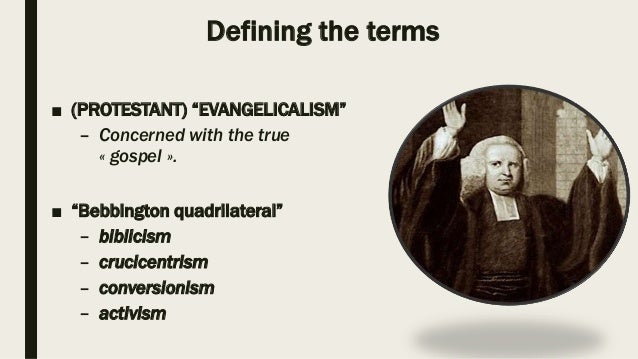
Image result for bebbington quadrilateralHistorians of evangelicalism are very interested in defining evangelicalism. It would seem obvious that scholars of a certain field would be dedicated to defining their object of study, but historians of evangelicalism go about this task with an admirable gusto. The act of defining is central to the field. Historian David Bebbington’s famous definition, the Bebbington Quadrilateral – evangelicalism as biblicism, crucicentrism, conversionism, and activism – has framed the conversation since 1989. As I listened to the excellent papers delivered by historians at the Noll Conference in March 2018, I began to wonder why Catholic historians do not seem so interested in defining their object of study, Catholicism.

Certainly we do not have quadrilateral. But should we have one?


Two answers to the question about the lack of enthusiasm for defining Catholicism pop up immediately. First, Catholicism does not appear to be as controversial in American politics, and as a result, the stakes of defining it are not as high. The conference suggested there is a pressing need to define evangelicalism in order to understand present day voting patterns. The second factor easing any pressure to define Catholicism is the structure of the Church itself. The centralized nature of the Church relieves scholars of the need to define Catholicism. At the conference I asked two colleagues who study evangelicalism why historians of Catholicism are not interested in definitions. Basically, the response I received was that the structure of the Catholic Church – a Pope and a hierarchy – means that less is up for grabs.

We should pause to ask if having a debate about the definition of Catholicism would be productive. I imagine some will think that having such a conversation would only serve as a distraction. But I found the debate about evangelicalism at the Noll Conference to be fascinating and generative. Is it a theology? Is it a politics? Is evangelicalism the media you consume? Is it a set of ideas? Is it worship? Is everyone who likes Billy Graham an evangelical? Is the scandal of the evangelical mind still scandalous?

It is possible to conclude that Catholic historians have been debating the definition of Catholicism implicitly in their books for years. The closest our field comes to The Scandal of the Evangelical Mind might be William Halsey’s classic study, The Survival of American Innocence: Catholicism in an Era of Disillusionment, 1920-1940. Halsey argued that a neo-scholastic worldview allowed Catholics to imagine themselves as existing outside the tragedy of twentieth century American history (the rise of ethical relativism, psychoanalysis, and subjectivity). It is tragic in Halsey’s tale, and rather a scandal, because the static mentality of Catholicism made it obtuse. Other scholars followed his lead and defined Catholicism as static because of the intellectual freeze brought on by the condemnations of Americanism and Modernism. But Halsey makes the important point that Catholicism could be construed as a set of mental categories. He does define his object of study. Jay Dolan’s work implied that only the methods of social history could move scholars of Catholicism closer to a useful definition of what they study. John McGreevy’s Catholicism and American Freedom would say Catholicism is an assent to a set of ideas. His Parish Boundaries would locate institutionalism at the center of what it means to be Catholic. His latest work on the Jesuits suggests any definition of Catholicism must consider the global. Robert Orsi’s work defines Catholicism as a religion of practice replete with longings for connections to the “real presence.” Relationships between heaven and earth are also at the heart this Catholic identity. As is gender, as works by Amy Koehlinger, Kathleen Sprows-Cummings, and Mary J. Henold make clear. The essays in Habits of Devotion on confession (James O’Toole), the Eucharist (Margaret McGuiness), prayer (Joseph Chinnici), and Marian devotion (Paul Kane) identify Catholicism as profoundly ritualistic and sacramental. Peter D’Agostino argues that Rome and trans-nationalism are key to defining American Catholicism. Younger scholars are contributing to this debate and taking it in new directions. Matthew Cressler has raised the question of how the definition of American Catholicism changes when we locate black Catholics at the center of our story. Catherine Osbourne’s new book suggests professionalism and professional identities are important to Catholic life in the twentieth century. Jack Downey makes the point that Americanization of Catholicism and its entrance into mainstream of American life should not stand as the ultimate end point for defining the men and women of the Old Faith. Not all Catholics wanted mainstream status because such an “achievement” entailed an ensnarement in modern materialism.

Catholic historians debate definitions of Catholicism without a central framing device.


This blog post raises the question of whether Catholic historians need a device like a quadrilateral to shape this debate and give it some structure. The question assumes, perhaps incorrectly, that scholars can, in fact, define Catholicism. It also pushes past any reservations about debating a definition rather than figuring out how Catholics shaped American History. But what if we synthesized the works in the field to produce a four-pronged definition?  What would rise to the surface if we made it goal to boil it all down to four categories? Or could we define Catholicism with a broader categorical move? Is it a theology? Is it a set of institutions? Is it an imagination? We might return to some classic sources written by theologians and social scientists. David Tracy’s Analogical Imagination or Andrew Greely’s The Catholic Imagination both spring to mind. Historians might walk the path hewn by the editors of the recently published The Anthropology of Catholicism: A Reader. Scholar of religion Kate Dugan, in her useful review, teases out the questions asked across the volume’s essays: “What counts as a Catholic idea and a Catholic person? Why does Catholicism continue to have influence the twenty-first century? If there is a Catholic imagination, or Catholic imaginations, who acts in it?” Historians of Catholicism might follow the lead of evangelical historians and these anthropologists and then ask a pack of similar questions. Then, of course, we should deliver a satisfying answer.


spacer

Five Questions with Catherine Osborne

Benjamin J. Wetzel

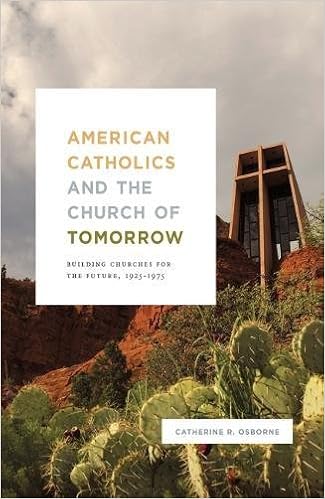
The Cushwa Center is pleased to celebrate a book publication by one of our former fellows (and former RiAH blogger), Catherine R. Osborne, who is now visiting assistant professor in the department of theological studies at Loyola Marymount University. American Catholics and the Church of Tomorrow: Building Churches for the Future, 1925-1975 was published in April by the University of Chicago Press.  I recently asked Catherine to elaborate more on her work.


BW: Briefly, what is the book about and what are its major claims?

CO: When I was working on the book and people asked me what it was about, I had five or six answers of varying lengths, depending on how interested I thought they actually were.  The three-word answer is "Catholic modernist architecture," but that's not really true.  First of all, it's not about architecture, exactly.  It's an intellectual and cultural history of mid-20th century approaches to Catholic worship space (which includes but is not limited to church buildings).  Because basically everyone sees ideas about church spaces as intimately linked to concepts of the Church, the book is also, therefore, about ecclesiology in this period, which includes the runup to and immediate aftermath of the Second Vatican Council.  And finally, it's about how mid-20th century American Catholics forecast and imagined the church/Church's future.  Some of that was quite practical: trying to figure out the height of the sanctuary steps if you were giving out Communion to people standing rather than kneeling, for example.  But some of it was more visionary.  What kind of churches would be suitable for a moon base?  What might LSD teach us about eschatology?  How could we make worship spaces that expressed the relationship between the "sacred" and the "profane" that's developed in Vatican II documents like Gaudium et spes?  I originally set out to write a book about architecture, but it ended up being a book about how 20th-century American Catholics thought about change and the future, as refracted through the way they thought about their worship spaces.

As for "major claims," there is a foundational claim that is not unique to me.  By the mid-20th century, evolutionary thought, broadly conceived, had become deeply embedded in every single academic and professional discipline, such that everyone with a good formal education (and a lot of other people too) was almost incapable of not seeing reality in fundamentally evolutionary terms.  I think that's just generally true.  But the book argues more formally that it was true of people formed as professional modernist architects, and that they then went out and made the case to their clients that the church building needed to adapt and evolve (i.e. to change), because everything needed to adapt and evolve.  That's just how the world works.  And what's especially interesting to me as an historian of theology is that simultaneously a lot of theologians are beginning to make the same argument about the Church itself, and the architects and theologians end up reinforcing each others' claims that the most important thing is not to get every worship space right; the most important thing is to have a stance or orientation towards a future of constant change.

This answer is already not "brief," but a few more specific contributions I see the book making: First, nearly everything written about modernist Catholic architecture has been either flat-out polemic, or is by architects, architectural historians, and liturgists who are arguing for a normative aesthetic of one kind or another.  I have my own feelings about aesthetics, but I very definitely wanted to uncover the thinking of this period and to keep the focus on that, and to do it in a generous rather than a suspicious way.  Second, in keeping with the theme of depolemicization, I revisit two theologians (the Catholic Pierre Teilhard de Chardin and the Baptist Harvey Cox) who were staggeringly, enormously widely read during the 1950s-70s, and who have since mostly fallen out of the Catholic academic theology canon and tend to get talked about very dismissively.  (On a personal note, I'm not a big Teilhardian, but I was surprised at how well Cox's The Secular City holds up.)  What got people so excited about these guys?  What effect did they have on worship space?  And third, I argue that if you want to understand why high modernist church architecture looks the way it does (all the concrete) you have to understand why architects and liturgists saw the new building materials and techniques of the 20th century as not only technically exciting, but liturgically and theologically significant.  I wanted my humanist readers not to be able to skip the paragraphs about engineering; you need to understand how it works in order to understand why people felt it was liturgically and theologically significant.  I'm not sure other people will necessarily think so, but to me, the chapter on concrete is the most important in the book.

BW: How does the book speak to issues of interest to readers of this blog?

CO: I would say that aside from the specific historical contributions (to the intellectual and cultural history of the Vatican II period especially), I wanted to think more generally about how religious people with strong secular, professional identities navigate both their religious and professional lives.  Most books about Catholicism--and I would venture to say about most religions--focus either on the experience of religious professionals (including laypeople whose primary work is "religious"--for example, Commonweal editors) or on the religious experiences of a more generic "laity" that have a variety of occupations.  But there's a kind of double consciousness that develops when you have a strong professional identity.  In this case, I was interested in how architects and artists (many of whom were Catholic) understood what they were doing when they built or thought about building Catholic churches or making Catholic art.  If you're trained as a modernist architect or artist, you're specifically trained not to copy visual elements or layouts from the past.  Rather, you're supposed to think the entire problem through from the beginning, and to create a building/work which is perfectly adapted to its time, place, and function, which means you need to understand all three of those things.  It's a very intensive process.  (And not coincidentally, it has a lot in common with what professional liturgists and theologians were doing in the runup to and aftermath of Vatican II.)  So: how does this strong self-image change how you relate to the Catholic Church and its clergy?

BW: I think it's safe to say that architecture is not on the radar of most historians.  In your view, what can scholars gain from sustained attention to the built environment?

CO: I'd say that "attention to the built environment" is a better term for what I do than "architectural history."  There's not a whole lot of it in the text of the book, but I read and thought a lot about space and place theory while I was researching, because I wanted to think about the way people emotionally relate to their spaces, how they interact with them, and what they want from them.  That includes what architects want, but also what clients and congregations want.  The physical look of the building, the strictly-speaking-architectural-history part, is necessary to write about, but what really excites me as a historian is figuring out the desire that's encoded in that look.

Of course, that desire isn't always singular.  One reason why this isn't only an intellectual history is that I love the moment when someone's theory meets reality.  You can have this beautiful church in your head, but you need to pay for it, and the roof can't leak, and you have to reconcile all the different ideas everyone has about what exactly "gathered around the altar" means for what kind of pews you should have.  The arguments people have in those moments are so revelatory about what really matters to them.  Specifically regarding the implementation of Vatican II--if you're doing an intellectual history of Vatican II, you can say what the documents said.  But when you look at people trying to build a building that responds to those documents, you're confronted right away with their ambiguities and silences, by all the decisions they punted on.

BW: Talk to us about your periodization: why did you choose 1925-1975, and what do scholars see differently when they focus on these years rather than on the typical "interwar," "postwar" or "Cold War" frameworks?

CO: The specific years are a little fuzzy, actually.  In the first chapter in particular I go pretty deeply into the 19th century, to the origins of modernist architectural theory.  The opening anecdote for the introduction is set in 1917.  The Liturgical Arts Society, on whose archives I built a lot of the original research, is formed in 1928.  But I picked 1925 because that's the year of a big, multi-year dustup in Commonweal between a number of modernists and anti-modernist architects (and their sympathizers), which I take to be the moment when a number of trends which had been stirring in a few Catholic individuals begin to coalesce into something like the beginnings of an organized movement for modernist architecture.  Nineteen Seventy-Five is also a little fuzzy.  Maybe I shouldn't admit this, but there's no real single endpoint to the book.  Somewhere around 1972-75, the big explosive debates that happen in the immediate aftermath of the Council, and which drive the second half of the book, start to settle down.  By 1980 they've coalesced into what I think of as the postconciliar settlement on what a "post-Vatican II church" should be like.  Things stay fairly stable after that until the big traditionalist backlash gets going in the late '90s.  So it made sense to stop somewhere in the mid-to-late '70s, and 1975 happened to be the date of the last church that's mentioned in the book, so I went with that.

The second part of that question: I do think that specific short timeframes have their own qualities and characteristics.  The 1950s really are different from the 1970s or from the 1920s in terms of American life and in terms of Catholic concerns.  But I am interested in what you might call early adopters, the few stubborn visionary types who push ideas forward until one day you turn around and they're conventional wisdom.  As a historian of American Catholicism and of Roman Catholicism generally, I see Vatican II as a big, important moment in a longer process, and I wanted to trace some of that process, with attention to the special characteristics of smaller periods of time.

BW: What advice can you give about the publishing process?

CO: I didn't think there was an obvious home for this book; most of the presses that do great work with American religious history don't do art books, and while my dissertation had several hundred photos, I was afraid that if I tried to place it with an architectural history press, it wouldn't be read by religious historians.  I was a first-time author and I had a big, complicated project with a lot of moving parts.  So I consider myself lucky to have met an editor who was genuinely interested in the book's potential.

My best advice, overall, is to find someone who wants you to write the book you want to write.  It was important to me that my editor be hands-on, which meant he or she had to understand and support what I wanted to do--blending religious history, which doesn't usually have a lot of pictures, with the visual arts.  Tim Mennel, my editor at Chicago, has a background in the history of urban planning, so he knew a ton about the specific history I was writing about in the second half of the book, and he was excited rather than put off by the interdisciplinary work I was doing.  (He was also extremely patient for three years while I ripped apart my original dissertation structure, did a lot of new research, and put the entire thing together again in a completely different order.)  I can't say enough about him.  Well, I do wish the book had 300 photos in color.  But within the constraints of the real world, I can't say enough about either Tim, or the staff of the press, who've uniformly been fantastic to work with.

spacer

New and Improved ACHA Graduate Student Summer Research Grants

 At its Jan 2018 meeting, the Executive Council of the American Catholic Historical Association, under the leadership of President Kathleen Sprows-Cummings, approved an increase in the number of Graduate Student Summer Research Grants to be awarded each summer and the Council authorized an increase in the amount of money per award.

The ACHA is happy to offer 4 grants for the summer of 2018, each for a total of $2500.


In taking this measure, the Executive Council wished to continue the ACHA’s long-standing commitment to graduate student research. The increased amount of support per award was also designed with the goal of funding more graduate student research in archives and libraries abroad.
Dr. Carolyn Twomey conducts research with a
Graduate Student Summer Research Grant from the ACHA
at the Parker Library at Cambridge University, Corpus
Christi College.

Graduate students who have completed their coursework and are researching topics related to the history of Catholicism broadly defined are encouraged to apply.

Applications are due on April 30. More details can be found here.


Many thanks,
Carolyn Twomey and Peter Cajka 


spacer

French Catholicism in the Early American West: Five Questions with Gabrielle Guillerm

Benjamin J. Wetzel

Gabrielle Guillerm is a Ph.D. candidate in history at Northwestern University. Her dissertation will examine French Catholicism in the early American west. She was awarded a 2017 Cushwa Center Research Travel Grant to pursue work on this topic at the Notre Dame archives. What follows is the first of several questions I recently asked Guillerm about her work.  Read whole thing at the Cushwa Center website!


BW Can you briefly describe your project for us?

Rtg Guillerm InterviewGG My dissertation, "The Forgotten French: Catholicism, Colonialism, and Americanness on the early trans-Appalachian Frontier," focuses on the Midwest and Kentucky and aims to recover the French Catholic story of the early United States. I posit that, compared to the colonial period, French Catholic cultural influences strengthened in the west over the early republican period even as the proportion of Francophone Catholics in this former French territory diminished. The development of these new French Catholic influences resulted from the French Revolution.  Refugee priests in the United States created new Catholic networks between France and the United States. These networks intensified in the early 19th century and were embodied by the circulations of hundreds of female and male missionaries and thousands of religious objects. French clergy built French religious orders and schools after French examples--the Congregation of Holy Cross and Notre Dame for instance--and spread popular French devotions, such as the devotion of the Sacred Heart. Non-French clergy themselves relied on the connections with France, which further contributed to spreading French Catholic influences.

This project seeks to understand how French Catholics and French Catholic influences fit into the new nation. Analyzing the encounter between Catholics and other trans-Appalachian populations, I argue that defining American identity was a contentious process, and central to this contestation were French Catholic missionaries and French Catholics. Indeed, French missionaries' status in the new nation was ambivalent: they were both threats to the country and agents of the nation's agenda in the West, insiders and outsiders.  On the one hand, they spread an alternative understanding of the new nation that challenged the assertion of the American identity as Anglo-Protestant; on the other hand, they took an active part in the building of the colonial settler nation promoted by the U.S. government.

Read the rest here!

spacer

Recapping the American Catholic Historical Association Meeting: A Guest Post from Stephanie A.T. Jacobe

Stephanie A.T. Jacobe

Stephanie A.T. Jacobe received her Ph.D. in history from American University in Washington, D.C. and also holds an M.A. in art history from Virginia Commonwealth University in Richmond, VA. She currently serves as the Director of Archives for the Archdiocese of Washington and as Adjunct Assistant Professor of Humanities at University of Maryland University College. Her dissertation, a biography of financier and Catholic philanthropist Thomas Fortune Ryan, is currently under revision. Her work has been supported by the Harvard Business School, the Cushwa Center, the Gilder Lehrman Institute of American History, and the Center for the History of Collecting in America located at the Frick Collection in New York City. She was recently elected chair of the Elections Board of the American Catholic Historical Association, and also serves as the editor of H-Catholic, one of the H-Net networks.

The annual meeting of American Catholic Historical Association (ACHA) began on Friday, January 5, 2018, and included two full days of concurrent sessions. The meeting took place in Washington, D.C.'s Woodley Park neighborhood and was held in conjunction with the annual meeting of the American Historical Association (AHA). Sessions included a range of American and European historical topics, and papers were presented by a mix of graduate students and established scholars. Though the meeting takes place among the much larger AHA gathering, the feel of the ACHA is that of a meeting within a meeting. Sessions are held at one of the conference hotels and those registered for the AHA have access to the book room and the job center. But smaller, more intimate, rooms are used for ACHA sessions and you will see many of the same faces in the multiple sessions you attend. It is a welcome haven from the hustle and bustle of the much larger conference.

The conference began bright and early on Friday morning with sessions about Catholic expansion in the western United States, and a new look at the education of girls in Central America. Another session looked at the intersection of politics and Catholicism. This began with Jason Duncan of Aquinas College, who discussed Martin Van Buren's ties to Catholics and his aim at building coalitions that included them even though he received significant backlash for it. Duncan argued that this is how Van Buren helped form the Democratic Party. William Kurtz of the John L. Nau II Center at the University of Virginia followed with a look at Catholic partisanship during the Civil War. I also presented a paper during this session about the influence that Catholicism had or did not have on the political careers of Chief Justice Roger Brooke Taney (1777-1864) and Chief Justice Edward Douglass White (1845-1921).

Though a winter storm was bearing down on the East Coast and the weather was extremely cold, a group of ACHA and American Society of Church History members embarked in a bus on Friday afternoon to the areas around the Catholic University of America. The group had a guided tour of the Franciscan Monastery of the Holy Land on Quincy Street and of the Basilica of the National Shrine of the Immaculate Conception, where everyone was able to see the newly-installed Trinity Dome along with a drive around the neighborhood.

I missed the 8:30 a.m. session on Saturday morning because a pipe broke in my hotel room late on Friday night due to the cold and I had to move rooms so they could fix it. The first panel I attended was at 10:30 a.m. entitled "Catholic Images, Narratives, and Identities in Early Modern Europe." Jeanne-Michelle Datiles of the Catholic University of America discussed Elizabethan Catholic Martyr literature. She discussed the intense martyr mentality of English Catholics during the Elizabethan period and how martyrologies such as that of Henry Walpole, S.J. were used and disseminated. Juan-Fernando Leon of Wheaton College (IL) discussed the eschatological message found in the plates of Casiodoro De Reina's Biblia Del Oso. De Reina translated the Bible into Spanish despite the Inquisition. The plates placed at the beginning of the book show a forest scene with a bear eating honey from a tree. Honey throughout the Bible is used as a symbol for wisdom. The final paper in the session, by Anatole Upart of the University of Chicago, discussed the Greek Catholic Ruthenians and their search for a home in seventeenth-century Rome.

At the annual luncheon the outgoing president, Kathleen Sprows Cummings, director of the Cushwa Center and associate professor of American studies and history at the University of Notre Dame, gave her presidential address entitled "Frances Cabrini, American Exceptionalism, and Rethinking U.S. Catholic History." Several awards were presented, including the following:

  • The Distinguished Award for Scholarship, presented to the Rev. Gerald Fogarty, S.J., of the University of Virginia;
  • The Distinguished Award for Teaching, presented to Anne Klejment of the University of St. Thomas;
  • The Distinguished Award for Service was presented to the American Catholic History Research Center and the University Archives at the Catholic University of America;
  • The 2018 John Gilmary Shea Prize was presented to William B. Taylor for his book, Theater of a Thousand Wonders: A History of Miraculous Images and Shrines in New Spain (Cambridge University Press, 2016);
  • The Howard R. Marraro Prize in Italian History was presented to John Howe for his book, Before the Gregorian Reform: The Latin Church at the Turn of the First Millennium (Cornell University Press, 2016);
  • The inaugural Henry C. Koenig Article Prize, for a biographical study of a Catholic individual (published in 2015 or 2016), was awarded to Paul T. Murray of Siena College, for "'The Most Righteous White Man in Selma': Father Maurice Ouellet and the Struggle for Voting Rights," The Alabama Review 68:1 (Jan. 2015): 31-73;
  • The Peter Guilday Prize for 2017 was given to Kathleen Walkowiak of Saint Louis University for her article, "Public Authority and Private Constraints: Eugenius III and the Council of Reims," that appeared in the American Catholic Historical Review 103 (Summer 2017).

After lunch the conference finished up with sessions on faith and doubt in Early Modern Europe, urban Catholic parish life in the United States, and saints and miracles. The session on saints and miracles included a paper by Carole Baker of Duke University on the highly decorated bodies of saints found in Bavaria, Austria, and Switzerland. It continued with Rosario Forlenza of New York University discussing Padre Pio and the cult of miracles that surrounds him and his relics in southern Italy. The final paper was by Mary Corley Dunn of Saint Louis University on Blessed Mary Catherine of St. Augustine, O.S.B., whose disability and constant illness after coming from France to Canada in the seventeenth century was portrayed in her vita as the root of her sanctity.

The conference finished on Saturday with the evening liturgy at 5 p.m. and then afterwards the social, which includes drinks and heavy hors d'oeuvres, for members of the ACHA. Both events bring members together, with the social allowing newer members and graduate students to get to know older, more distinguished, scholars. The ACHA is a very welcoming group and newer members are easily able to get to know the old-timers. Though the AHA annual meeting can be intimidating to new scholars and graduate students, the more intimate meeting of the ACHA is a welcome respite with friendly camaraderie among the participants.

The official program can be found here.
spacer

5 Questions with Ronit Stahl

Lauren Turek


Ronit Y. Stahl, a historian of modern American religion, law, and politics, is currently a fellow in the Department of Medical Ethics & Health Policy at the Perelman School of Medicine at the University of Pennsylvania. She earned her Ph.D. in history from the University of Michigan and was a Postdoctoral Research Associate at the John C. Danforth Center on Religion and Politics at Washington University in St. Louis from 2014-2016.

The following is a brief conversation we had about her excellent new book, Enlisting Faith: How the Military Chaplaincy Shaped Religion and State in Modern America, which came out this month on Harvard University Press.


Q1. Can you tell our readers a little bit about your book? What is your core argument?

Enlisting Faith tells the story of how the federal government, through the military chaplaincy, struggled with, encouraged, and regulated religious pluralism over the twentieth century. It traces how the United States shifted from a chaplaincy that consisted of only mainline (white and African American) Protestants and Catholics to one that counts Jews, Mormons, Muslims, Christian Scientists, Buddhists, Seventh-day Adventists, Hindus, and evangelicals and, as of spring 2017, recognizes over 200 different faith groups and denominations among military personnel. This evolution was uneven—neither accidental nor fully envisioned. Blurred religious and racial categories confounded a military that, for decades, remained invested in racial segregation and race has always complicated government oversight of religion. Nevertheless, changes in the chaplaincy emerged through a combination of incremental top-down decisions made by government officials and grassroots agitation from civilians.

My core argument is that despite the constitutional separation of church and state, the government managed religion in the military and religion has played a significant role in state administration. As a result, it’s important to think about religion-state influence as bidirectional: the state has shaped religion as much as religion has shaped the state.

Enlisting Faith also makes two related arguments about periodization and the institution of the military. First, I argue that the idea of “tri-faith America” emerged in World War I, not World War II or the Cold War, and the military initially cultivated religious pluralism for pragmatic, rather than ideological, reasons. By World War II, when consensus around “tri-faith America” achieved public prominence, it had already begun fracturing. More religious groups wanted recognition, some who fell outside the Protestant-Catholic-Jewish fold, like Buddhists, and some who rejected the pluralist ethos, like Protestant fundamentalists. This divide has grown, and it continues to challenge the military and American society writ large.


Second, and relatedly, the military became a major arena of inter- and intra-religious politics over the twentieth century because it is as much a social and cultural institution as it is a martial one. The military can be conservative and hierarchical and, simultaneously, progressive and innovative. In recognizing the value of diversity and enabling civil rights, it often led the way (imperfectly, to be sure) and hastened change. I show how the military has served as a laboratory for state policy and a bellwether of change in American society—and this holds for race, gender, and sexuality as much as it does for religion.

Q2. Why did you decide to research and write this book about the military chaplaincy?

I’ve long been interested in the relationship between religion and the state, and I wanted to examine a space of extended interaction, rather than brief flashpoints of conflict. Similarly, I’m fascinated by the intersection of pragmatism and ideology in state administration and wanted to think about politics outside of elections and legislatures. Early on, I briefly considered a comparative study of chaplains in different spaces – the military, prisons, hospitals, and universities. However, I quickly realized that the military is such a rich and complex institution to explore (complete with incredible archival records) that it was better to focus. Moreover, it’s a space in which federal oversight of religion has been constant. Despite occasional efforts to civilianize the chaplaincy, the government continues to commission and pay clergy to serve as chaplains rather than contract out religious services.

Q3. How does your book fit in to other recent scholarship on religion and politics, religion and foreign relations, and religion and twentieth-century U.S. history?

There’s been a wonderful outpouring of scholarship on religion of late, and Enlisting Faith enters a number of these discussions in a number of ways. A lot of scholarship in religion and politics tends toward either religion and conservatism or religion and liberalism. Enlisting Faith braids these strands together by looking at a space where values collide and what counts as “conservative” and what counts as “liberal” is sometimes less obvious. It’s also part of the rich conversations—among scholars and in the public sphere—about religious freedom and religious liberty in the United States. Whereas Tisa Wenger’s new book, Religious Freedom: The Contested History of an American Ideal, unravels ideas and rhetoric, Enlisting Faith takes a social history approach and examines the practice(s) of religious freedom, tracking successes and failures on the ground over the twentieth century.

In terms of religion and foreign policy, my book makes two central contributions. First, it decenters the Cold War as the singular moment in which the American state discovers religion as an instrument of foreign policy. Like Anna Su’s Exporting Religious Freedom, it argues for a broader twentieth-century history of the engagement between American religion and global politics. Second, it documents how chaplains engage in soft diplomacy. In the aftermath of World War II, chaplains shift from working exclusively with American troops to serving Americans and participating in relief work and relationship-building abroad. In postwar Europe and Asia, chaplains acted as brokers, ethnographers, and translators between the military and foreign populations. These roles blended missionary work and State Department outreach efforts in pursuit of military objectives, so they’re conduits between military and civilian, public and private spheres.


Finally, Enlisting Faith makes an argument for taking religion seriously as part of twentieth-century American history and showing how integral religion has been to American politics and social change through a key institution of government and governance. We’ve come a long way since Jon Butler’s “Jack-in-the-Box Faith: The Religion Problem in Modern American History” (2004) and Kevin Schultz and Paul Harvey’s “Everywhere and Nowhere: Recent Trends in American Religious History and Historiography” (2010). Nevertheless, there’s still some foot dragging about the importance of religion outside of narratives about the rise of the right and Islamophobia, especially in histories of the American state.

Q4. I know you did extensive archival research for this project - what was your favorite archival discovery? What made this find so surprising or interesting?

It’s so hard to choose, so I’ll quickly note two:
1. The full set of transcripts for the World War II radio show, “Chaplain Jim.” Crafted through a public-private partnership, broadcast on NBC’s Blue Network, and intended for women on the homefront, the show brought the ecumenical and pluralist worldview of the chaplaincy into American domestic spaces during the war. What was particularly exciting was that the transcripts bear the red pencil corrections of Chief of Chaplains William Arnold, who worked assiduously to make Chaplain Jim “anonymous”—that is, not identifiably Protestant, Catholic, or Jewish. The show is a soap opera filled with intentional messaging about religious pluralism as an American value, and thus offers a wonderfully rich artifact of popular culture in which religion and the state met. The show bridged military-civilian worlds and highlights how the chaplaincy’s gaze included women. The gender politics of the show are unsurprising for the time, but it’s a good reminder that women are not absent from all-male spaces.
2. A post-World War II petition requesting that the military add a “B” for Buddhist on dog tags. Religion was added to dog tags in World War II, but there were only three choices: P for Protestant, C for Catholic, or H for Hebrew. This meant that everyone who wasn’t Catholic or Jewish was labeled Protestant, which (very reasonably!) bothered many minority religions. After the war ended, Japanese-American Buddhists organized to lobby for change, and the signature sheets take up an entire unmarked box in the National Archives. What I mean by this is that that War Department used a decimal classification system to file and label records, and every other box in the Army chaplaincy record group bears a number indicating the topic of its content. Researchers can request, for example, all the records related to “marriage” or “photographs” or “meetings” by pulling boxes by decimal code. But this box had no decimal. This suggests that the chaplaincy had no idea how to label it. It also means the only way to find it is to pull every box in the record group. The petition is a really important document on its own: it gave me great material to think about the meaning of limited religious options for dog tags and how excluded Americans responded to the religious categories created by the state. It’s also a useful reminder that classification systems beget classification systems, and archives often replicate bureaucratic logic that needs to be analyzed.  

I could go on, but instead I’ll leave it to readers to discover tri-faith hymnals, records of courts-martial, and other fun sources in the book!

Q5. What do you plan to research for your next project?

I’m still thinking a lot about how religious freedom and religious pluralism operate in institutional spaces, but I’ve pivoted from the military to medicine. I’ve started a project researching the origins, creation, and impact of institutional and corporate conscience rights in health care. It’s a project that raises a lot of questions about what it means for an institution to be “non-sectarian,” how and when federal funds can flow to religious institutions, how religious freedom and discrimination intersect, and how individuals and institutions negotiate competing moral claims.  

Thank you so much for sharing these great details on your new book and future research, Ronit! I look forward to seeing further discussion unfold in the comments section and hope that everyone checks out Enlisting Faith!


spacer

Introducing the Second Edition of "American Catholic History: A Documentary Reader"

Today's guest post comes from Catherine R. Osborne (a former postdoctoral fellow at the Cushwa Center).  Catherine is now Visiting Assistant Professor in the Department of Theological Studies at Loyola Marymount University.  She is also the co-editor of the forthcoming second edition of American Catholic History: A Documentary Reader (NYU, 2017), the subject of today's post.  Thanks, Catherine!


Over a decade ago, I was working at the Francis and Ann Curran Center for American Catholic Studies at Fordham University (https://www.fordham.edu/cs/) when its then co-director, Mark Massa, SJ, asked me if I wanted to participate in his newest project: assembling a one-volume primary source reader for students taking courses in American Catholicism. Drawing on our own research and on the work of earlier anthologists, especially John Tracy Ellis's Documents of American Catholic History and the fabulous nine-volume Orbis series American Catholic Identities: A Documentary History (general editor, Christopher J. Kauffman), we selected, organized, and wrote introductions for 70 documents.

American Catholic History: A Documentary Reader (NYU Press) was released in 2008, and has been adopted in a variety of undergraduate courses since then. Several years ago, this time working at the Cushwa Center for the Study of American Catholicism at the University of Notre Dame, I wondered if it was time to think about reprinting. I contacted our editor to ask if it might be possible to add one or two documents whose omission had bothered me for years.

Out of that conversation developed, not a slightly modified reprint, but a totally new edition of the reader, which will be released November 14. The second edition has 88 documents, of which 34 are new; several have never been published before in any form. (https://nyupress.org/books/9781479874682/)

I want to reflect a little in the rest of this post on three elements that reshaped the new edition.


Experience

One of the most helpful things we did was to survey people who had used the first edition in their classrooms. This happened both informally, as we consulted our networks, and in the form of five anonymous readers' reviews from NYU Press. We asked both what documents could be cut from the first edition, and what would be best to add.

The second edition is a better book because of the feedback we were able to get from users. It became clear that most people were using the book to teach cultural history, not intellectual history; "American Catholic History" was also a much more popular title than "American Catholic Studies." It was therefore possible to cut back on the documents in the intellectual-history section of the first edition. On the other hand, many people asked for more material to help them teach immigration and anti-Catholicism in the 19th century. As a result, the reader now includes Lyman Beecher's "A Plea for the West," the Know-Nothing Oath, four of Thomas Nast's anti-Catholic cartoons, and (to help make the point that a lot of immigrants were not interested in assimilation!) the St. Raphael Societies' Memorial.

Diversity and Challenge

In the first edition, we tried to include documents from diverse points of view on a number of axes (clergy and laity; men and women; various national immigrant groups) and to provide documents that would give contrasting viewpoints on contentious issues: the schools, race, sexuality broadly writ, worship style. But on balance, reviewing the first edition, we felt it had not gone far enough, and our outside reviewers agreed. As a result, most of the documents that had to be cut because of space issues were clerical, "official," voices. I particularly wanted to include more women and more attention to Native American and African American experiences. Luckily, it was possible to draw not only on documents I had been aware of earlier--I especially wanted to include the 1968 "Statement of the Black Catholic Clergy Caucus"--but on a decade of intervening research. Mary Ewens' research on the Alaskan native order the Sisters of the Snow provided one document; Emily Clark's translation of documents from the Ursulines of New Orleans provided two more. The archivists for the Sinsinawa Dominicans have been looking into the history of the "American Citizenship Curriculum" for Catholic schoolchildren, and a selection from that now fills out the question of how Catholics were taught to be "American Citizens." The relatively new presence of internet archives helped enormously: the Georgetown Slavery Project provided a new document. Other documents came in a more old-fashioned way; having decided to add a document from the ACT UP protest against St. Patrick's Cathedral, I found the full text in a massive, doorstopping primary source reader on LGBT history.

I could go on, but I'll just add two stories. Sometimes you really hit the jackpot: Timothy Matovina directed me towards one of my favorite new documents, a sermon delivered in 2005. Given by a laywoman (one point in its favor!) it addressed devotion to Our Lady of Guadalupe (tragically missing from the first edition) in the context of immigration (helping to fill out both the continuing history of Catholic immigration and the way in which devotion helps immigrants manage their new lives.)

Other times, it's a struggle. One of the fastest-growing Catholic populations since the immigration reforms of the 60s has been Asian-American, especially Vietnamese and Filipino/a. We were unable to find a suitable document for the first edition and it was something I especially wanted to address in the second edition. Yet it was challenging to find the kind of document I wanted, despite getting in touch with several other scholars; what I could find in print, in English, was largely limited to more "official" points of view and gave little sense of the distinctiveness of these communities. I ended up with a news story on a Vietnamese parish that included an interview with a co-founder. But I am also now in touch with several scholars of (secular) Vietnamese-American history who have promised to keep an eye out for primary sources on Catholicism that they might be able to translate. Third edition?

Up to Date

The first edition's last document, chronologically, dated to 1988. We were reluctant to go too far into the present on the grounds that most people would want to use their own selection of recent documents to make whatever points they needed to make. In 2008, 1988 was a reasonable place to stop. In 2017, it clearly wasn't! So, we needed to make some decisions about what more recent developments seemed likely to still be salient in the future. Kate Dugan made a successful pitch for John Paul II's Denver World Youth Day speech (1993), where he discussed the culture of life and inspired a generation of "JPII Catholics." A few other more recent documents found their way into different sections. But we also chose to add a five-document section called "New Horizons," dealing with issues we felt would continue to be important. In order, these were the sexual abuse crisis; parish closings (on the one hand) and growth (on the other); and questions of gender and authority as exemplified in the Leadership Conference of Women Religious investigation. Finally, we concluded with Pope Francis's address to Congress in 2015, on the theory that it would allow courses to end with a reconsideration of what is interesting about American Catholicism.

To close this blog post on a personal note, this is the choice I wonder the most about right now. Shortly after the text of the book was finalized, Donald Trump was elected president, and an entire set of narratives of American history were, once again, profoundly disrupted. (Along with everything else being profoundly disrupted.) Francis's address was not entirely hopeful, but it did suggest a path forward to hemispheric unity and service which does not seem, as of October 2017, to be the way that we're heading. I have been using samples from the new reader with my own American Catholic History class this fall, and I am still not sure what document is going to close out the class in December.

spacer

Funding Opportunities from the Cushwa Center AND Five Questions with Katherine Dugan

Benjamin J. Wetzel

The Cushwa Center for the Study of American Catholicism is pleased to announce the annual deadline to apply for travel grants from the Cushwa Center.  The center offers four types of grants for projects related to the study of American and transnational Catholicism. Specifically:


The deadline for applying for each of these grants is December 31, 2017.  More information can be found at http://cushwa.nd.edu/grant-opportunities/.  Please direct any questions to cushwa@nd.edu.

Last year, Katherine Dugan, assistant professor of religion at Springfield College, received one of these grants for a project on millennial Catholic missionaries.  Recently, Catherine Osborne, a former postdoctoral fellow at the Cushwa Center, sat down with Dugan to discuss her work.  You can find the text of the interview here.

spacer

CFP: U.S. Catholic Historian theme issue on War and Peace

Lauren Turek


The U.S. Catholic Historian recently shared this call for papers for a future issue on the theme of "War and Peace." Here is the announcement with all of the details for proposing a contribution:


"For thirty-five years the U.S. Catholic Historian has published theme-based issues relevant to the history of American Catholicism.  An upcoming issue will address the theme of war and peace. Contributions could include, but are not limited to, studies of the following:


  • Catholic involvement in conflicts as officers, soldiers, nurses, and chaplains.
  • U.S. efforts at humanitarian aid during war: War Relief Services/Catholic Relief Services, etc.
  •  The approach of the U.S. Catholic hierarchy or certain bishop(s) to particular conflicts.
  • Catholic responses to documents including Pacem in Terris (1963), The Challenge of Peace (1983), etc.
  •  Catholic peace movements and activism such as the Catholic Peace Fellowship, Catholic Worker, etc.
  • Catholic conscientious objectors
  • Catholic press/magazines/newspapers and war
  • Theologians, philosophers, and intellectuals on war and peace
  • Catholics on the home front during war


Scholars considering a submission are asked to contact the editor, Fr. David Endres at DEndres@Athenaeum.edu before preparing a contribution. Approximate length is 7,000-10,000 words. We ask for submissions by August 1, 2018 and look forward to hearing from potential contributors."
spacer

Historiographic Saints


Isaac Hecker, circa 1890
In the spirit of RiAH's 10 year anniversary, we welcome a guest post from historian William Cossen. You can follow him at www.williamscossen.com and on Twitter @WilliamCossen.

What do historians of Catholicism owe to the saints about whom they write?

This question has been on my mind since the American Catholic Historical Association’s Annual Meeting in Denver this past January.  Two moments at the conference together served for me as the genesis of this question.  The first moment took the form of a comment from Thomas Rzeznik during his presentation for the ACHA’s presidential roundtable, about which I have written in more detail on John Fea’s Way of Improvement Leads Home blog.  Rzeznik noted that scholars of Catholicism should remain mindful of the multiple audiences they serve through their research and writing: the academy, the institutional church, and interested laypeople.

The second moment emerged following my own panel on Catholicism and Americanism.  I had a conversation on the state of the field of Catholic history with the panel’s organizer, Erin Bartram.   Both of our papers dealt with Isaac Hecker, a central figure in the study of mid- to late nineteenth-century U.S. Catholic history, and we briefly pondered the nature of writing about an individual such as Hecker, who is presently being investigated for potential canonization.

It is obviously not uncommon for historians of Catholicism to write about men and women who have been recognized as saints by the Catholic Church.  This may be somewhat rarer in scholarship on U.S. Catholicism, which reflects the fewer canonized saints from the United States than from other countries with longer histories of an extensive Catholic presence.  There are, however, several fine examples of recent historical scholarship that include canonized (or soon-to-be canonized) Catholics as central figures in their narratives.


Why this has been on my mind is that my research on Hecker could have the potential to turn up what may be, at least to present-day observers, unflattering information on this Servant of God (an initial step in the process of canonization).   While Hecker’s life has been examined as part of the history of transcendentalism, the religious conversion experience, and the Americanist controversy within late nineteenth-century Catholicism, my research on Hecker explores how his writings and their intellectual legacy intersected with ideologies of race and growing American imperialism during the same period.  Remaining mindful of the multiple audiences of a scholar of Catholicism, I want to employ a rigorous methodology befitting an academic historian.  I also want to provide a more detailed picture of Hecker that is neither hagiographical nor exaggeratedly critical, recognizing that the institutional church and Hecker’s canonization promoters may be undertaking the simultaneous process of writing their own histories of Hecker.  Following Pope John Paul II’s reform of the canonization process in 1983, religion journalist Kenneth L. Woodward writes, the Catholic Church’s saint-makers began “employ[ing] the academic model of researching and writing a doctoral dissertation.  Hereafter, causes would be accepted or rejected according to the standards of critical historiography.”   In contemporary saint-making, individuals involved with the formal canonization process as well as academic historians operating outside the church’s institutional structures are all involved in creating saintly historiographies that may or may not exist at odds with one another.

Subsequent to the ostensible historicizing and de-hagiographizing of the saint-making process, can non-church-affiliated, academic historians now function as unofficial and even unwitting promoters of a would-be saint’s canonization (if the history produced depicts saintliness) or as devil’s advocates (if the narrative produced depicts something else entirely)?   To what extent should (or even can) academic historians of Catholicism, when aware of an ongoing sainthood investigation for one of their scholarly subjects, let this knowledge play a role in shaping their narratives?  Can such a consideration be avoided once this knowledge has been attained?

It can be easy to lose sight of the constructedness of saints and especially of historians’ roles in the work of such construction.  Sociologist Pierre Delooz argues that “all saints are more or less constructed in that, being necessarily saints for other people, they are remodelled in the collective representation which is made of them.”   This project, though, did not cease in some remote past when the stories of saints were being written by hagiographers but rather continues to the present with the stories of saints being written by historians.  Saint-making and saint-unmaking are not discrete moments with discernible temporal boundaries but are rather ongoing projects of which historians are a part.  “Hagiography,” religion scholar Robert A. Orsi writes,” is best understood as a creative process that goes on and on in the circumstances of everyday life.”  It is not just devotees of the saints, however, who participate in this “creative process.”  Historians also play a central role in contextualizing the saints, separating myth from fact, revising the narratives of their lives, and at times recreating their hagiographies.  This scholarly production of saints is a reason why, as Orsi describes, “holy figures get caught up and implicated in struggles on earth.  They bear the marks of history.”   In describing the emergence in the early modern period of professional medical expertise as a required component of canonization investigations, historian Bradford Bouley explains, “[J]udging a prospective corpse during a canonization proceeding was not a simple act where the evidence at hand was easily reduced to a comprehensible category.  Rather, it was a process of negotiation in which the various demands of the community, the faith, and the practice of medicine conditioned the ways in which the truth of the saintly body was understood.”   The ongoing practice of saint-remaking is similarly a negotiated undertaking carried out as a dialogue between historians, their subjects, and their various audiences.
Related image
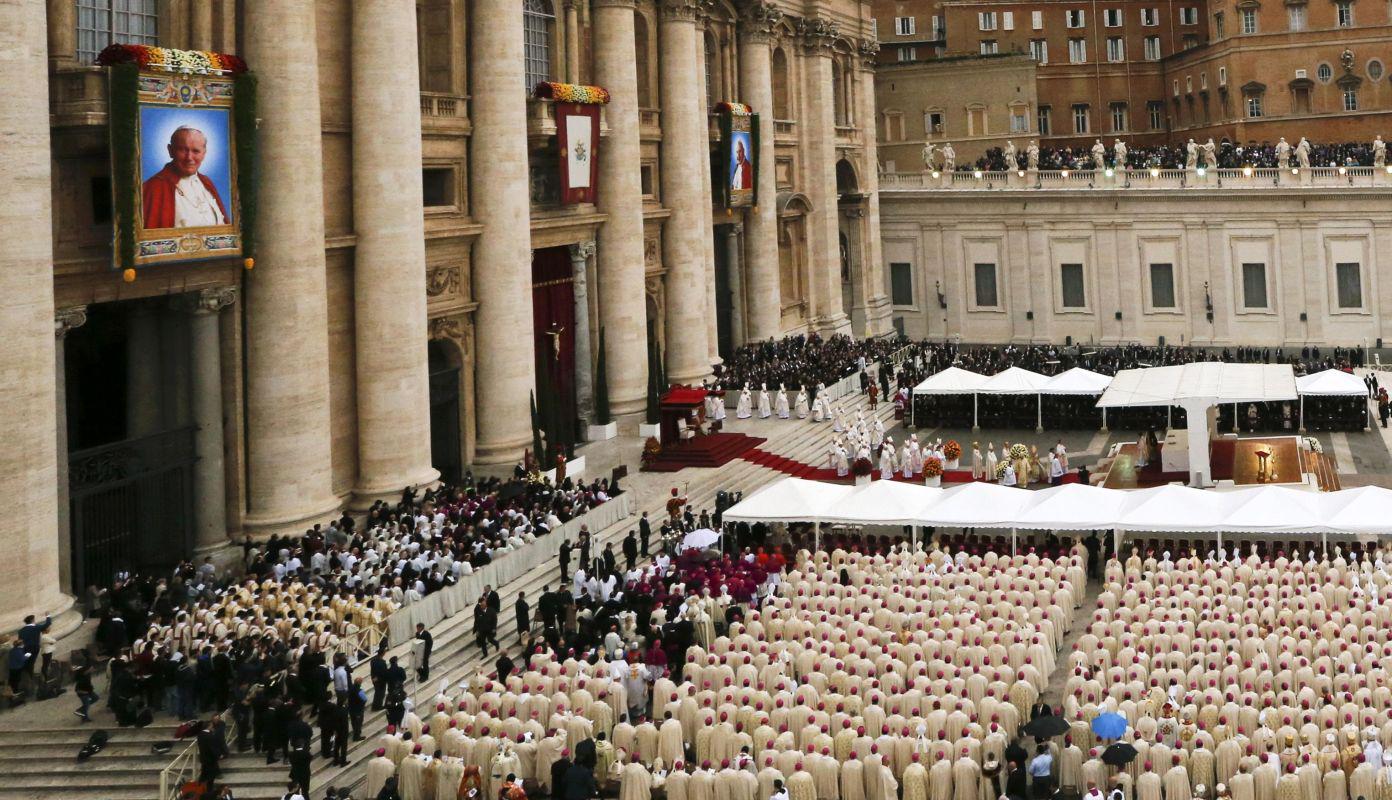
The canonizaiton of John Paul II and John XXIII


And what about that third audience that Rzeznik mentioned?  Interested laypeople.  Not only does the religious order Hecker founded, the Paulist Fathers, still operate actively, but Hecker must remain for some a figure of veneration with a fama sanctitatis (reputation for holiness) that would justify his cause for canonization.  The balance I am trying to strike between respect for Hecker the historical figure, respect for lay and clerical Catholics who may venerate him, and respect for the historical method, is a tenuous one.  I do not want to alienate this third audience if my scholarship casts Hecker in a negative light, but I also owe this audience, my other audiences, and Hecker an honest review of the primary sources wherever they may lead.  This consideration gives me pause to think about why a religious figure and their present-day admirers should command any more historical respect than their secular counterparts.  Is this just an unconscious blinder worn by historians of explicitly religious figures?  That is, do we ever adopt an additional degree of caution when analyzing religious subjects compared to non-religious subjects, even though the categories of religious and non-religious are themselves continually made and remade historically and historiographically?

In 1918, a piece in The Catholic Historical Review reflected on the effect of techniques of higher criticism being brought to bear on the histories of saints.  The unnamed author wrote that “American Catholic history thus far is largely biographical, and it is from the published lives of the leaders of the Church here that the future historian will be compelled to gather the larger part of his materials.”  They maintained that “if American Catholic history is to be protected against historiasters of the future,” historians of Catholicism must adopt a modern, rigorous, “technical method of research, of criticism, and of composition.”  This methodology applied equally to the lives of avowedly religious figures as it did to ostensibly non-religious figures.  The author argued that such a scientific method of historicizing necessarily entailed “criticism,” which, although “not the chief end of historical research,” was essential for the creation of an accurate narrative of the history of American Catholicism.”

This Progressive Era methodology of historical criticism of the church and its leading lights, however, was fraught with dangers to the historian.  Jesuit author Hippolyte Delehaye, a specialist in the study of hagiography, wrote in his 1907 book The Legends of the Saints: An Introduction to Hagiography, that “[r]eligious-minded people who regard with equal veneration not only the saints themselves but everything associated with them,” were appalled by historically critical interpretations of saints’ lives.  Delehaye was aware, then, of the multiple audiences of a historian of Catholicism; in this case, these audiences were academics practicing critical analysis and religious readers disturbed by an apparent undermining of saints’ cults.  The historian writing from a critical perspective about a saint or potential saint is therefore open, Delehaye argued, to charges of irreligiosity and of harboring an anti-saint attitude.  Delehaye thought this to be most unfortunate since many such historians, seeking only to treat their subjects and their discipline with respect, had been painted as “iconoclasts.”

Contemporary historians engaging in critical readings of figures regarded by some or many Catholics to be saints or at least saintly may face a difficult double bind: writing too positively about these individuals could lead to charges from fellow academics that they are writing hagiographies, and writing too negatively about them may lead to charges from these figures’ institutional and lay promoters that the historian has insufficiently respected the lived religious experiences of their subjects and their subjects’ devotees.  This is essentially the challenge facing any scholar, historian Jill Lepore explains, when he or she is “[f]inding out and writing about people, living or dead.”  In her 2001 article “Historians Who Love Too Much: Reflections on Microhistory and Biography,” Lepore writes, “It is necessary to balance intimacy with distance while at the same time being inquisitive to the point of invasiveness.  Getting too close to your subject is a major danger, but not getting to know her well enough is just as likely.”   For scholars of Catholicism, these difficulties may be rooted in the sense that hagiography and history can be neatly dichotomized, a position which would reveal a somewhat hubristic view of modern historians operating above hagiography and older hagiographers being incapable of writing accurate history.  I would like to suggest that there exists a finer line between the two narrative forms than may be acknowledged at first glance.  Jesuit scholar Michel de Certeau argues in The Writing of History that hagiography’s “combination of acts, places, and themes indicates a particular structure that refers not just primarily to ‘what took place,’ as does history, but to ‘what is exemplary.’”   From this perspective, the hagiographer is grappling just as much as is the historian with the challenge of creating for readers a usable past.

Whether a scholar of religion approaches her or his subjects from a position of methodological atheism or agnosticism or out of the belief that the presence of the supernatural in the world is a historical fact, this same scholar must reckon with the reality and associated responsibility that her or his scholarship can play a role, whether directly or indirectly, in shaping the historical memory, the prospects for canonization, and the nature of the veneration of a figure regarded by people of faith as a saint transcending history.


Bill graduated with a PhD in history from Penn State University in December 2016. He serves as the book review editor for H-SHGAPE (Society for Historians of the Gilded Age and Progressive Era) and is a member of the faculty of The Gwinnett School of Mathematics, Science, and Technology. His articles have been published in American Catholic StudiesThe South Carolina Historical Magazine, and U.S. Catholic Historian, and he has an article on Catholic labor schools forthcoming in The Catholic Historical Review. Cossen is currently revising his first book manuscript, which is titled Making Catholic America: Religious Nationalism in the Gilded Age and Progressive Era.


--------

Notes

 Dr. Bartram gave me permission to mention this conversation.  See author’s personal correspondence, June 23, 2017.

Examples include Anne M. Boylan, The Origins of Women’s Activism: New York and Boston, 1797-1840 (Chapel Hill: The University of North Carolina Press, 2002), 101-109, 118-124 [on Elizabeth Ann Bayley Seton]; Allan Greer, “Natives and Nationalism: The Americanization of Kateri Tekakwitha,” The Catholic Historical Review 90, no. 2 (April 2004): 260-272; Greer, Mohawk Saint: Catherine Tekakwitha and the Jesuits (New York: Oxford University Press, 2005); Robert A. Orsi, Between Heaven and Earth: The Religious Worlds People Make and the Scholars Who Study  Them (Princeton, NJ: Princeton University Press, 2005), 110-145 [on Gemma Galgani].

On the historical development of the saint-making process, see Pierre Delooz, “Towards a Sociological Study of Canonized Sainthood in the Catholic Church,” in Saints and Their Cults: Studies in Religious Sociology, Folklore and History, ed. Stephen Wilson (Cambridge, UK: Cambridge University Press, 1983): 189-216; Kenneth L. Woodward, Making Saints: How the Catholic Church Determines Who Becomes a Saint, Who Doesn’t, and Why (New York: Simon and Schuster, 1990); Fernando Vidal, “Miracles, Science, and Testimony in Post-Tridentine Saint-Making,” Science in Context 20, no. 3 (Sept. 2007): 481-508; Bradford Bouley, “Negotiated Sanctity: Incorruption, Community, and Medical Expertise,” The Catholic Historical Review 102, no. 1 (Winter 2016): 1-25.

Woodward, Making Saints, 91.

The formal power of the promotor fidei (popularly known as the devil’s advocate) was substantially diminished by the 1983 reform.

 Delooz, “Towards a Sociological Study of Canonized Sainthood in the Catholic Church,” 195 [emphases in original].

Orsi, Between Heaven and Earth, 4, 113.

Bouley, “Negotiated Sanctity,” 25.

“Historical Criticism,” The Catholic Historical Review 3, no. 3 (Oct. 1917), 368.

Hippolyte Delehaye, The Legends of the Saints: An Introduction to Hagiography, trans. V.M. Crawford (London: Longmans, Green, and Co., 1907), vii, viii.  Delehaye defines “hagiography” as a form of writing of “a religious character” that “aim[ed] at edification” (2).

Jill Lepore, “Historians Who Love Too Much: Reflections on Microhistory and Biography,” The Journal of American History 88, no. 1 (June 2001), 129.

Michel de Certeau, The Writing of History, trans. Tom Conley (New York: Columbia University Press, 1988), 270.

On methodological atheism and agnosticism, see Michael A. Cantrell, “Must a Scholar of Religion Be Methodologically Atheistic or Agnostic?,” Journal of the American Academy of Religion 84, no. 2 (June 2016): 373-400.

On historical presence, see Orsi, Between Heaven and Earth; Orsi, History and Presence (Cambridge, MA: The Belknap Press of Harvard University Press, 2016).  This scholarly reckoning represents an example of “abundant historiography,” which Orsi describes as “approaching events that are not safely cordoned off in the past, that are not purified, but whose routes extend into the present, into the writing of history itself.”  See Orsi, History and Presence, 71.

spacer