
Benjamin J. Wetzel
Although women's history is inseparable (or should be!) from our national narratives, the month of March serves as a time to reflect specifically on women's contributions to American history. Even more specifically, this month provides a special occasion to reflect on the history of women religious, and to announce some current and forthcoming scholarly initiatives from the Cushwa Center in this area.
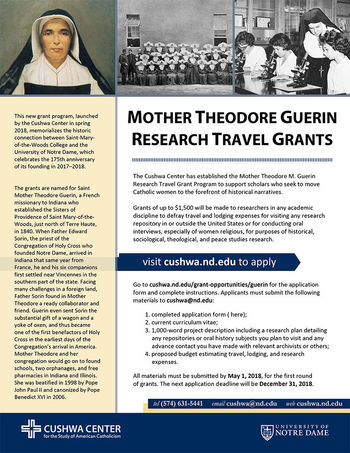
1) The center has launched the Mother Theodore Guerin Research Travel Grant Program. This program memorializes the historic connection between Saint Mary-of-the-Woods College and the University of Notre Dame by supporting researchers whose projects seek to feature Catholic women more prominently in stories of the past. Grants of up to $1,500 will be made to scholars seeking to visit any repository in or outside the United States, or traveling to conduct oral interviews, especially of women religious. An inaugural round of grants will be awarded in late spring 2018 (application deadline: May 1, 2018). Thereafter, applications will be due December 31 each year for research in the subsequent calendar year. More info here!
2) Please find a call for papers for the Eleventh Triennial Conference on the History of Women Religious here. The conference theme is "Commemoration, Preservation, Celebration," and will take place June 23-26, 2019 at Saint Mary's College (Notre Dame, IN). All details can be found here. The deadline to submit a paper or panel proposal is June 1, 2018.
3) The Center recently concluded a conference at Kylemore Abbey, Ireland, entitled "A Pedagogy of Peace: The Theory and Practice of Catholic Women Religious in Migrant Education." For more context on the history of Kylemore's Benedictine nuns, see this article by Jack Rooney.
4) Watch for a new edition of the American Catholic Studies Newsletter, to be published soon. For now, here is a sneak peek at the most recent article in the series, "Why I Study Women Religious," by Marie Marmo Mullaney (Caldwell University).
Finally, the Cushwa Center will be hiring an in-residence postdoctoral research associate for academic year 2018-2019. Find the job ad here! Applications due April 15!
Although women's history is inseparable (or should be!) from our national narratives, the month of March serves as a time to reflect specifically on women's contributions to American history. Even more specifically, this month provides a special occasion to reflect on the history of women religious, and to announce some current and forthcoming scholarly initiatives from the Cushwa Center in this area.
1) The center has launched the Mother Theodore Guerin Research Travel Grant Program. This program memorializes the historic connection between Saint Mary-of-the-Woods College and the University of Notre Dame by supporting researchers whose projects seek to feature Catholic women more prominently in stories of the past. Grants of up to $1,500 will be made to scholars seeking to visit any repository in or outside the United States, or traveling to conduct oral interviews, especially of women religious. An inaugural round of grants will be awarded in late spring 2018 (application deadline: May 1, 2018). Thereafter, applications will be due December 31 each year for research in the subsequent calendar year. More info here!
2) Please find a call for papers for the Eleventh Triennial Conference on the History of Women Religious here. The conference theme is "Commemoration, Preservation, Celebration," and will take place June 23-26, 2019 at Saint Mary's College (Notre Dame, IN). All details can be found here. The deadline to submit a paper or panel proposal is June 1, 2018.
3) The Center recently concluded a conference at Kylemore Abbey, Ireland, entitled "A Pedagogy of Peace: The Theory and Practice of Catholic Women Religious in Migrant Education." For more context on the history of Kylemore's Benedictine nuns, see this article by Jack Rooney.
4) Watch for a new edition of the American Catholic Studies Newsletter, to be published soon. For now, here is a sneak peek at the most recent article in the series, "Why I Study Women Religious," by Marie Marmo Mullaney (Caldwell University).
Finally, the Cushwa Center will be hiring an in-residence postdoctoral research associate for academic year 2018-2019. Find the job ad here! Applications due April 15!


