Showing posts with label Cushwa's posts. Show all posts

Funding Opportunities from the Cushwa Center

Maggie Elmore

The Cushwa Center for the Study of American Catholicism is pleased to announce the annual deadline to apply for travel grants from the Cushwa Center. The Center offers five different grants for projects related to the study of American and global Catholicism:


The deadline for applying for each of these grants is December 31, 2018. More information can be found at https://cushwa.nd.edu/grant-opportunities/. Please direct any questions to cushwa@nd.edu.
spacer

Fall Preview: Cushwa Center for the Study of American Catholicism

Maggie J. Elmore

(on behalf of the Cushwa Center)


This fall, the Cushwa Center for the Study of American Catholicism at the University of Notre Dame will be hosting a series of events that will appeal to a wide array of scholars of American religion. As always, the events are free and open to the public.

1) Hibernian Lecture: "America and the Irish Revolution, 1916-1922"│Sept. 21
The 2018 Hibernian Lecture marks the fortieth anniversary of the relationship between the Hibernians and the Cushwa Center. In 1978, the Ancient Order of Hibernians and Ladies Ancient Order of Hibernians undertook a campaign to establish an endowment at the University of Notre Dame for illuminating the Irish heritage in America. This year's lecture features Ruán O'Donnell. O'Donnell is senior lecturer in history at the University of Limerick. His current research examines Irish radicalism and international pro-Irish Republican networks during the Irish Revolution. Details here.

2) Public Lecture:"Historical Empathy in the Writing of Religious Biography"│Oct. 3
John Wilsey (Southern Baptist Theological Seminary) will discuss writing religious biography, drawing on his current research, a religious life of John Foster Dulles. Details here.

3) Cushwa Center Lecture: "Sex and American Christianity: The Religious Divides that Fractured a Nation"│Oct. 25
This year's lecture will feature R. Marie Griffith, John C. Danforth Distinguished Professor at Washington University in St. Louis. Griffith directs the John C. Danforth Center on Religion and Politics and is the author of Moral Combat: How Sex Divided American Christians and Fractured American Politics (Basic Books, 2017). Details here

4) Seminar in American Religion│Oct. 27
This semester the seminar will discuss David Hollinger's recent book, Protestants Abroad: How Missionaries Tried to Change the World but Changed America, (Princeton University Press, 2017). Commentators will include R. Marie Griffith (Washington University in St. Louis) and Rebecca Tinio McKenna (University of Notre Dame). Details here.

For those who can't attend, Cushwa's YouTube channel features video of most center events. Subscribe to see videos for these and other events as they're posted.

Please direct any questions to cushwa@nd.edu. We look forward to seeing you at these events!
spacer

5 Questions with Ben Wetzel

Cushwa Center

The Cushwa Center is pleased to announce that one of its postdoctoral research associates, Benjamin Wetzel, recently accepted a position as assistant professor of history at Taylor University (IN).  As Ben transitions into his new role, the center is pleased to welcome Maggie Elmore as a new postdoctoral research associate.  Maggie works on Latino/a Catholicism in the 20th century and comes to us from the University of California, Berkeley--you can read more about her here!

Cushwa Assistant Director Shane Ulbrich recently interviewed Ben about his research projects, his perspective on what the genre of biography can do for historians, and his thoughts on the state of the academic job market.  An excerpt of that interview is below, with the full transcript available on the Cushwa Center webpage.


Image Credit: Luzerne County Historical Society

SU: We've kept you busy at the Cushwa Center this year writing book reviews and event recaps, managing the center's monthly blog posts, and helping out with events and administration.  At the same time you've managed to teach a course and make progress on two book projects.  Tell us about the research you've been pursuing this year.

BW: I am currently working on two book-length projects.  The first is a revision of my dissertation, done at Notre Dame in the history department.  That project explores how America's Christian communities debated the righteousness of America's wars from 1860 to 1920.  Its main focus is on mainline white Protestants, who exercised the most cultural authority in that period, but it also provides sustained points of comparison with Christian groups on the margins of American life--black Methodists, Roman Catholics, and German-speaking Lutherans.  My thesis is that a combination of ideological orientation (theology and its related manifestations) and social position (class, race, geography) did the most to influence how American Christians thought about the wars their nation waged.  The manuscript is currently at the revise-and-resubmit stage with Cornell University Press.  During my year with the Cushwa Center, I received initial readers' reports from the press and formulated a response letter outlining the changes I would make during revisions.

My second project is a religious biography of Theodore Roosevelt (under advance contract with Oxford University Press, to be included in its "Spiritual Lives" series). The goal of the series to produce short (80,000 words) biographies of "prominent men and women whose eminence is not primarily based on a specifically religious contribution," but for whom religion (or doubt) was important.  The biographies are supposed to cover all the major events of the person's life with special attention to the religious story.  My life of TR will pay a lot of attention to his personal faith journey but will also situate him within the broader narrative of American religious history in the Gilded Age and Progressive Era.  During my year at Cushwa, I was able to research and write drafts of three chapters and take a short archival trip to work in the Theodore Roosevelt Collection at Harvard University.

SU: You taught a course for upper-level undergraduates this past semester on "Theodore Roosevelt's America."  How did it go?

BW: I was very pleased overall.  The idea was that the course would be about two-thirds on the life of TR himself and one-third on the Gilded Age and Progressive Era as a whole.  Of course there was a lot of intersection between the two: themes like empire, race, political developments, and even social and cultural issues all had significant overlap with TR himself.  The most successful feature of the course was probably an assignment where each student had to write a short review of a recent (last 20 years) book on TR, give a brief presentation to the class, and take five minutes of questions from classmates.  During these sessions I could tell there was real thinking and learning going on and a serious engagement with what professional historians actually do.  I am especially glad I was able to teach this course here since I am scheduled to do a related course ("The Roosevelts") during J-Term at Taylor this winter.

Read the rest here!
spacer

Five Questions with Catherine Osborne

Benjamin J. Wetzel

The Cushwa Center is pleased to celebrate a book publication by one of our former fellows (and former RiAH blogger), Catherine R. Osborne, who is now visiting assistant professor in the department of theological studies at Loyola Marymount University. American Catholics and the Church of Tomorrow: Building Churches for the Future, 1925-1975 was published in April by the University of Chicago Press.  I recently asked Catherine to elaborate more on her work.
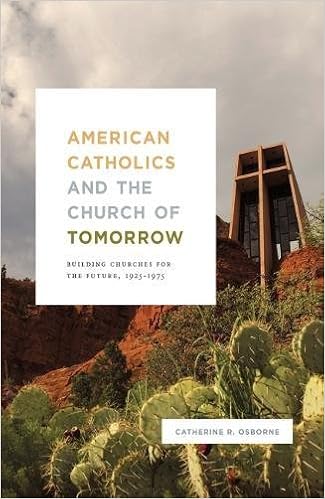


BW: Briefly, what is the book about and what are its major claims?

CO: When I was working on the book and people asked me what it was about, I had five or six answers of varying lengths, depending on how interested I thought they actually were.  The three-word answer is "Catholic modernist architecture," but that's not really true.  First of all, it's not about architecture, exactly.  It's an intellectual and cultural history of mid-20th century approaches to Catholic worship space (which includes but is not limited to church buildings).  Because basically everyone sees ideas about church spaces as intimately linked to concepts of the Church, the book is also, therefore, about ecclesiology in this period, which includes the runup to and immediate aftermath of the Second Vatican Council.  And finally, it's about how mid-20th century American Catholics forecast and imagined the church/Church's future.  Some of that was quite practical: trying to figure out the height of the sanctuary steps if you were giving out Communion to people standing rather than kneeling, for example.  But some of it was more visionary.  What kind of churches would be suitable for a moon base?  What might LSD teach us about eschatology?  How could we make worship spaces that expressed the relationship between the "sacred" and the "profane" that's developed in Vatican II documents like Gaudium et spes?  I originally set out to write a book about architecture, but it ended up being a book about how 20th-century American Catholics thought about change and the future, as refracted through the way they thought about their worship spaces.

As for "major claims," there is a foundational claim that is not unique to me.  By the mid-20th century, evolutionary thought, broadly conceived, had become deeply embedded in every single academic and professional discipline, such that everyone with a good formal education (and a lot of other people too) was almost incapable of not seeing reality in fundamentally evolutionary terms.  I think that's just generally true.  But the book argues more formally that it was true of people formed as professional modernist architects, and that they then went out and made the case to their clients that the church building needed to adapt and evolve (i.e. to change), because everything needed to adapt and evolve.  That's just how the world works.  And what's especially interesting to me as an historian of theology is that simultaneously a lot of theologians are beginning to make the same argument about the Church itself, and the architects and theologians end up reinforcing each others' claims that the most important thing is not to get every worship space right; the most important thing is to have a stance or orientation towards a future of constant change.

This answer is already not "brief," but a few more specific contributions I see the book making: First, nearly everything written about modernist Catholic architecture has been either flat-out polemic, or is by architects, architectural historians, and liturgists who are arguing for a normative aesthetic of one kind or another.  I have my own feelings about aesthetics, but I very definitely wanted to uncover the thinking of this period and to keep the focus on that, and to do it in a generous rather than a suspicious way.  Second, in keeping with the theme of depolemicization, I revisit two theologians (the Catholic Pierre Teilhard de Chardin and the Baptist Harvey Cox) who were staggeringly, enormously widely read during the 1950s-70s, and who have since mostly fallen out of the Catholic academic theology canon and tend to get talked about very dismissively.  (On a personal note, I'm not a big Teilhardian, but I was surprised at how well Cox's The Secular City holds up.)  What got people so excited about these guys?  What effect did they have on worship space?  And third, I argue that if you want to understand why high modernist church architecture looks the way it does (all the concrete) you have to understand why architects and liturgists saw the new building materials and techniques of the 20th century as not only technically exciting, but liturgically and theologically significant.  I wanted my humanist readers not to be able to skip the paragraphs about engineering; you need to understand how it works in order to understand why people felt it was liturgically and theologically significant.  I'm not sure other people will necessarily think so, but to me, the chapter on concrete is the most important in the book.

BW: How does the book speak to issues of interest to readers of this blog?

CO: I would say that aside from the specific historical contributions (to the intellectual and cultural history of the Vatican II period especially), I wanted to think more generally about how religious people with strong secular, professional identities navigate both their religious and professional lives.  Most books about Catholicism--and I would venture to say about most religions--focus either on the experience of religious professionals (including laypeople whose primary work is "religious"--for example, Commonweal editors) or on the religious experiences of a more generic "laity" that have a variety of occupations.  But there's a kind of double consciousness that develops when you have a strong professional identity.  In this case, I was interested in how architects and artists (many of whom were Catholic) understood what they were doing when they built or thought about building Catholic churches or making Catholic art.  If you're trained as a modernist architect or artist, you're specifically trained not to copy visual elements or layouts from the past.  Rather, you're supposed to think the entire problem through from the beginning, and to create a building/work which is perfectly adapted to its time, place, and function, which means you need to understand all three of those things.  It's a very intensive process.  (And not coincidentally, it has a lot in common with what professional liturgists and theologians were doing in the runup to and aftermath of Vatican II.)  So: how does this strong self-image change how you relate to the Catholic Church and its clergy?

BW: I think it's safe to say that architecture is not on the radar of most historians.  In your view, what can scholars gain from sustained attention to the built environment?

CO: I'd say that "attention to the built environment" is a better term for what I do than "architectural history."  There's not a whole lot of it in the text of the book, but I read and thought a lot about space and place theory while I was researching, because I wanted to think about the way people emotionally relate to their spaces, how they interact with them, and what they want from them.  That includes what architects want, but also what clients and congregations want.  The physical look of the building, the strictly-speaking-architectural-history part, is necessary to write about, but what really excites me as a historian is figuring out the desire that's encoded in that look.

Of course, that desire isn't always singular.  One reason why this isn't only an intellectual history is that I love the moment when someone's theory meets reality.  You can have this beautiful church in your head, but you need to pay for it, and the roof can't leak, and you have to reconcile all the different ideas everyone has about what exactly "gathered around the altar" means for what kind of pews you should have.  The arguments people have in those moments are so revelatory about what really matters to them.  Specifically regarding the implementation of Vatican II--if you're doing an intellectual history of Vatican II, you can say what the documents said.  But when you look at people trying to build a building that responds to those documents, you're confronted right away with their ambiguities and silences, by all the decisions they punted on.

BW: Talk to us about your periodization: why did you choose 1925-1975, and what do scholars see differently when they focus on these years rather than on the typical "interwar," "postwar" or "Cold War" frameworks?

CO: The specific years are a little fuzzy, actually.  In the first chapter in particular I go pretty deeply into the 19th century, to the origins of modernist architectural theory.  The opening anecdote for the introduction is set in 1917.  The Liturgical Arts Society, on whose archives I built a lot of the original research, is formed in 1928.  But I picked 1925 because that's the year of a big, multi-year dustup in Commonweal between a number of modernists and anti-modernist architects (and their sympathizers), which I take to be the moment when a number of trends which had been stirring in a few Catholic individuals begin to coalesce into something like the beginnings of an organized movement for modernist architecture.  Nineteen Seventy-Five is also a little fuzzy.  Maybe I shouldn't admit this, but there's no real single endpoint to the book.  Somewhere around 1972-75, the big explosive debates that happen in the immediate aftermath of the Council, and which drive the second half of the book, start to settle down.  By 1980 they've coalesced into what I think of as the postconciliar settlement on what a "post-Vatican II church" should be like.  Things stay fairly stable after that until the big traditionalist backlash gets going in the late '90s.  So it made sense to stop somewhere in the mid-to-late '70s, and 1975 happened to be the date of the last church that's mentioned in the book, so I went with that.

The second part of that question: I do think that specific short timeframes have their own qualities and characteristics.  The 1950s really are different from the 1970s or from the 1920s in terms of American life and in terms of Catholic concerns.  But I am interested in what you might call early adopters, the few stubborn visionary types who push ideas forward until one day you turn around and they're conventional wisdom.  As a historian of American Catholicism and of Roman Catholicism generally, I see Vatican II as a big, important moment in a longer process, and I wanted to trace some of that process, with attention to the special characteristics of smaller periods of time.

BW: What advice can you give about the publishing process?

CO: I didn't think there was an obvious home for this book; most of the presses that do great work with American religious history don't do art books, and while my dissertation had several hundred photos, I was afraid that if I tried to place it with an architectural history press, it wouldn't be read by religious historians.  I was a first-time author and I had a big, complicated project with a lot of moving parts.  So I consider myself lucky to have met an editor who was genuinely interested in the book's potential.

My best advice, overall, is to find someone who wants you to write the book you want to write.  It was important to me that my editor be hands-on, which meant he or she had to understand and support what I wanted to do--blending religious history, which doesn't usually have a lot of pictures, with the visual arts.  Tim Mennel, my editor at Chicago, has a background in the history of urban planning, so he knew a ton about the specific history I was writing about in the second half of the book, and he was excited rather than put off by the interdisciplinary work I was doing.  (He was also extremely patient for three years while I ripped apart my original dissertation structure, did a lot of new research, and put the entire thing together again in a completely different order.)  I can't say enough about him.  Well, I do wish the book had 300 photos in color.  But within the constraints of the real world, I can't say enough about either Tim, or the staff of the press, who've uniformly been fantastic to work with.

spacer

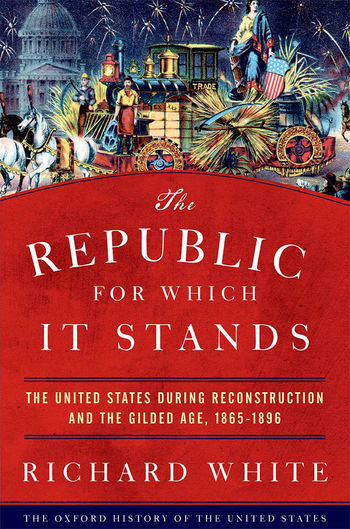
Religion in the Gilded Age: A Review of Richard White's The Republic for Which It Stands

Benjamin J. Wetzel

The following review appeared in the spring 2018 edition of the American Catholic Studies Newsletter.


Republic White


White, Richard. The Republic for Which It Stands: The United States during Reconstruction and the Gilded Age, 1865-1896. New York: Oxford University Press, 2017.


"For a while," Richard White observes in a bibliographical essay at the end of The Republic for Which It Stands, "the Gilded Age became the flyover country of American history, but at other times it has loomed large" (874).  White is correct, and at this particular moment the late 19th century seems to be making a comeback.  In October 2017, Ron Chernow (whose biography of Alexander Hamilton was the inspiration for the eponymous musical) released Grant, a 1,074-page biography of the Civil War general who served as president from 1869 to 1877.  One month later, Washington Post columnist Dana Milbank criticized the Republican tax plan with the headline, "Welcome to the New Gilded Age."  Milbank never explained the term or referenced the 19th century, evidently assuming that his readers already possessed a stockpile of assumptions about the period from 1865-1896.  Perhaps Milbank was right, since the economist Paul Krugman has for some years taken to associating our current era with the past age of robber barons and laissez-faire economics.

Whatever they think of the ideas of Chernow, Milbank, and Krugman, American historians will have to reckon with the late 19th century once again thanks to the newest contribution to the Oxford History of the United States series.  Richard White's The Republic for Which It Stands: The United States during Reconstruction and the Gilded Age, 1865-1896 weighs in at 941 pages, a mammoth book about an era known for its excesses.  White's tome is no excess, however; in this work the author of the Pulitzer-finalist Railroaded: The Transcontinentals and the Making of Modern America (2011) brings his expertise in western history to bear on American history more generally in this fascinating period.  This review will evaluate the book as a whole with special attention to White's treatment of religious topics.

Read the rest here!

spacer

Women's History/Catholic History: New Initiatives at the Cushwa Center

Benjamin J. Wetzel

Although women's history is inseparable (or should be!) from our national narratives, the month of March serves as a time to reflect specifically on women's contributions to American history.  Even more specifically, this month provides a special occasion to reflect on the history of women religious, and to announce some current and forthcoming scholarly initiatives from the Cushwa Center in this area.

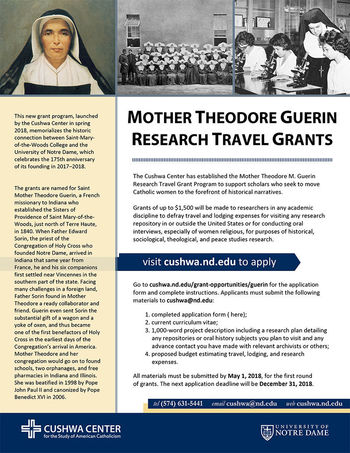
Theodore Guerin Travel Grant Flyer 05

1) The center has launched the Mother Theodore Guerin Research Travel Grant Program.  This program memorializes the historic connection between Saint Mary-of-the-Woods College and the University of Notre Dame by supporting researchers whose projects seek to feature Catholic women more prominently in stories of the past.  Grants of up to $1,500 will be made to scholars seeking to visit any repository in or outside the United States, or traveling to conduct oral interviews, especially of women religious.  An inaugural round of grants will be awarded in late spring 2018 (application deadline: May 1, 2018).  Thereafter, applications will be due December 31 each year for research in the subsequent calendar year.  More info here!

2) Please find a call for papers for the Eleventh Triennial Conference on the History of Women Religious here.  The conference theme is "Commemoration, Preservation, Celebration," and will take place June 23-26, 2019 at Saint Mary's College (Notre Dame, IN).  All details can be found here.  The deadline to submit a paper or panel proposal is June 1, 2018.

3) The Center recently concluded a conference at Kylemore Abbey, Ireland, entitled "A Pedagogy of Peace: The Theory and Practice of Catholic Women Religious in Migrant Education."  For more context on the history of Kylemore's Benedictine nuns, see this article by Jack Rooney.

4) Watch for a new edition of the American Catholic Studies Newsletter, to be published soon.  For now, here is a sneak peek at the most recent article in the series, "Why I Study Women Religious," by Marie Marmo Mullaney (Caldwell University).

Finally, the Cushwa Center will be hiring an in-residence postdoctoral research associate for academic year 2018-2019.  Find the job ad here!  Applications due April 15!
spacer

French Catholicism in the Early American West: Five Questions with Gabrielle Guillerm

Benjamin J. Wetzel

Gabrielle Guillerm is a Ph.D. candidate in history at Northwestern University. Her dissertation will examine French Catholicism in the early American west. She was awarded a 2017 Cushwa Center Research Travel Grant to pursue work on this topic at the Notre Dame archives. What follows is the first of several questions I recently asked Guillerm about her work.  Read whole thing at the Cushwa Center website!


BW Can you briefly describe your project for us?

Rtg Guillerm InterviewGG My dissertation, "The Forgotten French: Catholicism, Colonialism, and Americanness on the early trans-Appalachian Frontier," focuses on the Midwest and Kentucky and aims to recover the French Catholic story of the early United States. I posit that, compared to the colonial period, French Catholic cultural influences strengthened in the west over the early republican period even as the proportion of Francophone Catholics in this former French territory diminished. The development of these new French Catholic influences resulted from the French Revolution.  Refugee priests in the United States created new Catholic networks between France and the United States. These networks intensified in the early 19th century and were embodied by the circulations of hundreds of female and male missionaries and thousands of religious objects. French clergy built French religious orders and schools after French examples--the Congregation of Holy Cross and Notre Dame for instance--and spread popular French devotions, such as the devotion of the Sacred Heart. Non-French clergy themselves relied on the connections with France, which further contributed to spreading French Catholic influences.

This project seeks to understand how French Catholics and French Catholic influences fit into the new nation. Analyzing the encounter between Catholics and other trans-Appalachian populations, I argue that defining American identity was a contentious process, and central to this contestation were French Catholic missionaries and French Catholics. Indeed, French missionaries' status in the new nation was ambivalent: they were both threats to the country and agents of the nation's agenda in the West, insiders and outsiders.  On the one hand, they spread an alternative understanding of the new nation that challenged the assertion of the American identity as Anglo-Protestant; on the other hand, they took an active part in the building of the colonial settler nation promoted by the U.S. government.

Read the rest here!

spacer

Recapping the American Catholic Historical Association Meeting: A Guest Post from Stephanie A.T. Jacobe

Stephanie A.T. Jacobe

Stephanie A.T. Jacobe received her Ph.D. in history from American University in Washington, D.C. and also holds an M.A. in art history from Virginia Commonwealth University in Richmond, VA. She currently serves as the Director of Archives for the Archdiocese of Washington and as Adjunct Assistant Professor of Humanities at University of Maryland University College. Her dissertation, a biography of financier and Catholic philanthropist Thomas Fortune Ryan, is currently under revision. Her work has been supported by the Harvard Business School, the Cushwa Center, the Gilder Lehrman Institute of American History, and the Center for the History of Collecting in America located at the Frick Collection in New York City. She was recently elected chair of the Elections Board of the American Catholic Historical Association, and also serves as the editor of H-Catholic, one of the H-Net networks.

The annual meeting of American Catholic Historical Association (ACHA) began on Friday, January 5, 2018, and included two full days of concurrent sessions. The meeting took place in Washington, D.C.'s Woodley Park neighborhood and was held in conjunction with the annual meeting of the American Historical Association (AHA). Sessions included a range of American and European historical topics, and papers were presented by a mix of graduate students and established scholars. Though the meeting takes place among the much larger AHA gathering, the feel of the ACHA is that of a meeting within a meeting. Sessions are held at one of the conference hotels and those registered for the AHA have access to the book room and the job center. But smaller, more intimate, rooms are used for ACHA sessions and you will see many of the same faces in the multiple sessions you attend. It is a welcome haven from the hustle and bustle of the much larger conference.

The conference began bright and early on Friday morning with sessions about Catholic expansion in the western United States, and a new look at the education of girls in Central America. Another session looked at the intersection of politics and Catholicism. This began with Jason Duncan of Aquinas College, who discussed Martin Van Buren's ties to Catholics and his aim at building coalitions that included them even though he received significant backlash for it. Duncan argued that this is how Van Buren helped form the Democratic Party. William Kurtz of the John L. Nau II Center at the University of Virginia followed with a look at Catholic partisanship during the Civil War. I also presented a paper during this session about the influence that Catholicism had or did not have on the political careers of Chief Justice Roger Brooke Taney (1777-1864) and Chief Justice Edward Douglass White (1845-1921).

Though a winter storm was bearing down on the East Coast and the weather was extremely cold, a group of ACHA and American Society of Church History members embarked in a bus on Friday afternoon to the areas around the Catholic University of America. The group had a guided tour of the Franciscan Monastery of the Holy Land on Quincy Street and of the Basilica of the National Shrine of the Immaculate Conception, where everyone was able to see the newly-installed Trinity Dome along with a drive around the neighborhood.

I missed the 8:30 a.m. session on Saturday morning because a pipe broke in my hotel room late on Friday night due to the cold and I had to move rooms so they could fix it. The first panel I attended was at 10:30 a.m. entitled "Catholic Images, Narratives, and Identities in Early Modern Europe." Jeanne-Michelle Datiles of the Catholic University of America discussed Elizabethan Catholic Martyr literature. She discussed the intense martyr mentality of English Catholics during the Elizabethan period and how martyrologies such as that of Henry Walpole, S.J. were used and disseminated. Juan-Fernando Leon of Wheaton College (IL) discussed the eschatological message found in the plates of Casiodoro De Reina's Biblia Del Oso. De Reina translated the Bible into Spanish despite the Inquisition. The plates placed at the beginning of the book show a forest scene with a bear eating honey from a tree. Honey throughout the Bible is used as a symbol for wisdom. The final paper in the session, by Anatole Upart of the University of Chicago, discussed the Greek Catholic Ruthenians and their search for a home in seventeenth-century Rome.

At the annual luncheon the outgoing president, Kathleen Sprows Cummings, director of the Cushwa Center and associate professor of American studies and history at the University of Notre Dame, gave her presidential address entitled "Frances Cabrini, American Exceptionalism, and Rethinking U.S. Catholic History." Several awards were presented, including the following:

  • The Distinguished Award for Scholarship, presented to the Rev. Gerald Fogarty, S.J., of the University of Virginia;
  • The Distinguished Award for Teaching, presented to Anne Klejment of the University of St. Thomas;
  • The Distinguished Award for Service was presented to the American Catholic History Research Center and the University Archives at the Catholic University of America;
  • The 2018 John Gilmary Shea Prize was presented to William B. Taylor for his book, Theater of a Thousand Wonders: A History of Miraculous Images and Shrines in New Spain (Cambridge University Press, 2016);
  • The Howard R. Marraro Prize in Italian History was presented to John Howe for his book, Before the Gregorian Reform: The Latin Church at the Turn of the First Millennium (Cornell University Press, 2016);
  • The inaugural Henry C. Koenig Article Prize, for a biographical study of a Catholic individual (published in 2015 or 2016), was awarded to Paul T. Murray of Siena College, for "'The Most Righteous White Man in Selma': Father Maurice Ouellet and the Struggle for Voting Rights," The Alabama Review 68:1 (Jan. 2015): 31-73;
  • The Peter Guilday Prize for 2017 was given to Kathleen Walkowiak of Saint Louis University for her article, "Public Authority and Private Constraints: Eugenius III and the Council of Reims," that appeared in the American Catholic Historical Review 103 (Summer 2017).

After lunch the conference finished up with sessions on faith and doubt in Early Modern Europe, urban Catholic parish life in the United States, and saints and miracles. The session on saints and miracles included a paper by Carole Baker of Duke University on the highly decorated bodies of saints found in Bavaria, Austria, and Switzerland. It continued with Rosario Forlenza of New York University discussing Padre Pio and the cult of miracles that surrounds him and his relics in southern Italy. The final paper was by Mary Corley Dunn of Saint Louis University on Blessed Mary Catherine of St. Augustine, O.S.B., whose disability and constant illness after coming from France to Canada in the seventeenth century was portrayed in her vita as the root of her sanctity.

The conference finished on Saturday with the evening liturgy at 5 p.m. and then afterwards the social, which includes drinks and heavy hors d'oeuvres, for members of the ACHA. Both events bring members together, with the social allowing newer members and graduate students to get to know older, more distinguished, scholars. The ACHA is a very welcoming group and newer members are easily able to get to know the old-timers. Though the AHA annual meeting can be intimidating to new scholars and graduate students, the more intimate meeting of the ACHA is a welcome respite with friendly camaraderie among the participants.

The official program can be found here.
spacer

Cushwa Center Spring Events (and grant deadlines reminder!)

Benjamin J. Wetzel

As final exams wind down and the fall semester ends, the Cushwa Center would like to announce several public events it will be hosting and/or sponsoring at the University of Notre Dame during spring 2018.

1) The Seminar in American Religion | March 24
This semester the seminar will discuss Judith Weisenfeld, New World A-Coming: Black Religion and Racial Identity During the Great Migration (New York University Press, 2017).  In addition to Professor Weisenfeld, commentators will include RiAH founder Paul Harvey (University of Colorado) and Jennifer Jones (University of Notre Dame).  Details available here.  The book seminar will be held in conjunction with...

2) "Enduring Trends and New Directions: A Conference on the History of American Christianity in Honor of Mark Noll" | March 22-23
This conference will honor the career of Mark Noll by reflecting on his work in the history American Christianity while also looking forward to new directions in the field.  More info here.

3) "Centering Black Catholics, Reimagining American Catholicism" | April 11
This lecture by Matthew Cressler (College of Charleston) will honor the fiftieth anniversary of the founding of the National Black Catholic Clergy Caucus.

In addition, two other events will take place at international locations.

1) "'A Pedagogy of Peace': The Theory and Practice of Catholic Women Religious in Migrant Education" | March 14-17, Kylemore Abbey, Ireland
The Cushwa Center will gather scholars from around the world at the Kylemore Abbey Global Centre for a conference on the theme of Catholic women religious in migrant communities. The conference will feature both Catholic sisters and lay scholars.

2) Book Launch of Matteo Binasco, Roman Sources for the History of American Catholicism, 1763-1939 (Notre Dame, 2018) | May 24, Notre Dame Rome Global Gateway, Rome, Italy


The Cushwa Center would also like to remind everyone that applications for funding opportunities are due in ten days, December 31!  Specifically, we offer four kinds of grants:


  • The Theodore M. Hesburgh Research Travel Grant (to use the Hesburgh Papers at Notre Dame)
  • The Research Travel Grant (to use Notre Dame archival resources)
  • The Hibernian Research Award (for projects related to Irish experiences in Ireland and the United States)
  • The Peter R. D'Agostino Research Travel Grant (to use Roman archives for an American Catholic-focused project)

  • For more information about our funding opportunities, visit our website or email cushwa@nd.edu.


    spacer

    Religion and the World War I Centennial

    Benjamin J. Wetzel

    Aisne-Marne American Cemetery and Memorial 
    Wikimedia Commons

    From 2011 to 2015, historians of the Civil War occupied an enviable position: they had four long years to enjoy the 150th anniversary of the conflict, with a spate of monograph publications, conferences, and other academic events scheduled to commemorate the sesquicentennial.  Now, from 2017 to 2018, we are in the midst of another anniversary: the centennial of the United States's involvement in World War I.  From April 1917, when Congress declared war at President Woodrow Wilson's request, to November 1918, when a cease-fire was signed, the United States sent millions of soldiers (not to mention nurses, chaplains, and other personnel) to Europe in an effort that eventually turned the tide of the war in favor of the allies.  Without question, the Great War and the 1919 Treaty of Versailles set in motion forces that would culminate in, to use historian Modris Eksteins's phrase, "the birth of the modern age."

    Until recently, however, relatively little attention has been paid to the role of religion in the conflict.  This post aims for a very quick overview of some of the recent literature concerning religion and World War I, with an emphasis on the American side of things.  The post is suggestive rather than exhaustive; please feel free to add other texts in the "comments" section.


    For a long time, only a few books dealt extensively with the subject of religion and the Great War.  The first real attempt, Ray H. Abrams's Preachers Present Arms (1933) marshalled a mountain of evidence in support of a "social control" thesis; in his view, ministers supportive of the war were both victims of the Wilson administration's propaganda and conduits of it.  John F. Piper, Jr.'s The American Churches in World War I (1985) was a rebuttal to Abrams; Piper attempted to show that most clergymen were justified and relatively restrained in their patriotism.  The next substantial treatment, Richard Gamble's The War for Righteousness (2003), stressed the ways that the New Theology and the Social Gospel motivated liberal Protestants to back the war as a progressive, ameliorative measure.

    Since Gamble's revision, other works have also tackled the subject of American religion and World War I, but from different angles.  Jonathan H. Ebel's Faith in the Fight (2010) shifts the discussion away from elite clergymen toward ordinary soldiers.  With impressive use of private sources like letters as well as public ones like the Stars and Stripes newspaper (the official publication of the American Expeditionary Force), Ebel shows that ordinary doughboys often echoed conventional religious justifications for the conflict.  Other studies situate US religious support for the war in a wider context.  Ebel's most recent book, G.I. Messiahs (2015), for example, begins an examination of the soldier as a religious image in the twentieth century with a chapter on World War I.  Likewise, Andrew Preston's magisterial Sword of the Spirit, Shield of Faith (2012) situates religious support for World War I in the longer perspective of the interplay between faith and foreign policy throughout all of American history.  In The Great and Holy War (2014), Philip Jenkins puts the American religious story in a global context; Jenkins demonstrates that figures from most of the nations involved in the war argued that the Almighty was really backing their cause.

    The most recent literature on this topic has helped to fill in the picture more completely.  RiAH's own Cara Burnidge's A Peaceful Conquest (2016) revisits the issue of Christianity and the Great War, but from a different perspective.  Burnidge focuses on Woodrow Wilson's own serious religiosity in an account that fuses intellectual, political, diplomatic, and religious history.  Gordon Heath's edited volume, American Churches and the First World War (2016) is a boon to scholars since its chapters cover how a range of denominations dealt with the war.  Familiar categories like "evangelicals" and "Catholics" appear, but these are supplemented by chapters dealing with groups as diverse as Quakers, Lutherans, Mormons, and Jehovah's Witnesses.

    British, Canadian, and German religious experiences in the war have recently been chronicled as well. Edward Madigan's Faith Under Fire (2011) explores the experiences of Anglican chaplains; Madigan and M.F. Snape's The Clergy in Khaki (2013) gathers a range of authors to deal with the British chaplaincy; and Mark D. Chapman's Theology at War and Peace (2016) examines how English theologians dealt with Germany in the Great War.  Like his American volume, Gordon Heath's edited collection, Canadian Churches and the First World War (2014), covers a spectrum of Christian denominations.  For the German scene, consult Lea Herberg's edited volume, Theologie im Kontext des Ersten Weltkriegs (2016) and the latter half of Gunter Brakelmann's Deutscher Protestantismus in den Kriegen 1870/71 und 1914-1918 (2014).  For a global overview of religion and the Great War, German readers can peruse Martin Greschat's Der Erste Weltkrieg und die Christenheit (2014).

    There are doubtless many conferences and events planned to commemorate the World War I centennial.  I will end by highlighting one such conference, to be held at my alma mater.  The Center for Vision & Values at Grove City College (PA) will host "World War I and the Shaping of the Modern World" from April 12-13, 2018.  While panelists will address a variety of sub-topics, religion is sure to feature prominently.  Click on the hyperlink to find out more information and register.

    As mentioned earlier, feel free to add other recent studies or relevant upcoming conferences, symposia, etc. in the comments section!


    spacer

    Introducing the Second Edition of "American Catholic History: A Documentary Reader"

    Today's guest post comes from Catherine R. Osborne (a former postdoctoral fellow at the Cushwa Center).  Catherine is now Visiting Assistant Professor in the Department of Theological Studies at Loyola Marymount University.  She is also the co-editor of the forthcoming second edition of American Catholic History: A Documentary Reader (NYU, 2017), the subject of today's post.  Thanks, Catherine!


    Over a decade ago, I was working at the Francis and Ann Curran Center for American Catholic Studies at Fordham University (https://www.fordham.edu/cs/) when its then co-director, Mark Massa, SJ, asked me if I wanted to participate in his newest project: assembling a one-volume primary source reader for students taking courses in American Catholicism. Drawing on our own research and on the work of earlier anthologists, especially John Tracy Ellis's Documents of American Catholic History and the fabulous nine-volume Orbis series American Catholic Identities: A Documentary History (general editor, Christopher J. Kauffman), we selected, organized, and wrote introductions for 70 documents.

    American Catholic History: A Documentary Reader (NYU Press) was released in 2008, and has been adopted in a variety of undergraduate courses since then. Several years ago, this time working at the Cushwa Center for the Study of American Catholicism at the University of Notre Dame, I wondered if it was time to think about reprinting. I contacted our editor to ask if it might be possible to add one or two documents whose omission had bothered me for years.

    Out of that conversation developed, not a slightly modified reprint, but a totally new edition of the reader, which will be released November 14. The second edition has 88 documents, of which 34 are new; several have never been published before in any form. (https://nyupress.org/books/9781479874682/)

    I want to reflect a little in the rest of this post on three elements that reshaped the new edition.


    Experience

    One of the most helpful things we did was to survey people who had used the first edition in their classrooms. This happened both informally, as we consulted our networks, and in the form of five anonymous readers' reviews from NYU Press. We asked both what documents could be cut from the first edition, and what would be best to add.

    The second edition is a better book because of the feedback we were able to get from users. It became clear that most people were using the book to teach cultural history, not intellectual history; "American Catholic History" was also a much more popular title than "American Catholic Studies." It was therefore possible to cut back on the documents in the intellectual-history section of the first edition. On the other hand, many people asked for more material to help them teach immigration and anti-Catholicism in the 19th century. As a result, the reader now includes Lyman Beecher's "A Plea for the West," the Know-Nothing Oath, four of Thomas Nast's anti-Catholic cartoons, and (to help make the point that a lot of immigrants were not interested in assimilation!) the St. Raphael Societies' Memorial.

    Diversity and Challenge

    In the first edition, we tried to include documents from diverse points of view on a number of axes (clergy and laity; men and women; various national immigrant groups) and to provide documents that would give contrasting viewpoints on contentious issues: the schools, race, sexuality broadly writ, worship style. But on balance, reviewing the first edition, we felt it had not gone far enough, and our outside reviewers agreed. As a result, most of the documents that had to be cut because of space issues were clerical, "official," voices. I particularly wanted to include more women and more attention to Native American and African American experiences. Luckily, it was possible to draw not only on documents I had been aware of earlier--I especially wanted to include the 1968 "Statement of the Black Catholic Clergy Caucus"--but on a decade of intervening research. Mary Ewens' research on the Alaskan native order the Sisters of the Snow provided one document; Emily Clark's translation of documents from the Ursulines of New Orleans provided two more. The archivists for the Sinsinawa Dominicans have been looking into the history of the "American Citizenship Curriculum" for Catholic schoolchildren, and a selection from that now fills out the question of how Catholics were taught to be "American Citizens." The relatively new presence of internet archives helped enormously: the Georgetown Slavery Project provided a new document. Other documents came in a more old-fashioned way; having decided to add a document from the ACT UP protest against St. Patrick's Cathedral, I found the full text in a massive, doorstopping primary source reader on LGBT history.

    I could go on, but I'll just add two stories. Sometimes you really hit the jackpot: Timothy Matovina directed me towards one of my favorite new documents, a sermon delivered in 2005. Given by a laywoman (one point in its favor!) it addressed devotion to Our Lady of Guadalupe (tragically missing from the first edition) in the context of immigration (helping to fill out both the continuing history of Catholic immigration and the way in which devotion helps immigrants manage their new lives.)

    Other times, it's a struggle. One of the fastest-growing Catholic populations since the immigration reforms of the 60s has been Asian-American, especially Vietnamese and Filipino/a. We were unable to find a suitable document for the first edition and it was something I especially wanted to address in the second edition. Yet it was challenging to find the kind of document I wanted, despite getting in touch with several other scholars; what I could find in print, in English, was largely limited to more "official" points of view and gave little sense of the distinctiveness of these communities. I ended up with a news story on a Vietnamese parish that included an interview with a co-founder. But I am also now in touch with several scholars of (secular) Vietnamese-American history who have promised to keep an eye out for primary sources on Catholicism that they might be able to translate. Third edition?

    Up to Date

    The first edition's last document, chronologically, dated to 1988. We were reluctant to go too far into the present on the grounds that most people would want to use their own selection of recent documents to make whatever points they needed to make. In 2008, 1988 was a reasonable place to stop. In 2017, it clearly wasn't! So, we needed to make some decisions about what more recent developments seemed likely to still be salient in the future. Kate Dugan made a successful pitch for John Paul II's Denver World Youth Day speech (1993), where he discussed the culture of life and inspired a generation of "JPII Catholics." A few other more recent documents found their way into different sections. But we also chose to add a five-document section called "New Horizons," dealing with issues we felt would continue to be important. In order, these were the sexual abuse crisis; parish closings (on the one hand) and growth (on the other); and questions of gender and authority as exemplified in the Leadership Conference of Women Religious investigation. Finally, we concluded with Pope Francis's address to Congress in 2015, on the theory that it would allow courses to end with a reconsideration of what is interesting about American Catholicism.

    To close this blog post on a personal note, this is the choice I wonder the most about right now. Shortly after the text of the book was finalized, Donald Trump was elected president, and an entire set of narratives of American history were, once again, profoundly disrupted. (Along with everything else being profoundly disrupted.) Francis's address was not entirely hopeful, but it did suggest a path forward to hemispheric unity and service which does not seem, as of October 2017, to be the way that we're heading. I have been using samples from the new reader with my own American Catholic History class this fall, and I am still not sure what document is going to close out the class in December.

    spacer

    Funding Opportunities from the Cushwa Center AND Five Questions with Katherine Dugan

    Benjamin J. Wetzel

    The Cushwa Center for the Study of American Catholicism is pleased to announce the annual deadline to apply for travel grants from the Cushwa Center.  The center offers four types of grants for projects related to the study of American and transnational Catholicism. Specifically:


    The deadline for applying for each of these grants is December 31, 2017.  More information can be found at http://cushwa.nd.edu/grant-opportunities/.  Please direct any questions to cushwa@nd.edu.

    Last year, Katherine Dugan, assistant professor of religion at Springfield College, received one of these grants for a project on millennial Catholic missionaries.  Recently, Catherine Osborne, a former postdoctoral fellow at the Cushwa Center, sat down with Dugan to discuss her work.  You can find the text of the interview here.

    spacer

    Thomas Jefferson, Slavery, and Religion: Rethinking an American Icon

    The Cushwa Center would like to introduce one of its new postdoctoral research associates, who will be overseeing the center's monthly blogging at RIAH.  Benjamin J. Wetzel specializes in American religious, political, and intellectual history in the period from 1860 to 1920.  Ben looks forward to working with fellow postdoc Pete Cajka (already well-known to readers of this blog) at the Cushwa Center in the coming academic year.

    Benjamin J. Wetzel

    Thomas Jefferson's reputation has suffered in recent years.  In 2015, at the College of William & Mary (his alma mater), students covered Jefferson's campus statue with post-it notes reading "racist" or "slave owner."  Last month, the University of Virginia began plans to honor the labor of slaves who literally built the university, reminding the public again of Jefferson's own life-long ownership of slaves.  At a more trivial level, the reputation of Jefferson's rival Alexander Hamilton has witnessed a stunning revival thanks to the popularity of Lin-Manuel Miranda's extraordinary musical.


    In this context, then, comes John B. Boles's new biography of the third president.  At 626 pages, Jefferson: Architect of American Liberty (Basic, 2017) is, in the words of Gordon Wood, "the fullest and most complete single-volume life of Jefferson" since 1970.  Indeed, Boles offers a sprightly narrative that illuminates most facets of Jefferson's life.  This review will focus on only two elements of the book, however: Boles's interpretation of Jefferson's relationship with slavery, and Boles's treatment of Jefferson's religious views.


    From the beginning of the book, Boles (Rice University) tries to complicate the image of Jefferson as merely a hypocritical racist.  In this he has some work to do, for it is not immediately clear to many people today how Jefferson could write that "all men are created equal" while holding hundreds of people in bondage and freeing very few upon his death.  Nevertheless, Boles does an admirable job of putting Jefferson in context: he inherited a good deal of debt (and accumulated some more of his own), making widespread emancipation financially difficult; he labored under the strictures of a 1793 Virginia law that allowed manumitted slaves to be seized as payment for their former owner's debts; and he had to deal with an 1806 state law requiring any freed slaves to leave Virginia within a year.  One might argue that Jefferson could have found a way around each of these problems, but Boles's point is that emancipation would have been more difficult than commonly imagined.

    Boles also is at pains to show what he perceives as Jefferson's true anti-slavery beliefs.  In 1770, for example, Jefferson did pro bono legal work on behalf of a young mixed-race slave suing for his freedom.  Four years later, he could write that "the abolition of domestic slavery is the great object of desire in these colonies where it was unhappily introduced in their infant state."  (Whether this was accurate or not is beside the point.)  As president, he used his 1806 annual message to Congress to call on that body to prohibit the transatlantic slave trade (which it did).  Most famously, in his Notes on the State of Virginia (1787), he expressed a desire that the United States might abolish slavery completely.

    Boles also assesses Jefferson's relationship with his slave Sally Hemings.  Today, based on DNA and other kinds of evidence, historians think it almost certain that Jefferson fathered six children through Hemings after the death of his wife Martha.  Naturally, some observers have alleged that Jefferson was nothing more than a rapist.  While acknowledging the common practice of slaveowners using their power to force themselves on slave women, Boles thinks the Jefferson-Hemings relationship was an exception: "mutual affection between individuals of unequal status can develop in certain circumstances" (154).  Among other evidence, Boles points out that Hemings could have gained her freedom in France (when Jefferson brought her there in 1787) but instead chose to return to Virginia with him.

    In all of this, Boles does not attempt to pardon Jefferson's behavior.  An advocate of colonization and the inferiority of blacks (his description of African Americans in Notes on the State of Virginia makes for truly nauseating reading), Jefferson held views that can only be described as unambiguously racist.  Boles does not shy away from these facts but tries to present Jefferson in context--and tries to help modern readers understand why Jefferson thought the way he did.  Boles explains, but he does not excuse.  Still, not all will be convinced, especially of his treatment of the Hemings-Jefferson relationship.  It is worth pointing out that Hemings was thirty years younger than Jefferson, and that she was only sixteen when she theoretically had the opportunity to gain her freedom in France.  Both of these facts make it hard to believe that she really chose love over freedom.

    Perhaps of even more interest to readers of this blog is Boles's treatment of Jefferson's religion.  Like most of the Founding Fathers, Jefferson cannot be described as an orthodox Christian; indeed, among the major founders he probably strayed the farthest from traditional Christianity.  Boles notes his "emerging skepticism toward orthodox Anglicanism" (19) as a teenager and describes his youthful rejection of the Trinity, Christ's divinity, and the atonement.  A decade later, Jefferson had grown more respectful of Christianity although he would never wholeheartedly take part in Virginia's Anglican establishment.  His rumored heterodoxy (or even atheism) would haunt him in the 1800 election, when Federalists put those charges to good political use.  In 1804, and then again in 1820, he edited the New Testament gospels, removing sayings of Jesus he thought inauthentic.  The result was a work stripped of the supernatural, leaving only (in Boles's words) "the simple, unadorned ethical principles of Jesus" (452).  Despite this, Jefferson still thought himself "a real Christian, that is to say, a disciple of the doctrines of Jesus" (452).

    He refused to proselytize for his beliefs, however, claiming "I am of a sect by myself" (452).  He agreed with John Adams that the restoration of the Jesuits in 1814 bode evil for the nation, arguing that it was "a retrograde step from light towards darkness."  Thus, while Jefferson mostly stood against the religious trends of the early nineteenth century, the individualism and anti-Catholicism on display here help us see how he also partook of the spirit of the age.  Historians might think more about how religious outliers like Jefferson nevertheless maintained commonalities with larger trends.

    Perhaps Jefferson's greatest achievement was his lifelong advocacy for religious freedom.  Too radical for its day, Jefferson's draft of a 1776 Virginia Constitution would have provided for "full and free liberty of religious opinion" with a disestablishment of the Anglican Church.  What did ultimately gain acceptance (although not until 1786) was Jefferson's Virginia Statute for Religious Freedom, which Jefferson meant to grant religious liberty even to non-Christian religions.  The statute would be one of three accomplishments he insisted must be included on his tombstone.

    Overall, Boles's biography illuminates Jefferson's life in profound ways.  One does not have to agree with all of Boles's perspectives to gain greater insight into Jefferson, American religion, and the early national period.  While the book is a bit repetitive in places (Boles tells us no fewer than three times that Jefferson diluted his wine with water, for example), it succeeds as an astute, judicious assessment of our third president.  While it certainly falls into the unfashionable category of "great man biography," Jefferson: Architect of American Liberty engages themes of live interest to all kinds of historians.  The book will undoubtedly be the definitive biography for the foreseeable future.

    spacer

    5 Questions on Catholics and Suburanization with Stephen Koeth

    Shane Ulbrich

    Stephen Koeth, C.S.C.
    [This month's Cushwa post features an interview by Shane Ulbrich with Research Travel Grant recipient Stephen Koeth, C.S.C., about his work on the postwar suburbanization of American Catholics. Stephen, a Holy Cross priest, is a doctoral candidate in history at Columbia University. His writing has appeared in The Journal of Church and State and U.S. Catholic Historian.]

    SU: Tell us about how your project developed. 

     SK: My dissertation explores the postwar suburbanization of American Catholicism by examining the creation and expansion of the Diocese of Rockville Centre in suburban Long Island, which throughout the 1960s was one of the fastest growing Catholic communities in the country. It describes how Catholic pastoral leaders grappled with the rapid exodus of the faithful from urban ethnic neighborhoods to newly built suburbs, and how Catholic sociologists and intellectuals assessed the effects of suburbanization in reshaping definitions of family, parish, and community. I also hope to trace how changing experiences of family and community, the economics of suburban life, and efforts to build and maintain suburban Catholic schools altered lay Catholics’ view of the state and their voting habits, thus transforming Catholicism’s role in American politics from the New Deal to the Reagan Revolution. This topic first began to take shape when I read Tom Sugrue’s contribution to Catholics in the American Century, one of the most recent volumes in the Cushwa Center Studies of Catholicism in Twentieth-Century America series. Sugrue pointed out that “the history of Catholic suburbanization … and its implications for Catholic politics remain mostly unexamined.” And yet, Sugrue argued, suburban Catholics contributed to a “growing grassroots rebellion against taxation,” to “the erosion of support for the state,” and to “the challenge to liberalism” that reconfigured American politics through the 1960s and 70s. [1] I read Sugrue’s observation as a challenge and opportunity to bring together my long-standing interest in how Catholics have shaped their American identity with coursework in urban history I undertook as a doctoral student at Columbia University with the great historian of suburbanization, Kenneth Jackson.


     SU:  What did you come to the Notre Dame Archives to find? Did you end up making any valuable discoveries you didn’t anticipate? 

    Map from Philip Murnion, et al., The Archdiocese of New York: Prospects and Recommendations for the Future (New York, March 1968)
    SK: I specifically came to Notre Dame to search the archives of the Christian Family Movement. From the 1940s through the 1970s, the CFM aimed to assist married couples in properly understanding family, community, and parish life, and deepen member couples’ commitment to involvement in their parish and community. In the archives I was able to find numerous CFM handbooks used for group discussion, lectures from CFM annual conventions, and articles from the CFM newsletter, Act. Additionally, thanks to wonderful assistance from the archivists at Notre Dame, I will be able to listen to digitized recordings of oral interviews that were conducted with CFM members in the 1980s. These materials make clear the evolving ways in which Catholics understood the parish, especially in light of the liturgical movement and demographic change. I was also pleased to uncover more valuable material than I had originally expected in the papers of Fr. Philip Murnion, a priest-sociologist who founded the National Pastoral Life Center. His studies of parish life and priesthood, including for the Archdiocese of New York, contain interesting reflections on how suburbanization was re-shaping pastoral planning on the diocesan level.

    SU: You said that a lot about Catholic suburbanization remains unexamined by historians. Is your research uncovering surprising trends or challenging standard narratives about the period? 

    SK: One of the most popular tropes about postwar suburban Catholics is that they so valued Catholic education, and were having so many children, that newly established parishes usually built a parochial school first, and celebrated Sunday Mass in the gymnasium or cafeteria until the parish could afford to build a church. Of course, this pattern did in fact play itself out in many suburban parishes, but it was far from universally true, and the narrative may actually obscure as much about suburban Catholicism as it illuminates. St. Bernard’s Parish in Long Island’s famed Levittown development, for example, helps provide a necessary corrective. After the parish was founded in 1948 a church was built and sisters were recruited to teach religious education classes in parishioners’ homes. Not until 1961, however, was a parish school opened, and only after the parish had a contentious debate about the necessity and value of Catholic education. Parishioners questioned the advisability of spending so much money on building a school when it could only accommodate a small percentage of the parish’s children, when parishioners’ heavy tax burden was simultaneously funding new public schools, and when the ecumenical spirit of Cold War religiosity – and, in time, the Second Vatican Council – engendered suspicion of Catholic separatism.

    Getting beyond the standard narrative of the postwar building boom and recovering these debates provides crucial insight into broader uncertainties in American Catholicism occasioned by the collapse of the Catholic ghetto. These include issues of assimilation to mainstream American culture, inculcating the faith in the next generation, the quality of Catholic schools, and the relationship between church and state. These are all issues I hope to explore more deeply in the dissertation.

    SU:  You mentioned Tom Sugrue’s argument that suburban Catholics contributed to a “growing grassroots rebellion against taxation.” Could you say more about the role you’re finding taxation played in Catholic suburbanization and its politics?

    SK: As I mentioned, suburban Catholics found themselves under the weight of home mortgages, the increasing taxes levied by suburban municipalities that were massively expanding public services, and, in some cases, the tuition bills for sending their children to the parish school. In response, Catholic lobbying groups in New York and around the nation intensified their efforts to obtain state aid for parochial schools, hoping that such financial relief would lower tuitions, increase enrollments, and thus ensure the survival of Catholic schools. Political candidates from both parties also appealed to Catholic voters by supporting state aid for parochial schools. In 1967, delegates to the New York State constitutional convention proposed repealing the state’s 1894 “Blaine Amendment” which had prohibited state aid to church-related schools. This was a considerable victory for Catholic lobbying efforts in Albany. However, when the proposed constitution was put before the state’s electorate, it was voted down even in heavily Catholic areas of suburban Nassau County. At the time, political commentators concluded that Catholic voters must have feared that the new constitution would lead to increased financial obligations for the state and thus to higher taxes.

    I am still sorting out precisely what this result, when combined with other data such as enrollment figures in suburban parish schools, has to tell us about Catholic assimilation, the laity’s support for parochial schools, and Catholic voters’ understanding of church-state relations. But the 1967 referendum strongly suggests that suburban Catholic voters placed a higher priority on minimizing their tax burden than on preserving a Catholic subculture through the support of Catholic schools. I think that this episode, and the larger story of Catholic suburbanization, can help us fill out the historiography of postwar conservatism and adjudicate historiographical debates about white backlash and the disintegration of New Deal liberalism. Catholics are often oddly omitted from the story of postwar conservatism. Historians who do try to explain the political realignment of American Catholicism, and the Catholic contribution to the Reagan Revolution, usually focus on the politics of race relations, law-and-order, and especially abortion. I hope to show that postwar political realignment can’t be fully understood without reference to the cultural, economic, and political changes wrought by the suburbanization of Catholic voters throughout the 1950s and 60s.

    SU: What other archives will you be visiting? 

    SK: In addition to my research in the archives at Notre Dame, I have already spent several months researching in the archives of the Diocese of Rockville Centre. I had the opportunity to examine numerous diocesan and parish collections as well as twenty years of the diocesan newspaper, The Long Island Catholic. In the coming months, I will be working in the archives of the Diocese of Brooklyn and the Archdiocese of New York, in the U.S. Bishops’ Conference papers at The Catholic University of America, and in select collections of women’s religious orders which were active in the suburbs I am studying. Finally, and perhaps most importantly, I hope to visit several suburban parishes to explore their collections of bulletins, newspapers, and other documents.

     [1] R. Scott Appleby and Kathleen Sprows Cummings, ed. Catholics in the American Century: Recasting Narrative of U.S. History (Ithaca, NY: Cornell University Press, 2012): 70–72, 79.
    spacer

    Five Questions with Eladio Bobadilla on Immigration and Catholic History

    Catherine R. Osborne (for the Cushwa Center for the Study of American Catholicism, University of Notre Dame)

    Eladio Bobadilla
    Eladio Bobadilla is a Ph.D. candidate in U.S. History at Duke University. His dissertation is entitled "'One People Without Borders': The Chicano Roots of the Immigrants Rights Movement, 1954-1994," and explores how Mexican-Americans, long ambivalent and even opposed to undocumented immigration, came to see themselves and the undocumented as "one people." He was awarded a 2016 Theodore M. Hesburgh Travel Grant to consult Fr. Hesburgh's papers related to his work on the Commission on Immigration and Refugee Policy. (The next grant applications will be due October 1, so start thinking of topics now!)

    CO: What got you interested in this topic?

    EB: My interest in this topic is largely autobiographical. Immigration is part of my story and has shaped me and my worldview since I was a child. My father was, at various points in his life, a bracero, an undocumented immigrant, a permanent resident, and a U.S. citizen. I, too, was undocumented until the age of 19. So questions about immigration—and about shifting and unstable identities—were always part of my experience. Similarly, growing up in Delano, CA, home of the farm labor movement, inspired me to ask questions about the relationship(s) between labor, immigration, capitalism, and social movements.


    CO: After spending some time at the archives, what do you see as Fr. Hesburgh's relevance to your overall project?

    EB: Father Hesburgh possessed a rare set of qualities that are seldom found so neatly packaged in one human being alone: he was compassionate, but he was pragmatic. He had equal measures of moral vision and political will. He was interested in social justice and in rational debate. He could get people who disagreed fundamentally with each other to sit in a room and actually listen to one another, and crucially, to compromise in fruitful ways. Father Hesburgh understood that neither pure isolationism nor fully open borders were sensible or workable positions, and he worked really hard to ensure that what ultimately became policy was both in the national interest and as humane as possible.

    CO: What would you still like to know that you weren't able to answer through the Hesburgh archives?

    Reagan signs the Immigration Reform and Control Act of 1986
    EB: There is so much that archives alone cannot answer. That is why I am interested in oral history. Much of what I found in the Hesburgh archives has led me to ask new questions and to seek answers in other ways. For example, it is clear from my work at the Hesburgh archives that no one was truly happy with the outcome of the Immigration Reform and Control Act of 1986, and I think it’s fair to say, that just about everyone has considered it a failure in some way or another. Hispanics thought it was a racist piece of legislation. Businesses interests felt like they weren’t given enough access to labor. Conservative hard-liners thought it was too lenient and permissive. But what about the immigrants themselves, those whose status was normalized by IRCA? What did they think? Well, we don’t really find their voices in the archives. But, it seems to me, from talking to them, that they would hardly see IRCA as a failure. This piece of legislation changed millions of lives for the better, in tangible and discernible ways: they were able to finally work and live without fear, to sponsor family members—or at the very least to visit them without risking their lives on the return trip. They were able to buy homes, to start businesses. Sometimes, even the best archives cannot adequately capture the human experience. This is why I combine oral history and other methods with archival research. Often archives leave researchers with more questions than answers, but that’s not a bad thing. It’s important to know what we don’t know, so to speak, and to find other ways to answer important historical questions.

    CO: What's your favorite document you found at the ND archives?

    EB: One of my favorite finds in the archives at Notre Dame was an Air Force manual detailing the processing of Vietnamese refugees. Specifically, the manual outlined how to properly welcome and assist those refugees in the United States. This was an interesting find for a number of reasons. It wasn’t directly related to my research topic, but it allowed me to think—and in some ways challenged me to think—differently about immigration. The manual was a two hundred-plus page document that enthusiastically welcomed Vietnamese refugees fleeing the Vietnam War, and for me, it was a document that clearly and starkly highlighted the complicated nature of immigration policy. At the same time that American officials were trying to limit immigration from Latin America, regularly describing it as a crisis and a social problem, thousands of Vietnamese were being relocated, housed, and provided with jobs and legal status. What this reveals is that immigration has often been, more than an issue in itself, what I call a “filter issue,” one that is really a placeholder for other, broader concerns, from economic anxiety to questions about war and imperialism.

    CO: This is obviously a topic with a lot of salience today -- maybe more than you could have guessed when you set out to write about it. Do you see today's American church leaders continuing their role, or is it different? Any lessons today's Catholic immigrants-rights' activists could learn from their predecessors?

    EB: The Catholic Church and people of faith have a tremendous role to play today in today’s immigration debate. The debate about immigration has, in many ways, devolved into little more than an emotional shouting match. The rhetoric one hears today, even in supposedly reputable sources, is based on dangerous premises that rely less on logic and more ugly, racial undertones. It seems to me that what we’re lacking today is empathy. The dehumanization of human beings, whose humanity is often reduced to illegality, has dangerous precedents in history. This isn’t to say that immigration doesn’t have real consequences for Americans, or that the answer should be simply to open the borders, though I think in reality globalization has already done this. But the stereotypes and scapegoating that we hear in today’s immigration debates are dangerous and frightening to those of us who study history. The Church, I think, has a role in mediating these discussions, just as Father Hesburgh did in the 1980s, and in reminding people of faith there are real human beings, often poor and vulnerable, behind the heated rhetoric—and that they are here because they are desperate and poor, often because of corporate greed and inhumane trade and social policies. In other words, the church can help remind people that the problem isn’t “illegals,” but vast economic interests that create poverty and drive immigration, as well as power-hungry political forces eager to exploit people’s very economic real anxieties and cultural fears. I have been impressed, and putting aside any notion of objectivity, grateful and inspired to hear Pope Francis speak to this issue with tremendous moral clarity and courage. He has repeatedly reminded his flock and the world that human lives and human welfare should always come before profit. That is a remarkably radical and necessary message at a time when capitalist orthodoxy has sought to render compassion obsolete.
    spacer

    The Catholic News Archive

    Catherine R. Osborne

    While admittedly sometimes the very last thing I want is more sources -- there are so many sources, I lament as I trim redundant quotes out of my current manuscript -- I also can't help but be excited by how many digitization projects are out there. One with incredible potential, I think, is the Catholic News Archive, a project of the Catholic Research Resources Alliance.


    The CRRA has been working on preliminaries for this archive since 2011. Some helpful history and background on all their work is here. They've identified a list of diocesan and national Catholic papers as "priority papers" for their own digitizing. Fundraising is ongoing, but they've been able to open a test site for the archive, which is already really useful even though there are only seven titles; one of them is the National Catholic Reporter, and another is the Catholic News Service feeds.

    You can browse by date (currently, 1920-1968) or by title. You can also do full-text keyword searches.

    As a bonus, the CRRA has been compiling links to other Catholic papers available online elsewhere. There's a cool interactive map:


    It's hard for me to overstate my level of excitement about the possibilities here as the archive grows. Individual papers will be a critical resource for those wishing to write specifically on (say) Miami or San Francisco, but an entire collection of representative dioceses and national news sources makes it possible to engage in larger comparative research. I spent an hour this afternoon collecting mentions of "experimentation" for an article I'm developing--work I would have spent a week or two on using microfilm. 

    Just thinking about the Vatican II era which the CRRA is currently seeking grants for, a number of potential projects come immediately to mind. Searchable access to these papers would shed significant light on local and national American Catholic responses to the Cold War, to the Vietnam War (including the foundations of the peace movement which played an important role during the 1970s and 1980s), to civil rights, and to increasing immigration from Mexico, the Philippines, Vietnam, and other countries in the aftermath of the 1965 immigration bill. Diocesan papers, despite their often "official" tone, contain critical information on diocesan and parish activities around these and other issues, while the National Catholic Reporter made these issues its "beat" and provides granular coverage. These papers also contain coverage of important and understudied national stories; for example, the way in which Catholic sisters both transformed and were transformed by the women's movement has yet to be fully explored, and the digitization of local and national papers would provide amazing data. And of course these papers, despite their origin in committed Catholic groups, don't need to serve as a resource only for 'celebratory' scholarship. We could look for topics not covered, including those of critical interest today like homosexuality, birth control, divorce, and, of course, sexual abuse. Digital access to these papers makes these primary sources readily available to scholars of social, economic, political, and other histories as well, opening up opportunities not only with Catholic history but within American (and even global) history as a whole. It will enrich these projects in a way which would be impossible if scholars whose primary area was not religion had to travel to a specialized library in order to use microfilm of rare diocesan newspapers.

    Now if only someone can point me to the entire digitized and searchable Catholic Directory....
    spacer