Showing posts with label religion in urban america. Show all posts

9 Questions with Matthew J. Cressler

I recently interviewed Matthew J. Cressler about his new book Authentically Black and Truly Catholic, published in 2017 with New York University Press. Matthew is no stranger to this blog -- he wrote regularly for RiAH for a few years -- and we are pleased to see his book in print. He is currently Assistant Professor of Religious Studies at the College of Charleston. 


PC: Your book tells the story of a profound transformation of what it meant to be Black and Catholic. Where does Authentically Black and Truly Catholic begin?

MC: Though the introduction provides some background in Black Catholic history, the story really opens with encounters between Black southern migrants and white Catholic missionaries in the Gre
at Migrations in the 1920s. It is hard to overstate the significance of Black migrations in the making of the twentieth-century U.S. Catholic history. Cities across the urban North were veritable Catholic metropolises at the start of the twentieth century. So when Black migrants from the rural South, most of whom were evangelicals and many of whom had been touched by the Holiness-Pentecostal revivals sweeping the South, began arriving cities like Chicago by the hundreds of thousands it had a profound impact on the urban religious landscape. The first three chapters of the book tell the story of what happened when predominantly white and Catholic neighborhoods on the South and West Sides of Chicago became predominantly Black and non-Catholic in a matter of years. It focuses on the fraught relationships missionaries and migrants forged in these years. Missionaries reimagined these neighborhoods as “foreign mission fields” full of heathens in need of conversion and worked to repopulate empty pews with Black converts. And many migrants also found Catholic rituals and relationships quite compelling, especially as they and their children were introduced to them in parochial schools. This resulted in a period of unparalleled growth. There were approximately 300,000 Black Catholics in 1940. By 1975 there were almost 1 million, a 208% increase, and the Black Catholic center of gravity had shifted from the coastal South to the industrial North.


PC: One of the key interventions you make in your book is showing how historians need to focus less on white interracialists and more so on white missionaries. You bring to our attention the missionary priests and sisters who worked to convert African Americans in the twentieth century and you unpack the strategies they used to accomplish these ends. On page 12 you write: “White missionaries had a far wider impact on Black Catholic communities than white interracialists.” Explain what you mean by this. Why are white missionaries in Chicago so important? 

MC: To be a bit more precise, I think that if we want to understand the lives of Black Catholics themselves (and, frankly, the lives of innumerable Black people who encountered Catholics and didn’t convert themselves), it is more important to focus on white missionaries than interracialists. “Interracialists,” a term often used interchangeably with “Catholic [racial] liberals,” were white and Black Catholics committed to the fight for an interracial, integrated America. Since John McGreevy introduced us to them in his ground-breaking book Parish Boundaries (1996), interracialists have been the main focus for studies on Catholics and race. And this is understandable. They set the terms of Catholic engagement with race, such as there was any, from the 1930s through the mid-1960s. As such, they’ve represented an attractive subject for scholars searching for Catholic models for racial justice. However, I argue that an overemphasis on interracialists has obscured the lives of most Black Catholics. Most Black Catholics didn’t engage in interracialist activism. (As a sidebar, this shouldn’t come a surprise. The vast majority of Catholics didn’t engage in interracial activism. Activism is, by definition, the exception rather than the rule.) If we want to understand why so many Black people became Catholic in the first half of the twentieth century, we are better served by studying the relationships between missionaries and migrants. Now, this can bring us face-to-face with uncomfortable truths like, for instance, the fact that most missionaries were more concerned with the eternal salvation of Black souls than with the alleviation of “temporal ills” like poverty and racism. This discomfort, the fact that white missionaries may be unpalatable to twenty-first century scholars and readers alike, may have something to do with why they’ve gotten short shrift (they’re present in Parish Boundaries, for instance, but certainly not the heroes of the story). But I think that if we want to understand why so many African Americans converted to Catholicism in this period, we have to dive deep into the fraught relationships migrants and missionaries formed in neighborhoods, in parishes, in parochial schools. Missionaries are so important to the story of Black Catholics in Chicago (and across the country) in the Great Migrations because it is missionaries (an exceptional few, but missionaries all the same) who invited Black women, men, and children into Catholic churches and schools, who introduced them to Catholic rituals and relationships, and who facilitated the conversion of tens of thousands of Black Catholics.

PC: African Americans converted to Catholicism in large numbers in the mid-twentieth century. But Chapter 2 slows the reader down to show how the subjects you study help us to understand the nature of conversion. Conversion is not just a choice, you argue, but a process of coming to feel and know – in one’s body – that the Catholic Church was “the One True Faith.” How does your book help us to understand conversion? How does it provide an alternative to previous understandings?

MC: Though this is starting to shift among scholars, popular conceptions of conversion still tend to imagine it as a choice among religious options. This stems from still deeper assumptions about what “religion” is in the first place, assumptions that real religion is rooted in sincerely held and deeply personal beliefs that then manifest out in the world in the form of ritual, worship, etc. What I found in my research, especially in a treasure trove of the letters written by Black converts to Catholicism collected in the Sisters of the Blessed Sacrament archives, was almost the opposite. Conversion didn’t begin with intellectual assent to propositional beliefs, after which came a commitment to new rituals and relationships. Actually, most converts decided to, in the words of one letter-writer, “do what others were doing” first. They learned new prayers, they attended Mass, they formed relationships with Catholics as well as with Catholic saints, they practiced new ways of moving their bodies – all of which, along with catechetical classes, eventually contributed to a deeply embodied sense of knowing that the Catholic Church was the “One True Church.” This was especially true in parochial schools, where Catholic and non-Catholic children alike were disciplined (literally and figuratively) in new ways of living in the world. Parents of parochial school children, Catholic and non-Catholic alike, were required to attend religious instruction classes and Mass so as to assure that the educational work of the women religious and priests were not being undermined in the home. Together this lead to mass conversions, often with entire families being baptized on the same day. Now, a natural critique of this arrangement (and one forwarded by both contemporaries and later scholars) is that it coercive. That the missionary model that required students and parents to practice Catholicism (even if they were not themselves Catholic) precludes the free choice that is necessary for a conversion to be sincere and true. What I’m trying to do here – and I’m drawing on Catherine Bell and Talal Asad and Robert Orsi and others – is move us away from thinking about conversion as either choice or coercion and, instead, to think of it as an educative process by which people are inculcated in a new way of being in the world.

PC: What were some of the costs and anxieties that came with an African American’s conversion to Catholicism?

MC: This is directly connected to my comments on conversion above. First of all, certain costs and anxieties might lead someone to convert in the first place. Perhaps you’ve fallen in love and your fiancé is insisting you become Catholic or the marriage is off. Maybe you fear your children will not receive an adequate education in a public school setting and so parochial schools are the best options for you and your family. Or, like many a parent, you worry about losing relationships with family members if they become Catholic and you don’t. So costs and anxieties and all the contingencies and coincidences that make up human life can and do play an essential part in the making of conversion. (And, again, this does not render their conversions less authentic. It simply allows converts to be human.) Now, once you became Catholic, a whole new set of costs and anxieties came with it. Becoming Catholic in the first half of the 20th century, in the age of the “One True Church,” meant that you were committing (at least in theory) to never stepping into a Protestant church (since Protestants were heretics). Considering the fact that most African Americans who were religious were evangelical Protestants, this could mean severing familial ties. Not attending weddings, funerals, and reunions. Not being able to be buried in your family cemetery – there were quite a few conflicts between Catholic priests and the surviving families of deceased Catholic converts who refused to give their family members a “proper” Catholic burial. If you converted to Catholicism and your immediate family members had not, this could lead to even greater anxieties about nothing short of the salvation of your father or mother or brother or sister’s soul.

PC: Catholicism offered African Americans a different regime of rituals, doctrines, and bodily exercises than, say, Pentecostalism or the Holiness Movement. Why is this important, especially in the urban context of Chicago?

MC: I like that way of putting it – “different regime of rituals, doctrines, and bodily exercises.” This different regime is important because it was happening at precisely the same moment (i.e. in the midst of the Great Migrations) that another regime was not only becoming more popular in Black churches across Chicago and the urban North, but also coming to be understood by scholars and popular audiences alike to be the essential way of being Black and religious. As Wallace Best put it in Passionately Human, No Less Divine, the Great Migrations gave birth to a “new sacred order in the city” as southern evangelical Black Christianity – distinguished by what W.E.B. DuBois characterized as “the preacher, the music, and the frenzy” – came North and combined with the exigencies of the city to produce new ways of being Black and religious. This new sacred order spread through storefronts and institutional churches, transforming the religious landscape of the Black Metropolis. A significant minority of Black religious communities sought to distance themselves from these new religious lifeways. Black Muslims, Black Hebrews, Moorish Americans, and, yes, I would argue Black Catholics all shared in the same impulse to create alternative ways of being Black and religious beyond the boundaries of what has traditionally been conceived as “the Black Church.” I dive into this argument in depth in Chapter 3 by highlighting a particularly dramatic example of this, a Black Catholic performance of the Living Stations of the Cross on the South Side of Chicago. For the better part of 30 years, Black parishioners at Corpus Christi Catholic Church performed a silent pantomime of the passion of the Christ and drew pilgrims (white and Black, Catholic and non-Catholic) from across greater Chicagoland. This performance, built on scripted silence, disciplined movement, and the recitation of wrote prayers, was contrasted with (sometimes self-consciously) the growing sense that “authentic” Black religious life was about ecstasy, emotion, and spontaneity. Black Catholics, for this reason, provide a great case study in what Curtis Evans called “the burden of black religion.”

PC: Okay, if the Great Migrations and conversion is where the book begins, where does it end? What explains the momentous shift in what it meant to be Black and Catholic over the course of the twentieth century? 

MC: If the first half of the book is a story of conversion, the second half is a story of revolution. One of the things that is so remarkable about this history is that the Catholicism that so many Black converts found so compelling in the 1940s, ‘50s, and ‘60s no longer existed by the end of the century. This is because the Black Power movement and the Second Vatican Council transformed about what it meant to be both Black and Catholic. This is what Chapters 4 and 5 are about. Black Power galvanized a generation of Black Catholic activists who fought for control of Catholic institutions, representation in the U.S. Church, and incorporation of what they took to be “authentically Black” ways of being religious in Catholic life. Vatican II provided these activists with the resources (theological, liturgical, political) to make these arguments within the Church. This convergence revolutionized what it meant to be Black and Catholic in the U.S. On the national level, it gave rise to an unprecedented wave of Black Catholic institution building – the Black Catholic Clergy Caucus, the National Black Sisters’ Conference, and the National Office for Black Catholics were all founded between 1968 and 1970. These institutions and the activists that gave them life came to be known as the “Black Catholic Movement.” On the local level, it sparked struggles for the control of Catholic institutions and produced some surprising alliances – uniting, for example, the young revolutionary Fred Hampton’s Illinois Chapter of the Black Panther Party with Concerned Black Catholics fighting for the pastorate of activist-priest Fr. George Clements. And on an individual level, it led to bitter debates about whether it was even possible to be both Black and Catholic. On one side, the Catholicism that attracted converts in the first half of the twentieth century came under attack as a “white religion.” On the other side, many of the biggest critics of those activists were Black Catholics themselves. The result was that, over the course of the 1970s, much of the Black Catholic Movement was devoted to “converting,” as it were, fellow Black Catholics to a new way of being Black and Catholic. The book effectively ends in 1984 when the ten Black bishops in the United States (whose rise to power is indebted to this very movement) famously declared that Black Catholics had “come of age” and that it was possible to be both “authentically Black” and “truly Catholic.” This bishops’ statement, “What We Have Seen and Heard,” is where the title of my book comes from.


PC: How did the Black Power movement in the Catholic Church change its relationship with the Black Church? How does your study of Black Catholics challenge or force us to revise some of this history?

MC: Great question! In the first half of the book, Catholics really see themselves as the “One True Church” in contrast to, to quote one particularly provocative missionary, the “religious quackery” of the plethora of Protestant churches proliferating around them. This went for Black Catholics as well. Converts understood themselves to be joining the Church Universal, a church that transcended the vicissitudes of the temporal world and the particularities of race. So converts very much did not see themselves as part of the Black Church. With the rise of a particular mode of Black consciousness in the Black Power era, this all changes. Activists in the Black Catholic Movement start to argue that Black Catholics, by virtue of being Black in America, are inheritors of a distinctively Black spirituality with roots in Africa as well as of the legacies of the Black Church. They engage in conversations with Black Catholics across what could be called an Afro-Catholic diaspora – from North America to the Caribbean to the African continent – about what it means to be “authentically Black,” whether that is compatible with being “truly Catholic,” and how best to go about actualizing an “authentically Black” Catholicism. They turn to Black Protestant leaders and emergent programs on Black Church studies to be educated in new ways of understanding what it means to be Black and religious, whether that means worshipping in different ways or reorienting one’s sense of the past in connection to the present. They experiment with new Black liturgical practices and repopulate parishes with Black saints and African iconography. All of this makes it possible, really for the first time in their history, for Black Catholics in the U.S. to think of themselves as Catholic and as members of “the Black Church.” (Though, by no means did all Black Catholics conceive of themselves this way. As I’ve mentioned, many actively resisted this reading.)


PC: You note in the final chapter the fascinating story of how the Black Power movement within Catholicism continued to draw upon the tactics of missionary Catholicism. These churches, specifically Holy Angels, were unapologetically Black churches, and integrated Black pride into the official curriculum. Yet they required the parents of the children to attend mass and catechism classes! Could we say that there is profound continuity within this profound transformation?

Yes, I found this fascinating too. On the macro level, when we’re talking about the Black Catholic Movement, what comes to the fore is a critique of the “missionary mentality” the Church had in regard to Black Catholics – how the U.S. Church treated Black people as “foreign missions” to be converted, rather than as full-fledged members. This critique is spot-on, historically speaking, and remained quite compelling for Black Catholics on the local level as well. But what is interesting is that, strategically speaking, it is clear that many of the missionary “tactics,” so to speak, remained essential to the thriving of Black Catholic communities even as they rejected other logics of the missionary mentality. So students attending Holy Angels School on the South Side of Chicago learned both about transubstantiation and about who Angela Davis was; parents whose students enrolled at Holy Angels had to attend religious instructions and Mass and, in a sense, take ownership of the life of the parish, even if they were not themselves Catholic; the community celebrated a Catholic Mass dedicated to the memory of assassinated Black Panther leader Fred Hampton. So yes, I think you’re right. If you’re focusing on the macro-level, it would be easy to read the rise of Black Catholicism in the Black Power era as an outright rejection of the (white) Catholic past. But when you examine Black Catholics in the idiosyncrasies and contingencies of particular communities, the answers become more complicated. Yes, this period gave birth to new ways of being Black and Catholic. But, no, this did not entail a wholesale rejection of all that came before it. Often, it involved the creative combination of the missionary past with the Black Power present.

What are you working on next?

I’ve got a few things going right now, but the most immediate one is an article manuscript tentatively titled “Categorizing Catholic Racism.” It draws on an extensive archive of Catholic hate mail collected in archdiocesan archives across the country. It seems that whenever the Catholic Church engaged in (or, even more so, was perceived to be engaging in) efforts to desegregate parishes, homes, and schools, slews of white Catholics wrote letters to their archbishops that expressed rage, disgust, and a deep sense of betrayal over the direction of what they took to be their Church. This piece seeks to take the voices of these white Catholics seriously as central subjects in U.S. Catholic history and categorize the different dynamics (social, political, theological, etc.) that shaped the contours of white Catholic racism, in particular. I’m also engaged in a collaborative project on “Colonialism, Catholicism, and Race in the Lands that Became the United States.” This project has gathered a number of scholars, from across different disciplines, who study Catholics in a variety of different times and places in the history of North America. What unites us is a commitment to thinking through how the study of Catholicism might shift if we were to consider colonialism and race as constitutive categories for the field of Catholic Studies, rather than as merely isolated interests of those of us who study non-white Catholics.

spacer

Six Questions With Kyle Roberts: The Rise of Evangelical Gotham


Kyle Roberts is Associate Professor of public history and new media at Loyola University Chicago and director of the Jesuit Libraries Provence Project. I recently interviewed Kyle about his new book, Evangelical Gotham: Religion and the Making of New York City, 1783-1860 (University of Chicago Press).


PC: What happens to early American Religious History – and American history – if we locate evangelical revivals in New York City rather than at Cane Ridge? What should we rethink?

KR: In graduate school in the early 2000s, the scholarship that I found most engaging was about evangelicalism and urban religion. Yet the two rarely overlapped. Antebellum evangelicalism was often told as a rural story – more likely to focus on camp meetings on the frontier than on outpourings of the spirit in urban churches. We knew more about Cane Ridge in 1801 than Allen Street in 1832. Works of urban religion tended to be post-Civil War studies of religious groups moving into urban environments created by others and trying to make them their own. I wanted to know what role the religious played in building the modernizing city in the first place. No city grew at a more transformational rate than New York in the first half of the nineteenth century, so I thought I would look there.


New York City turned out to have played a significant role in the expansion American evangelicalism. It became a national, and later international, center for evangelical cultural production. The printing presses of the American Bible Society, the American Tract Society, the Methodist Book Concern and other evangelical ventures produced the materials that were read across the country. Every May, the leaders of these societies came together in the city to plot their strategies for the coming year. New York’s place as the nation’s commercial center opened up access to both funding and distribution routes that brought these works across the country and around the world. 

These institutions, while nationally supported, would not have existed without the growing evangelical community in New York. They provided the financial resources, wrote the tracts, and ensured the distribution of these works. As the writings of Michael Floy, Phoebe Palmer, and others show, urban revivals energized evangelical New Yorkers in their national – even international – project.

My hope in Evangelical Gotham is ultimately to recover the vibrancy (and the tensions) within New York’s urban religious community, but also to restore its place to the larger national and international story that we tell about the spread of evangelicalism.


PC: Your work brings a cast of fascinating characters to our attention: Isabella Marshall Graham (widow activist), Ezra Styles Ely (urban missionary and social reformer), Phoebe Palmer (theologian and missionary), and Michael Floy (prolific reader of urban evangelical texts). Tell the blog about your favorite character and explain how he or she illumines the broader story you tell in Evangelical Gotham.

KR: Phoebe Palmer was, perhaps, the story that surprised me the most. I remember going to major research libraries and finding so few of her works in their collections. How is it that someone who had such an impact on mid-nineteenth century evangelical theology been so forgotten? 

What fascinates me about Palmer’s story is the question of what happens when you get your wish. The post-revolutionary generation of evangelical New Yorkers had the chance to create in the city a world that certainly wasn’t there when they arrived from destinations around the Atlantic World following the American Revolution. Palmer represents the first real generation of native-born evangelical New Yorkers. She grew up in a world where evangelicals put into practice their ideals for promoting conversion and social activism. Yet rather than easing the course of their spiritual journeys, this world created new anxieties for the rising generation, especially about their inability to live up to what was expected of them. In Palmer’s case, it proved to be a remarkably productive tension, inspiring her to reach back to early generations to recover ideas about holiness that set the theological agenda for many evangelicals of her generation and those who followed.

There is far more to be written about the children of nineteenth-century evangelicals!

PC: In addition to a roundtable on your own book, the Religion in American History blog recently celebrated the twentieth anniversary of John T. McGreevy’s Parish Boundaries. Do the urban evangelicals you study have a “idiom” about space? Or are they defined by a constant crossing of space into other spaces?  How does evangelical theology clash or sync with urban spaces in a rapidly expanding city?

KR: Great question. On the one hand, I would argue that the evangelical approach to urban space was dynamic and flexible. Evangelicals thought very creatively about the ways in which secular urban spaces could be put to sacred uses. What made a space sacred was the preaching of the Word to a gathering of engaged people. All they need for that was a place for the preacher to stand and some benches. This allowed storefronts to become churches without much trouble. When they encountered a new kind of space, they thought about what it meant to the audiences that inhabited it. For example, when they preached on board a ship, they respected the meaning ascribed to different places on a deck and positioned people relative to them (see the illustration of the Bethel Meeting on the Receiving Ship Fulton in the New York Navy Yard). In boardinghouses, a different dynamic (and hence type of participation) unfolded. For urban evangelicals, spaces could move easily between sacred and secular uses and meanings.

On the other hand, evangelicals certainly understood the importance of branding and marking the landscape within the urban marketplace. The first John Street Methodist church in lower Manhattan (erected 1768; seen in the illustration here) is exemplary of what I call the evangelical vernacular that proliferated across not only New York, but much of the East Coast in the late eighteenth and early nineteenth-century. These structures are often three-bays wide, one-and-a-half stories tall, their gable ends face the street, and they purposely do not have steeples (although they might have a cupola).  This is an extraordinarily effective urban form, one that can be built as easily at the back of lots as on the corner of an intersection, as large or small, with as expensive or as cheap materials they could afford. But most of all, it all those unfamiliar with the city (which was most people in New York in the nineteenth-century) to quickly identify an evangelical congregation.

PC: One of the key areas where your book helps us to see the dynamism of the city in stoking religion is print culture. How did the city promote religious reading? How did the city help evangelicals as readers and producers of print? How does Evangelical Gotham fit in with the history of print culture in the early republic?

KR: Evangelical New Yorkers appreciated that they lived in a city that was competing with Philadelphia for supremacy in the growing nation. The race to be a national center for print production was one of many such competitions. At the turn of the nineteenth century, London evangelicals had suggested the efficacy of the organized production and distribution of religious print through associations like the Religious Tract Society and the British and Foreign Bible Society. Within a decade or so, New Yorkers followed their lead.

By the second quarter of the nineteenth century, evangelical print was being produced by non-denominational, denominational, and even commercial printers across New York. Non-denominational societies such as the American Tract Society and American Bible Society relocated to the city and made it their base of operations. Denominational publishing houses, such as the Methodist Book Concern, also set-up shop. Both sought to produce as much print and to make it as affordable as possible. Realizing the money to be made from the evangelical market, commercial publishers also began to publish a range of religious works. Harper Brothers, for example, was founded by four brothers who had grown up in the John Street Methodist Church. Commercial publishers kept their secular titles, but also profited from the religious ones they sold. Evangelicals made it very difficult to avoid their printed works; they even distributed tracts to every household in the city in 1835! 

Not only were evangelical New Yorkers surrounded by religious print, but they also had the opportunity to contribute their own voices to it. A small tract written by the nurseryman and Sunday school teacher Michael Floy was picked up and printed in the national Methodist magazine, The Christian Advocate and Journal, soon reaching audiences across the nation.  

I think we have underappreciated the extent to which evangelical adoption of new printing technologies, their experiments with the organization of wide scale production, and their innovative thinking about distribution not only benefited their own objectives, but also advanced printing more broadly in the city and nation.


PC: Explain for the blog what you meant on page 7 of the introduction: “Evangelicals did not just live in New York; they lived through it.”

KR: Early on I took to heart Robert Orsi’s admonition that urban religion was not simply religion that took place in cities, but religion that existed at the intersection of religion and the city. Taking seriously that intersection opens up the realization that the faith of evangelical New Yorkers was dependent, in both conscious and unconscious ways, on the city around them. Every walk through city streets, experience in the marketplace, and interaction in the workplace had the potential to be just as formative as services in their churches and Bible reading in the family parlor. 

As I note at the end of the first chapter, at some point in the construction of their spiritual autobiographies, evangelical New Yorkers invariably reflected on the place of New York in their journeys. For the Baptist preacher Charles Lahatt, New York was just one of many stops along a lifetime’s journey that began in the German states and ended as a missionary in western New York. Freed slave George White saw New York City as a land of deliverance, especially compared to the Virginia of his enslavement. And for Divie Bethune, New York was the Celestial City, to which the Lord had directed him “from that sink of iniquity, that blackness of darkness, Tobago” where he had been a clerk on a plantation. New York was many things to many people: a safe harbor in a storm, a conflicted land of deliverance, and even a heavenly reward. To tell the story of urban evangelicals we need to focus on both the urban and the evangelical.

PC: What’s next?

KR: I’m just back from a research trip across the Midwest to a variety of nineteenth-century Catholic settlements. My Loyola students and I have been working on the Jesuit Libraries Provenance Project (https://jesuitlibrariesprovenanceproject.com/) for several years now, and as I move towards writing a book about what we’ve uncovered, I feel the need to see their churches, communities, and homes. As you’ve noted in your questions about my focus on space, I find it difficult to write about a subject if I haven’t seen the physical place in which they lived, moved, and had their being. Writing about New York while a graduate student in Philadelphia and living in Boston was relatively easy: I could hop on a bus or train and be there in a few hours. The Catholic world of the Missouri, Mississippi, and Ohio River valleys is a much broader space.  Westphalia, Hermann, Perryville, and Teutopolis are a little more difficult for me to ordinarily reach from my academic home in Chicago. But it was worth it. Logging over 2000 miles in a rental car gave me plenty of time to reflect on how the landscape of the Midwest might shape not only the economic, political, and social worlds of Catholics, but also inform their spiritual worlds as I gear up to start writing about them.

spacer

Crossing Parish Boundaries: An Interview with Tim Neary

Karen Johnson

Tim Neary's recent book Crossing Parish Boundaries: Race, Sports, and Catholic Youth in Chicago, 1914-1954 traces the decades of interracial contact between Chicago's youth in Bishop Bernard Sheil's Catholic Youth Organization (CYO).  Tim complicates the argument that working-class white ethnics were some the most anti-black people in the urban north at mid-century, situates black Catholics' experiences squarely in the Black Metropolis, illuminates how black Catholics created their own places, and speaks to the civil rights movement historiography, as it merges urban and religious history wonderfully.  Recently I interviewed Tim, and I have posted our conversation below.  You can also see a recording of Tim's recent talk the Cushwa Center here.

KJ: I’m fascinated by your arguments that Sheil and black Catholics assumed that social change would come by working “within the system,” rather than challenging it.  Could you speak to this dynamic in and beyond your book's time frame?

TN: When I first started doing research in the late 1990s on African American Catholics in Chicago, I began noticing that disproportionate numbers of Chicago’s African American political and business leaders during the twentieth century were black Catholics—or at least educated in Catholic schools. While only a small percentage of African Americans were Catholic, they seemed to pop up everywhere in the historical record as civic leaders. The first African American elected to citywide office in 1971—City Treasurer Joseph Bertrand—for example, was a Catholic who attended Corpus Christi grade school and St. Elizabeth’s high school in the Bronzeville neighborhood on Chicago’s South Side before attending the University of Notre Dame on a basketball scholarship. And there were many others like him, including the first African American president of the Cook County Board, John Stroger, a black Catholic who grew up in Arkansas and moved to Chicago in 1953 after graduating from the nation’s only African American Catholic university—Xavier in New Orleans. Ralph Metcalfe, a Chicago native, was another example. Metcalfe attended Marquette University in Milwaukee on a track scholarship, starred in the 1932 and 1936 Summer Olympics, and rose through the political ranks to become a U.S. Congressman representing the Illinois First Congressional District during the 1970s.

In addition to sharing the same race and religion, each man was a product of Chicago’s Irish Catholic Democratic Party political machine.
Political scientist and Harold Washington campaign advisor William Grimshaw dubbed them Mayor Richard J. Daley’s “loyalist black elites.” Daley, not known for racial enlightenment, needed African Americans to represent political wards in the city’s segregated, all-black neighborhoods. He chose black Catholics, because they were “part of the system” by virtue of attending Catholic schools and participating in Catholic parish life. In this symbiotic relationship, a premium was put on loyalty and knowing one’s place in the system. Blacks were supposed to serve the machine and not rock the boat, what activist and historian Timuel Black has called “plantation politics.”

Within this arrangement, it was difficult for the loyalist black elites to challenge the white power structure on the issue of civil rights. Metcalfe, for example, remained a faithful foot soldier for the machine in 1966 when Martin Luther King came to Chicago. Publicly siding with Daley, Metcalfe said Chicago could work out its race problems without the presence of King, encouraging the civil rights leader to return to the South. Even after the rise of the Black Power movement and King’s assassination, Metcalfe remained within the fold. When Metcalfe ran for Representative William Dawson’s vacated Congressional seat in 1970, for example, he campaigned on a “law and order” platform, fully aligning himself with Daley. 

Metcalfe finally broke with Daley in 1972 over the issue of police brutality in the African American community, transforming himself from machine loyalist to black activist. Infuriated, Daley stripped Metcalfe of his Democratic Party ward leadership positions and ran an opponent against him in the 1976 primary, but Metcalfe won the primary and held on to his seat. In a 1976 Chicago Tribune Sunday magazine feature entitled “Docile No More,” the black Catholic Congressman is quoted saying, “It’s never too late to be black,” and “I am the same Ralph Metcalfe. The only difference is that I no longer represent the 3rd Ward and the 1stCongressional District but all oppressed people.”

I think Metcalfe’s story speaks to the difficulty that many African American Catholics had embracing civil rights and black pride movements. While black Protestant churches in the South and North produced significant numbers of African American clergy who led on the issue of civil rights, most Catholic clergy were white Euro-Americans who failed to challenge publicly the status quo of race relations during the civil rights era. There were notable exceptions, but they were in the minority.

KJ: You do a wonderful job describing the places black Catholics created in worship. Could you speak broadly to the importance of paying attention to place for scholars of religion, as well as scholars of race?

TN: Karen, I agree with you and other scholars of race and religion—like historians Arnold Hirsch, John McGreevy, Robert Orsi, Ellen Skerrett, and Thomas Sugrue, among others—that place is essential to understanding people’s experiences and subsequent worldviews. Where we live, work, learn, and play shapes us in so many ways.

In the book, I try my best to recreate the world in which African American Catholics grew up during the 1920s and 1930s in the parishes of St. Elizabeth, Corpus Christi, and St. Anselm in Chicago’s Bronzeville. This is the same neighborhood described by sociologists St. Clair Drake and Horace Cayton in the 1945 classic, Black Metropolis. Bronzeville has received significant attention by scholars of African American history and culture during the past 50-60 years, including works on religion. Catholicism, however, has been virtually absent from the literature, despite the major institutional presence of the Catholic Church in the neighborhood during the mid-twentieth century as noted by Drake and Cayton. More recently, some historians—like Suellen Hoy, who has written on the ministry of Catholic sisters in Bronzeville—have begun to fill the gap. It is my goal to place Catholicism side-by-side other well-known Bronzeville institutions, like the Savoy Ballroom and Wabash YMCA, so that readers can see that neighborhood kids who participated in the Catholic Youth Organization (CYO) lived lives as blacks and Catholics simultaneously. That is, when they stepped into Corpus Christi’s grand, Cathedral-like church building at 49th and South Parkway (today Martin Luther King, Jr. Drive), they brought their “Bronzeville-ness” with them. In the same way, when they walked out of Corpus Christi onto the streets of Bronzeville, they carried with them their Catholic sensibilities.

We have a tendency as scholars to separate and isolate various aspects of our subjects’ lives. While difficult, I think it is well worth the effort to try to understand, as best we can in a holistic way, the entirety of their lived experiences.

KJ: The CYO had an impact in that it provided hundreds of thousands of Chicagoans and Americans opportunities for interracial contact that were outside their jobs and often in settings that could be seen as pretty intimate (i.e. swimming pools – the cover is so suggestive!). But the CYO ultimately declined, and its message did not persevere in the broader culture. What is its significance, then, for us as historians? For people who might want to speak to racial and religious issues in contemporary life? You say it can offer a model for us – can you speak further to that?

TN: I believe that the story of the CYO—which served as a national model for youth ministry between 1930 and 1954 under the direction of its founder Bishop Bernard Sheil—is instructive for us today. In February, I spoke to a national gathering at Notre Dame of Catholic youth sports directors. While many of their Catholic programs use the name “CYO,” most of them had never heard of Sheil or the organization’s origins during the Great Depression in Chicago. Like other audiences whom I’ve addressed, they were surprised to hear that a Catholic bishop ran a nationally-known, large-scale youth sports and educational organization which was interracial and ecumenical a generation before the modern civil rights movement and the Second Vatican Council. At a time when segregation—racial, spatial, and economic—is stark and continues to grow, Sheil’s expansive and inclusive approach is worth reexamining.

As an auxiliary bishop of the Archdiocese of Chicago, Sheil understood his responsibility for pastoral leadership to extend to every resident of the 350 parishes within Cook and Lake Counties—whether they were Catholic or not. In this particular case, Catholicism’s parochial system ironically served to cross boundaries of race, religion, and class throughout the Chicago metro region. Parish boundaries replicated neighborhood boundaries, which demarcated segregation, but Canon Law recognized each parish as equal. Therefore, when CYO boxers competed before tens of thousands of fans at Soldier Field, CYO basketball teams played before hundreds in gymnasiums across the city, or CYO swimmers met in Washington Park before much smaller crowds, blacks and whites, as well as Catholics and non-Catholics, participated as competitors on an even playing field. The winners then went on to travel on interracial squads to compete against CYO champions in other cities.

In creating the CYO, Sheil followed four simple principles: 1) respond to an urgent need (the rise of juvenile delinquency, secularism, and materialism during the era of Al Capone); 2) be pragmatic (choose a glamour sport like boxing to attract tough kids); 3) include everyone (in the spirit of Catholic universalism and New Deal pluralism); and 4) meld religious virtue with civic engagement (e.g., holding summer vacation schools in public parks staffed by both Catholic nuns and New Deal government workers).       

Today, we might use terms like public-private partnerships, faith-based initiatives, youth mentorship, community engagement, social responsibility, and social capital to talk about such a model. Not unlike the 1920s when Bishop Sheil’s boss Cardinal George Mundelein charged Sheil with developing a comprehensive program to respond to the social ills plaguing young people, cities today—in particular Chicago—face high levels of poverty, violence, and racism. I think we need a model that works in a coordinated way on both the macro (citywide/diocesan-wide) and micro (neighborhood/parish) levels. While by no means a panacea during its time, Sheil’s CYO did improve lives, and I believe that we can learn from it.

KJ: Your book has opened up so many research possibilities for future scholars.  What subjects do you think are ripe for research?

TN: There is so much that we still do not know about the intersection of African American life and Catholicism in U.S. history. Historians of black Catholicism, like the late Cyprian Davis, Cecilia Moore, and Dianne Batts Morrow among others—have filled in many of the gaps in what religious studies scholar Albert Raboteau has called the “minority within a minority.” And scholars of Catholic interracialism—including R. Bentley Anderson, John McGreevy, and Stephen Ochs, among others—have taught us much about the history of African Americans’ encounter with the “white” Catholic Church. Yet, there is much more work to do. Part of the challenge is avoiding the parochialism of our respective scholarly fields. It shouldn’t just be religious history scholars but urban, labor, sports, cultural, and political historians who “take religion seriously” as a category of analysis. We’ve seen tremendous growth in this area over the last generation, and I’m cautiously optimistic about the future.

The impact of Catholic schools on African Americans, particularly in northern cities during the twentieth century, is just one example where further research could pay big dividends. How did parochial education affect African Americans? In what ways did it help? In what ways did it hurt? What effect did it have on the economic status, political views, and interracial interactions of black alumni from Catholic schools? Likewise, how did Catholicism’s large-scale encounter with African Americans during the twentieth century affect the Catholic Church? Did it alter teachings on racial justice, liturgical practices, or political party affiliation? The potential number of research questions appears to be endless.  

KJ: You had to do a lot of creative searching for your sources.  Tell us about them, especially for Sheil and black Catholics.

TN: In his time, Bishop Sheil was a nationally-known figure, meeting with President Franklin Roosevelt at the White House, featured in national publications like the New York Times and Time magazine. When Cardinal Mundelein died in 1939, many thought Sheil, his second-in-command, would become Chicago’s next archbishop. He was passed over for the job, however, and, although he remained a popular public figure through World War II and the immediate postwar years—speaking out on issues of racial justice and workers’ rights—his position within the American Catholic Church never regained the prominence it had held during the Depression. By the early 1950s, declining health, a growing CYO debt, and run-ins with his ecclesiastical superior plagued Sheil. In 1954, a few months after a public feud with U.S. Senator Joseph McCarthy, Sheil resigned from the CYO. The Archdiocese of Chicago largely dismantled the program and stepped back from Sheil’s progressive social agenda. The “Apostle of Youth” remained in Chicago for another twelve years as pastor of a North Side parish, but he became a sort of persona no grata among the leadership of the archdiocese. In 1966, after Cardinal John Cody forced him to step down from his position as pastor, he left the only city he had ever lived in for retirement in Tucson, Arizona, dying in 1969 at the age 83.

I mention all that to explain why relatively little has been written on Sheil. No full-length biography exists, for example. It is rumored that he burned his personal papers out of bitterness. This was a challenge for me doing research. I relied on limited CYO records in the archives of the Archdiocese of Chicago, journalistic accounts, and oral histories. Historian Steven Avella has a chapter on Sheil in his book on mid-twentieth century Chicago Catholicism, This Confident Church (Notre Dame, 1993), and Cardinal George Mundelein biographer Edward Kantowicz describes the relationship between Sheil and Mundelein in Corporation Sole (Notre Dame, 1983). Otherwise, Sheil is largely forgotten. Besides his name attached to the Catholic student center at Northwestern University and a small Chicago park, there is little memory of the bishop and his substantial influence on Chicago and the nation during the mid-twentieth century.

Likewise, sources of African American Catholics can be difficult to come by. Catholic sisters, who encountered thousands of black students in schools across the country, were typically modest to the point of anonymity, unlikely to write memoirs or commemorate their selfless works. Oral histories can be excellent sources of information—and were for me—but require significant investments of time and energy. Moreover, we’re losing more and more of those voices each day as black Catholics born in the first half of the twentieth century pass on. Nonetheless, parish records, diocesan archives, school yearbooks, government documents, newspaper accounts, and many other sources are out there for those willing to search for them.
spacer

"Evangelical Gotham" Roundtable: An Audience Comment

Jonathan Den Hartog

I very much appreciated the just-concluded roundtable on Kyle Roberts' Evangelical Gotham.

I found myself taking in the roundtable just as I was finishing reading the book. 

So, in the spirit of an "audience comment," let me add one additional point that particularly struck me.

I was much impressed by the way Roberts' focus on religion in New York City opened up consideration of the meaning of New York City on other levels--the national and the international. The book works as a fine-grained study of one particular place (Manhattan), expressed with even more particular details of congregations and individuals. Yet, by choosing New York, the book has situated its local story in a city where developments in local religious life could produce effects beyond its borders.

One direction the City faced was westward, to the American continent. New York grew in economic and cultural significance throughout the nineteenth century, and its impact was energized by the opening of the Erie Canal in 1825. New York print culture came to shape, if not the nation, at least a much larger region of the North. Thus, it mattered what was printed and that much of the printed materials were Bibles or Christian tracts or religious magazines. 

Further, New York City became the headquarters for national organizations such as the American Bible Society and the American Tract Society. These organizations had a national reach and a national impact, but their activities were coordinated by individuals living and working in New York. So, the religious life of Gotham shaped the practice of faith throughout the nation. This linking of the local and the national was evident in the annual celebrations that these national organizations put on simultaneously in New York's public spaces, with events such as addresses and parades.

At the same time, the City continued to face the Atlantic. Roberts begins with the Atlantic orientation, as travelers of all kinds came to relocate in the city. But it's worth remembering that New York remained a significant port throughout the period covered in the book. It was a node in the web of exchange that was the Atlantic World. Local events and figures influenced the people and ideas which circulated throughout the Atlantic.

I suspect that international ideal motivated the evangelism to sailors that Roberts documents. Not only were sailors resident in New York, but their journeys would take them to many other ports, making them potential evangelists themselves. At the same time, as a port, New York was ideally situated as an embarkation point for American missionaries heading abroad.

As a receiving port, New York could also hear of new developments in the broader, transatlantic evangelical culture. So, the American Bible Society grew under the inspiration of the British and Foreign Bible Society, just as missionary endeavors were motivated by the example of the London Missionary Society.

Thus the story of Evangelical Gotham was not just about itself, but its influence was felt nationally and internationally. I'm appreciative for Roberts' illustration of how historical particularity, when studied deeply, can open up into broader stories and significances. So, in agreement with the roundtable contributors, let me encourage people to give the book some careful consideration.
spacer

Walking the City

We conclude our roundtable review on Kyle Roberts' Evangelical Gotham with a reflection from the author himself. Thanks to everyone who contributed to the conversation, and please do chime in below to continue the dialogue.


What a genuine pleasure it has been this week to have four thoughtful scholars of American religion share their journeys through Evangelical Gotham. I can’t think of better traveling companions. I have admired their scholarship and benefited from their conversation over the past decade. As with the best walks through a city, they have allowed me to point out the sites that most interest and excite me and, in return, have shared my enthusiasm, asked for clarification, and drawn my attention to things that I have missed.

This book began as an excuse to get off the Amtrak at Penn Station during my regular commute in graduate school between Boston and Philadelphia. The books that intrigued me the most at that time (and which helped me while away the six-hour train ride) were the new histories of evangelicalism that sought to understand not only what evangelicals did, but why they did it. What would make an enslaved woman join the Moravian Church? How did a slaveholder reconcile his need for independence with the conversion of his wife and slaves? How could a “crazy” itinerant melt hearts?  With notable exceptions, these new histories were often stories of camp meetings in the rural hinterland, of circuit preachers riding to an early grave. What happened to evangelicals when they went to the city? 

Nassaus St. Then.
There were, of course, wonderful books on religion in cities, whether it be Italian Catholic mothers in Harlem or Salvation Army lasses downtown, but these were stories about what the religious did to make their own place in cities that other people had made. What about those who had built the city in the first place? New York certainly did not emerge fully formed. Between 1780 and 1860 settlement raced up Manhattan Island from (what is now) City Hall Park to the base of Central Park. Someone had to do all that building. Certainly, the religious, maybe even evangelicals, played a part? As it turns out, they had quite an influential role. My contention in Evangelical Gotham is that evangelical investment in the spiritual marketplace, church building, cultural production, and moral reform, to give just a few examples, shaped the development of the modernizing city and the experience of life within it. In the process, evangelicalism came to be decidedly shaped by the experience of urban life.

Nassau St. Now
Evangelical ability to turn space into place was key to that strategy, as Lincoln Mullen points out. Reading the work of Henry Glassie, Dell Upton, Bernard Herman, and Robert Blair St. George, I knew that I had to get off the train and take in the urban built environment. How different New York looked from all the maps and illustrations that I had uncovered in the archive! But I couldn’t just look at buildings for their own sake. My reading of the vast trove of surviving evangelical diaries, autobiographies, newspapers, and tracts reminded me of the generative and constitutive role that space plays in nearly every facet of evangelical life. At a crucial moment in my thinking, Tom Tweed’s Crossings and Dwellings helped me to understand the centrality of placemaking to the urban religious.  The places evangelicals inhabited could be real or imaginary. They saw New York through many lens – some sacred, some secular - and, in turn, sought to transform it, often just temporarily, to their own ends. No stable, storefront, or ship’s deck was safe.

Digital mapping gave me a means to try to make sense of the massive amount of data about place that I was uncovering. Without Google Earth and (later) Google Fusion Tables, it would have been hard to see the patterns in evangelical emplacement strategies that make up the maps in my book. While mapping software is good at conveying some kinds of spatial information, it doesn’t work as well with others. How might I convey Margaret Prior’s conversion experience as the Word wafted on the wings of a breeze out the window of the Methodist meeting house across the adjoining yard to her “unperceived” ear as she sat beneath a shade-tree?  My programming skills weren’t (still aren’t) that good. I hope Monica Mercado will invite me to sit in on her class one day as she and her students follow Prior through the city. I would share my own clumsy attempts at mapping Henry Chase’s journeys in 1821-22 through what is now the Lower East Side when he first became a missionary to mariners. At first, he followed the systematic landscape of the grid, calling at every house up one street and then down another. Within a matter of weeks those carefully laid plans were jettisoned by the demands of the women of the neighborhood who wanted his time and attention. Zipping back and forth from one house to another to offer spiritual and temporal support to these women certainly reminded him that the promise of the linear grid was illusory (and that urban evangelicalism was a women’s religion). As a scholar who chose the medium of a book to tell this story, I strive to demonstrate those journeys of faith through the city in other ways – through text and image. I have, however, deposited all my mapping data with the New York Public Library for those who want to recreate the past journeys of others. 

Could Catholics have been contenders for the souls of evangelicals in Gotham’s spiritual marketplace? Christine Croxall asks a great question. By utilizing a broad definition of evangelicalism, I could see a much wider array of actions and strategies in the city’s spiritual marketplace than if I had focused on a single denomination. While evangelicals dominated the city’s spiritual marketplace through mid-century, they were certainly never alone. Some of the scholarship that most interests me these days is by Croxall and Bridget Ford that take seriously the ways in which evangelicals and Catholics fed off each other’s strategies.  That became clear as I looked at how John Hughes approached parish building in the later 1840s. Did that imitation/emulation extend to their beliefs as well? Fear and hatred of Roman Catholicism was deeply engrained in Protestant DNA by this point. Perhaps what the examples of the almshouse residents that Croxall points to tell us less about a battle for doctrinal understandings than for the rich and varied modes of popular religiosity, pulling from Protestant, Catholic, and other belief systems that existed in early national and antebellum New York. Theirs is a world now largely lost to us.

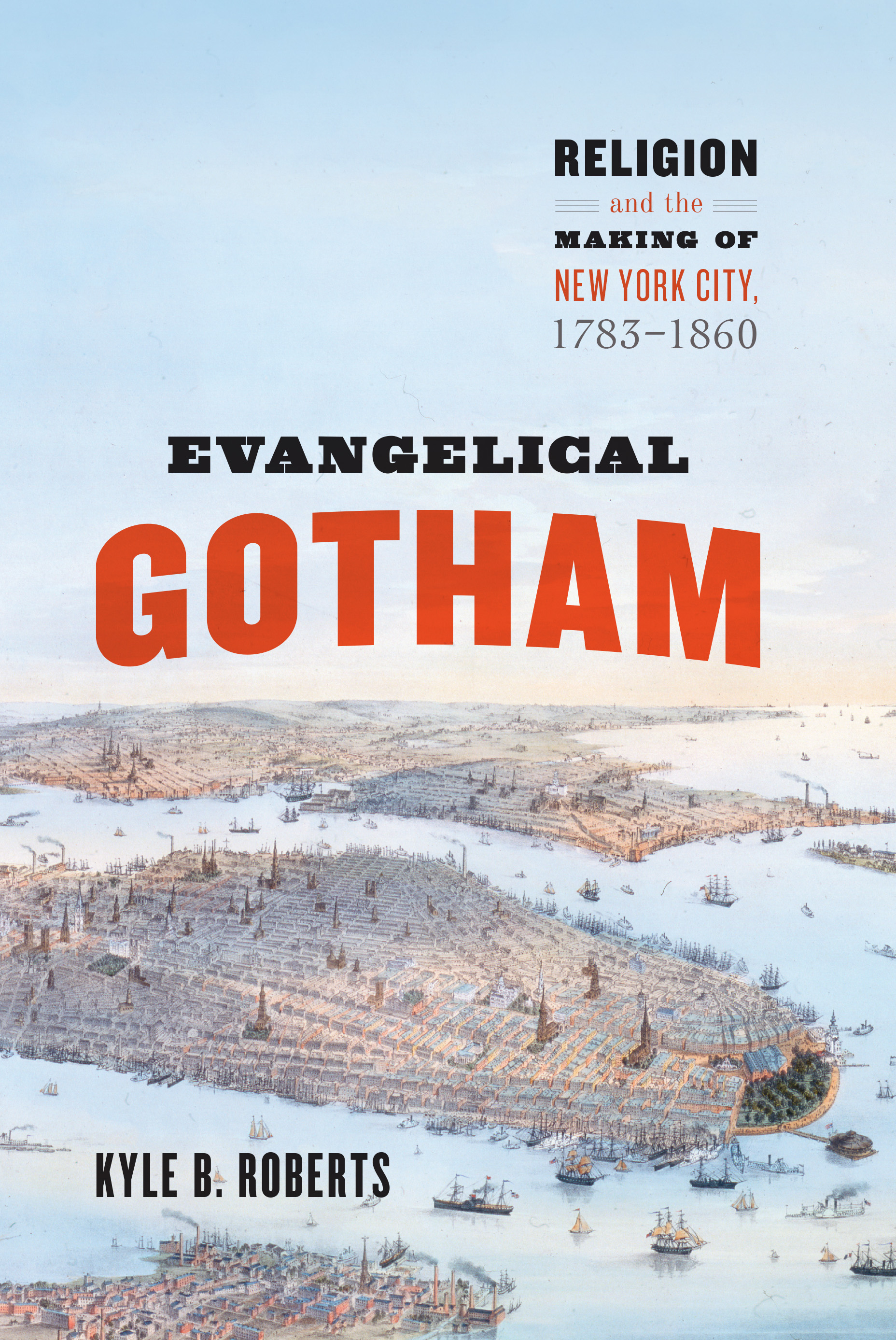
To conclude, I’ve always loved Michel de Certeau’s “Walking in the City” from The Practice of Everyday Life where he reminds us that to truly understand a city, we must go down from the height of steeple to the level of the street. It is in the daily movements and interactions of men and women, the “ordinary practitioners of the city,” that the city is constituted. I fully embraced that idea and spent much time looking closely at what I found down there. Catherine O’Donnell’s comments remind me however of my need to climb back up into the steeple, or better yet, to figure out where John Bornet secured his view of Manhattan in his panoramic birds’ eye view that adorns the cover of my book. John McGreevy, in his comments on the twenty-fifth anniversary of Parish Boundaries published in this blog a few months back, refers to this as the need to remember to come up for aid.  What can I say? Evangelical Gotham is a seductive place! But I wholeheartedly agree that pulling back to see the commonalities across time and space is essential. My journey through Evangelical Gotham has, in some ways, come to an end while it is just beginning for others. Fortunately for me, I am beginning my next journey with the rich reflections of four fellow travelers in my head and my heart.

spacer

On Maps, Faiths, and Works

This next post in our ongoing roundtable review of Kyle Roberts' Evangelical Gotham comes to us from Christine Croxall. A scholar of the religious histories of the Mississippi River Valley at the dawn of the nineteenth century, Crozall is a postdoctoral research associate at the John C. Danforth Center on Religion and Politics at Washington University in St. Louis. Her post is also the last in this series. Kyle Roberts' response will come tomorrow.

by Christine Croxall


Old St. Peter's Catholic Church
Huzzah for visuals! In Evangelical Gotham Kyle Roberts not only gives us woodcuts, drawings, and paintings of the meetings houses that dotted early Manhattan, but he also provides seven maps plotting New York houses of worship for the years 1790, 1810, 1823, 1828, 1834, 1845, and 1856. These maps and the series of congregation and membership tables in the appendix, I suspect, will become definitive data for early New York religion.

 The final chapter of Evangelical Gotham is, in my mind, the key to the entire project. The question it considers is not so much why did the stakeholders of a dwindling Methodist congregation come to fisticuffs in the street in 1856? but instead, what does the church's history tell us about evangelicalism's role in the expansion of New York City? Roberts traces how the members of John Street Methodist Episcopal Church rebuilt their meetinghouse in lower Manhattan, not once, but twice in the early 1800s, and then opted—after their public tussle—to stay rooted there rather than moving uptown with their Presbyterian and Baptist neighbors. In Roberts's telling, the John Street church is an exception that illumines a broader trend. By mapping congregations' proliferation and dispersal and contextualizing New York's church growth in relation to the city's economic and demographic expansion, Roberts offers a generative interpretation of religious developments in early New York.


One of the engines Roberts identifies for the burgeoning of urban evangelicalism in the early 1800s is revivalism—not a woodsy romp toward Zion (though camp meetings in rustic Long Island and up the Hudson at Sing Sing did energize some of the faithful), but instead a citified version featuring superstar preachers in local pulpits. Roberts argues these revivals propelled not only conversion and adherence but also urban reform and benevolence efforts. His analysis prompted me to wonder how we can determine causality in church membership. Did revivalism generate lasting religious commitments? Or was individual religious adherence based more on what a person did (or did not do) before and after the revival: going to prayer meetings, attending worship, reading devotional texts, collecting clothing for the indigent, being baptized? What kinds of experiences and practices most often fostered religiosity, and how might we measure and track these factors?

The interplay of actions and faithfulness connects to a refrain I noticed among New Yorkers who chose not to adhere to evangelicalism: a chorus of what the evangelicals would call works righteousness. The dying Deist who rationalized that he drank only moderately and honored the Sabbath by smoking with his neighbors instead of peacocking at church (74), the black man who believed his past sins wouldn't matter if he behaved better in the future (95), and the sick mariner who was "unconcerned about his soul" and had "always lived a moral life and needs nothing more" (106) frustrated their proselytizers by insisting that their behavior more than their beliefs were what mattered.

Catholics, of course, were the ones evangelical missionaries, preachers, and authors typically accused of prioritizing works over faith. Roberts describes the Catholic community in 1810 New York as "small, poor, and marginal, with only one parish" (74). (By 1855 they constituted eighteen percent of the total adult population, more than twice that of the evangelicals [Table A.4, 270-271].) This claim caught my attention. Yes, many of the Catholics were poor, particularly the Irish immigrants who constituted a majority of the parish of St. Peter's in 1810. But was the community so small or marginal? The priest of the parish estimated fourteen thousand Catholics in New York in 1808.  A social historian  mining the sacramental records from 1785-1815 has recovered a dynamic and engaged Catholic community comprised of Irish, French, German and African American residents.  As a scholar who studies how Catholics and Protestants in the early republic used the presence of religious competitors—that is, each other—to spur adherence among their own flocks, I am curious how viewing Catholicism as a true contender for the hearts and souls of early New Yorkers might shift Roberts's narrative of the first batch of evangelicals, the post-revolutionary generation.
spacer

Mapping the Women of "Evangelical Gotham"

We continue our series on Kyle Roberts' Evangelical Gotham with a post from friend of the blog and assistant professor of history at Colgate University Monica Mercado. Where prior posts honed in on the how cities and spaces fit into Robert's analysis, Mercado highlights the ways in which these concepts both mask and reveal gender.

by Monica L. Mercado

During the first weeks of my lecture course “Women in the City,” I introduce my undergraduate students to the complex geographies of lower Manhattan, or what the historian Kyle Roberts calls Evangelical Gotham. Sitting in a classroom in upstate New York, our windows facing the hills and valleys that made up the nineteenth century’s infamous “Burned-Over District,” we scrutinize early engravings of Five Points and other images of men and women navigating urban space in antebellum America.

The Five Points
With Evangelical Gotham: Religion and the Making of New York City, 1783-1860, Roberts reminds his readers that late eighteenth and nineteenth-century evangelical Protestantism -- so often understood as the rural camp meeting, a world away from the imagined depravity of the crowded, congested, “godless” city – was actually an urban phenomenon, deeply rooted in changing ideas of space and place. “Evangelicals,” he writes in the book’s Introduction, “positioned themselves well for the spiritual marketplace by rethinking what made space sacred and experimenting with new kinds of religious places.” Those places often lacked a steeple or set of pews -- recognizable markers of religious architecture in the expanding city grid. Instead, Roberts argues, his actors understood the sacred “to come not from the physical space itself but from the actions of believers.” Storefront churches, publishing houses, hospitals and orphanages could be, in Roberts’ words, reclaimed and reformed by men and women with evangelical agendas. (8)


Building on the foundational work of early women’s historians who located in postrevolutionary New York a new cast of characters reforming the city in their image, Roberts weaves the experiences of white evangelical women throughout this argument. [fn 1] In order to understand the world of Evangelical Gotham, Roberts suggests, we must pay careful attention to leaders such as reformer Isabella Marshall Graham -- whose Ladies’ Society for the Relief of Poor Widows with Small Children “transformed how evangelical New Yorkers thought about the women and men outside of their meetinghouses and inspired a rising generation to attempt to convert the city” (52) – and revivalist Phoebe Worrall Palmer, whose ministry embraced not only print and domestic missions, but also a weekly “Tuesday Meeting” for evangelical men and women held not at church, but in her own parlor on Rivington Street.

How might the historian of American religion visualize these spatial and spiritual conquests? In a series of carefully drawn maps of New York churches inserted throughout the text, beginning with 1790 and ending with an expansive 1856 city grid, Roberts marks only formal houses of workshop, and not the experiments with sacred space that are crucial to his narrative, such as Phoebe Palmer’s townhouse or the Ladies’ Society for the Relief of Poor Widows’ meeting rooms. If Evangelical Gotham is to rewrite the antebellum urban spiritual landscape, does the act of mapping obscure the spatial impact of religious women, whose ministries frequently took them outside of the church sanctuary? Evangelical women’s mobility – both real and imagined, in text and image – is nowhere to be seen when we place church addresses on a map. [fn 2]

 What would a more expansive mapping project look like? In many ways, our historical subjects have laid the groundwork with their extensive publishing operations. In my own research and teaching, for example, I have used the domestic missions of the American Female Moral Reform Society (AFMRS), founded in 1834, as an alternative map of nineteenth-century New York. In their own newspapers, tracts, and memoirs, the women of the AFMRS charted their involvement in new realms of responsibility and geography. My students are captivated by the memorial volume Walks of Usefulness: or, Reminiscences of Mrs. Margaret Prior, a collection of the activities of the Society’s first paid female missionary, who visited thousands of New York families and workplaces every year before her death in 1842. Prior’s vivid descriptions of urban life constitute a significant documentary history of antebellum New York, and the varied experiences of its working poor. Traipsing through “dark, filthy rooms,” “miserable abodes,” and “cold, damp basements,” Prior entered new neighborhoods, homes, prisons, brothels, and factories on a daily basis, determined to repair the degraded conditions of urban life with spiritual and material assistance. [fn 4]

Margaret Prior
 Like many of the other city missionaries Roberts chronicles in his book, Margaret Prior and the AFMRS exhibited an evangelical “mania for quantification. (86) Mobile and “scribbling,” women missionaries like Margaret Prior exemplify the Evangelical Gotham ethos, one that urges historians of American religion to expand our maps of the urban religious landscape. Could a reimagined map help us see how evangelical women missionaries experienced their mobility, and their calling, separate from men? What shape did their paths take – where did these men and women intersect, and where did they meet, outside of the churches? The missionary fervor of nineteenth-century voluntary societies adds new points on the maps of Evangelical Gotham, suggesting the creative possibilities of recentering the act of mapping around women’s movement through New York City. As Roberts writes, “Awakening often involved crossing out of one’s community and into another, which could happen as easily during a walk across the city as a voyage across the ocean.” (22)

Notes

[fn 1] See, for example (and as Roberts also cites), Carroll Smith Rosenberg, Religion and the Rise of the American City: The New York City Mission Movement, 1812-1870 (Ithaca, NY: Cornell University Press, 1971), Christine Stansell, City of Women: Sex and Class in New York, 1789-1860 (New York: Knopf, 1986), and Anne M. Boylan, On the Origins of Women’s Activism: New York and Boston, 1797-1840 (Chapel Hill: University of North Carolina Press, 2002).

[fn 2] Elsewhere, I have argued that evangelical Protestant missionaries and their voluntary societies found reason to portray Protestant women as special conveyors of the word. In tracts, missionary reports, and memoirs, images of evangelical women’s mobility circulated in print across the Protestant world, illustrating battles over religious literacy and women’s influence in nineteenth-century America.

[fn 3] Margaret Prior’s narratives are a terrific teaching tool in the undergraduate classroom. I often assign a selection of Walks of Usefulness reprinted as “A Moral Reformer Makes Her Rounds” in the women’s history collection Root of Bitterness: Documents of the Social History of American Women, second edition (Boston: Northeastern University Press, 1996), 198-203.
spacer

The Places of "Evangelical Gotham"

Today we continue our roundtable review of Kyle Roberts' Evangelical Gotham with a post from longtime RiAH blogger Lincoln Mullen. You can see the rest of the posts in this series here. 

by Lincoln Mullen

New York's churches 1845
from Roberts, Evangelical Gotham
 In his elegantly written account, Kyle Roberts takes his readers on a tour of Evangelical Gotham. The book has a strong chronological through line, explaining how evangelicals went through three distinct periods in bringing their message of conversion and reform to New York City (10--11). While the spatial organization of the book is less obvious from its table of contents, Evangelical Gotham is a book that is fundamentally organized around place. This may seem like an obvious point to make about a book that focuses on a single city, but my aim is to show how Roberts uses spatial concepts.
Evangelical Gotham is explicit in its debt to the concept of "crossing and dwelling" articulated by Thomas Tweed. Roberts makes this clear in his first chapter, where he writes about spiritual autobiographies at the end of the eighteenth and beginning of the nineteenth centuries. He takes a fresh approach to this topic by giving conversion narratives a meaning both in geographic and spiritual space. Evangelicals crossed religious boundaries by converting, but many of them did so at the same time that they were crossing the ocean or moving to the city. And once they arrived in New York, these newly converted evangelicals had to dwell not just in the city but also had to find a church or "community of faith" (27).

Geographic and spiritual space were thus experienced in mutually constitutive ways. This conjunction becomes a key to understanding much of the book, as does the emphasis on conversion. Conversion and other themes such as benevolence or reform recur throughout the book because they were perennial evangelical concerns. A real contribution of the book is the way that Roberts sets those concerns in relation to other questions such as denominational affiliation and worship practice. A key sentence comes in the conclusion, where he writes, "As denominational and sectarian choices proliferated, evangelicalism's appeal lay in the ease with which its small core of common principles could be incorporated into the matrix of beliefs and practices provided by them" (254). As any number of studies have told us, evangelicalism is a transdenominational movement focusing on conversion. Evangelical Gotham shows how people who held those evangelical convictions had to live them out in different churches competing within a single city. If most studies of evangelicalism are weighted towards crossing, then this book gives due emphasis to dwelling.
This book can also be understood in terms of the meaning of places. Geographers make a distinction between space and placeSpace is abstract location: the island of Manhattan, or the latitude and longitude coordinates that identify it. Place is the meaning that humans make out of space. This book shows how evangelicals made, or attempted to make, the space of New York into a religiously meaningful place. As he points out, for evangelicals "sacredness was understood to come not from the physical space itself," as it might for Catholics or Episcopalians who consecrated worship spaces, "but from the actions of believers who gathered there to hear the gospel preached" (8).

Other scholars have used that same concept, but Evangelical Gotham applies it a great many kinds of places. Turning different kinds of spaces into places that had meaning for evangelicals is thus a kind of analysis common to each chapter. Doubtless I have left out some of these kinds of places or movements, but a non-exhaustive list includes immigration into and out of the city; the locations of churches within the city and their movement over time; the domestic space of the home; the architecture of churches and the use of storefronts and homes as worship spaces; "mixed use" spaces put to both religious and commercial uses, not least the homes of benevolent organizations like the American Tract Society and American Bible Society; "bethel" services held on board ships; the commercial space of both the religious marketplace and the financial and consumer marketplaces; the grid of New York streets that controlled the placement of new churches and the expansion of evangelicalism; riots in the streets targeting abolitionist evangelicals; and networks of commerce and mission, expressed not least in networks of print.

The discussions in the book are under-girded by Roberts's maps, in which he plots the locations of churches over time and categorizes them by denomination and whether or not they were evangelical, and by his appendix, in which he gives membership figures for various denominations over time. This empirical work lets him claim that "evangelical congregations emerged from the margins to the center of the urban spiritual marketplace," eventually constituting 59 percent of churches (264). And it lets him claim that "the percentage of New Yorkers who had a conversion experience and joined an evangelical church increased steadily from 4 percent of the city's adult population in 1790 to 15 percent in 1855." These figures are also put to good use in showing whether congregations attracted new members via converting the lost or merely attracting existing evangelicals (173). This quantitative work is pursued with a rigor seldom seen since the work of Terry Bilhartz or Paul Johnson,

I do not wish to give the impression that the book is as laden down with theory as this review, because it isn't. And for that matter, the book touches on a great many topics, from abolition to the financing of churches, which I do not have space to discuss here. This book is likely to become essential reading for anyone wishing to understand early nineteenth-century evangelicalism or how religion functions in urban spaces. It seems to me that all of the contributions in the book are aligned to these questions about crossing and dwelling, space and place---just as evangelical churches and organizations were once aligned to the grid of New York streets.
spacer