Showing posts with label teaching philosophy. Show all posts

Undergraduates Actually Want a Liberal Arts Education

Andrea L. Turpin

Undergraduate students actually want a liberal arts education—when presented with the arguments for it. How do I know?

First, some background: this year the College of Arts & Sciences at Baylor University approved a unified core curriculum for all of its students, from physics majors to English majors. Like all human products, this specific core has its strengths and weaknesses. But I love working for an institution that values the liberal arts enough to require a large proportion of its students to take courses across a fairly broad range of subjects. In fact, several of the courses in the core are straight-up required—all students must take exactly those courses. The rest of the core consists of the more common “distribution list” system whereby students select courses from among several options in each area. After fulfilling the core requirements, A&S students complete their degree with a combination of electives and additional requirements for their particular major.

In the town hall faculty meetings leading up to finalizing the content of the core, I shared an exercise I have done with students four times now, stretching over nearly a decade. This exercise has yielded uniform and, to me, surprising results: undergraduate students really want a large liberal arts core curriculum. Let me explain.

Given my research interests, I like to work the history of higher education into my courses. It always proves popular because students rarely get it in their other classes and they find it so obviously relevant to their lives. I have managed to work this particular exercise into a course I taught once at Notre Dame on American reform movements and a course I have taught three times at Baylor on the Gilded Age and Progressive Era. Because of enrollment policies at both institutions, these classes all included a large number of students who were not history majors.

James McCosh
During a week spent teaching the massive changes to American higher education that occurred in the decades around 1900, I hold an in-class debate on whether a college curriculum should consist primarily of required courses or primarily of electives. Before class, I have students read the respective arguments advanced by James McCosh, president of Princeton (1868-1888), and Charles William Eliot, president of Harvard (1869-1909).


In brief, McCosh defended a more traditional, largely required liberal arts curriculum by arguing that not all courses impart the same level of mental training and, human nature being what it is, most students would elect the easiest courses if given the opportunity. McCosh added that many students only discover their talent for and interest in a subject during a course they would never have elected to take. Finally, he asserted that full human development requires fostering several different types of mental capacities, and true education requires a certain breadth of knowledge about the world. Meanwhile, Eliot defended a “new departure” in college education by boldly arguing for an entirely elective curriculum. He argued that students enter college with exposure from high school to a wide variety of subjects and already know their tastes and talents. They would dedicate themselves more to classes that genuinely interest them, and would thereby better learn the sorts of reasoning skills that can be actually be gained through any number of widely varying courses. Simultaneously, they would thus better directly prepare themselves for work after graduation.
Charles William Eliot

For RiAH’s readership, I should note a similar argument between these educators over collegiate religion. As I discuss in more detail in my book (along with their views on women's education!), McCosh defended requiring students to attend chapel—although you cannot make a horse drink, you have a moral obligation to lead him to water—whereas Eliot made chapel voluntary and sought to induce students to attend by filling the pulpit with a rotating supply of famous ministers.

In class, I assign students to teams and have them draw on McCosh’s and Eliot’s respective arguments to debate the nature of an ideal college curriculum. I then force students into an all-or-nothing choice—entirely required courses vs. entirely elective courses—and have them vote what they really think (as opposed to speaking for the side to which I had assigned them for the debate).

I have been asking students this question since Fall 2009 (with the most recent poll being Fall 2017) and the result always is the same. Every. Single. Time. Here it is:

50% vote for entirely required, and 50% vote for entirely elective. Let this sink in for a minute. Fully half of my students believe so strongly in the value of a robust liberal arts education that they are willing to give up all choice in the curriculum to get it. And the half that voted for an entirely elective curriculum does not actually find that forced choice ideal—they would prefer that some of the curriculum be required. After the initial vote, I let students choose between “greater than 50% required” vs. “around 15% required,” and it still comes out 50-50, although some students switch camps. It’s important to note we were debating requiring specific classes, not merely requiring selecting from distribution lists. So students were voting for greater than 50% of their curriculum being exactly defined.

Moral of the story: When they have a chance to think through the best arguments from educators of the past, students buy into the idea of a liberal arts core more than we think they do...even to the point where half of them don’t think 15% is enough and are willing to go with greater than 50% to get more. And even to the point where half of the them would recommend an entirely required college curriculum over one where nothing was required.

Although I am considerably more in favor of majors and electives than was McCosh, I believe that overall students benefit from a comparatively larger liberal arts core, for the reasons he advanced. It should be an encouragement to those of us who teach in what may be the ultimate humanities discipline—history—that when students hear those arguments, so many of them agree. We just need to share that history with them. Fortunately, that’s what we do well.

spacer

Incorporating Religion into the U.S. History Survey

Andrea L. Turpin

I’m trying something new this semester. After six years of teaching roughly the same books in my U.S. history survey class (1877-present), I’m changing most of them up. Yay for the time tenure provides! My motivation is two-fold. First, let’s be honest, I’m pretty sick of the ones I’ve got. They’ve worked great, but I teach this course every semester, and six years is a long time. But second, I also want to do a better job of incorporating religion into the course narrative.

This is perhaps an odd situation for someone who works at a religiously affiliated institution (Baylor). Nevertheless, while I’ve generally been happy with how I have integrated religious history into my upper-level courses, I’ve never quite found my groove with the survey. (So many topics! So little time!)

One problem is, of course, the textbook. I’ve noted in a previous post the surprising similarities I’ve found teaching fundamentalism and teaching feminism. Well, I’ve also found a similarity between how textbooks handle religion and how they handle women: the dreaded sidebar. (And don’t even get me started with how they (don’t) handle the history of education, or science….)
 
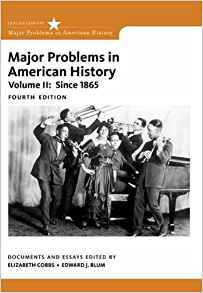
A notable exception is the most recent (4th edition) of the document reader Major Problems in American History, Vol. II: Since 1865, edited by Elizabeth Cobbs and Ed Blum. They purposefully incorporated more primary and secondary sources on the subject of American religious history into this edition with the result that the book is now one of the best for this topic. But I am experimenting with going without a document reader, so I was still left with the textbook problem.

I asked colleagues for their syllabi and discovered one main way to tackle the marginalization of religion in the American history survey is simply to assign a regular textbook and then use book-length primary or secondary sources on religious history as supplements. For example, I’ve heard positive reports from colleagues who have taught the U.S. history survey and assigned Barry Hankins' Jesus and Gin: Evangelicalism, The Roaring Twenties, and Today's Culture Wars, Charles Marsh’s God’s Long Summer: Stories of Faith and Civil Rights, or Darren Dochuk’s From Bible Belt to Sun Belt: Plain-Folk Religion, Grassroots Politics, and the Rise of Evangelical Conservatism.

In the end, I decided to experiment with a different direction. First, I’m trying out an unusual textbook, Unto a Good Land: A History of the American People, Vol. 2: From 1865, written with the explicit intention of incorporating religion well into the narrative of U.S. history. It employs sidebars, to be sure, but also weaves religious history into its treatment of other topics. A drawback is that it has not been updated since 2005, so needs to be supplemented with subsequent scholarship.

Second, I chose additional book-length readings that took a similar approach. They are not about religious history per se, but all incorporate it as a significant element: Timothy Gilfoyle's The Urban Underworld in Late Nineteenth-Century New York: The Autobiography of George Appo with Related Documents from Bedford St. Martin’s Series in History and Culture; Melton McLaurin’s Separate Pasts: Growing Up White in the Segregated South; and Donald Critchlow’s Phyllis Schlalfy and Grassroots Conservatism: A Woman's Crusade (which I’ve used before). Appo was the son of an Irish immigrant and a Chinese immigrant. He lived a life of crime before becoming a Progressive reformer, and he reflects on the place of religion in the lives of both prisoners and reformers. McLaurin similarly offers poignant reflections on the intersection of religious and racial ideals in his native North Carolina in the 1950s. And Schlafly’s Catholicism weaves throughout Critchlow’s narrative, though its focus is politics.

It should be noted that I’m also assigning various brief primary sources and Jill Lepore’s The Secret History of Wonder Woman. Because Wonder Woman.

I’m hoping that using this new collection of books will enable students to walk away with a sense of the connections between religious history and other aspects of American life. I will report back after this semester on how the experiment has gone! In the meantime, I’d love to hear from others what approaches you have found work well for incorporating religious history into the U.S. history survey.


spacer

Fundamentalism, Feminism, and Other Curse Words: Teaching Controversy with Civility

Andrea L. Turpin

Every semester I tell my history students the same bad joke: fundamentalism and feminism are actually a lot alike—they are both f-words that we hurl at our political enemies depending on which side of the spectrum we’re on. Which is to say that for the average American these words function not according to some dictionary definition but rather as a catch-all insult for someone too far to the right or the left, respectively.

In fact, my informal polls of students, friends, and random people who will answer my questions indicate that there is no widely agreed upon definition of either word in common parlance. I am one of those relatively rare Americans who runs in both blue and red circles, so while my polls aren’t scientific, they do actually capture a bit of the breadth of perspectives on these concepts. So I’ve learned that when teaching my feminist-leaning students about fundamentalism or my fundamentalist-leaning students about feminism, I first have to cut through a great deal of highly charged emotion. A few different approaches have proved fruitful.

First is simply helping students become aware of the functional definitions of these words that they are carrying around in their heads. For example, I will ask my classes for their associations with the word “feminism.” I get a lot of answers similar to the ones Kristin Kobes Du Mez enumerated in a recent blog post on common misconceptions about feminism. Most associations are negative, with “man-hating” leading the pack.

I then share with students some of the reforms that have been advocated by women and men who have identified as feminists and that I suspect students would all support—things like women’s suffrage and equal pay for equal work. (Most are shocked to learn that employers have only been required to pay men and women the same for the same work since 1963!) We talk about the fact that feminism itself is a wide spectrum encompassing many different viewpoints and attitudes. As Du Mez points out, there is as much variation among those who own the word “feminist” as among those who own the word “Christian.”

I have found that I need to address one particular issue directly: the contemporary association of feminism with the pro-choice movement. When proving to my students that the word “feminism” means different things to different people, I ask them to envision two hypothetical people, one of whom would say “I am a feminist” and one of whom would say “I am not a feminist.” Then I tell them that both people believe exactly the same things. They both believe that women are still at a social and legal disadvantage in this nation and that making the necessary changes should be both a personal and a national priority. They both believe, for example, that the United States should institute paid maternity leave and that more women should run for Congress so that women’s particular needs and interests are better represented among lawmakers.

Then I add that both of these hypothetical people are pro-life, perhaps believing that human life starts at conception, and thus viewing unborn women as deserving legal protections too. The first person thinks of himself or herself as a “pro-life feminist,” but the second rejects the feminist label entirely because of its association with the pro-choice perspective. And then I tell students that we could equally envision a person who holds all the preceding beliefs but is pro-choice, perhaps believing that to force a woman to carry a child would be intolerable state coercion—and who still rejects the label “feminist” because in his or her social circle it carries man-hating connotations.

A second approach to cutting through students’ instinctive emotional reactions is introducing them to the stories of real, flesh-and-blood, complicated people who identify as feminists or as fundamentalists. For the latter, probably the most helpful text I’ve found to use in class is James Ault’s Spirit and Flesh: Life in a Fundamentalist Baptist Church. Ault wrote up his experiences as a participant-observer sociologist in a fundamentalist church in the 1980s where he was seeking to understand why some women rejected the feminist movement. A feminist himself, Ault was not ready to chalk up these women’s perspective to false consciousness, so he wanted to better grasp their logic.

This book teaches really well because it reads like a novel, complete with plot twists and a surprise ending. But most importantly, Ault succeeds in portraying his subjects sympathetically, in all their human complexity. And he advances a theory that makes for good classroom debate: he claims that in certain types of communities women experience fundamentalist teaching on gender roles as improving their lives and perceive feminism to threaten those improvements, whereas in other types of communities the opposite proves true. (I also highlight for students that historically the term “fundamentalist” refers to someone who believes certain aspects of Christian doctrine are necessary for the eternal salvation of literally everyone. Thus, at their best, fundamentalists or other conservative Christians who fight to preserve those beliefs—or the gender roles they believe follow from those convictions—see doing so as an act of love.) A bonus to teaching Ault's book is that he further brings his subjects to life in the documentary film Born Again, which adapts readily to the classroom because the DVD contains both a 60- and a 90-minute cut.

Another book I’ve found helpful in the classroom is Donald Critchlow’s Phyllis Schlafly and Grassroots Conservatism. Critchlow does an excellent job of articulating the inner logic of both liberalism and conservatism in the second half of the twentieth century. Accordingly, he helps students understand how people of genuinely good will could reach opposite conclusions about how best to address the nation’s problems. Indeed, simply learning about Schlafly stretches the minds of both conservative and liberal students—conservative students see a woman who shares their views but worked more than 40 hours a week outside the home, and liberal students see a woman vehemently opposed to their views who nevertheless embraced the belief that women had a responsibility not only to the home, but also to the nation.

I sometimes supplement the relevant passages in Critchlow with Jonathan Haidt’s system for understanding liberal vs. conservative moral instincts, as laid out in The Righteous Mind. Haidt is particularly good at articulating how conservatives and liberals each more easily perceive different threats to the social order earlier than the other. Thus, regardless of which system we believe to be more effective overall at achieving the common good, liberals and conservatives are both wise to ask what the other camp may be seeing that we are blind to—and to tweak our own policies accordingly. I admit I’ve found it difficult to figure out which passages from Haidt to excerpt, so I typically just incorporate his insights into my lecture and refer interested students to the book for further reading (some take me up on it!).

As I tell my students, my ultimate goal is not necessarily for them to change their political convictions. Of course, I certainly have my own opinions on how best to achieve the common good, so I am not indifferent to what they believe! But for the purposes of the course, my goal is for class members to be able to sympathetically articulate the logic behind various political and religious positions.

I explain that by “sympathetic” I mean not that they necessarily agree with someone else’s position, but rather that they are able to articulate it in terms that person would agree with. Not only is doing so basic “golden rule” decency, I tell them, but it’s also ultimately the most effective technique for changing someone else’s mind. In political or religious debate, everyone is protecting something they perceive to be of value. Only by acknowledging the best in what the other person is trying to protect can we hope to persuade our conversation partner that there might be a better way to accomplish that goal, one that does not simultaneously threaten other goods.

And just in case I haven’t sufficiently sold students on the benefits of tabling their emotions long enough to listen carefully to those with whom they disagree, I casually mention that explaining each controversial position will be on the final. Whether they have indeed expanded their mental worlds, or whether they just want the A, I am pleased to report they do pretty well.
spacer

Fun with Polygamy, or, "A House Full of Females" & the Benefits of Teaching Mormon History

Andrea L. Turpin

I love Mormon history. I have found a way to work it into literally all the courses I have ever taught. I am neither a Mormon nor a historian of Mormonism, but I've discovered that teaching the history of the Church of Jesus Christ of Latter-day Saints brings to life so many aspects of nineteenth-century American history in a way that students always find gripping. Specifically, recounting the development of the LDS church during this era provides a fresh way to present topics as diverse as racial prejudice, Western expansion, revivalism and the larger significance of Protestant theological debates, changing gender roles, anti-Catholic prejudice, the utopian impulse, the expansion and contraction of the franchise, and debates over religious freedom, among others.

I teach in a history department, so an additional asset of Mormon history for me is that the church's formative years run from the publication of the Book of Mormon in 1830 through the renouncing of polygamy by LDS church president Wilford Woodruff in 1890. In other words, early Mormon history can be used in both halves of the US Survey course, whether you divide it at the end of the Civil War in 1865 or the end of Reconstruction in 1877.

I also teach at an institution (Baylor) where many students identify as Christians, so discussing Mormon history allows for class reflection about how historians treat faiths that believe that God has broken into human history in miraculous ways. Many students affirm that God raised Jesus from the dead on a specific date in history but dismiss Joseph Smith's assertion that the Book of Mormon is the result of digging up and translating golden plates whose location was revealed to him by the angel Moroni. Teasing out the similarities and differences between these historical claims makes for fruitful discussion.

Of course, a big part of why my classes are so interested in nineteenth-century Mormons is their practice of polygamy, or "plural marriage" as it was known. When I first started teaching in 2009 and asked undergraduates for their associations with Mormonism, the number one answer was Big Love--now it's Sister Wives. (Honorable mention in different years has gone to Mitt Romney, the Broadway musical The Book of Mormon, and "those guys in black suits.") Students' association of Mormons with polygamy makes LDS history especially useful for teaching women's history.


It is a truism in American women's  history that Quakers (the Society of Friends) led in the fight for women's rights in the nineteenth century, owing in large part to the peculiarities of their theology. They believed God had placed in all people an "Inward Light" that testified to the truth, so women and men were equally qualified to preach. Quaker women thus developed both the skills and the convictions to work for women's equality. As an intellectual historian, I love such a clear-cut case where beliefs affected practice! It makes sense to students too. But because Mormon theology taught plural marriage, it causes undergraduates cognitive dissonance when they learn that Mormons also led in some feminist reforms. In 1870, Utah became the second territory to grant women the vote (and the third state in 1896), and Mormon women embraced the national women's rights movement long before it gained wider popularity in the early twentieth century.

This cognitive dissonance can be productive. It makes students work harder to understand and develop empathy for people who are different from them, which is one of my chief goals for all my history courses. Another benefit is that students tend to think that their constellations of beliefs make inherent sense together, and the surprise of Mormon feminism helps them think more precisely about what their own ideas do and don't imply. Finally, their cognitive dissonance allows us to discuss how there are both objective and subjective components to what constitutes oppression--which sheds light on students' own experiences in contemporary religious traditions that place restrictions on women's roles.

Another thing that I have managed to work into (almost) all of my classes is the work of Laurel Thatcher Ulrich. I love everything that Ulrich has ever written, so sight unseen I put her new book, A House Full of Females: Plural Marriage and Women's Rights in Early Mormonism, 1835-1870 (New York: Knopf, 2017), on the syllabus for my graduate course this semester on Women, Gender, and Sex in American Religious History. It did not disappoint. With her characteristic human sympathy, Ulrich argues--or, more accurately, demonstrates in narrative form--that the communal impulse, both theological and practical, within the early LDS church served to build the habit of collective self-assertion among Mormon women. The book's title is a quotation referring not to a polygamous household, but rather to a gathering of the Women's Relief Society in the Fourteenth Ward Meeting House in Salt Lake City. This voluntary association of Mormon women, many in plural marriages, literally embodies the communal sensibilities that led them to join together in defense of their understanding of women's interests.

My graduate students really liked the book, by which they meant that they actually enjoyed reading it. Considering the book's length and their reading loads, this is no faint praise. They liked it because one of Ulrich's great skills as a historian is using sources creatively to tease out the fullness of what life was like for women in the past whose lives are less documented than those of many men. Thus, readers get a sense of walking with multiple individual frontier Mormon women through the specific ups and downs of their lives and end up forming a very real sense of human connection with them. In this case, Ulrich relied on the diaries, letters, poems, albums, society minutes--and, yes, quilts--of over twenty women and men in plural marriages to excavate their own thoughts about and experiences with the practice, and thus to make sense of how women could and did simultaneously advocate for plural marriage and women's rights.

Students noted that the drawback to Ulrich's inclination to let Mormon women and men speak for themselves is that she sometimes downplays the problems and contradictions that plague every individual and belief system. Some wished for greater treatment of Mormon racism and the problems of neglect and abuse that could arise in Mormon households. Still, Ulrich admirably highlights the emotional tensions experienced by both women and men in plural marriages, and she follows those who spoke out against it as well as those who defended it. The struggle all historians share between assessing our subjects and listening to them on their own terms made for productive class conversation.

So consider this post a plug for reading A House Full of Females and for mining the riches of Mormon history--both for its own significance and for the ways it can challenge students from other traditions toward greater empathy and toward greater reflection on their own heritage and beliefs. For my part, I will now be adding to my undergraduate lectures some of the women's stories that Ulrich has so painstakingly unearthed and so beautifully retold.

spacer