Showing posts with label conferences. Show all posts

Religious Internationalism at the Conference on Faith and History

Lauren Turek

To follow on Andrea L. Turpin's helpful recent post about Women & Gender presentations at the upcoming Conference on Faith and History, I would like to highlight presentations that will have some bearing on religion and international relations, broadly conceived. This includes panels or papers that touch on U.S. foreign policy, diplomacy, religious internationalism, foreign missionary work, war and society, and the like.

The Conference on Faith and History will hold its 31st biennial meeting on October 4-6, 2018 in Grand Rapids, MI. The theme of the conference is “History and the Search for Meaning,” and the full conference schedule is available here.

Panels and papers of particular interest to scholars of religion and internationalism include the following:


Thursday, October 4

Session 2: War, the Environment and the Fallout of Violence
Chair: William Katerberg, Calvin College

Papers:

  • “Environmental Impact of the Civil War in Syria," Kincaid Wurl, Southern Adventist University
  • “The National Park Service and the Story of the Buffalo National River: A Social Case Study of Environmentalism,” Coplea Donley, John Brown University
  • “The Inhibitions of War and Violence on Sustainable Development,” Karyn Ashley Spirek, Huntington University
  • “Khmer Rouge: A Traumatized Kingdom,” Jamie Conrad, Huntington University


Session 3: Making Peace and Ending Wars
Chair: Douglas Howard, Calvin College

Papers:

  • “Pol Pot’s Cambodia and Social Mechanism Used for Genocide,” Ellie Lawson, Huntington University
  • “The Iraqi High Tribunal’s Disruption of Nuremberg Legacy of Post-Conflict Justice,” Adele Duval, Eastern Nazarene College
  • “Peace for Cambodia?” Alexandra Seleyman, Huntington University

Session 8: Rebuilding in Europe from Rome to the Cold War

Papers:

  • “Controlling Their Emotions: How the Political Establishment Felt About Churchill,”Holly Holton, Huntington University
  • “The Practicality of Morality in International Politics: Vaclav Havel and the Larger World,” Paige Hungar, Covenant College
  • “Vaclav Havel: Building Democracy in a Post-Communist World,” Madison Morin, Eastern Nazarene College
  • “For the Good of Res Publica: Civic Virtue in the Roman Republic,” David Engstrom, Trinity International University


Session 10: Building and Rebuilding through Development, Human Rights, and Diplomacy
Chair: Kelli McCoy, Point Loma Nazarene University

Papers:

  • “Rethinking Models of International Development,” Malachi Wise, Huntington University
  • “The Failure of Diplomatic Relations between the United States and Japan,” Alana Bates, Huntington University
  • “A Communist Economic Miracle?” Alec Boyd-Devine, Huntington University
  • “Effectiveness of HUMINT in the Middle East,” Jordan Hayley, Liberty University


Session 14: American Foreign Policy and the Cold War
Chair: William Katerberg, Calvin College

Papers:

  • "Neither Saints nor Simpletons: Harry Truman, Anti-Catholicism, and the Nomination of a Vatican Ambassador," Christopher Estep, Eastern Nazarene College
  • “FDR, Churchill, and the Future of Postwar Indochina, 1940-1943,” Taylor Holliday, Huntington University
  • “Before Vietnam: Understanding the Initial Stages of US Involvement in Southeast Asia,” Jacob Mach, Bowling Green State University & Cedarville University
  • “India’s Complications with the Cold War,” Sarah Nelson, Point Loma Nazarene University

Session 15: History, War and Politics in England
Chair: Lisa Clark Diller, Southern Adventist University

Papers:

  • “The Steel Wall of England: The Curious Case of the English Knight during the Hundred Years’ War,” Mitchell Gehman, Liberty University
  • “Churchill’s Reign of Regrets: A Study of Wartime Leadership,” Claire Harvey, Huntington University
  • “The Politics of Terror: The British Cabinet and the Strategic Bombing Campaign of 1918,” Perry Colvin, Auburn University


Friday, October 5

Session 13: Christian Mission in the Non-Western World
Chair: Joel Carpenter, Calvin College

Papers:

  • "E.H. Broadbent and Brethren Missions to Russian Turkestan, 1900 and 1908," William Wood, Point Loma Nazarene University
  • “Faith and Friendship: The ‘affective cosmopolitanism’ of Charles Freer Andrews (1871-1940),” Bernardo Michael, Messiah College
  • “Harriet Newell’s Conversion to Usefulness: Understanding the Memoir that Contextualized American Women in Mission,” Hannah Nation, Gordon-Conwell Theological Seminary

Comment: Joel Carpenter, Calvin College

Session 14: Missionary Anxieties: Doubt, Empire, and Commerce in Nineteenth-Century British Missions
Chair: Jason Bruner, Arizona State University

Papers:

  • “‘Extending a Superior Light Farther than the Roman Eagles Ever Flew’: The Clapham Sect’s Influence in India," Ryan Butler, Baylor University
  • “‘Why Doest Thou Thus?’ Suffering, Failure, and Providence in Nineteenth-Century British Missionary Documents,” Kelly Elliott, Abilene Christian University
  • “Python Buys Sheep’s Farm: Using Non-British Sources on West African Christianity, 1850-1900,” Paul Grant, University of Wisconsin–Platteville

Comment: Jason Bruner, Arizona State University


Saturday, October 6

Session 34: “And He Must Win the Battle”: God and Nation in Twentieth Century England, Germany and the United States
Chair: Erik Benson, Cornerstone University


  • “The Power of a Hymn: Choral Singing Defining National Identity,” Ruth Dewhurst, Georgia State University
  • “Theodore Roosevelt’s Religious Support for World War I,” Benjamin Wetzel, Taylor University
  • “'Massive Retaliation’: Power and Morality in John Foster Dulles’ World,” John Wilsey, Southern Baptist Theological Seminary

Comment: Erik Benson, Cornerstone University


Session 38: Roundtable on Dale Van Kley's Reform Catholicism and the International Suppression of the Jesuits in Enlightenment Europe
Chair: Katherine van Liere, Calvin College

Participants:
Jeffrey D. Burson, Georgia Southern University
Andrea Smidt, Geneva College
Daniel Watkins, Baylor University
Comment: Dale Van Kley, Ohio State University Emeritus

Session 44: Christianity and Secularism in the Twentieth-Century United States
Paper:  "Catholic Conscience Language in the Secular Human Rights Revolution, 1970-1985"
Peter Cajka, University of Notre Dame

Session 50: Roundtable: New Perspectives on Religion in American Internationalism
Chair: Gale Kenny, Barnard College

Participants:
Emily Conroy-Krutz, Michigan State University
Mark Edwards, Spring Arbor University
Lauren Turek, Trinity University
Daniel Hummel, University of Wisconsin-Madison

Comment: Audience


Looking forward to seeing those of you who be attending the conference next week!



spacer

Women & Gender at the Conference on Faith and History

Andrea L. Turpin

I'm getting excited for the biennial Conference on Faith and History held this year at Calvin College in Grand Rapids, MI October 4-6. My anticipation is not only linked to the hope that this Texan will get to experience some Fall. It is also linked to the large number of promising papers on the program.

This year marks the conference's 50th anniversary and I look forward to hearing reflections on where the field has been and where it is going. Even more so, I look forward to seeing first hand where it is going. One of the things that is so promising about the papers is how much the conference has diversified since I first began attending exactly ten years ago. Every single time slot of panel presentations contains at least one paper on women's or gender history and a couple contain entire competing panels. Notably, the presidential plenary by my Baylor colleague Beth Allison Barr will incorporate women's history.

Equally encouraging is the range of these papers. Recurring topics include the intellectual history of thought both by and about women, the religious lives of women of color, and the religious lives of women from multiple traditions including Muslim, Jewish, Catholic, Mormon, and Protestant. (I should add that one notable omission is that there are no papers whose main topic is religion and sexuality.)

I have bolded the papers and panels on women's and gender history below. Enjoy!

Note: The careful reader will notice that I have not listed my own panels. I will be presenting on a roundtable Friday at 4:15pm on "Christian Scholarship for Such a Time as This: A Reassessment." Women's and gender history will play a significant role in the discussion but is not the main focus. I am also indulging another of my interests by serving as commentator for a fascinating panel Saturday at 2:30pm on "Religious Education as Cultural Transmission in Twentieth-Century America."


Friday, October 5, 8:00-9:30 a.m.

Session 3: Gendered Faith in Early America: Women as Civil Authorities, Moravian Missionaries, and Disabled Christians
Meeter Center Lecture Hall

Chair: Lisa Clark Diller, Southern Adventist University
  • “Flourishing Families or Spit-in-the-Face? Women, the Book of Exodus and Civil Authority in Colonial America,” Kristina Benham, Baylor University
  • “Hearing the Gospel in a Silent World: Disability, Gender and Religion in the Massachusetts Bay Colony,” Katherine Ranum, University of Cincinnati
  • “New Madrid Earthquakes of the Cherokee Nation: Women Shaken and Bonded,” Lucinda Yang, Baylor University
Comment:   Lisa Clark Diller, Southern Adventist University

Session 7: Christian Women and the History Profession
Prince Conference Center, Hickory Room

Chair: Loretta Hunnicutt, Pepperdine University
  • Nadya Williams, University of West Georgia
  • Meghan DiLuzio, Baylor University
  • Elizabeth Marvel, Baylor University

Friday, October 5, 10:00-11:30 a.m.

Session 9: Historical Thinking and Evangelical Institutions
Prince Conference Center, Willow West

Chair:  David Swartz, Asbury University
  • “The Role of the Christian Institution in the History of Evangelical Divorce and Remarriage,” Margaret Flamingo, University of Wisconsin-Madison
  • “What Has Grand Rapids To Do With Nashville? Christian Historians Examining, Enduring, and Engaging with Popular Christian Cultures,” K. Scott Culpepper, Dordt College
  • “Does Evangelical Pietism Undermine the Life of the Mind? The Case of Bethel College, Indiana, 1947-2017,” Dennis Engbrecht, Bethel College & Timothy Erdel, Bethel College
Comment:   David Swartz, Asbury University


Friday, October 5, 2:15-3:45 p.m.

Session 17: Sacred Texts in American History
Commons Annex, Room 214 (upper level)

Chair:  John Turner, George Mason University
  • “Reconfiguring the Archive: Women and the Social Production of the Book of Mormon,” Amy Easton-Flake, Brigham Young University & Rachel Cope, Brigham Young University
  • “The Practical and Poetic Pietist: John Quincy Adams and the Bible,” Matt McCook, Oklahoma Christian University
  • “’The Bible is Assumed’: The Great Books Movement and the Place of Protestants in the ‘Great Conversation,’” Fred Beuttler, University of Chicago
  • “The Enlightenment and Modernity in Carl F.H. Henry’s Account of Western Civilization,” Mike Kulger, Northwestern College
Comment:   John Turner, George Mason University

Session 18: Political Hope in the Age of Fracture
Prince Conference Center, Willow East

Chair: Michael Hammond, Taylor University
  • “‘That Unageing Spiritual Reality’: Kathleen Raine, Temenos and the Hope of Civilization,” Eric Miller, Geneva College
  • “This Town Ain’t So Bad: Spending Heavenly Eternity in Springfield with the Simpsons,” Paul Arras, SUNY Cortland
  • “Friendship and Culture War: Wallace Stegner’s Crossing to Safety and its Historical Moment,” Matthew Stewart, Syracuse University
Comment:  Jeff Bilbro, Spring Arbor University

Session 22: Teaching Islamic History and Culture in the Christian University
Commons Annex, Alumni Board Room (upper level)

Chair: Douglas Howard, Calvin College
  • “What has Baghdad to do with Jerusalem and Athens? Situating Classical Islam within the Western Tradition,” Anthony Minnema, Samford University
  • “We Speak for Ourselves: The Use of Oral History in the Classroom to Cement the Experience of Muslim Americans in the Broader Narrative of U.S. History," Amy Poppinga, Bethel University
  • “Fostering Humility and Hospitality through the Study of Jewish and Islamic Fundamentalisms,” Sarah Miglio, Wheaton College
  • “How do you Teach Honor Killings? Sufi Transgressive Piety, Lottie Moon, and the Benefits of Comparative History,” Annalise DeVries, Samford University
Comment:  Douglas Howard, Calvin College

Session 23: Legacies of the Protestant Reformation
Meeter Center Lecture Hall

Chair: Ron Rittgers, Valparaiso University
  • “Division in Unity: Historiography and the Legacies of the Radical Reformation, ”Joe Super, Liberty University Online
  • “Margaret Baxter: ‘Nursing Mother’ of Protestant Dissenters,” Seth Osborne, Southern Baptist Theological Seminary
  • “Theological Responses to the Synod of Dort in France” (in celebration of the 500th anniversary of the synod), Martin Klauber, Trinity International University
Comment:   Ron Rittgers, Valparaiso University


Friday, October 5, 4:15-5:45 p.m.

Session 25: The Mississippi Delta and the Long Civil Rights Movement
Prince Conference Center, Willow West

Chair: John Giggie, University of Alabama
  • “Seek the Welfare of the City Where I have Sent You,” Alicia Jackson, Covenant College
  • ““She was Counsellor and Advisor”: Black Women Fraternal Leaders in the Mississippi Delta, 1940s–1970s,” Katrina Sims, Hofstra University
  • “Fannie Lou Hamer as Organic Theologian, ”Jemar Tisby, University of Mississippi
Comment:  Paul Harvey, University of Colorado

Session 26: Vocation ‘Between the Times’: Catholic Women from Revolution to Council
Commons Annex, Room 214 (upper level)

Chair: Emily McGowin, Wheaton College
  • “Vocation ‘Between the Times’: A Rule for the Active Apostolate,” Laura Eloe, University of Dayton
  • “Vocation ‘Between the Times’: Mary as a Model for Catholic Mothers in the 1950s,” Annie Huey, University of Dayton
  • “Vocation ‘Between the Times’: A Mother and a Mystic,” Joshua Wopata, University of Dayton
Comment:   Emily McGowin, Wheaton College

Session 30: Historians as Social and Moral Critics
Meeter Center Lecture Hall

Chair:  William Katerberg, Calvin College
  • “History that Heals: Reflections on Canada’s Truth and Reconciliation Commission from a Settler Historian,” William Van Arragon, King’s University
  • "The Historian as Moral Critic: John Higham, Christopher Lasch, Andrew Bacevich," John Haas, Bethel College
  • “The Artist as Historian: Carrie Mae Weems and the Photographic Archive,” Elissa Weichbrodt, Covenant College
Comment:  William Katerberg, Calvin College

Session 32: Shifting Evangelical Identities in Secularizing America
Commons Annex, Lecture Hall C/D (lower level)

Chair: Brenda Thompson Schoolfield, Bob Jones University
  • “Earthrise: The Religious Politics of a Stamp and the Role of Conspiracy in the Era of Late 1960s Fake News and Its Implications for the Social Media Age,” Bobby Griffith, The University of Oklahoma
  • ““Last at the Cross, and First at the Resurrection”: Sam Jones’s Theology of Gender,” Anderson Rouse, University of North Carolina at Greensboro
  • “Billy Graham’s Northwestern Years (1948-1952) and Emerging Evangelical and Fundamentalist Identities,” Greg Rosauer, University of Northwestern–St.Paul
Comment:  Brenda Thompson Schoolfield, Bob Jones University


Friday, October 5, 7:00 p.m.

Presidential Plenary—Beth Allison Barr, Baylor University
Prince Conference Center, Great Hall
PAUL, MEDIEVAL WOMEN AND 50 YEARS OF THE CFH: NEW PERSPECTIVES


Saturday, October 6, 8:00-9:30 a.m.

Session 33: Defending Black Citizenship: African-American and White Christians on Abolition, Prohibition, and Lynching in the U.S. South and Borderlands
DeVos Communication Center, Bytwerk Theater (lower level)

Chair: Paul Harvey, University of Colorado
  • “Black Pastors Defending Black Bodies: Lynching and the Church,” Malcolm Foley, Baylor University   
  • “Religious Abolitionism and the Quest for African-American Citizenship in Cincinnati,” Scott Anderson, University of Mary-Hardin Baylor
  • “Defending Black Manhood: African Americans’ Religious (Anti-)Prohibition Activism,” Brendan Payne, North Greenville University
Comment:   Pearl Young, University of North Carolina

Session 40: Ideals of Womanhood in American Christianity
Meeter Center Lecture Hall

Chair: Margaret Bendroth, Congregational Library & Archives
  • ““Let any anxious and pious mother remember the perils, and the rescue of the son of Monica”: St. Monica as Female Exemplar in Nineteenth-Century Protestantism,” Paul Gutacker, Baylor University
  • ““I’m for the ERA”: Faith, Feminism, and the Active Politics of a Southern Baptist First Lady,” Elizabeth Flowers, Texas Christian University
  • “The ‘Noblest Career of All’: Housekeeping, Homemaking, and the Ideal of Evangelical Postwar Domesticity,” Adina Johnson Kelley, Baylor University
Comment:  Margaret Bendroth


Saturday, October 6, 10:00-11:30 a.m.

Session 42: Women, Race, and Authority in American Religious Movements
Meeter Center Lecture Hall

Chair: Jeanne Petit, Hope College
  • “Unexpected Scope for Work: Black Women Doctors and the Seventh-day Adventist Church,” Lisa Clark Diller, Southern Adventist University
  • “Women’s Protests at the American Presbyterian Congo Mission, 1916-1933,” Kimberly Hill, University of Texas at Dallas
  •  “Shaping Women of ‘Unsubdued Spirit’: Rebecca Gratz and Female Religious Leadership in Antebellum American Judaism,” Elise Leal, Whitworth University
Comment:  Jeanne Petit, Hope College

Session 47: Versions of Holiness: Saints and Nuns from Medieval England to Africa and the American West
Commons Annex, Room 214 (upper level)

Chair: Jennifer Hevelone-Harper, Gordon University
  • ““Present your bodies a sacrifice to the Lord”: The Physical and Spiritual Care of Nuns in Late Medieval England,” Elizabeth Marvel, Baylor University
  • “Constructing Houses in the American West: Candlelight, Bricks, and Communion,” Danae Jacobson, University of Notre Dame
  • “Women on the Move from a Global Perspective: A Gendered Analysis of Saints’ Lives in Medieval Ethiopia and Europe,” Anna Redhair, Baylor University
Comment:  Jennifer Hevelone-Harper, Gordon University

Session 48: Evangelical Uses of the Past
Prince Conference Center, Willow East

Chair: Jay Green, Covenant College
  • ““Everyone is a child of destiny”: Henrietta Mears and the Meaning of History,” Amber Thomas, University of Edinburgh
  • “Our City: History Creation and late Nineteenth-Century Urban Evangelicalism,” Andrew MacDonald, Trinity Evangelical Divinity School
  • “Conservative Resurgence or Conservative Takeover? Usable History at The Southern Baptist Theological Seminary,” Lisa Weaver Swartz, Asbury Theological Seminary
Comment:  Jay Green, Covenant College


Saturday, October 6, 2:30-4:00 p.m.

Session 52: Beyond the Voting Booth: Evangelicals and Race, Gender, and Memory
Meeter Center Lecture Hall

Chair:  Bill Svelmoe, St. Mary’s College
  • “Exhibiting Evangelicalism: Protestant Public Memory at the Billy Graham Center Museum,” Devin Manzullo-Thomas, Messiah College
  • “White Evangelicals as ‘a people’: The Church Growth Movement from India to the United States,” Jesse Curtis, Temple University
  • “Grooming Evangelical Womanhood: The Pioneer Girls and Gendered Identity,” Rebecca Koerselman, Northwestern University
Comment:  Bill Svelmoe, St. Mary’s College

Session 56: ‘For whatsoever things were written aforetime were written for our learning”: Christian Uses of the Past to Shape the Present and Future
Prince Conference Center, Willow East

Chair: Seth Perry, Princeton University
  • “Lost Cause Hagiography: Rewriting Saints Felicity and Perpetua as Southern Catholic Martyrs,” David Roach, Baylor University
  • “‘Crying out against Conditions’: Protestants and Labor, 1908-1940,” Tori Jessen, University of Alabama
  • “‘Beloved prostitutes and rough fishermen’: Appeals to the Early Church in the Emerging Church Movement,” John Young, University of Alabama
Comment:  Seth Perry, Princeton University

spacer

Do Catholic Historians Need to Define Catholicism?

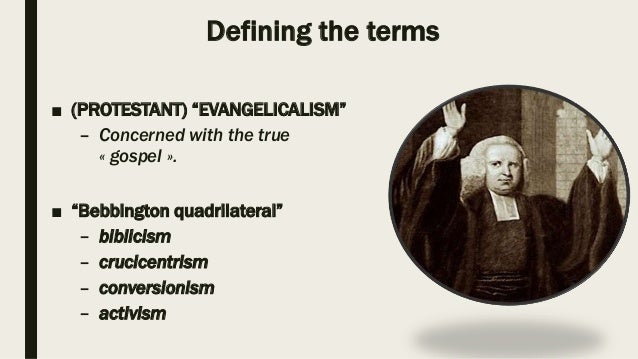
Image result for bebbington quadrilateralHistorians of evangelicalism are very interested in defining evangelicalism. It would seem obvious that scholars of a certain field would be dedicated to defining their object of study, but historians of evangelicalism go about this task with an admirable gusto. The act of defining is central to the field. Historian David Bebbington’s famous definition, the Bebbington Quadrilateral – evangelicalism as biblicism, crucicentrism, conversionism, and activism – has framed the conversation since 1989. As I listened to the excellent papers delivered by historians at the Noll Conference in March 2018, I began to wonder why Catholic historians do not seem so interested in defining their object of study, Catholicism.

Certainly we do not have quadrilateral. But should we have one?


Two answers to the question about the lack of enthusiasm for defining Catholicism pop up immediately. First, Catholicism does not appear to be as controversial in American politics, and as a result, the stakes of defining it are not as high. The conference suggested there is a pressing need to define evangelicalism in order to understand present day voting patterns. The second factor easing any pressure to define Catholicism is the structure of the Church itself. The centralized nature of the Church relieves scholars of the need to define Catholicism. At the conference I asked two colleagues who study evangelicalism why historians of Catholicism are not interested in definitions. Basically, the response I received was that the structure of the Catholic Church – a Pope and a hierarchy – means that less is up for grabs.

We should pause to ask if having a debate about the definition of Catholicism would be productive. I imagine some will think that having such a conversation would only serve as a distraction. But I found the debate about evangelicalism at the Noll Conference to be fascinating and generative. Is it a theology? Is it a politics? Is evangelicalism the media you consume? Is it a set of ideas? Is it worship? Is everyone who likes Billy Graham an evangelical? Is the scandal of the evangelical mind still scandalous?

It is possible to conclude that Catholic historians have been debating the definition of Catholicism implicitly in their books for years. The closest our field comes to The Scandal of the Evangelical Mind might be William Halsey’s classic study, The Survival of American Innocence: Catholicism in an Era of Disillusionment, 1920-1940. Halsey argued that a neo-scholastic worldview allowed Catholics to imagine themselves as existing outside the tragedy of twentieth century American history (the rise of ethical relativism, psychoanalysis, and subjectivity). It is tragic in Halsey’s tale, and rather a scandal, because the static mentality of Catholicism made it obtuse. Other scholars followed his lead and defined Catholicism as static because of the intellectual freeze brought on by the condemnations of Americanism and Modernism. But Halsey makes the important point that Catholicism could be construed as a set of mental categories. He does define his object of study. Jay Dolan’s work implied that only the methods of social history could move scholars of Catholicism closer to a useful definition of what they study. John McGreevy’s Catholicism and American Freedom would say Catholicism is an assent to a set of ideas. His Parish Boundaries would locate institutionalism at the center of what it means to be Catholic. His latest work on the Jesuits suggests any definition of Catholicism must consider the global. Robert Orsi’s work defines Catholicism as a religion of practice replete with longings for connections to the “real presence.” Relationships between heaven and earth are also at the heart this Catholic identity. As is gender, as works by Amy Koehlinger, Kathleen Sprows-Cummings, and Mary J. Henold make clear. The essays in Habits of Devotion on confession (James O’Toole), the Eucharist (Margaret McGuiness), prayer (Joseph Chinnici), and Marian devotion (Paul Kane) identify Catholicism as profoundly ritualistic and sacramental. Peter D’Agostino argues that Rome and trans-nationalism are key to defining American Catholicism. Younger scholars are contributing to this debate and taking it in new directions. Matthew Cressler has raised the question of how the definition of American Catholicism changes when we locate black Catholics at the center of our story. Catherine Osbourne’s new book suggests professionalism and professional identities are important to Catholic life in the twentieth century. Jack Downey makes the point that Americanization of Catholicism and its entrance into mainstream of American life should not stand as the ultimate end point for defining the men and women of the Old Faith. Not all Catholics wanted mainstream status because such an “achievement” entailed an ensnarement in modern materialism.

Catholic historians debate definitions of Catholicism without a central framing device.


This blog post raises the question of whether Catholic historians need a device like a quadrilateral to shape this debate and give it some structure. The question assumes, perhaps incorrectly, that scholars can, in fact, define Catholicism. It also pushes past any reservations about debating a definition rather than figuring out how Catholics shaped American History. But what if we synthesized the works in the field to produce a four-pronged definition?  What would rise to the surface if we made it goal to boil it all down to four categories? Or could we define Catholicism with a broader categorical move? Is it a theology? Is it a set of institutions? Is it an imagination? We might return to some classic sources written by theologians and social scientists. David Tracy’s Analogical Imagination or Andrew Greely’s The Catholic Imagination both spring to mind. Historians might walk the path hewn by the editors of the recently published The Anthropology of Catholicism: A Reader. Scholar of religion Kate Dugan, in her useful review, teases out the questions asked across the volume’s essays: “What counts as a Catholic idea and a Catholic person? Why does Catholicism continue to have influence the twenty-first century? If there is a Catholic imagination, or Catholic imaginations, who acts in it?” Historians of Catholicism might follow the lead of evangelical historians and these anthropologists and then ask a pack of similar questions. Then, of course, we should deliver a satisfying answer.


spacer

CFP: Newberry Seminar on Religion in the Americas

2018-2019 Academic Year
CALL FOR PROPOSALS
Submission Deadline: June 1, 2018
The Religion and Culture in the Americas Seminar explores topics in religion and culture broadly and from interdisciplinary perspectives including social history, biography, cultural studies, visual and material culture, urban studies, and the history of ideas. We are interested in how religious belief has affected society, rather than creedal- or theological-focused studies.


The Seminar provides an opportunity for scholars to share works-in-progress, and we encourage papers that use new methods, unveil archival discoveries, or need feedback in preparation for book and journal article publication. The seminar will meet on selected Fridays during the academic year, 3-5 pm, at the Newberry Library in Chicago, Illinois.

To submit a proposal, please visit our webform at https://www.newberry.org/seminar-proposal-form and upload a one-page proposal, a statement explaining the relationship of the paper to your other work, and a brief CV.
Applications will not be accepted via email.

If you are not at present interested in giving a paper but want to receive papers and participate in the discussion, please read our Registration Information found online. The Newberry is unable to provide funds for travel or lodging for presenters and respondents, but can assist in locating discounted accommodations.

For further information about Newberry seminars, please email scholarlyseminars@newberry.org

https://www.newberry.org/newberry-seminar-religion-and-culture-americas

The Religion and Culture in the Americas Seminar is co-sponsored by Albion College, the Cushwa Center for the Study of American Catholicism at the University of Notre Dame, University of Illinois at Chicago, and Wheaton College.

The Seminar’s organizers for 2018-2019 are: Kathleen Sprows Cummings, University of Notre Dame; Karen Johnson, Wheaton College; Malachy McCarthy, Claretian Missionaries Archives; Rima Lunin Schultz, Independent Scholar; and Kevin Schultz, University of Illinois at Chicago.

spacer

U.S. Women, Gender, & Sexuality Papers at the American Society of Church History

Andrea L. Turpin

I hope to see many readers at the annual conference of the American Society of Church History (ASCH) next week! This year the ASCH meets concurrently with the American Historical Association (AHA) in Washington, DC from Thursday, January 4 through Sunday, January 7. (Which is, as always, the day before our classes start at Baylor...) Specifically, ASCH panels meet at the Dupont Circle Hotel.


I am pleased to report that most time slots feature at least one paper on women, gender, and/or sexuality in U.S. religious history. Indeed, on Friday morning there are two entire panels on the subject that—unfortunately—conflict with each other. Nearly all the papers in this field this year focus on Protestants, but there are a large number that consider women and gender in American religion within an international context. Recurring themes include feminism and anti-feminism, the intersection of gender and race—and to a lesser extent class—women's religious thought (which makes my intellectual history heart happy), and, of course, women's roles within Christian communities. There are a few papers on masculinity and sexuality, and I would love to see even more in future years.

So, without further ado, I've listed below in bold the papers and panels explicitly featuring U.S. women, gender, and/or sexuality. Enjoy!

Friday, January 5, 8:30 AM – 10:00 AM
American Evangelical “Niche” Ministries and Religious Negotiation of the Postwar Era
Foxhall Ballroom (Ground Floor)

Chair: Darren Dochuk, University of Notre Dame
Papers: “‘Free on the Inside’: Evangelical Prison Ministry in the Age of Law and Order”
Aaron Griffith, Duke University Divinity School
“Piety, Pageants and Playing Indian: Gendered Identity at Summer Camps in the Postwar Era”
Rebecca A. Koerselman, Northwestern College

“‘There is talk of Black Power…it is time somebody talked about God Power’: Evangelical Sports Ministries and the Black Athlete in
the Long 1960s”
Paul Emory Putz, Baylor University
Comment: Neil J. Young, George Mason University

Friday, January 5, 10:30 AM – 12:00 PM
U.S. Protestant Women and Transatlantic Intellectual Cultures in
the Nineteenth Century
Dupont Ballroom B (Ground Floor)

Chair: Candy Gunther Brown, Indiana University
Papers: “Pious Mothers of the Early Church”: Antebellum Women
Historians and the Christian Past”
Paul Gutacker, Baylor University
“Southern Belle, Southern Metaphysician: German Thought and Augusta Jane Evans’s Gendered Apologetics”
Joel Iliff, Baylor University
“Seeing Farther: Mary Virginia Terhune Interprets Darwin for Her
Readers”
Sara S. Frear, Houston Baptist University
Comment: Margaret Bendroth, Congregational Library & Archives


Friday, January 5, 10:30 AM – 12:00 PM
Roundtable: White Protestant Women and the Feminist Movement: Critically Assessing Kristin Kobes Du Mez’s Katharine Bushnell
Georgetown Room (Second Floor)

Chair: Heath W. Carter, Valparaiso University
Papers: “‘The White Life for Two’: The Racial Origins of Sexual Purity”
Sara Moslener, Central Michigan University
“What is Feminism Outside a Mass Movement? ‘Evangelical Feminism’ and the Class-Conscious Feminist Movement It Rejected”
Janine Giordano Drake, University of Great Falls
“Katharine Bushnell, Pandita Ramabai, and the ‘World-Wide Sisterhood of Women’”
Anneke Stasson, Indiana Wesleyan University
“Contentious Women? The Response of Protestant Women’s Organizations to the Fundamentalist-Modernist Controversy”
Andrea L. Turpin, Baylor University
Comment: Kristin Kobes Du Mez, Calvin College


Friday, January 5, 1:30 PM – 3:00 PM
Feminism or Public Housekeeping? Liberal Protestant Women’s Work in the 20th Century
Dupont Ballroom A (Ground Floor)

Chair and Comment: Peter J. Thuesen, Indiana University-Purdue
University Indianapolis
Papers: “The Secularization of Women’s Role in Mid-Twentieth-Century Mainline Protestantism”
Margaret Bendroth, Congregational Library & Archives
“The Maternalist Theology of Margaret Mead”
Elesha J. Coffman, Baylor University
“Diaconal Maternalism”
Jenny Wiley Legath, Center for the Study of Religion


Friday, January 5, 3:30 PM – 5:00 PM
A Century of Activism in the Methodist Theological Tradition
Georgetown Room (Second Floor)

Chair and Comment: Morris Davis, Drew University
Papers: “The Worth of the Slave: Arguments for the Freedom of the Slave in Early Wesleyan Methodist Connection Poetry and Hymns”
Patrick Eby, Wesley Seminary, Indiana Wesleyan University
“Southern Methodist Women and the Social Gospel: Race Relations and Industrial Labor Activism in the Early Twentieth Century”
Chelsea Hodge, University of Arkansas
“The Methodist Episcopal Church and Birth Control”
Ashley B. Dreff, Hood Theological Seminary


Saturday, January 6, 10:30 AM – 12:00 PM
Making White Evangelicals: Racial Encounters and Religious
Identities in the Second Half of the Twentieth Century
Glover Park Ballroom (Ground Floor)

Chair and Comment: Randall Stephens, Northumbria University
Papers: “The Southernization of Evangelicalism: Religious Broadcasting and Massive Resistance in the 1960s”
Paul Matzko, Pennsylvania State University
“A Colorblind Campus? White Evangelical Colleges and Black Students in the Era of Civil Rights”
Jesse Curtis, Temple University
“‘That’s real manhood’: Promise Keepers, Racial Reconciliation, and Muscular Christianity”
Hunter Hampton, University of Missouri


Saturday, January 6, 1:30 PM – 3:00 PM
Foreign Missions, Domestic Consequences: A Roundtable
Glover Park Ballroom (Ground Floor)

Chair: Christine Heyrman, University of Delaware
Papers: “Missionaries Write the World: Reception of Foreign
Missionary Texts in 19th Century America”
Emily Conroy-Krutz, Michigan State University
“Ritualizing Human Rights: Protestant Churchwomen and the United Nations in the Postwar Era”
Gale L. Kenny, Barnard College

“World Disorder and American Protestant Political Mobilization in the 1940s”
Gene Zubovich, Washington University in St. Louis
“Heathen Resonances”
Kathryn Gin Lum, Stanford University

Saturday, January 6, 1:30 PM – 3:00 PM
The Body Social and Socialized Bodies in Puritan New England
Dupont Ballroom (Ground Floor)

Chair: Douglas Winiarski, University of Richmond
Papers: “The Haughty Daughters of Zion: Fashioning Early New
England”
Martha L. Finch, Missouri State University

“States in Motion: Social Justice, Distributive Justice, in Early New England”
Scott McDermott, Albany State University
“The freedom of this Body Politick”: Puritanism and the Problem of Godly Rule
Adrian Chastain Weimer, Providence College
Comment: James P. Byrd, Vanderbilt Divinity School


Saturday, January 6, 3:30 PM – 5:00 PM

Christian America and the Promise of Good Government
Foxhall Ballroom (Ground Floor)

Chair: Jennifer Graber, University of Texas, Austin
Papers: “I am FOR the ERA”: Faith, Feminism, and the Activist Politics of a Southern Baptist First Lady”
Elizabeth Flowers, Texas Christian University

“Nelle Morton, Southern Christian Activism, and Making the Best of Bad Government”
Alison Greene, Mississippi State University

“‘They thought the world had ended, and they thought it was their doom’: How Midwestern Christians Made Sense of the Crises of the
1930s and Came to Terms with Federal Aid.”
Randall Stephens, Northumbria University
“‘We the People of the Brawley Migratory Farm Labor Camp,’
Re-Constituting American Religions on the Margins of the Nation”
Jonathan Ebel, University of Illinois
Comment: Heather Curtis, Tufts University

Sunday, January 7, 11:00 AM – 12:30 PM
Mormonism and its Institutions
Georgetown Room (Second Floor)

Chair: Sonia Hazard, Franklin & Marshall College
Papers: “A Compromise to Save the University of Utah”
Brian Ricks, Independent Scholar
“Three Decades of Change in the Institutional Support of Mormon
Women’s History”
J. B. Haws, Brigham Young University

Comment: Audience

Sunday, January 7, 11:00 AM – 12:30 PM
Norms and Movements after World War II
Dupont Ballroom (Ground Floor)

Chair: Elizabeth Flowers, Texas Christian University
Papers: “‘For such a time as this’: The Esther Motif, Providence, and Evangelical Political Engagement after World War II”
Amber Thomas, University of Edinburgh

“‘Keeping the Lines of Communication Open’: The Malone Consultations and the Limits of Neighborliness in American Protestantism
in the Mid-Twentieth Century”
Devin C. Manzullo-Thomas, Messiah College
“The Catholic Church and the Discourse of Development, 1945-1967”
Joshua David Bishop, Fordham University
“‘Most Outstanding Pastor’s Wife’: Competition, Southern Baptists,
and Ideals of Femininity in the 1950s”
Adina Johnson, Baylor University

Comment: Audience

ADDENDUM: Here are some affiliate sessions on the topic that look excellent (and expand the field beyond Protestantism):

American Catholic Historical Association 12: American Catholic Sexual Revolution
Saturday, January 6, 2018: 8:30 AM-10:00 AM
Executive Room (Omni Shoreham, West Lobby)

Chair: Monica Mercado, Colgate University
Papers: "The Cultural Margin of Faith: Ingrid Bergman, Anna Magnani, and Alternative Portraits of Catholic Women in Postwar Film"
Anthony Smith, University of Dayton
"Sex, Catholic Style: The Sexual Revolution, Women’s Liberation, and Marriage Magazine, 1960–75"
Mary Henold, Roanoke College
"The Spiritual Side of the Gay Rights Struggle: The Case of Dignity/New York"
Thomas F. Rzeznik, Seton Hall University
Comment: Monica Mercado, Colgate University


Conference on Faith and History 2: Roundtable Discussion: Writing Women’s Religious Biography
Saturday, January 6, 2018: 10:30 AM-12:00 PM
Lincoln West (Washington Hilton, Concourse Level)

Chair: Heather Hartung Vacek, Pittsburgh Theological Seminary
Comment: Kristin Kobes Du Mez, Calvin College , David Holland, Harvard Divinity School , Nancy Koester, independent scholar and Matthew Avery Sutton, Washington State University


spacer

Democracy, Higher Education, and the Problem of the Common Good

Andrea L. Turpin

A month ago I attended two national conferences on back-to-back weekends: the Society for U.S. Intellectual History (USIH) met October 26-29 in Dallas, TX and the History of Education Society (HES) met November 2-5 in Little Rock, AR. A week and a half of intensive immersion in the current scholarship of two overlapping fields made some common themes jump out. (And also produced fascinating insights into the variable quality of Marriott hotels. But I digress.)

Specifically, I was struck by historians' interest in two topics: the concept of the common good and the problem of how values are, or are not, transmitted to the next generation. I suspect these themes jumped out at me in part because they seem so salient in the current widespread breakdown of civil dialogue. Both of these lenses prove helpful for producing a clearer understanding of U.S. history, especially U.S. religious history—and for seeing how best to frame that history for our students today.

The question of the common good was raised most forcefully in a pair of book panels, one from each conference. USIH dedicated a plenary session to James Kloppenberg’s monumental work Toward Democracy: The Struggle for Self-Rule in European and American Thought (Oxford, 2016). A fair amount of the panelist and audience questions revolved around the role of religious beliefs, past and present, in forming and sustaining democracy. In answer to one of these questions, Kloppenberg articulated his conviction that some conception of the common good is necessary to ground democracy; otherwise politics becomes a zero-sum game. He asserted that historically democracy in the North Atlantic world grew in large part from Jewish and Christian roots—but that most religious and moral systems advocate some version of the golden rule that provides democracy’s necessary ethic of reciprocity. Therefore, democracy can certainly thrive in a climate of religious pluralism, but he fears it might not survive a devolution of belief in our responsibility as individual citizens to advance the common good. (Though Kloppenberg noted that he is by temperament a cautious optimist about our nation’s ability to rally around this ideal more robustly in the future.)


The question thus arises how past generations of Americans have successfully produced a commitment to the common good—and how we can do so again today. A partial answer comes from the book panel hosted by HES the next week on Charles Dorn’s For the Common Good: A New History of Higher Education in America (Cornell, 2017). Dorn’s book examines the different purposes higher education has served throughout American history—but notes that inculcating civic-mindedness has been present throughout. Instilling in students concern for the public welfare has, however, often been eclipsed by competing purposes. Those he details are the ideals of practicality, commercialism, and affluence. In other words, higher education has frequently been largely valued as an avenue to some sort of worldly success—which makes sense, considering how expensive it can be in terms of both money and time. Nevertheless, the existence of a through line of commitment to the common good among higher educational institutions throughout American history provides a rich heritage for contemporary colleges and universities to draw on.

Dorn also served as one of the commentators for the HES panel on my book, A New Moral Vision: Gender, Religion, and the Changing Purposes of American Higher Education, 1837-1917 (Cornell, 2016). He rightly noted that I too perceive the question of the nature of the public welfare to have loomed large in the educational debates that underlay our current college and university landscape. He put the question to me of whether the common good was solely in the eye of the beholder during the fractious discussions about the respective roles of gender, religion, and class in higher education that I analyze—or whether there was some criteria that educational founders, leaders, administrators, and boosters could have used to better adjudicate competing claims.

In many ways this is THE question I believe we have to answer as educators today. I responded that for past educators it seems to have been relatively easy to agree that colleges and universities should serve the public good, less easy to agree on the exact nature of that good, and harder still to agree on how to achieve it. Specifically, I think it is fair to say that both past and present Americans have agreed on many common goods plural, but that it has been much harder to agree on their ranking, and hence on which policies, both educational and political, best serve the nation. Additionally, my findings led me to conclude that it is nearly impossible for any one type of institution to do equally well by all types of students. The institutional pluralism of modern American higher education thus indeed seems best for a pluralistic nation. Yet if all these institutions seek to orient their students toward a common good—even if they do not agree on its exact nature—graduates will be primed for the process of democratic discussion.

But how can we know if students have internalized the moral vision their institutions have cast? I care about this question both as a historian and as an educator. I venture an answer in my book with respect to the institutional histories discussed there, but I also note that the question is notoriously difficult. I was therefore delighted to hear scholars at both conferences wrestling with the question of transmitting values. This theme was rarely the topic of an entire panel, but frequently appeared within individual papers. Collectively these papers indicate that attempts to transmit values to the next generation have often been mediated by educational institutions, religious institutions, or both. They have likewise been bound up in the tension between serving a particular religious community and serving the wider community:

Pete Cajka noted how the nineteenth-century U.S. Catholic school system sought both to preserve the faith and to form citizens. Benjamin Park noted how both Catholics and Mormons of that era shared a concern to stabilize American democracy by grounding Christian values in a religious hierarchy that could constitute a court of final appeal throughout time. I highlighted in my USIH presentation considerable concern within early twentieth-century mainline churches for how to retain the involvement of a new generation of college-educated women who were finding more opportunities for their talents outside the church. John Compton examined how J. Howard Pew’s father tightly controlled his education to inculcate in him a more conservative view of the relationship between Christianity and economics than characterized the bulk of his fellow Presbyterians. Daniel Williams noted how mid-twentieth century mainline apologists sought to defend Christianity not primarily for its own sake, but rather because they believed its values sustained the democratic political order.  Mario Rewers determined that students of the pioneer American studies classes actually valued and internalized their intended lessons in critical thinking. Elesha Coffman described how Margaret Mead wrestled with the problem of revising the baptismal liturgy of the Episcopal Church: if it changed too much, it wouldn't pass on the essence of the faith to the next generation, but if it didn’t change enough, that new generation would refuse to receive it. Matthew Bowman discussed how Robert Bellah’s concern with cults—very successful at transmitting their values and beliefs—focused on their separatist lack of interest in the common good. And Milton Gaither detailed what factors have correlated with successfully transmitting religious beliefs to the next generation and analyzed why the contemporary homeschooling movement did not actually succeed in doing so at a higher rate than average.

So where does all this leave me in my dual roles of historian seeking to understand changing American religious and moral values and educator seeking to instill in my students a desire to pursue the common good? I would say these conferences have challenged me to think more carefully in my own scholarship about how generational continuities and changes occur within educational and religious communities. And they have encouraged me to frame my teaching even more clearly around the pursuit of a common good throughout American history.

Perhaps there is hope: I stole an end-of-semester exercise from my colleague Elesha Coffman and asked students to list (anonymously) one thing they’ll do differently as a result of the class. Student answers included: “After this class, it will be easier for me to understand/appreciate others’ opinions,” “I cannot allow assumptions, fear, or ignorance to cloud my perspective,” “Be careful when discussing certain topics and always do my research first,” and, finally, “What I will do differently is analyze presidential candidates from a more unbiased, neutral perspective rather than putting them exclusively in the box of their political party.”
spacer

Religion at the Ninth Annual Meeting of the Society for U.S. Intellectual History


Image result for 9th annual s-usih conference
I did not attend all of the panels on religion at the Ninth Annual Meeting of the Society for U.S. Intellectual History. My brief reflections here are in response to the panels I did attend (including my own) but I also make mention of the many projects of interest to our readers. I left with two questions and bring attention to two trends.

 S-USIH offers a space for historians of religion from various organizations – the ASCH, the ACHA, the AAR, etc.  – to meet and explore common interests. The common thread at the 9th Annual S-USIH is an interest in how the study of religion overlaps with the study of thought more broadly.


Two Questions: Synthesis and Lived Religion

Related image
The Mapparium 
Can intellectual history provide us with tools to build a coherent narrative of America’s religious history even in the face of tremendous pluralism? What themes can intellectual history offer historians of religion? Panels offered familiar conceptual devices to gather religion under the umbrella of “Civil Religion” or “The Public Sphere.” Papers approached these canopies from a diversity of angles. Sarah Georgini considered the message sent by the Christian Scientists with the construction of the Mapparium. Her paper made the important point that the craftsmen and architects who labored to materialize a religious vision are the subjects of American intellectual history. David Mislin examined the concept of evil in liberal Protestants’ midcentury theology. Rachel Gordon analyzed middlebrow Jewish literature published in the 1940s and 1950s, weighing its effects on Jewish citizenship. In a panel on Civil Religion, audiences explored John Foster Dulles’s Manichean worldview (John D. Wilsey); the supra-national thought of Jerry Falwell (James M. Patterson); Congress placing “In God We Trust” on its rostrum to spite the Supreme Court’s decision in Engel v. Vitale (Fred W. Beuttler); Protestants and Catholics using human rights language to shape politics in Latin America (Lauren F. Turek); and a linguistic analysis of American exceptionalism from George W. Bush to Barack Obama (Hilde Eliassen Restad). Pluralism, one of the cornerstones of our field, was on full display in Dallas. Panels ran across the denominational (Presbyterians, Jews, Catholics, Christian Scientists) and trans-denomination (evangelical, liberal protestant) axes. Panels also implied that “anxiety” and “crisis” shaped religious life in the US. A panel featuring Daniel Williams, John Compton, and Benjamin Leavitt – chaired by Molly Worthen – considered mid-century religious thought in an “Anxious Age.”

Image result for congress rostrum in god we trust
In God We Trust, Congress's Rostrum 
We might permit ourselves a moment to dwell on the ability of intellectual history to bring the congeries of religious history under a synthetic roof.  All of these religions enter into public space from their own institutional positions. Hence, there is utility in bundling religion into a broader Public Sphere or a Civil Religion.


We might also dwell on how religious pluralism feeds into the broader theme of “The Culture of Democracy.” James Kloppenberg’s Toward Democracy makes the case that the ethical teachings of Christianity, and the small Protestant towns of New England, facilitated the rise of our current democratic political horizons. Papers by Benjamin E. Park, Matthew Bowman, and Lily Santoro considered “Protestant Democratic Culture,” “Civic Religion,” and the concept of “Fit Christian Citizens.” My own paper looked at how Catholics fit into culture of democracy: culture, meaning a series of practices, ideas, and ideals to work towards.Gale Kenny ended a roundtable on the state of the field of religious history with a provocative question: is US Intellectual History Protestant history? 

How will intellectual historians address the issues raised by historians of lived religion? The theory of lived religion – and its emergence out of archival sources – poses a serious epistemological challenge to intellectual historians. Cultural history dwells on the incongruous nature of religion or its eclectic nature. Religious thoughts are seen as provisional and experimental. At the state of the field panel, Erin Bartram raised the question about the relationship between sources in the intellectual history canon where religion appears organized and sources like diaries in which subjects feed off multiple fonts of religious ideas.  The panel considered the issue at length but never shied away from the suggestion that the archives – and certain methods of social history – are a boon to intellectual history and the history of religious thought. Rendering religion into a systematic body of thought with the tools of intellectual history remains a productive endeavor for our field and for understanding religion more broadly. Dan Hummel’s paper raised the question of how the historian of religion – while “taking religion seriously” – also considers how religion is shaped by other realms of behavior: social, cultural, economic, and political.  Ben Wright responded with a question of what it might mean to be seduced by religious subjects who wanted the people around them to think they were religious. The state of the field panel considered how to balance the fairly streamlined content of doctrine next to the messiness of religion in the lives our subjects. How should intellectual historians approach these problems?

Trends: International History and Gender 

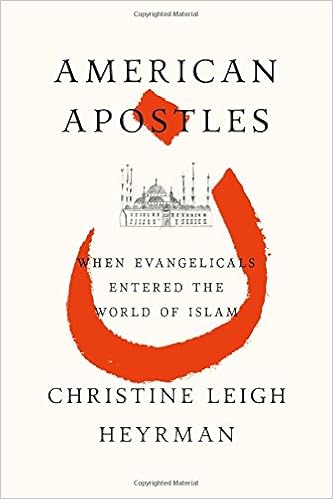
American religion is very much “out in the world,” as panels in Dallas amply demonstrated.  S-USIH conference presenters operate in the jet stream of Andrew Preston’s Sword of the Spirit, Shield of Faith: Religion in American War and Diplomacy and David Hollinger’s Protestants Abroad: How Missionaries Tried to Change the World but Changed America. Woodrow Wilson’s social gospel now plays an important role in American empire (Cara Burnidge), missionaries imbued science in Hawaii with the divine (Tracy Laevelle), and religion, of course, also challenged empire (Ray Haberski). As mentioned above, Lauren Turek’s work brings the fields of American religion and international human rights history into conversation. Emily Conroy-Krutz’s paper on the state of the field panel considered how recent books by Christine Heyrman and Michael Altman study religion abroad to illumine religious issues in America. Conroy-Krutz makes the important point that recent scholarship has portrayed missionaries both as purveyors of bias and important sources of cosmopolitanism.  The subjects we study in the field of American religious history go out into the world and think about a wide range of issues. Religion is exported as well as imported.


Image result for mike altman hindooImage result for christine heyrman islam

Women’s and gender history intersected with long-standing research trends in the field of American Intellectual and religious history.  These approaches are producing new insights into old questions. Erin Bartram offered an analysis of how gender shapes the construction of the female self in the nineteenth century. Religion and religious questions are involved in the construction of the self and the recognition of boundaries between the individual and society. Elesha Coffman discussed the ways the legacy of Betty Friedan occluded historians’ understandings of Margaret Mead, the subject of her new book Oxford’s Spirited Lives series. Andrea Turpin’s paper considered women from both sides of the Fundamentalist-Modernist controversy. Elizabeth H. Flowers asked why women were so involved in spreading the doctrine of inerrancy in the late twentieth century. Karen K. Seat looked at how ideas of women’s labor helped to explain the general turn towards neo-conservative policy during and after the Reagan era. These papers demonstrated that women thinkers and ideas about gender shaped key trends in American history: the rise of the self, fundamentalism, the rise of the right, second wave feminism, and neoliberalism.


spacer

Religion at the U.S. Intellectual History Conference

Andrea L. Turpin

I am looking forward to the annual conference of the Society for U.S. Intellectual History (S-USIH) this coming weekend, October 26-29, 2017, at the Dallas/Plano Marriott at Legacy Town Center! (This Baylor professor got lucky with travel this year.)


One of the striking things about the program is how many papers related to American religion it contains. Indeed, this blog is exceptionally well represented. I am presenting, as are four fellow bloggers: Pete Cajka, Elesha Coffman, Lauren Turek, and blogmeister Cara Burnidge. Literally every time slot of panels save the very last one (which meets at 10am Sunday morning) has at least one paper on U.S. religious history--and more than one time slot has two entire panels on U.S. religion meeting simultaneously. There's a good mix of full panels on religious history and individual papers relating religion to a panel dedicated to a different main topic. Another encouraging sign of the vitality of the field is that the religious historians presenting at the conference span all career stages from graduate student to full professor.

Probably the most common themes in the papers are the connections between religious thought and politics/economics or women/gender. Other papers explore the intersection of religious thought with ideas about empire, education, and science. Judaism, Catholicism, and Protestantism--both conservative and liberal--are all reasonably well represented, with liberal Protestantism the most common. In the future, I would love to see more papers on the religious thought of people of color and religious thought beyond the boundaries of Christianity and Judaism.

I've listed below in bold the papers and panels explicitly featuring American religion. They give a good sense of the state of the field of the intersection of U.S. religious and intellectual history. Enjoy!

2017 USIH CONFERENCE SCHEDULE

Friday, October 27, 2017

8:00 AM – 9:40 AM                 Session I

“Religious Ideas: A State-of-the-Field Roundtable based on 19th and 20th Century American History” (roundtable)
Moderator:  Gale Kenny, Barnard College
Emily Conroy-Krutz, Michigan State University
Daniel Hummel, Harvard University
Peter Cajka, Notre Dame
Jacob Hiserman, Baylor University

“Humanisms in Twentieth Century American Culture” (panel)
 Chair/Comment:  Elisabeth Lasch-Quinn, Syracuse University
 Paul Murphy, Grand Valley State University, “Two Humanisms – Separate and Distinct, Conservative and Progressive – and the Belief in an American Mind”
 Stephen P. Weldon, University of Oklahoma, “Intellectuals and the Role of Liberal Religion as a Change Agent in 20th-Century America: The Example of American Humanism”
 Emily J. Griffin, University of Oklahoma, “Post-War Industrial America and the Shaping of the
Humanistic Worldviews of Kurt and Bernard Vonnegut”

 
“Modern Moral Causes in Context” (panel) (a/v)
Chair: Lilian Calles Barger, Independent Scholar
Chris Babits, University of Texas at Austin, “Curing the Fallen: Women Conversion Therapists, Freudianism, and Prayer in the 1970s and 1980s”
Alexander Steele, University of Minnesota, “Black Lives Matter: History, Memory, and the Politics of Dissent”
Adam Shapiro, “Does the March for Science Have an Intellectual History?”
Comment: audience

10:00 AM – 11:40 AM             Session II

Annuit Coeptis: Forms of Civil Religion in the Midst of Crisis, 1953-2012” (roundtable)
Moderator: Ethan Schrum, Azusa Pacific University
Hilde Eliassen Restad, Bjørknes College
John D. Wilsey, Princeton University
James M. Patterson, Ave Maria University
Fred W. Beuttler, University of Chicago
Lauren F. Turek, Trinity University

1:30 PM – 3:10 PM                 Session III

“Religion and Nationalism in Early America” (panel)
Chair/Comment: Emily Conroy-Krutz, Michigan State University
Katherine Carté Engel, Southern Methodist University, “The Shallow Roots of American Religious Nationalism”
Ben Wright, University of Texas at Dallas, “Nationalism, Denominationalism, and the Benevolent Empire”
William Black, Rice University, “Cumberland Presbyterians and the Project of the Christian Nation”

3:30 PM – 5:10 PM                 Session IV

“Fundamentalists v. Feminists? Reevaluating the Role of Women and Gender in Conservative Protestant Political Engagement” (panel)
Chair/Comment: Daniel K. Williams, University of West Georgia
Andrea L. Turpin, Baylor University, “Women Between Fundamentalism and Modernism: Fusing Conservative Theology and Progressive Politics in the Presbyterian Church and the YWCA”
Elizabeth H. Flowers, Texas Christian University, “From Eve’s Curse to Eden’s Blessing: Submission, Complementarianism, and the Gendering of Inerrancy”
Karen K. Seat, University of Arizona, “The Symbiosis of Social and Fiscal Conservatives: Gender and Human Care in a Neoliberal World”

7:00 – 9:00 PM                        Friday Plenary Roundtable    

Toward Democracy as Faith or Doubt”
Moderator: Christopher Cameron, University of North Carolina, Charlotte
Caleb McDaniel, Rice University
Amanda Porterfield, Florida State University
Manisha Sinha, University of Connecticut
Daniel Wickberg, University of Texas at Dallas
Respondent: James Kloppenberg, Harvard University

Saturday, October 28, 2017

8:00 AM – 9:40 AM                 Session V

“U.S. Women and Transatlantic Intellectual Cultures in the Nineteenth Century” (panel)
Chair/Comment: Sarah Gardner, Mercer University
Paul Gutacker, Baylor University, “Church Fathers and ‘Nursing Mothers’: Adaptations of Religious Historiography by Antebellum Women Historians”
Jonathan G. Koefoed, Belhaven University, “Harriet Beecher Stowe: A Transatlantic Romanticist”
Joel Iliff, Baylor University, “The Sable Wings of Skepticism: Antebellum Southern Women, German Thought, and Intellectual Crises of Faith”
Sara S. Frear, Houston Baptist University, “Seeing Farther: Mary Virginia Terhune Interprets Darwin for Her Readers”

“How to Make an ‘American Century’: Religion and the Shaping of the Modern Public Sphere” (panel)
Chair/Comment: Ray Haberski
Sara Georgini, Massachusetts Historical Society, “Making the Mapparium”
David Mislin, Temple University, “‘A Great Time to Be Alive’?: The Midcentury Protestant Establishment and the Memory of the Past”
Rachel Gordan, Brandeis University, “’Introduction to Judaism’ Literature”
 
10:00 AM – 11:40 AM             Session VI

“Markers of Memory in the Long 19th Century” (panel) (a/v)
Chair: Leslie A. Butler, Dartmouth College
Erin Bartram, University of Hartford, “’Jane’s mind desires intensely demonstration in all things’: Experiments in Imperfect Happiness in Antebellum America”
Lauren Davis, University of Texas at Dallas, “Free Women of Color and Counter-Domesticities of the Circum-Caribbean: Plaçage, Passing, Broken Marriages, and Religious Vocation as Alternatives to the Cult of True Womanhood in New Orleans, 1765-1865”
Nicolette Gable, College of William and Mary, “Memories of History in the Mauve Decade”
Ermine Algaier, Monmouth College, “Historicizing Alice’s ‘Valuable & Much Prized by W.J.’ Bibliography: A Nostalgic Reading”
Comment: audience

“Deep in the Mind of Texas: Unsung Texas Intellectuals, 1865-1965”
Chair/Comment: Robert H. Abzug, University of Texas at Austin
David Weinfeld, Virginia Commonwealth University, “Zionist, Pragmatist, Texan: The Case of Constance Pessels”
Karen Kossie-Chernyshev, Texas Southern University, “Lillian Jones Horace (1880-1965) and Zora Neale Hurston (1890-1960): Twin Towers of Black, Southern, Female Intellectual Engagement in Comparative/Contrastive Review”
Cynthia Morales, Texas State University, “Alonso S. Perales: Defender of His ‘Race’”

“In a Mirror, Darkly: Religion, Empire, America” (panel)
Chair/Comment: Philip Goff, Center for the Study of Religion and American Culture, IUPUI
Tracy Laevelle, Creighton University “A Fatal Experiment: Missionary Science and ‘Providential Colonialism’ in Nineteenth-Century Hawaii”
Cara Burnidge, University of Northern Iowa, “Woodrow Wilson’s ‘Spiritual Mediation’ and American Empire”
Raymond Haberski, Indiana University-Purdue University Indianapolis, “Competing Affections: The Challenge of Peace and Moral Debate Over Empire”

“Faith in an Anxious Age: Religious Thought in Mid-Twentieth-Century America” (panel)
Chair/Comment: Molly Worthen, University of North Carolina, Chapel Hill
Daniel K. Williams, University of West Georgia, “Believing in God in the 1950s: Rational Defenses of Faith among Evangelicals, Mainline Protestants, and Catholics in the Early Postwar Years”
John W. Compton, Chapman University, “Holding the Vital Center: The National Council of Churches and the Postwar Welfare State”
Benjamin P. Leavitt, Baylor University, “Experiments in Education: Robert Lincoln Kelly, the Council of Church Boards of Education, and Religious Instruction in Early Twentieth-Century Colleges and Universities”

1:30 PM – 3:10 PM                 Session VII

“Feminist Disruptions in Theory” (panel)
Chair/Comment: Andrew Hartman, Illinois State University
Matthew Brown, University of Texas at Dallas, “William Moulton Marston’s Feminist-Scientific Critique of Freud”
Elesha Coffman, Baylor University, “Margaret Mead, Betty Friedan, and the Boundaries of Feminism”
Lilian Calles Barger, Independent Scholar, “From Subjectivity to Revolution: Radical Feminism and the Uses of Marcuse”
Gregory Jones-Katz, The Chinese University of Hong Kong, “The ‘Female’ School of Deconstruction and the Transformation of Feminism, 1969-1993”

3:30 PM – 5:10 PM                 Session VIII

“Democracy and Christianity in the American Political Arena” (panel)
Chair/Comment: Elesha Coffman, Baylor University
Benjamin E. Park, Sam Houston State University, “Self-Rule in a Godly Society: Antebellum Challenges to Protestant Democratic Culture”
Matthew Bowman, Henderson State University, “Robert Bellah and the Cults: Civic Religion, Liberal Protestantism, and Democracy in an Age of Anxiety”
Lily Santoro, Southwest Missouri State University, “Scientifically Creating Righteous and Fit Christian Citizens”

“Pluralism and Democracy in the Twentieth Century” (panel)
Chair/Comment: Anne Kornhauser
Andrew Seal, Yale University, “Pluralism and Its Problems: Reconstructing the Postwar Critique of Liberal Social Science”
Tom Arnold-Forster, Cambridge University, “Populism and Pluralism after the Scopes Trial”
Merve Fejzula, Cambridge University, “Cultural Pluralism and American Democracy in Black Diasporic Thought”

“Remembering and Forgetting that Old-Time Religion in the Age of Trump” (roundtable)
Moderator: L.D. Burnett
Jeff Sharlet, Dartmouth College
Randy R. Potts, freelance writer
Molly Worthen, University of North Carolina at Chapel Hill
Wassim Daghrir, University of Sousse

Sunday, October 29, 2017

8:00 AM – 9:40 AM                 Session IX

“Circulation of Ideas in Early Republic and Antebellum America”
Chair: Michael Landis, Tarleton State University
Rebecca Brenner, American University, “Mr. Jefferson’s Library & Mr. Madison’s War”
Samuel Davis, Temple University, “’Which all should labor to remove’: Colonization and Removal in the Old Northwest”
Daniel Roeber, Florida State University, “Delivering Religion at Reduced Rates: The Post Office and Religion in the Early Republic”
spacer

R&AC Proceedings, Experiences as a Grad Student

Today, the Center for the Study of Religion and American Culture made its Proceedings available. This publication allows those who were not able to make it to Indianapolis in June to access the ideas shared at the conference. Or, for those like me, it helps attendees view those ideas with fresh eyes. 

In conjunction with the the publication of the Proceedings, today's guest post reviews R&AC's 5th Biennial Conference from the perspective of a first-year PhD student. Our guest author is  Melanie Monteclaro Pace, a Ph.D. student in American Religions at the University of Virginia. Readers can follow her on Twitter: @monteclaro_pace

Melanie Monteclaro Pace

In June, I drove from Charlottesville to Indianapolis to attend the 5th Biennial Conference on Religion & American Culture. As a first-time conference attendee, I wasn’t sure what to expect—especially at an event that typically draws only a handful of graduate students, and even fewer first-year Ph.D. students like myself.

And, you might well ask: Why would a graduate student want to attend a conference like R&AC?

However, I’m happy to report that being a graduate student at R&AC 2017 was such a cool experience. And by that, I mean it was a professional development opportunity that I would recommend to any graduate student in the field of American religion. Here are some reasons I found attending this conference so valuable:

Connection. At R&AC, I got to meet the scholars whose work I’d been getting to know over the course of the past year—an opportunity unique to a small gathering that is difficult to come by at larger conferences. Nothing beats getting to chat with the folks who are writing the books you’re reading as a way to feel more connected to the field. And connecting to the field in meaningful ways is one of the primary tasks of an early-career graduate student.


Many early-career graduate students struggle with knowing how to position our own scholarship in the field. Attending conferences like R&AC can help with this. At R&AC, I was able to watch scholars engaging with one another in real time, giving me a panoramic view of the state of the field. This year’s sessions included a range of papers addressing cutting-edge topics in the study of American religion, such as the category of religious “nones,” the use of digital methods, and the question of how we might situate American religion in a global context.

Conversation.
R&AC is all about conversation. It’s a conversation that begins with the first panel on Day 1, as presenters and audience members settle into the format in the round at 8:30am with their first, second, and possibly third cups of coffee. This conversation not only carries through to the final panel on Day 2, but at lunch, in the hallways, and over snacks at the catered “Nourishment Hub”—which, I’ll pause to observe, included gummy bears and Reese’s Pieces. (I helped myself liberally to both.) 

At R&AC, I got to take part in these conversations about critical issues in religious studies with some of the leading scholars in the field. As an early career graduate student trying to carve out a space of inquiry for myself within scholarship on American religion, it was particularly helpful to witness these conversations between scholars. I was also privy to real talk about the academic job market, teaching in diverse contexts, and the challenges that face early-career faculty. This alone was worth the nine-hour drive.

Community. Networking is important for all early-career graduate students. Even the most well intentioned and generous of the leading scholars in our field don’t have time to review the writing of every aspiring student. So, when we as graduate students are trying to get feedback on a manuscript or, eventually, navigate the job market with the support of influential faculty, it helps if those faculty are able to put a face to a name and a piece of work. R&AC, an unusually intimate conference, can help this happen.


Furthermore, as is the case in much of the academy, religious studies as a discipline is slowly diversifying but remains predominately white and male. This can make it challenging for minority students and women to find peers and faculty who share their experiences. As a first-generation graduate student and woman of color, one of the best parts of R&AC for me was getting to talk with early-career scholars who could share their experiences as women and minorities in the academy. Not only did I benefit from their insights, but I look forward to staying in touch as I continue my studies.

In closing, I’m really glad that I attended R&AC this year. I’d like to offer an additional thank-you to the folks who helped make R&AC a positive experience for me as a graduate student (I’ll do my best to pay it forward!).

And to my fellow graduate students in American religion: I know how challenging it can be to work out the logistics of conference travel and funding. But, if you can, I’d encourage you to attend the 6th Biennial Conference in Religion and American Culture, which takes place in June 2019.

In the meantime, don’t miss the informative—and occasionally entertaining!—Twitter conversation on this year’s conference at #RAAC2017.

spacer

RiAH at 10: We Don't Need No Stinkin' Badges!

Elesha Coffman

I like academic conferences. Always have. Way back when I was the editor of Christian History magazine, I attended a Conference on Faith and History meeting in San Diego and then the American Society of Church History winter meeting in San Francisco, searching for new story ideas and potential authors. My husband, Eric, was with me in San Francisco, and we found ourselves in an elevator with two tweed-coated male historians who were so engrossed in their conversation that they were just riding up and down, oblivious to whatever floor they were supposed to be heading to. When we were out of earshot, Eric asked me, "Are these your people?" and I knew that the answer was "Yes." Soon I had left journalism for grad school in the history of American religion.

This blog has functioned, for me, primarily as an extension of academic conferences. My very first posts, in summer 2011, recapped the Religion and American Culture conference, which had raised two huge questions: "Do Religion Scholars Read the Bible?" and what is the "Future of Religion in America?" In my first job, at a school with just two historians and one religion scholar on faculty, I did not get to have these conversations, and I wasn't ready for them to end when I departed from Indianapolis. The inestimable Paul Harvey allowed me to throw my thoughts onto the blog and keep the ball rolling.

One of my favorite conference photos, from Mainz 2014
In the past six years, I've previewed and reviewed numerous other conferences here, as well as shared updates from the American Society of Church History, of which I became a council member in 2015. (Don't forget to renew your membership and stay at the ASCH hotel in D.C. in January!) People I've "met" through RiAH I subsequently met, and often presented alongside, at real-life conferences, where our interactions were enriched by the sustained conversation made possible at this blog. In New York, or Chicago, or wherever, instead of, "Hello, what is it you work on?" while we squint at each other's nametag, it's, "So good to see you, I loved that book review you posted, you're taller than I expected, and how is that new class going?"

In my view, the whole field functions better because we can meet here even when we can't meet in person. Thanks for this tremendous feat of event-planning, Paul!
spacer

"Enduring Trends and New Directions: A Conference on the History of American Christianity in Honor of Mark Noll"

[Good morning! This month the Cushwa Center has invited James Strasburg and Jonathan Riddle to post a preview of the upcoming conference "Enduring Trends and New Directions: A Conference on the History of American Christianity In Honor of Mark Noll." Strasburg and Riddle are the co-chairs of Mark Noll's retirement conference and are also PhD candidates at the University of Notre Dame working under Noll's direction. Below the jump, their post includes information about the (free!) conference, as well as a brief interview with Noll himself. Hope to see you there!]

James Strasburg and Jonathan Riddle (with special interview guest Mark Noll)


At the end of the 2015-2016 academic year, Mark Noll retired from the University of Notre Dame. The end of his tenure as professor marks the end of era. To mark the occasion, this spring the University of Notre Dame will host a conference on the history of American Christianity in Noll’s honor, entitled “Enduring Trends and New Directions.” The conference begins on Thursday, March 30, and continues through Saturday, April 1.

True to form, Noll insisted that the conference be about the history itself, not the historian. He was especially eager to give younger scholars, including his students, an opportunity to present their work in progress. To that end, the conference will feature four panels showcasing new work in the history of American Christianity. The University Notre Dame, where Noll spent the last ten years teaching and advising, will be especially represented in these panels.

Yet the conference will also serve as an occasion to reflect on Noll’s career and the influence of his scholarship. Students and colleagues from various stages of Noll’s career will share personal reflections, John Wilson will host an interview with Noll during lunch on Friday, and Noll himself will deliver remarks at the Friday evening banquet. Further, two roundtables will be devoted to more reflective, retrospective conversation. The first will check in on the state of “the evangelical mind,” while the second will examine the role of grand narratives in the history of American Christianity.

The conference coincides with and includes the Seminar in American Religion, hosted each semester by the Cushwa Center for the Study of American Catholicism. This semester, Laurie Maffly-Kipp and Thomas Bender will respond to John T. McGreevy’s latest book, American Jesuits and the World: How an Embattled Religious Order Made Modern Catholicism Global (Princeton, 2016).

For the full conference program, and to register (for free), visit nollconference.com. The deadline to register is March 15.

To preview the conversations we’ll be having at the conference, we asked Noll a few retrospective and forward-looking questions. For more along these lines, join us at the conference!

Mark Noll (Photo courtesy William Koechling)
JS & JR: Now that you've retired from the University of Notre Dame, what will you miss most about being a professor? What are you most looking forward to in retirement?

MN: I certainly will miss the regular interchange with graduate students that has been a real highlight of my time at Notre Dame. Regular contact with faculty colleagues will also be missed. I will not miss most committee work, though occasionally the chance to work on important issues (like graduate student admissions) was very meaningful. In retirement, I hope to be able to keep writing, with one book pretty clear in my mind how it should go, but also a few others less clearly foreseen. I also welcome the chance to spend more time with family, both in the Chicago area and in the far-flung places our children and grandchildren now inhabit, and also to feel a little freer in helping out church and philanthropic tasks.

JS & JR: What are a few of the most significant changes in the writing of American religious history that you've witnessed during your career?

MN: In the early 1970s Sydney Ahlstrom published his landmark survey, A Religious History of the American People, a splendid book that dwelt almost entirely on the history of Christian movements (and among Christian movements primarily Protestant, and among Protestant primarily proprietary Protestants). Over the past half-century, “American religious history” can no longer be considered synonymous with the history of Christianity in the United States. The main reason I describe myself as a “historian of Christianity” is to indicate my desire to continue on in the Ahlstrom trajectory, but now with what has become the need for more truth in advertising. “American religious history” has been greatly enriched in recent decades by contributions from many of the social sciences and by recognizing that the United States is now home to non-Christian traditions, and to traditions of no religion, that deserve serious consideration as historical subjects. For myself, as someone greatly interested in the history of Christian theology, Christian intellectual life, and Christian organizational development, I do not resent “religious history” or “pluralistic American religion,” for I regard these fields as supplementary or complementary to my own work. But I do think the need to make such distinctions has become necessary.

The leaders of “American religious history” when I came on the scene were mostly seminary-trained men associated with research university divinity schools (i.e., Ahlstrom, Handy, Marty), with exceptions like William McLoughlin and Ed Gaustad. Now divinity-school training and divinity school-location have become less common.

Another set of great changes concerns the ever-increasing quantity of high quality publication in American religious history and the overlapping domains of the history of Christianity in the U.S. (Not as much, regrettably, has taken place in the awareness of U.S. historians concerning the significant parallel histories of religion/Christianity in Canada and Mexico, which also inhabit “America.”) Attention to groups that once looked marginal—both Christian and non-Christian—is also much more obvious. It probably goes without saying that I’m delighted with the great surge in excellent publication on African American churches, Pentecostal and evangelical white Protestants, Catholics of all varieties, and more.

JS & JR: What would you say are the exciting new trends in the field?

MN: I’m looking forward to the conference to see what those are!
spacer