Showing posts with label Catholic Studies. Show all posts

5 Questions with David Endres

I corresponded recently with Fr. David Endres about his new book, Many Tonges, One Faith: A History of Franciscan Parish Life in the United States. Fr. Endres is Associate Professor of Church History and Historical Theology at the Athenaeum of Ohio where he also serves as Dean. He is also the hardworking  editor of the US Catholic Historian.


(1) Writing a history of Franciscan parishes is a huge undertaking. As you note, at the height Franciscan parish ministry in 1968, the order ran around 500 parishes and missions in the US. Tell the blog how you approached this challenge and why you settled on writing the history of fourteen specific parishes. 

Unlike the Jesuits and Dominicans, among other religious communities, there have been almost no studies of US Franciscanism to date. That was the impetus for the United States Franciscan History Project under the direction of Jeffrey Burns and the Academy of American Franciscan History: to bring together scholars to reflect on different aspects of the US Franciscan story. In addition to my book on Franciscan parishes, there has been one other monograph published in the project series: Ray Haberski’s Voice of Empathy: A History of Franciscan Media in the United States. Hopefully, additional forthcoming volumes will address other topics.


One 1950s survey of the Franciscans’ US presence blamed factionalization within the Franciscans on the lack of national or international studies that go beyond a given Franciscan province or branch of the order. He (a friar himself) lamented that he would never be able to please his confreres -- the Conventuals, Third Order Regular, and Capuchins would feel overlooked if he concentrated on the more numerous OFMs (Friars Minor) and all the priests and brothers would resent being chronicled along with the secular Franciscans and the numerous women’s branches.

I tried to keep some balance, and perhaps since I am not a Franciscan myself, I was a bit freer to shape the book around specific parishes – no matter the branch or branches of Franciscanism represented.  I looked for compelling stories that related to broader developments in the history of the Church and nation, but also attempted to provide a diverse representation of parishes – ethnically and geographically, large and small, active and now closed or merged. I knew that to tell such a large story, I had to be selective in choosing parishes to detail. The number “fourteen” was somewhat arbitrary, but I think it provides enough case studies to derive some general conclusions.

To achieve this diversity of place and kind, I made use of numerous archives. The archives of the St. Barbara Province in Santa Barbara, California and the St. John Baptist Province here in Cincinnati provided a wealth of information. Even though Cincinnati is 800 miles from New Orleans, friars from the Cincinnati province ministered in Louisiana (along with Michigan, Indiana, Kentucky, Arizona, and New Mexico) so archives helped extend my research reach. Other holdings were consulted in person or with the help of kind archivists and librarians.

(2) You show how Franciscans very much became tied to place in America. Tell the blog how the order was shaped by American realities. 

I think that too often scholars (who do not necessarily focus on religious history), see Catholic history in particular as not having much to do with the US historical narrative. But in addition to being tied into major developments in American Catholic history, the book, I hope, helps explore major demographic and social trends that transcend the US Catholic experience.

Those developments included the realities of frontier life, massive European immigration, and the emergence of ethnic-predominate cities. These geo-demographic shifts propelled Franciscans into pastoring parishes in the nineteenth century, though this was not part of their experience in Europe.

In the latter half of the twentieth century, the Franciscans were again shaped by new American realities – the interstate highway system, growth of suburbia, the Baby Boom, feminism, and protest movements of the 1960s and beyond. All of these impacted parish life, affecting how Franciscans ministered and how they assessed their ministries.

By engaging some of these broader developments in American life and the American religious experience, I hoped to situate Franciscan parishes within the US historical narrative, not as an aberration, but as a nexus of local institutions and communities that help compose the “American story.”

(3) Many Tongues, One Faith is as much a global story as it is a national story. How does the story of the Franciscans compare to other orders? I'm thinking here of John McGreevy’s work on the Jesuits. Both orders were shaped by the secularization policies of Europe and their coming to the US, but did they respond in different ways? 

It is certainly a global story. The first Franciscans to the US – whether Irish, Italian, German, or Polish – all came from European provinces, bringing with them their own ideals and expectations about being Catholic, being Franciscan, and being ministers of the Gospel. This was not unique to the Franciscans, but I think that friars and religious sisters responded in different ways from the Jesuits and others, partly because of the distinctiveness of their charism.

In the conclusion of the book, I discuss the Franciscan charism: to be poor among the poor; to foster fraternity and community; to be ministers of reconciliation, healing, and peace; and to serve where there is the greatest need, often among those on the margins of society. Their charism, especially the commitment to ministering to the underserved, impacted the locus of their ministries. While the Jesuits had a lively Euro-American exchange of personnel among their colleges, the Franciscans were missioned to the frontier, or urban centers, or Native American missions. Though some returned home later in life, most stayed in America.  Consequently, their lives were significantly shaped by their local experiences of ministry and the people they encountered. More so perhaps than other orders, the Franciscans seemed to stay close to the people, identifying with them, no matter if their own ethnic, racial, or socioeconomic backgrounds were dissimilar.

The work of John McGreevy and others now provide some interesting possibilities for inter-“religious order” comparisons. The Jesuits, more so than the Franciscans, traveled to and from Europe – even after many years of ministry in America – and maintained a close connection to the Jesuit superior general in Rome. The order overall maintained a greater top-down, military model. Overall, my reading of the Franciscan story is that they were more decentralized in their identities and decision-making. The provinces and the semi-autonomous Franciscan “custodies” emphasized local governance. This helped them to respond to local situations and needs in ways different from other orders.

(4) Of the fourteen parishes you wrote about, do you have a favorite? 

Of those that I detail in the book, the one that has resonated most with me is the Shrine of Our Lady of Consolation in Carey, Ohio, located about three hours north of my home. As a Marian shrine that remains popular among pilgrims, it is a place where the present is linked to the past. In Carey, an image of Our Lady of Consolation was imported from Luxembourg and brought in procession to its new home at the church in 1875. On the day of the procession, rain threatened on all sides but did not fall on the statue or procession. The safe passage of the statue through the storm was viewed as miraculous. At the same time, unbeknownst to those in the procession, a little girl whose family had taken part in the procession was healed from an incurable illness. It was the first of many miraculous healings, which many believe continue at the shrine today. Dozens of artifacts lining the shrine’s walls stand as testimony to the claims: crutches, casts, splints, and even a six-foot-long wicker basket.
The history of the shrine is full of fascinating stories – some of which are outside the scope of Many Tongues, One Faith or could only be discussed briefly therein. I am particularly interested in the healings said to have occurred there and how they were publicized, especially in the first decades of the twentieth century. The healings shed light on ethnic and devotional Catholicism and how “holy places” operated within the psyche of American Catholics. And as much as believers venerated the location as a place of special intercession by the Blessed Virgin Mary, the shrine also has been the target of anti-Catholicism: a Ku Klux Klan demonstration, an arson attempt, and a successful theft of the famous statue. The vacillations of belief and doubt provide an interesting lens to view religious devotion, reported miracles, and the advancement of science.

My study of the shrine has developed into a near book-length manuscript, “America’s Lourdes: Devotion and Healing at the Shrine of Our Lady of Consolation.” I hope to further develop the topic over the coming years and ready it for publication.

(5) Your book builds on the social history tradition of Jay Dolan and Patrick Carey’s classic studies of parish life. One might say the parish is where “the rubber meets the road.”  Why is the parish still a great lens to use to study US Catholic history?

I am indebted to earlier scholarship that helped focus on lay Catholics and their involvement in parish life. Today, as in the past, most Catholics’ experience of the Church is at the level of the parish.  More so than any diocesan structure or specialized Church-run institution, the parish is primary to a community’s religious experience. The correspondence of bishops, their sermons, and financial ledgers readily available at diocesan archives tell part of the story, but only part of it. Getting beyond institutional records to tell the stories of communities is the challenge and also the benefit of researching parishes.

I attempted to use various sources to find the “voice” of friars, women religious, and lay Catholics, utilizing local and parish histories, newspapers, bulletins, and occasionally, interviews. My hope is that it has helped flesh out the lived experience of everyday “people in the pews.” Of course, a selective, case-study approach offers some insights into that experience, but also implicitly points to the need for further studies. If my research has provided an impetus or avenues for future research, it will have achieved part of the goal of the United States Franciscan History Project.

spacer

Do Catholic Historians Need to Define Catholicism?

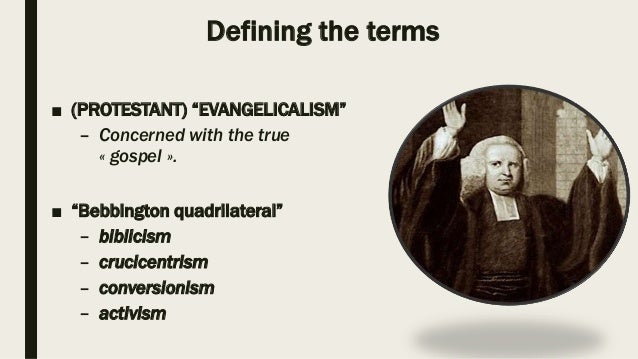
Image result for bebbington quadrilateralHistorians of evangelicalism are very interested in defining evangelicalism. It would seem obvious that scholars of a certain field would be dedicated to defining their object of study, but historians of evangelicalism go about this task with an admirable gusto. The act of defining is central to the field. Historian David Bebbington’s famous definition, the Bebbington Quadrilateral – evangelicalism as biblicism, crucicentrism, conversionism, and activism – has framed the conversation since 1989. As I listened to the excellent papers delivered by historians at the Noll Conference in March 2018, I began to wonder why Catholic historians do not seem so interested in defining their object of study, Catholicism.

Certainly we do not have quadrilateral. But should we have one?


Two answers to the question about the lack of enthusiasm for defining Catholicism pop up immediately. First, Catholicism does not appear to be as controversial in American politics, and as a result, the stakes of defining it are not as high. The conference suggested there is a pressing need to define evangelicalism in order to understand present day voting patterns. The second factor easing any pressure to define Catholicism is the structure of the Church itself. The centralized nature of the Church relieves scholars of the need to define Catholicism. At the conference I asked two colleagues who study evangelicalism why historians of Catholicism are not interested in definitions. Basically, the response I received was that the structure of the Catholic Church – a Pope and a hierarchy – means that less is up for grabs.

We should pause to ask if having a debate about the definition of Catholicism would be productive. I imagine some will think that having such a conversation would only serve as a distraction. But I found the debate about evangelicalism at the Noll Conference to be fascinating and generative. Is it a theology? Is it a politics? Is evangelicalism the media you consume? Is it a set of ideas? Is it worship? Is everyone who likes Billy Graham an evangelical? Is the scandal of the evangelical mind still scandalous?

It is possible to conclude that Catholic historians have been debating the definition of Catholicism implicitly in their books for years. The closest our field comes to The Scandal of the Evangelical Mind might be William Halsey’s classic study, The Survival of American Innocence: Catholicism in an Era of Disillusionment, 1920-1940. Halsey argued that a neo-scholastic worldview allowed Catholics to imagine themselves as existing outside the tragedy of twentieth century American history (the rise of ethical relativism, psychoanalysis, and subjectivity). It is tragic in Halsey’s tale, and rather a scandal, because the static mentality of Catholicism made it obtuse. Other scholars followed his lead and defined Catholicism as static because of the intellectual freeze brought on by the condemnations of Americanism and Modernism. But Halsey makes the important point that Catholicism could be construed as a set of mental categories. He does define his object of study. Jay Dolan’s work implied that only the methods of social history could move scholars of Catholicism closer to a useful definition of what they study. John McGreevy’s Catholicism and American Freedom would say Catholicism is an assent to a set of ideas. His Parish Boundaries would locate institutionalism at the center of what it means to be Catholic. His latest work on the Jesuits suggests any definition of Catholicism must consider the global. Robert Orsi’s work defines Catholicism as a religion of practice replete with longings for connections to the “real presence.” Relationships between heaven and earth are also at the heart this Catholic identity. As is gender, as works by Amy Koehlinger, Kathleen Sprows-Cummings, and Mary J. Henold make clear. The essays in Habits of Devotion on confession (James O’Toole), the Eucharist (Margaret McGuiness), prayer (Joseph Chinnici), and Marian devotion (Paul Kane) identify Catholicism as profoundly ritualistic and sacramental. Peter D’Agostino argues that Rome and trans-nationalism are key to defining American Catholicism. Younger scholars are contributing to this debate and taking it in new directions. Matthew Cressler has raised the question of how the definition of American Catholicism changes when we locate black Catholics at the center of our story. Catherine Osbourne’s new book suggests professionalism and professional identities are important to Catholic life in the twentieth century. Jack Downey makes the point that Americanization of Catholicism and its entrance into mainstream of American life should not stand as the ultimate end point for defining the men and women of the Old Faith. Not all Catholics wanted mainstream status because such an “achievement” entailed an ensnarement in modern materialism.

Catholic historians debate definitions of Catholicism without a central framing device.


This blog post raises the question of whether Catholic historians need a device like a quadrilateral to shape this debate and give it some structure. The question assumes, perhaps incorrectly, that scholars can, in fact, define Catholicism. It also pushes past any reservations about debating a definition rather than figuring out how Catholics shaped American History. But what if we synthesized the works in the field to produce a four-pronged definition?  What would rise to the surface if we made it goal to boil it all down to four categories? Or could we define Catholicism with a broader categorical move? Is it a theology? Is it a set of institutions? Is it an imagination? We might return to some classic sources written by theologians and social scientists. David Tracy’s Analogical Imagination or Andrew Greely’s The Catholic Imagination both spring to mind. Historians might walk the path hewn by the editors of the recently published The Anthropology of Catholicism: A Reader. Scholar of religion Kate Dugan, in her useful review, teases out the questions asked across the volume’s essays: “What counts as a Catholic idea and a Catholic person? Why does Catholicism continue to have influence the twenty-first century? If there is a Catholic imagination, or Catholic imaginations, who acts in it?” Historians of Catholicism might follow the lead of evangelical historians and these anthropologists and then ask a pack of similar questions. Then, of course, we should deliver a satisfying answer.


spacer

New and Improved ACHA Graduate Student Summer Research Grants

 At its Jan 2018 meeting, the Executive Council of the American Catholic Historical Association, under the leadership of President Kathleen Sprows-Cummings, approved an increase in the number of Graduate Student Summer Research Grants to be awarded each summer and the Council authorized an increase in the amount of money per award.

The ACHA is happy to offer 4 grants for the summer of 2018, each for a total of $2500.


In taking this measure, the Executive Council wished to continue the ACHA’s long-standing commitment to graduate student research. The increased amount of support per award was also designed with the goal of funding more graduate student research in archives and libraries abroad.
Dr. Carolyn Twomey conducts research with a
Graduate Student Summer Research Grant from the ACHA
at the Parker Library at Cambridge University, Corpus
Christi College.

Graduate students who have completed their coursework and are researching topics related to the history of Catholicism broadly defined are encouraged to apply.

Applications are due on April 30. More details can be found here.


Many thanks,
Carolyn Twomey and Peter Cajka 


spacer

Recapping the American Catholic Historical Association Meeting: A Guest Post from Stephanie A.T. Jacobe

Stephanie A.T. Jacobe

Stephanie A.T. Jacobe received her Ph.D. in history from American University in Washington, D.C. and also holds an M.A. in art history from Virginia Commonwealth University in Richmond, VA. She currently serves as the Director of Archives for the Archdiocese of Washington and as Adjunct Assistant Professor of Humanities at University of Maryland University College. Her dissertation, a biography of financier and Catholic philanthropist Thomas Fortune Ryan, is currently under revision. Her work has been supported by the Harvard Business School, the Cushwa Center, the Gilder Lehrman Institute of American History, and the Center for the History of Collecting in America located at the Frick Collection in New York City. She was recently elected chair of the Elections Board of the American Catholic Historical Association, and also serves as the editor of H-Catholic, one of the H-Net networks.

The annual meeting of American Catholic Historical Association (ACHA) began on Friday, January 5, 2018, and included two full days of concurrent sessions. The meeting took place in Washington, D.C.'s Woodley Park neighborhood and was held in conjunction with the annual meeting of the American Historical Association (AHA). Sessions included a range of American and European historical topics, and papers were presented by a mix of graduate students and established scholars. Though the meeting takes place among the much larger AHA gathering, the feel of the ACHA is that of a meeting within a meeting. Sessions are held at one of the conference hotels and those registered for the AHA have access to the book room and the job center. But smaller, more intimate, rooms are used for ACHA sessions and you will see many of the same faces in the multiple sessions you attend. It is a welcome haven from the hustle and bustle of the much larger conference.

The conference began bright and early on Friday morning with sessions about Catholic expansion in the western United States, and a new look at the education of girls in Central America. Another session looked at the intersection of politics and Catholicism. This began with Jason Duncan of Aquinas College, who discussed Martin Van Buren's ties to Catholics and his aim at building coalitions that included them even though he received significant backlash for it. Duncan argued that this is how Van Buren helped form the Democratic Party. William Kurtz of the John L. Nau II Center at the University of Virginia followed with a look at Catholic partisanship during the Civil War. I also presented a paper during this session about the influence that Catholicism had or did not have on the political careers of Chief Justice Roger Brooke Taney (1777-1864) and Chief Justice Edward Douglass White (1845-1921).

Though a winter storm was bearing down on the East Coast and the weather was extremely cold, a group of ACHA and American Society of Church History members embarked in a bus on Friday afternoon to the areas around the Catholic University of America. The group had a guided tour of the Franciscan Monastery of the Holy Land on Quincy Street and of the Basilica of the National Shrine of the Immaculate Conception, where everyone was able to see the newly-installed Trinity Dome along with a drive around the neighborhood.

I missed the 8:30 a.m. session on Saturday morning because a pipe broke in my hotel room late on Friday night due to the cold and I had to move rooms so they could fix it. The first panel I attended was at 10:30 a.m. entitled "Catholic Images, Narratives, and Identities in Early Modern Europe." Jeanne-Michelle Datiles of the Catholic University of America discussed Elizabethan Catholic Martyr literature. She discussed the intense martyr mentality of English Catholics during the Elizabethan period and how martyrologies such as that of Henry Walpole, S.J. were used and disseminated. Juan-Fernando Leon of Wheaton College (IL) discussed the eschatological message found in the plates of Casiodoro De Reina's Biblia Del Oso. De Reina translated the Bible into Spanish despite the Inquisition. The plates placed at the beginning of the book show a forest scene with a bear eating honey from a tree. Honey throughout the Bible is used as a symbol for wisdom. The final paper in the session, by Anatole Upart of the University of Chicago, discussed the Greek Catholic Ruthenians and their search for a home in seventeenth-century Rome.

At the annual luncheon the outgoing president, Kathleen Sprows Cummings, director of the Cushwa Center and associate professor of American studies and history at the University of Notre Dame, gave her presidential address entitled "Frances Cabrini, American Exceptionalism, and Rethinking U.S. Catholic History." Several awards were presented, including the following:

  • The Distinguished Award for Scholarship, presented to the Rev. Gerald Fogarty, S.J., of the University of Virginia;
  • The Distinguished Award for Teaching, presented to Anne Klejment of the University of St. Thomas;
  • The Distinguished Award for Service was presented to the American Catholic History Research Center and the University Archives at the Catholic University of America;
  • The 2018 John Gilmary Shea Prize was presented to William B. Taylor for his book, Theater of a Thousand Wonders: A History of Miraculous Images and Shrines in New Spain (Cambridge University Press, 2016);
  • The Howard R. Marraro Prize in Italian History was presented to John Howe for his book, Before the Gregorian Reform: The Latin Church at the Turn of the First Millennium (Cornell University Press, 2016);
  • The inaugural Henry C. Koenig Article Prize, for a biographical study of a Catholic individual (published in 2015 or 2016), was awarded to Paul T. Murray of Siena College, for "'The Most Righteous White Man in Selma': Father Maurice Ouellet and the Struggle for Voting Rights," The Alabama Review 68:1 (Jan. 2015): 31-73;
  • The Peter Guilday Prize for 2017 was given to Kathleen Walkowiak of Saint Louis University for her article, "Public Authority and Private Constraints: Eugenius III and the Council of Reims," that appeared in the American Catholic Historical Review 103 (Summer 2017).

After lunch the conference finished up with sessions on faith and doubt in Early Modern Europe, urban Catholic parish life in the United States, and saints and miracles. The session on saints and miracles included a paper by Carole Baker of Duke University on the highly decorated bodies of saints found in Bavaria, Austria, and Switzerland. It continued with Rosario Forlenza of New York University discussing Padre Pio and the cult of miracles that surrounds him and his relics in southern Italy. The final paper was by Mary Corley Dunn of Saint Louis University on Blessed Mary Catherine of St. Augustine, O.S.B., whose disability and constant illness after coming from France to Canada in the seventeenth century was portrayed in her vita as the root of her sanctity.

The conference finished on Saturday with the evening liturgy at 5 p.m. and then afterwards the social, which includes drinks and heavy hors d'oeuvres, for members of the ACHA. Both events bring members together, with the social allowing newer members and graduate students to get to know older, more distinguished, scholars. The ACHA is a very welcoming group and newer members are easily able to get to know the old-timers. Though the AHA annual meeting can be intimidating to new scholars and graduate students, the more intimate meeting of the ACHA is a welcome respite with friendly camaraderie among the participants.

The official program can be found here.
spacer

9 Questions with Matthew J. Cressler

I recently interviewed Matthew J. Cressler about his new book Authentically Black and Truly Catholic, published in 2017 with New York University Press. Matthew is no stranger to this blog -- he wrote regularly for RiAH for a few years -- and we are pleased to see his book in print. He is currently Assistant Professor of Religious Studies at the College of Charleston. 


PC: Your book tells the story of a profound transformation of what it meant to be Black and Catholic. Where does Authentically Black and Truly Catholic begin?

MC: Though the introduction provides some background in Black Catholic history, the story really opens with encounters between Black southern migrants and white Catholic missionaries in the Gre
at Migrations in the 1920s. It is hard to overstate the significance of Black migrations in the making of the twentieth-century U.S. Catholic history. Cities across the urban North were veritable Catholic metropolises at the start of the twentieth century. So when Black migrants from the rural South, most of whom were evangelicals and many of whom had been touched by the Holiness-Pentecostal revivals sweeping the South, began arriving cities like Chicago by the hundreds of thousands it had a profound impact on the urban religious landscape. The first three chapters of the book tell the story of what happened when predominantly white and Catholic neighborhoods on the South and West Sides of Chicago became predominantly Black and non-Catholic in a matter of years. It focuses on the fraught relationships missionaries and migrants forged in these years. Missionaries reimagined these neighborhoods as “foreign mission fields” full of heathens in need of conversion and worked to repopulate empty pews with Black converts. And many migrants also found Catholic rituals and relationships quite compelling, especially as they and their children were introduced to them in parochial schools. This resulted in a period of unparalleled growth. There were approximately 300,000 Black Catholics in 1940. By 1975 there were almost 1 million, a 208% increase, and the Black Catholic center of gravity had shifted from the coastal South to the industrial North.


PC: One of the key interventions you make in your book is showing how historians need to focus less on white interracialists and more so on white missionaries. You bring to our attention the missionary priests and sisters who worked to convert African Americans in the twentieth century and you unpack the strategies they used to accomplish these ends. On page 12 you write: “White missionaries had a far wider impact on Black Catholic communities than white interracialists.” Explain what you mean by this. Why are white missionaries in Chicago so important? 

MC: To be a bit more precise, I think that if we want to understand the lives of Black Catholics themselves (and, frankly, the lives of innumerable Black people who encountered Catholics and didn’t convert themselves), it is more important to focus on white missionaries than interracialists. “Interracialists,” a term often used interchangeably with “Catholic [racial] liberals,” were white and Black Catholics committed to the fight for an interracial, integrated America. Since John McGreevy introduced us to them in his ground-breaking book Parish Boundaries (1996), interracialists have been the main focus for studies on Catholics and race. And this is understandable. They set the terms of Catholic engagement with race, such as there was any, from the 1930s through the mid-1960s. As such, they’ve represented an attractive subject for scholars searching for Catholic models for racial justice. However, I argue that an overemphasis on interracialists has obscured the lives of most Black Catholics. Most Black Catholics didn’t engage in interracialist activism. (As a sidebar, this shouldn’t come a surprise. The vast majority of Catholics didn’t engage in interracial activism. Activism is, by definition, the exception rather than the rule.) If we want to understand why so many Black people became Catholic in the first half of the twentieth century, we are better served by studying the relationships between missionaries and migrants. Now, this can bring us face-to-face with uncomfortable truths like, for instance, the fact that most missionaries were more concerned with the eternal salvation of Black souls than with the alleviation of “temporal ills” like poverty and racism. This discomfort, the fact that white missionaries may be unpalatable to twenty-first century scholars and readers alike, may have something to do with why they’ve gotten short shrift (they’re present in Parish Boundaries, for instance, but certainly not the heroes of the story). But I think that if we want to understand why so many African Americans converted to Catholicism in this period, we have to dive deep into the fraught relationships migrants and missionaries formed in neighborhoods, in parishes, in parochial schools. Missionaries are so important to the story of Black Catholics in Chicago (and across the country) in the Great Migrations because it is missionaries (an exceptional few, but missionaries all the same) who invited Black women, men, and children into Catholic churches and schools, who introduced them to Catholic rituals and relationships, and who facilitated the conversion of tens of thousands of Black Catholics.

PC: African Americans converted to Catholicism in large numbers in the mid-twentieth century. But Chapter 2 slows the reader down to show how the subjects you study help us to understand the nature of conversion. Conversion is not just a choice, you argue, but a process of coming to feel and know – in one’s body – that the Catholic Church was “the One True Faith.” How does your book help us to understand conversion? How does it provide an alternative to previous understandings?

MC: Though this is starting to shift among scholars, popular conceptions of conversion still tend to imagine it as a choice among religious options. This stems from still deeper assumptions about what “religion” is in the first place, assumptions that real religion is rooted in sincerely held and deeply personal beliefs that then manifest out in the world in the form of ritual, worship, etc. What I found in my research, especially in a treasure trove of the letters written by Black converts to Catholicism collected in the Sisters of the Blessed Sacrament archives, was almost the opposite. Conversion didn’t begin with intellectual assent to propositional beliefs, after which came a commitment to new rituals and relationships. Actually, most converts decided to, in the words of one letter-writer, “do what others were doing” first. They learned new prayers, they attended Mass, they formed relationships with Catholics as well as with Catholic saints, they practiced new ways of moving their bodies – all of which, along with catechetical classes, eventually contributed to a deeply embodied sense of knowing that the Catholic Church was the “One True Church.” This was especially true in parochial schools, where Catholic and non-Catholic children alike were disciplined (literally and figuratively) in new ways of living in the world. Parents of parochial school children, Catholic and non-Catholic alike, were required to attend religious instruction classes and Mass so as to assure that the educational work of the women religious and priests were not being undermined in the home. Together this lead to mass conversions, often with entire families being baptized on the same day. Now, a natural critique of this arrangement (and one forwarded by both contemporaries and later scholars) is that it coercive. That the missionary model that required students and parents to practice Catholicism (even if they were not themselves Catholic) precludes the free choice that is necessary for a conversion to be sincere and true. What I’m trying to do here – and I’m drawing on Catherine Bell and Talal Asad and Robert Orsi and others – is move us away from thinking about conversion as either choice or coercion and, instead, to think of it as an educative process by which people are inculcated in a new way of being in the world.

PC: What were some of the costs and anxieties that came with an African American’s conversion to Catholicism?

MC: This is directly connected to my comments on conversion above. First of all, certain costs and anxieties might lead someone to convert in the first place. Perhaps you’ve fallen in love and your fiancé is insisting you become Catholic or the marriage is off. Maybe you fear your children will not receive an adequate education in a public school setting and so parochial schools are the best options for you and your family. Or, like many a parent, you worry about losing relationships with family members if they become Catholic and you don’t. So costs and anxieties and all the contingencies and coincidences that make up human life can and do play an essential part in the making of conversion. (And, again, this does not render their conversions less authentic. It simply allows converts to be human.) Now, once you became Catholic, a whole new set of costs and anxieties came with it. Becoming Catholic in the first half of the 20th century, in the age of the “One True Church,” meant that you were committing (at least in theory) to never stepping into a Protestant church (since Protestants were heretics). Considering the fact that most African Americans who were religious were evangelical Protestants, this could mean severing familial ties. Not attending weddings, funerals, and reunions. Not being able to be buried in your family cemetery – there were quite a few conflicts between Catholic priests and the surviving families of deceased Catholic converts who refused to give their family members a “proper” Catholic burial. If you converted to Catholicism and your immediate family members had not, this could lead to even greater anxieties about nothing short of the salvation of your father or mother or brother or sister’s soul.

PC: Catholicism offered African Americans a different regime of rituals, doctrines, and bodily exercises than, say, Pentecostalism or the Holiness Movement. Why is this important, especially in the urban context of Chicago?

MC: I like that way of putting it – “different regime of rituals, doctrines, and bodily exercises.” This different regime is important because it was happening at precisely the same moment (i.e. in the midst of the Great Migrations) that another regime was not only becoming more popular in Black churches across Chicago and the urban North, but also coming to be understood by scholars and popular audiences alike to be the essential way of being Black and religious. As Wallace Best put it in Passionately Human, No Less Divine, the Great Migrations gave birth to a “new sacred order in the city” as southern evangelical Black Christianity – distinguished by what W.E.B. DuBois characterized as “the preacher, the music, and the frenzy” – came North and combined with the exigencies of the city to produce new ways of being Black and religious. This new sacred order spread through storefronts and institutional churches, transforming the religious landscape of the Black Metropolis. A significant minority of Black religious communities sought to distance themselves from these new religious lifeways. Black Muslims, Black Hebrews, Moorish Americans, and, yes, I would argue Black Catholics all shared in the same impulse to create alternative ways of being Black and religious beyond the boundaries of what has traditionally been conceived as “the Black Church.” I dive into this argument in depth in Chapter 3 by highlighting a particularly dramatic example of this, a Black Catholic performance of the Living Stations of the Cross on the South Side of Chicago. For the better part of 30 years, Black parishioners at Corpus Christi Catholic Church performed a silent pantomime of the passion of the Christ and drew pilgrims (white and Black, Catholic and non-Catholic) from across greater Chicagoland. This performance, built on scripted silence, disciplined movement, and the recitation of wrote prayers, was contrasted with (sometimes self-consciously) the growing sense that “authentic” Black religious life was about ecstasy, emotion, and spontaneity. Black Catholics, for this reason, provide a great case study in what Curtis Evans called “the burden of black religion.”

PC: Okay, if the Great Migrations and conversion is where the book begins, where does it end? What explains the momentous shift in what it meant to be Black and Catholic over the course of the twentieth century? 

MC: If the first half of the book is a story of conversion, the second half is a story of revolution. One of the things that is so remarkable about this history is that the Catholicism that so many Black converts found so compelling in the 1940s, ‘50s, and ‘60s no longer existed by the end of the century. This is because the Black Power movement and the Second Vatican Council transformed about what it meant to be both Black and Catholic. This is what Chapters 4 and 5 are about. Black Power galvanized a generation of Black Catholic activists who fought for control of Catholic institutions, representation in the U.S. Church, and incorporation of what they took to be “authentically Black” ways of being religious in Catholic life. Vatican II provided these activists with the resources (theological, liturgical, political) to make these arguments within the Church. This convergence revolutionized what it meant to be Black and Catholic in the U.S. On the national level, it gave rise to an unprecedented wave of Black Catholic institution building – the Black Catholic Clergy Caucus, the National Black Sisters’ Conference, and the National Office for Black Catholics were all founded between 1968 and 1970. These institutions and the activists that gave them life came to be known as the “Black Catholic Movement.” On the local level, it sparked struggles for the control of Catholic institutions and produced some surprising alliances – uniting, for example, the young revolutionary Fred Hampton’s Illinois Chapter of the Black Panther Party with Concerned Black Catholics fighting for the pastorate of activist-priest Fr. George Clements. And on an individual level, it led to bitter debates about whether it was even possible to be both Black and Catholic. On one side, the Catholicism that attracted converts in the first half of the twentieth century came under attack as a “white religion.” On the other side, many of the biggest critics of those activists were Black Catholics themselves. The result was that, over the course of the 1970s, much of the Black Catholic Movement was devoted to “converting,” as it were, fellow Black Catholics to a new way of being Black and Catholic. The book effectively ends in 1984 when the ten Black bishops in the United States (whose rise to power is indebted to this very movement) famously declared that Black Catholics had “come of age” and that it was possible to be both “authentically Black” and “truly Catholic.” This bishops’ statement, “What We Have Seen and Heard,” is where the title of my book comes from.


PC: How did the Black Power movement in the Catholic Church change its relationship with the Black Church? How does your study of Black Catholics challenge or force us to revise some of this history?

MC: Great question! In the first half of the book, Catholics really see themselves as the “One True Church” in contrast to, to quote one particularly provocative missionary, the “religious quackery” of the plethora of Protestant churches proliferating around them. This went for Black Catholics as well. Converts understood themselves to be joining the Church Universal, a church that transcended the vicissitudes of the temporal world and the particularities of race. So converts very much did not see themselves as part of the Black Church. With the rise of a particular mode of Black consciousness in the Black Power era, this all changes. Activists in the Black Catholic Movement start to argue that Black Catholics, by virtue of being Black in America, are inheritors of a distinctively Black spirituality with roots in Africa as well as of the legacies of the Black Church. They engage in conversations with Black Catholics across what could be called an Afro-Catholic diaspora – from North America to the Caribbean to the African continent – about what it means to be “authentically Black,” whether that is compatible with being “truly Catholic,” and how best to go about actualizing an “authentically Black” Catholicism. They turn to Black Protestant leaders and emergent programs on Black Church studies to be educated in new ways of understanding what it means to be Black and religious, whether that means worshipping in different ways or reorienting one’s sense of the past in connection to the present. They experiment with new Black liturgical practices and repopulate parishes with Black saints and African iconography. All of this makes it possible, really for the first time in their history, for Black Catholics in the U.S. to think of themselves as Catholic and as members of “the Black Church.” (Though, by no means did all Black Catholics conceive of themselves this way. As I’ve mentioned, many actively resisted this reading.)


PC: You note in the final chapter the fascinating story of how the Black Power movement within Catholicism continued to draw upon the tactics of missionary Catholicism. These churches, specifically Holy Angels, were unapologetically Black churches, and integrated Black pride into the official curriculum. Yet they required the parents of the children to attend mass and catechism classes! Could we say that there is profound continuity within this profound transformation?

Yes, I found this fascinating too. On the macro level, when we’re talking about the Black Catholic Movement, what comes to the fore is a critique of the “missionary mentality” the Church had in regard to Black Catholics – how the U.S. Church treated Black people as “foreign missions” to be converted, rather than as full-fledged members. This critique is spot-on, historically speaking, and remained quite compelling for Black Catholics on the local level as well. But what is interesting is that, strategically speaking, it is clear that many of the missionary “tactics,” so to speak, remained essential to the thriving of Black Catholic communities even as they rejected other logics of the missionary mentality. So students attending Holy Angels School on the South Side of Chicago learned both about transubstantiation and about who Angela Davis was; parents whose students enrolled at Holy Angels had to attend religious instructions and Mass and, in a sense, take ownership of the life of the parish, even if they were not themselves Catholic; the community celebrated a Catholic Mass dedicated to the memory of assassinated Black Panther leader Fred Hampton. So yes, I think you’re right. If you’re focusing on the macro-level, it would be easy to read the rise of Black Catholicism in the Black Power era as an outright rejection of the (white) Catholic past. But when you examine Black Catholics in the idiosyncrasies and contingencies of particular communities, the answers become more complicated. Yes, this period gave birth to new ways of being Black and Catholic. But, no, this did not entail a wholesale rejection of all that came before it. Often, it involved the creative combination of the missionary past with the Black Power present.

What are you working on next?

I’ve got a few things going right now, but the most immediate one is an article manuscript tentatively titled “Categorizing Catholic Racism.” It draws on an extensive archive of Catholic hate mail collected in archdiocesan archives across the country. It seems that whenever the Catholic Church engaged in (or, even more so, was perceived to be engaging in) efforts to desegregate parishes, homes, and schools, slews of white Catholics wrote letters to their archbishops that expressed rage, disgust, and a deep sense of betrayal over the direction of what they took to be their Church. This piece seeks to take the voices of these white Catholics seriously as central subjects in U.S. Catholic history and categorize the different dynamics (social, political, theological, etc.) that shaped the contours of white Catholic racism, in particular. I’m also engaged in a collaborative project on “Colonialism, Catholicism, and Race in the Lands that Became the United States.” This project has gathered a number of scholars, from across different disciplines, who study Catholics in a variety of different times and places in the history of North America. What unites us is a commitment to thinking through how the study of Catholicism might shift if we were to consider colonialism and race as constitutive categories for the field of Catholic Studies, rather than as merely isolated interests of those of us who study non-white Catholics.

spacer