Showing posts with label roundtables. Show all posts

Jews on the Frontier, a Roundtable: Rabin response

Today we conclude our roundtable on Jews on the Frontier with a response from the author, Shari Rabin. See Parts I, II, and III here. Shari is Assistant Professor of Jewish Studies and the Director of the Pearlstine/Lipov Center for Southern Jewish Culture at the College of Charleston.

Shari Rabin
This book was in many ways motivated by a frustration and a hope. A frustration with what I felt was a disconnect between American religious history and American Jewish history and a hope that I might be able to create conversations between those two fields. Given that origin story, I really could not be more delighted to be having this conversation, first in person in Atlanta and now on the USReligion blog. Thank you to Charlie for orchestrating the conversation and to Andy McKee, Kate Rosenblatt, and Kati Curts for their close readings of the work.

I am going to start by attending to Kate and Andy’s questions about my subjects: who are they, why are so many of the men, and what about the mobility of women? I went looking for records of ordinary Jews moving throughout the American hinterland and their religious inclinations and expressions. I went to archives and basically tried to look at anything that dealt with American Jews before 1880 on the off chance that there would be something shedding light on mobility and/or religion. It really was needle in a haystack research and I was not able to find a whole lot of women’s materials.

Of course women are central to American Jewish history and American religious history – women’s history is American religious history, in Ann Braude’s famous formulation, and when you look to the congregations, women are absolutely present.[1] Karla Goldman’s wonderful book on this period, Beyond the Synagogue Gallery: Finding a Place for Women in American Judaism (Harvard University Press, 2000), draws attention to this, and in fact one of my favorite findings was that women were being counted in a minyan in the 1850s, for pragmatic reasons. As some of you have noted, however, one of the main interventions of the book was to decenter the congregation as a unit for understanding American Judaism. So, this is one possible reason for the dearth of evidence. There were, however, some intriguing hints of women’s autonomy – an ad for Jewish governesses in the 1870s and examples of Jewish women operating Jewish boardinghouses, in the process effectively commercializing the Jewish home and family. Jewish women were subject at the end of the day to the same constraints as other American women, for whom individual travel was socially suspect if not prohibitively expensive or potentially dangerous. And here it is worth noting that the bulk of my subjects are not only male but also young and economically precarious – two categories of Jews that are not often the subject of scholarly attention.

For the work on religious corporations, I must tip my hat first to Sarah Barringer Gordon for her wonderful work on African American congregations in the early republic.[2] The fact that Jews now gathered in legal corporations was significant –this was the only place where they were identified as Jews by the state. They had to write charters – which they saw as documents of great significance – create boards, and set about the work of communal governance. This also meant that they could end up in the courts – I’ve actually been working on an article for a while about this. It seems to me that some amount of transformation happens in religious life just through the process of adapting to the corporate form, and in court cases in particular, you can see how this encouraged Jews to make Judaism and its peculiarities legible to a Protestant-inflected legal system.

Both Kate and Andy raise questions about interactions between Jews and the non-Jews who surrounded them. Kate raises, in so many words, the question of anti-Semitism. To what extent were the restrictions of the moral establishment really oblivious to their implications for Jews? There were cases – most egregiously California in the 1850s – where explicit anti-Jewish motivations for Sunday closing laws were expressed, but my sense is that most non-Jews were simply too unfamiliar with Jews to directly target them. Jews were small in number and widely dispersed – they remained sufficiently individual and invisible to go un-thought of. One proposed chapter from the dissertation prospectus that I never wrote was explicitly about representations of Jewish mobility in American culture, especially literature and the press, and that kind of study would likely produce different results; but from looking at the state and at everyday life, I did not see a lot of anti-Jewish sentiment. When non-Jews did take notice, more often it was marked by curiosity and even fascination.

Andy: thank you for digging into the example of Solomon Nunes Carvalho, who, by the way, was from Charleston, and is the subject of a recent documentary called Carvalho’s Journey.[3] A few other interesting notes about him: he was traveling on behalf of the American state – looking for a route for the transcontinental railroad, and he wrote his memoir in support of the presidential aspirations of John C. Fremont, who had led that expedition. At the end of the trip he went to Los Angeles, where he helped local Jews organize the first Hebrew Benevolent Society there. So he encompasses a number of the themes of the book really nicely. As Andy noted, Carvalho was no fan of polygamy, but interestingly, he was somewhat sympathetic to Brigham Young, writing, “I received a good deal of marked attention from his excellency, Governor Young; he often called for me to take a drive in his carriage, and invited me to come and live with him, during the time I sojourned there.”[4] Far more common, however, were interactions with Protestant neighbors, however, including in churches where some Jews attended worship.

Jews regularly interacted with individual non-Jews, but they also did keep an eye on other religious communities. They mostly thought that everyone else had things figured out, and they looked to their models of doing things and debated what would work for them. For instance, we see Isaac Leeser complaining about the confusion within American Jewry, “this circumstance will not be met with in any other religious denomination in the country; for they all have statistics.”[5] A version of the denominational model was appealing to him and to Wise, but there also is one example of a Jew looking to the Mormons as a model for solving the chaos of American Jewish life, suggesting the creation of a Jewish territory and eventual state, where the Sabbath – and all of the other resources of Jewish life – could be kept. Furthermore, it would rescue Jews from being a minority and prevent conversion, intermarriage, and/or assimilation.[6]

This brings me to Andy’s questions about feelings of loss, which were real, as were feelings of anger and bewilderment when Jews denied or ignored Jewish practice or affiliation. For instance, the editor of the Jewish Messenger impugned the masculinity of Jewish who denied or ignored their Jewishness and family members in Europe wrote frantic letters to their children in America (see the Loewner family in chapter 3). And there were Jews who did convert to Christianity. For instance, on page 90 I write about a man whose brother-in-law had been converted on Isaiah chapter 53, and was desperately seeking guidance from Isaac Leeser. I think some of the flexibility within congregational life, comes from the pragmatic realization that at least these people were willing to participate. I am also glad you picked up on the history of emotions that the book details. Jewish lives were shaped not only by economic factors or by religious principles, but by visceral feelings that united and commingled the two.

Along with Kate Rosenblatt, Kati Curts pushes me on the question of contemporary relevance. She points to the final line of the book, which in some drafts I deleted, but that ultimately, in a fit of bravery, I chose to keep. I think that the book shows that American religious life has always been eclectic and confusing and outside of as much as within religious congregations. The health of Judaism – or any religious community – is in the activities of those who claim that religious identity, not in the membership rolls of congregations or the proclamations of clergypeople.

The stakes, for me, are about dropping the normative valences in our studies of American religious life – or at the very least, disentangling our operative definitions and boundaries from those of religious elites and institutions. I also want to point to the complexity of religious identity in practice and its embeddedness in the operations of capitalism and the state. At the end of the day, it is not useful to reduce people to denominational identities. They are first and foremost situated subjects navigating everyday life by using a range of resources, religious and otherwise.

In terms of theorizing concepts like “progress” and civil religion, I think I would first point to their geographic valences. These kinds of political and religious projects are appealing in part because they are mobile and capable of continental pervasiveness. Two other notes: I think it is important to recognize that these concepts and terms can be used to many different ends and can have different entry points and meanings for people. It may say more about us than about our past or our subjects if we describe something like “progress” as only and exclusively Protestant. The case of minhag further points to constructedness of geographic identities: minhag America was preceded by and continued to coexist and overlap with other minhagim, which had varying geographic and historical origins.

I think part of what I am doing in this book is leaning on the American in American religious history. I read a lot of social history in writing it, because I wanted to think about the United States not only as a neutral backdrop to the religious histories taking place there, but as a distinctive (though not exceptional!) economic and political matrix within which religious formations emerge, and to which they respond. Jews offered one set of reactions based on their own set of traditions and concerns, but other groups certainly did too. I am curious to find out if people think that I’ve described, to paraphrase Kati Curts, a religious then that is recognizable for other groups. And does it describe the religious now that she invokes? I wanted to provocatively gesture to the present-day implications in the book, but ultimately I wrote a study of the nineteenth century, and my readers are as expert as I in diagnosing the religious now. For now, I will end by thanking these particular readers for their careful and enthusiastic engagement.


[1] “Women’s History is American Religious History,” in Thomas Tweed, Retelling U.S. Religious History (Berkeley: University of California Press, 1997).

[2] Sarah Barringer Gordon, “The African Supplement: Religion, Race and Corporate Law in Early National America,” William and Mary Quarterly 72, no. 3 (July, 2015): 385-422.

[3] See also http://juvenileinstructor.org/from-the-archives-a-jewish-perspective-on-mormon-undergarments-and-more-circa-1853/

[4] Incidents of Travel and Adventure in the Far West (New York: Derby & Jackson, 1860), 213.

[5] "What Can be Done," Occident 10, 1852, 371.

[6] On the Establishment of a Jewish Colony in the United States, Occident 1 (1843), 28.

spacer

Jews on the Frontier, a Roundtable: Curts

This is Part III of our forum on Shari Rabin's Jews on the Frontier. See here for Part I and Part II. Today's post is from Kati Curts, who is Assistant Professor of Religious Studies at Sewanee: The University of the South.

Kati Curts

I am an avid and long-standing fan of the project that became Shari Rabin’s award-winning book. Readers will find it to be a brisk, engaging text that is rich with fascinating historical details about otherwise unknown, often overlooked, and sometimes rather surprising sources. It recounts the lives, labors, loves, and losses of men (and, occasionally, a few women) who have not often surfaced in our histories of religion in America.

Readers of this blog have already learned about several of these figures from Kate Rosenblatt and Andrew McKee in their previous posts on Parts I & II of this book, respectively. Though I won’t spend much time myself delving into specific archival anecdotes that appear in the final section of this text, there are a great many more such men that you’ll want to read about for yourself—including Edward Rosewater, a telegraph operator who opens and helps close the book and is remembered in Rabin’s history not only for being the man who wired the text of the Emancipation Proclamation across the continent but also for founding a newspaper and Jewish benevolent society in Omaha, Nebraska. So too we meet here even less prominently positioned historical pioneers, like one Mr. Kusel, who settled on Menominee Indian land in 1851 and shortly thereafter wrote in to a Jewish periodical in order to publicly cheer and discursively map the presence of his co-religionists “in the backwoods country” who had gathered together on the Day of Atonement (1-2, 123). Indeed, it is figures like these who frequently receive pride of place in Rabin’s telling, and this is true too in the final section of the book, where an array of Jewish leaders also receive special attention. Even those rather well-known leaders we have met in other studies of American Jewish history—including prominent figures like Rabbi Isaac Mayer Wise and Isaac Leeser—come alive anew in this book as we learn to consider them not only as prominent founders of emerging Jewish congregations and denominations but also as mobile Jews themselves, negotiating the challenges and chances afforded them in frontier contexts and across an increasingly westward moving U.S. nation-state. Fortunately, you’ve already gleaned much about this part of Rabin’s narrative from previous posts. So, part of what I want to do here is to help draw us all yet further into key aspects and argumentative interventions of this text—particularly as they relate to the final portion of this book and contribute to debates in the broader study of religion in American history.

As we move into Part III of this book, Rabin trains our eyes upon the ways that Jewish leaders aimed to unify and address the relational challenges of fast-moving and far-flung Jews across the American continent. For leaders like Wise and Leeser, the absence of authoritative rabbis and definitive, geographically-determined rites seemed an unsettling flip-side to the new-found freedom that many Jews, including themselves, found in the U.S. Consequently, we learn in this section how American mobility meant not only the chance to respond creatively to this new continental context but also how it obliged Jews to confront new kinds of problems—problems they had not encountered elsewhere, including, notably, those that concerned the formation and maintenance of Jewish community.

Religious leaders and ordinary Jews felt themselves increasingly thrust into what they referred to as a “congregation of strangers,” a setting that prompted feelings of alienation and estrangement, loneliness and distrust, uncertainty and anxiety, even as they sought affiliation with their coreligionists and others on the American frontier (103). This is a history, then, not only of physical mobility but also of the (e)motional terrain Jews in America traversed and transformed. “Unfettered mobility” was never just the removal of obstacles for movement across space, it also provoked and compelled new kinds of concerns for Jewish Americans about identity, trustworthiness, expertise, and community. Among the prevailing questions they asked themselves and one another was how important it was, or should be, to be a member of a formal religious congregation. How was being a member of a benevolent society—for example B’nai B’rith—really all that different than being a member of a particular congregation, especially if no such congregation really even existed in the frontier locales these men inhabited? Likewise, they wondered what to do about religious leaders and functionaries—rabbis and hazanim—who might have uncertain, maybe even suspicious, identities. Did this require some kind of official credentialing process to adjudicate the credible from the con-man? And what kind of individual or organization had, or should have, that kind of licensing authority? Furthermore, they wondered, was it even possible (let alone desirable) to organize or standardize the “dizzying array of Jewish practices” that so many of these 19th-century Americans encountered and developed for themselves in America (113)? And was it ever possible to organize without also standardizing?

In Rabin’s analysis we see many different ways in which mobile Jews in the early and mid-19th century answered these questions. For some, including Wise and Leeser, congregational affiliation was central. Yet, for many others, including many of those Jews-on-the-move who corresponded regularly with leaders like Wise and Leeser, other bureaucratic and technological means proved to be far more significant in how they found and sustained community. It is for this reason that personal correspondence and its transport by way of an improving postal service, the printed press and an expanding railroad system, and statistical collection and the development of increasingly sophisticated census data, among other things, all prove to be more central to the analysis Rabin offers in this final portion of the book than whether one was a member of a formal congregation.

Jews on the Frontier attests to the ways that the tools and technologies of American political and social life made up what Rabin refers to as the “infrastructure” of 19th-century American Judaism, and she suggests, perhaps also of American religion more broadly. Rabin demonstrates how and why denominations and congregations were (and should be) less significant to understandings of 19th century religious life than previous scholarship has tended to recognize. This is one of the key interventions of the text as a whole. In this final section of the book, Rabin brings this crucial observation together with a broader argument about the structures of religion in American life—how both institutions and individuals get networked into a broader infrastructure of mobility in America. It is those institutions and individuals who best facilitated and helped other Jews negotiate their opportunities and obligations of mobility that proved to be most vital in Jewish Americans’ lives. Circulating newsprint, statistical collection, circuit-riding preachers, rail-riding rabbis, and the contingent labor of hazanim are all shown here to be central to the story of how mobile Jews sought to transform themselves from strangers into friends in 19th-century America.

It was only later and never inevitable that congregations were formalized as central unifying constructs among many Jewish Americans. If scholars have tended to emphasize those later congregational affiliations, this is because, Rabin argues, historians have tended to focus too much on later periods of American Jewish history, explaining how that later 19th & early 20th-century moment was the time when “a rising tide of institutionalization and denominational identity…would peak” (144). In this book, Rabin instead presses readers back in the chronology of American Jewish history in order not only to better see that earlier time for the more institutionally messy and mobile history it offers us, but also because, she insists, this earlier moment actually offers us a better way to understand and make sense of the patterns of our own historical present. For Rabin, what is sometimes told as a story of religious declension, de-institutionalization, assimilation, or secularization is better understood as part of long-standing movement(s), particularly those built upon and structured around the realities and relational dynamics of mobile Jewish life in America.

Indeed, Jews on the Frontier teaches us to see a considerably more complex rendering of all of American religious life – which brings me to the second intervention this book makes that I want to emphasize here. That is, how Rabin not only situates Jewish life in relation to its extra-institutional infrastructure but also connects it to a central ideological narrative or what she refers to as the “mobile imaginary” of 19th-century America: the relationship of the discourse of unfettered mobility with that of Manifest Destiny (124). It was in and through this unique mobile imaginary that Jews helped situate, stabilize, and strengthen their own particular religious forms as part of broader American movement. Indeed, mobile Jews joined other 19th-century Americans in making assumptions about and contributing to racial, social, and political projects centered upon the idea that whiteness and westward expansion were signs of “civilizational progress.” If Protestants advanced progressive theologies in support of Manifest Destiny, Jewish Americans too contributed to such imaginaries. “As Americans deemed white, they too were to replace the Spanish Catholics and Native Americans who had previously ruled and occupied the land,” Rabin explains. “They benefited from Manifest Destiny and they applied its language and concepts toward their own religious ends, mixing and matching it with Jewish diasporic and messianic traditions” (124). This part of Rabin’s argument is rather brief, offering her and other scholars the chance to expand upon it in research yet to come, but it nonetheless manages to play an important role in Rabin’s larger analysis not least because it is one place where she shows specifically the ways in which concepts of “progress” were never solely promotions of Protestantism, and demonstrates how racial and religious imaginaries in this mobile American context were never innocently rendered. Certainly Protestant Christianity contributed to Manifest Destiny’s many ideological forms in important and influential ways. This is something we know—and we’ve come to know it well from previous studies in American religious history. But we learn from Rabin here that 19th-century Jews, too, were agents of and discursively implicated subjects in the imperial project of Manifest Destiny’s racial, geographical, and sociopolitical expansion.

This striking aspect of Rabin’s argument also allows us to see one way this book confidently responds to scholarship that, she argues, tends to orient too much and too often upon an analysis of Protestant hegemony. In contrast, Rabin teaches us that too often Protestantism has served as simultaneously the documentary finding of our archival studies and the prevailing interpretive presumption of what we will find there. This is a bold provocation, but it is based not on a simple assumption that lived practice or pluralist provision is necessarily equal to or even somehow manages to exceed structural constraints. Instead, Rabin builds this argument upon a study of the creative but contingent lives of mobile Jews amid the infrastructures and imaginaries they found themselves and that they labored to reproduce. For Rabin, then, an appeal to “lived religion” isn’t a simple interpretive counter-pose to narratives of hegemonic Protestantism. One might wonder whether she just wants to have it both ways, but that does not seem quite right either. Instead, Rabin suggests that such an oppositional approach to the study of American religious life reduces the complexity of both interpretive positions. She, perhaps like the subjects of her history, moves readily, if not entirely resistantly, between and amid both. Any narrative tendency toward Protestant consensus in histories of religion may “rightly emphasize the power dynamics and social structures shaping American religions,” she writes, but “go[es] too far in declaring Protestantism to be the first cause of them all.” This is an important nuance. Rabin wants to challenge what she sees as the Protestant/pluralist binary manifest in much of the historiography of religion in America, turning instead to a different kind of diagnosis. “Beginning with Jews instead of Protestants and turning to the unexpected and unauthorized religious formations of the road,” she argues, “we can see that the United States is not primarily Protestant or pluralist; rather, it is mobile” (142). Re-centering studies of American religion on the vast array of Jews moving around and about 19th century America, as Rabin has done here, urges those of us who have learned well the narrative of Protestant hegemony to confront historical complexities otherwise belied in our presumptions about Protestantism and its legacies of domination in Christonormative conception.

The argument Rabin advances in this book contends that what is particularly American about the wide array of historical figures we meet in this text is not their tendencies to assimilate or resist patterns of Protestantism or pluralism but rather their characteristic mobility amid these interpretive prototypes. It is the opportunity and obligation to move—physically, structurally, ideologically—that best characterizes all religious life, including Jewish life, in America. Rather than create what she describes as “overwrought divisions between what is Jewish and what is Protestant,” Rabin argues that to see American Judaism for what it was (and is), historians must recognize the “commonalities, overlaps, parallels, and internal complexities” of religious lives forged and reformed on the move. In this final portion of the text—titled “Creating an American Judaism”—we see how that mobility, as infrastructure and imaginary, “as both a product of political dynamics and as a set of challenges that all religious communities must confront,” facilitated the ways in which American Judaism and American religion itself was (and, she says, is) imagined and interpreted—by historical subjects like those she uncovers in the archive but also by all of us as scholars and students, who endeavor to make sense of that documentary record (142).

As an example of that imaginative, interpretive work by both historical figures and historians, Rabin emphasizes three discursive tropes that each contributed to this broader mobile, American imaginary she describes. Concepts of “the Jewish pastoral ideal,” the motif of the “Jewish heart,” and the “progressive” appeal of a “continental minhag” are crucial components of her analysis in Part III. Some might see in the success of these three tropes the powerful press of Protestantism upon Jewish ideation in the U.S. context, but such an interpretive move is, Rabin suggests, to misunderstand the mobile dynamics of Jewish life. Instead, she explains how these ideals and imaginaries required no specific or hard-to-acquire material resources nor did they necessitate formalized institutional congregations, aspects that proved to be beneficial for many of these mobile Jews as they moved around and about the continent. Together, they helped advance a new set of forms in and for American Judaism, a set of forms and transformations that proved influential because they furthered the mobility of Jews in America and helped Jews manage the particular challenges they faced in this new continental context. Ultimately, Rabin asserts: “Hand wringing about the consequences of mobility was not a sideshow to more pressing concerns, it was the engine of the era’s transformations” (139). This book describes, particularly in this last section, how mobile Jews were not just subject to these transformations but served as crucial and creative agents of them, crafting and reconceiving American social and political life while forming an important place for themselves within its imperial contours.

These are compelling and critical contributions not only to the historiography of American Jewish life but also to the study of religion in America more broadly. To conclude, I want to hone in on two sets of lingering questions I have about the stakes of the historical rendering Rabin has offered here. First: what made an institution particularly successful in facilitating or negotiating American mobility? That is, what made an institution something more, something extra, something infrastructural? We learn, for instance, that benevolent societies like B’nai B’rith were particularly well-suited to this task, partly because they coincided with and collided less with a culture of voluntarism than other denominational institutions tended to. But I can imagine an argument that suggests this very aspect of voluntarism cannot and should not be understood outside its Protestant contours. And yet, as I write this, I am also reminded by Rabin that we too often and too easily find Protestantism in just these kinds of interpretive moves. So, how does Jews on the Frontier help us answer that question differently than we otherwise might when focusing not on those ever-present Protestants in American religious historiography but on the mobile, 19th-century Jewish Americans of this book?

Second: if prior scholarship has tended to help us recognize the ways we reinscribe and re-enact forms of Protestant subjectivity in our historiography by suggesting we are somehow all Protestant (or post-Protestant) today, Rabin counters with the firm assertion that “we are all mobile Jews, grappling religiously—in all kinds of configurations—with the uncertainties, possibilities, and limits of American life.” We—all of us—she argues, find ourselves in a world that is “best described as lonely, isolating, … suspicious, and above all, mobile.” Our world—like that earlier 19th-century one—is also shaped, she says, by chaotic geographic movement, vast technological change, and lots of new ways to seek stability, identity, and community…not only in congregations and denominations but perhaps more so “through social media, consumer products, family practices, and multiple traditions” (145–146). Among the things this book does best is to invite discussion and debate about this kind of historical description and genealogical ascription. Are we all today, as Rabin claims, mobile Jews? What are the stakes of this kind of diagnosis—of a 19th-century past rendered in and for our 21st-century present? What does it urge us to recognize—about ourselves, about the role of our institutions, about the tenuousness of our relations, (or perhaps instead our relational resiliency in the face of increasing mobility), just to name a few possibilities?

Or, to ask this second question in a slightly different register, what must we theorize differently, now that we have begun to learn how to better recognize the important contributions of mobile Jews to the historically-generated categories that we scholars and students of religion have too often tended to ascribe too quickly or too easily to Protestantism? The question of voluntarism may offer one such possibility. Another might be the concept of “progress” she (and we) continue to grapple with today. Knowing now the contested ways in which it has been imagined, not only by the Protestants of our typically-told histories, but also the ways in which 19th-century Jews debated among themselves and imagined it rather differently, how might we rethink or reinterpret “progress” as an historically-derived category of and for our own now? Or, to take another quick example, I wonder how ideas about and projects for a “continental minhag” (whether the “American” minhag proposed by Wise or the Sephardic-influenced version of shared rites described in relation to Leeser’s writings) might prompt us to re-think or re-theorize concepts of what we have otherwise referred to as “civil religion” in America (136). These are just riffs, though—random examples I’m throwing out here as points of departure for discussion and debate. I imagine Rabin and those who follow in the wake of her important book can imagine many other, and better, areas for us to re-think and re-theorize. How might we all now trek a bit more adventurously into the theoretical frontier into which Rabin has led us with such historical sure-footedness? I, for one, look forward to seeing where else she and others might take us, particularly now that we have such an archivally rewarding text with which to begin plotting our paths and for which to begin recognizing new patterns of movement and motive.

spacer

Jews on the Frontier, a Roundtable: McKee

This is Part II of our forum on Shari Rabin's Jews on the Frontier. See here for Part I. Today's post is from RiAH's own Andy McKee, a PhD candidate in American Religious History at Florida State University.

Andy McKee

I’ve been tasked with providing a commentary on part two of Jews on the Frontier, titled “The Lived Religion of American Jews,” which contains chapters three and four of the book. These are, respectively, titled “I Prefer Choice Myself: Family and the State” and “Tis in the Spirit Not in the Form: Material Culture and Popular Theology.” Part two of the book, as Rabin explains in the introduction of the book, “explores the consequences of mobility in distinct but intersecting spheres of religious life – family and the life cycle (chapter 3), and material culture and Popular theology (chapter 4).” In this section of the book, she shows how Jews lived their lives outside of strictures of traditional Jewish law. While some have written about this as a process of assimilation, Rabin argues that a “more expansive standards of Jewish authenticity on the road, in the market, and in relationship to the American state” developed.

Rabin traces the history of “lived religion” through the usual suspects: Orsi, Tweed, Hall. Crossing, Dwelling, Faith, Community, 115th, they all make an appearance in the book’s introduction and early footnotes. Rabin notes that both Tweed and Orsi argue that the lived experiences of Catholics in America challenges the dominant Protestant narratives our field of American religious history loves to give. Indeed, as Rabin contends, in line with this scholarship on lived (as opposed to dead?) Catholicism, the study of nineteenth-century Jews in America reveals the “larger structures of race, economics, and the law” highlighting how a small percentage of the total population showed the power dynamics of America’s religious orientations.

And yet, at least by my count, there are more references to oysters in the footnotes of these chapters than to Orsis. The only citation of Hall, Orsi, or Tweed in Part Two on “Lived Religion” is footnote 8 in chapter 4, which mentions Hall’s edited volume alongside histories of capitalism and critiques of church history. This is not to say that Rabin’s use of lived religion is incorrect or fraudulent, but instead, I think, points to the ways in which the field of American religions, at least how I like to imagine it, has integrated these studies successfully. In Rabin’s work, lived religion signals, perhaps, less of a historiographical concern (though that is certainly present), and instead points us to the ways in which Jews attempted to, or not, remain Jewish when they should have been unable to. Being Jewish in the nineteenth century American West was a creative process. As Rabin so puts it, maybe “we should set aside the raucous evangelical preacher, the pious Christian mother, or the fervent Mormon pioneer,” and look at the “mobile Jew” as an archetypal religious American.

Rabin asks us therefore to consider how Jewish lives were lived Jewishly on the frontier of American life. Traditional birth, marriage, burial, and nearly everything in between challenged the lived Jewish experience of maintaining “Jewishness.” Access to proper foods, marriage partners, family life, and religious rituals determined how successfully Jews could retain their Jewishness, should they wish to. Chapter three subtitled “Family and the State” for instance, considers how “Jewish resources” were accessed, or not. Rabin examines birth, marriage, child rearing, and death in this chapter to argue that as Jews were shaped by the spaces of mobility, they to shaped how the West was shaped by Jews. While Jewish writers and later historians lamented the loss of community, Rabin moves to show how a narrative of Jewish assimilation fails to show how Judaism was lived and experienced in the nineteenth century.

If mobility, or the promise of mobility, drove Jews westward, the search for stability eventually seems to have taken over. Jews, Rabin argues, embraced the challenges of distance, worked to fulfill tradition Jewish practices but changed the meaning of Jewishness in various ways. Travel allowed far-flung Jews to get a Jewish education in large, mostly east coast cities. Rabin shows how Jews navigated funerary practices by buying plots of land to open Jewish cemeteries, but death often brought difficultly in securing proper burial grounds. Even in death, these Jews were mobile. People were mourned by friends and family, both Jews and non-Jews. Corpses were buried only to sometimes be unburied and then reburied when they could be taken to Jewish cemetery plots. Death practices, like nearly every facet of Jewish lives, were shaped by the freedoms allowed by the state, and made it possible for Jews to engage or ignore nearly every facet of their obligations to their faith.

Chapter four shows how theology was reconfigured to fit shortages of “Jewish stuff” for rituals, worship, and social relations. I like this categorization of “stuff” as an academic tool for thinking about how materials were moved, created, exchanged, and made meaningful to certain people. Rabin traces the development of information networks of knowledge, intellectual resources, and materials to show that attempts at remaining Jewish changed the boundaries of what it meant to be authentically Jewish. Mobility fueled new, creative Jewish ideologies. Sometimes, this was done from necessity. The lack of materials, knowledge, and Jewish bodies present at a gathering limited certain practices.

Mobile nineteenth-century Jews were constantly thinking about their next meals. Or, at least according to some, they should have been paying better attention. One of the main ways Rabin shows how Jewish challenges of authenticity occurred around food preparation practices and eating habits. Often hamstrung by inability to procure kosher foods, mobile Jews ate pork, shellfish, and joked, to paraphrase Rabin, about the chasm between their diets and their religion. One traveler, the Charleston, South Carolina-born artist Solomon Nunes Carvalho went hungry when in the Far West because he refused to take part in eating a porcupine that was prepared for dinner one night. He wrote “The meat was white, but very fat, it looked very much like pork. My stomach revolted at it, and I sat hungry around our mess, looking at my comrades enjoying it.” He wrote that the porcupine weighed about thirty pounds.

Jews also pop up in unexpected places. Or, at least until you finish this book, they are unexpected. Sure, we know that Jews lived in cities like Cincinnati and San Francisco, but Rabin moves us to places like Apalachicola, Florida; Silver City, Idaho; and Quincy, Illinois, to name but a few of the many, many examples given in these chapters. She also moves us between locations, and takes us on the trails of nineteenth century America, as shown in the porcupine incident of 1853. While Cincinnati and Isaac Meyer Wise pop up in this narrative, the focus is mostly on lesser known mobile Jews and the spaces of Judaism they inhabited. The specter of Wise does haunt the pages of this section, as the tension between individual practices and communal obligations were ever present and rarely ever settled. The stuff of American Judaism Rabin contends, rightly of course, were consumer choices, no longer primarily communal products.

A central theme to this section, and I think the book as a whole, is the idea of using mobility as a trope for American religious history. I really like thinking about this conception as American religion in the nineteenth century as something focused on movement. New settlements, new railroads, confidence in a future marked by new cities, opportunities, and changes. I want to return to Carvalho briefly because I found his account so interesting and in many ways he embodies the “unfettered mobility” of the lived religion of nineteenth century Jews. Though he only appears on two pages in this book, his writing in Incidents of Travel and Adventure in the Far West, published in 1860, raised questions for me about how Jews imagined their religion against others in this mobile period.

In the preface to his book, Carvalho, writes about his engagement with Mormons in Utah. He writes, “While the Latter-Day Saints publicly adopt every opportunity to openly avow and zealously propagate the System of Polygamy – in direct opposition to the established and acknowledged code of morality, as practiced by all civilized nations – I bu (?) exercise my prerogative in exposing some of its abuses, which consider destructive to morality, female delicacy, and the sanctity of marriage.” The abuses of a polygamous life occur, Carvalho wrote later in the book, “when human passions are allowed free scope, and not subjected to laws, either social or moral.” Quoting the book of Genesis, Carvalho refutes the biblical premise of polygamy. He then spends several pages of his book giving a practical explanation of the evils polygamy writing that in a community of 50,000 men and 50,000 women, polygamy practices would leave some 27,000 men wifeless. For Carvalho, society basically collapses in on itself from there.

So my question for Rabin is this: how did mobile Jews imagine themselves in relationship to other American religions? If they viewed their religion as possessing practical tools for changing to fit the challenges of the American landscape, did they think other religious groups could do the same? Or were others less religious, however measured, compared to the adaptations Jews were able to make?

Mobility certainly affected other North American religious groups in the nineteenth century. As Jews stretched their legs and moved across the frontier, I wonder what more could be said about the lived experience of limited mobility. The idea of frontier, the west, and the promises of mobility pulled Jews across the continent. Freedom is everywhere in this book for its actors. So, which Jews could not move freely? The network of correspondence that developed during this period and connected Jews to families across the country reflects a fear by some that their relatives would be less Jewish as they moved. Of course, we all know that distance makes the heart grow fonder, but I’d love to hear more about Jews who feared that other Jews would lose their Jewishness. How did this feeling of loss reflect onto those who chose to remain Jewish? The emotional ties created, sustained, and sometimes lost during this time show how the idea of a stable Jewish identity was inherently unstable, sometimes on purpose, sometimes due to messy circumstances.

Focusing on Jews in this narrative allows Rabin, and the reader, to think through the processes of mobility over long distances, were shaped, and shaped space, place, geography, and the environment. Travel and settlement in the nineteenth century was never easy, let alone trying to remain loyal to an ever-shifting definition of authentic religion. I’ve been thinking about the issues raised within this book as I teach religion in American history this semester. This book is built from a wonderfully vast archive, both geographically and temporally, and I’d love to hear you talk about how you choose your actors. Who got cut out? Why? Rabin asks us to consider what it meant to live as Jewish person in the nineteenth century. The story told in part two, of a quest “for authenticity on the road, in the marketplace, and in relationship to the American state,” gives us a means to understand the tests, fears, and being forced to face a lived religion built from “unfettered mobility.” In this, Rabin’s work promises to challenge scholars of American religion to journey beyond our standard narratives of stable religious actors, and to explore the unruliness and the untidiness of the everyday.
spacer

Jews on the Frontier, a Roundtable: Rosenblatt

This week at RiAH, we're featuring a roundtable of reviews of Shari Rabin's Jews on the Frontier: Religion and Mobility in Nineteenth-Century America (NYU Press, 2017). The book has three sections, so each of the contributions will focus on one section. On Thursday we will publish a response from the author. These presentations were originally delivered at the AAR-Southeast annual meeting in March. We start with Kate Rosenblatt on Part I. Kate is Visiting Professor at the Tam Institute for Jewish Studies at Emory University.

Kate Rosenblatt

Rabin begins her account by correcting the deep imbalance in American Jewish historiography that has focused much of our attention on the masses of Eastern European Jews who arrived beginning in the 1880s. Rabin highlights that the migrations of earlier Jews, largely but not exclusively from German lands, and, importantly, Jews outside of New York City. It is in this period, she argues, that many if not most American Jewish communities were created, and in which American Jews created the infrastructure of American Jewish life.

From the vantage point of the nineteenth century, away from the Lower East Side, Rabin sees the interactions – or, perhaps, the lack thereof – between Jews and the American state. Rabin notes that historians of race have long argued that American Jews became white only in the early twentieth century as the result of protracted social and cultural processes. And while Jews sometimes described themselves as a race, Rabin importantly argues that, from the vantage point of the American state, Jews were always white. Their racial categorization as white thus enabled what she calls “unfettered mobility.”

This was distinctly different from the history of Jews in Europe, which was marked by a “intense, if uneven, regulation.” Into the 19th century, European governments continued to regulate mobility and to make differentiations between Jews and others. Nationalism reinvigorated these processes, motiving states to “reinforce borders, monitor movement, and identify and surveil citizens, residents, and foreigners alike through internal passes, external passports, and a variety of other documents.” And even as many governments enacted emancipatory laws and gave Jews some rights of citizenship, they continued to classify them as Jews. In practice, this meant that Jews were tracked into certain occupations and forbidden from others; their religious lives were conducted through government-supported Jewish communities; and they faced severe limitations on landownership, residence, and travel.


The American context was radically different, given the American state’s deep disinterest in classifying Jews as Jews. The federal government had no religious affiliation, gathered no data about the religious affiliation of its citizens, and those individual states with religious establishments did away with them over the course of the 19th century. Race, rather than religion was the operative category: citizenship was open to “free white persons” who resided in the country for a number of years, declared their intention to be naturalized, and renounced foreign allegiances. And, indeed, from the vantage point of the American state, Jews were, from the beginning, white and as such had access to what Rabin terms “unfettered mobility”: the guarantee that free white men could move as they pleased.

And, indeed, in America, Jewish men had the ability to move freely across the continent, as the United States expanded both geographically and economically across the continent. In the absence of any visible difference from other white Americans (native born or immigrant), Jewish movement in the United States was neither monitored nor organized, as it was in Europe. As Rabin argues, “the mobile American was a white, individually pious male whose primary affiliation was with his fellow citizens on the move.” Indeed, as Jewish men moved into newly-acquired territories, the salient details were not their identity as Jews but rather their ability to perform “proper manners and middle-class gentility” in their interactions with strangers and customers.

It was in the context of their interactions with strangers, however, that some Jews experienced what Rabin calls the “re-fettering of mobility.” Unlike the federal government, which resisted any oversight of mobility or residence of citizens, states and local governments passed “countervailing legislation” to impose order in economic life. This was particularly onerous for the large number of Jewish peddlers. As Rabin notes, peddlers served an important function in bringing goods to far-flung places, but, at the same time, they were also “mysterious strangers whose goods promised instant self-transformation, eliciting consumer and even sexual seduction.” Thus, many cities and states sought to regulate and even limit peddling through licenses that varied in cost and requirements. Further, local authorities objected to Sabbath-breaking, passing laws that made working on Sunday illegal.

This re-fettering was amplified during the Civil War, when Jews, suspected of war profiteering, were subject to General Grant’s infamous General Order No. 11, which accused Jews as a class of violating trade regulations and expelled them from lands under his command (Mississippi and large parts of Western Tennessee and Kentucky). Jews successfully appealed to President Lincoln, who rescinded the order. In the Confederacy, General Lee refused a rabbi’s request to grant Jews a two-week furlough to travel during the fall holidays, arguing that he could not grant such permission to a class of citizens and that Jews would have to make their own individual application for travel. In other words: both the US and the Confederacy refused “to make Jewish mobility a matter of state interest,” either in service to economic regulation or religious observance.

Rabin’s account of the vast new opportunities for ambitious Jewish immigrants on the move in unfettered ways is an important intervention into the literature, one that takes seriously the legal structures of the American state with relation to 19th century American Jews. And she compelling recounts the trials and travails that come along with such opportunity for the many Jewish men who sought new opportunities in the context of America’s growing market economy and territorial expansion. But it also raises questions about the possibilities of movement for Jewish women, whose mobility was tied to family rather than to economic or geographical opportunity. Is there a Jewish female “unfettered mobility,” divorced from a woman’s relationship to a man recognized by the American state as white? Do you have any archival sources that speak to women’s mobility outside of the context of family relocation? In this respect, are Jewish women’s patterns of mobility more akin to those of Christian women, rather than to their male Jewish counterparts?

Further, Rabin interprets attempts to restrict mobility – such as peddling licenses and Sunday closing laws – as efforts to curtail mobility on the basis of time or occupation. Yet some of her own evidence suggests that Jews are being or behaving in ways that are problematic beyond their occupational or temporal patterns. As white persons, Jews had access to mobility from which African Americans and Native Americans were barred, but they remained Jewish migrants “awash in a sea of Christian faith,” to use Jon Butler’s phrase, which marked them as different even if racial categories granted them access to the spaces and privileges of white America. In other words, to what extent can or should we see this regulation as an attempt to regulate Jews as Jews whose practices and patterns run up against a deeply engrained Christian moral establishment and its concomitant anti-Jewish politics (even if the latter was mild compared to that of Europe)? And while it certainly benefitted Jews to be understood as white by the state, did this really mean that other Americans were unable to differentiate among white ethnics in day to day interactions?

In her second chapter, Rabin connects the issue of regulation – or lack thereof – to the emerging patterns of American Jewish institutional life. Monitored and regulated mobility for Jews in Europe brought with it official Jewish institutions and communities; in America, in the absence of regulated mobility, there were no such official bodies to provide access to the necessities of Jewish life and worship. Over time, Jews built ties to other coreligionists on the move – through family and hometown ties, kosher boardinghouses, the Jewish press, and informal worship gatherings – and created institutions including benevolent, mutual aid, literary and debate societies; fraternal lodges such as the Independent Order of B’nai Brith, and congregations. Indeed, in the historiography of nineteenth-century American Jews, historians have carefully tracked the emergence of institutions – most frequently synagogues – that appear, at least outwardly, as stable and coherent. Further, historians have assumed that congregational membership is a good indicator of religious commitment.

Importantly, however, Rabin reorients our approach to these institutions. Congregational membership, she argues, was “far from a decisive measure of religious commitment,” and indeed, these congregations created as many conflicts as they solve. Indeed, she notes, though rarely noted in institutional studies, “evidence of outsiders, conflicts, and misbehavior is abundant” within the archival record. Drawing on the “lived religion” history/ethnography methodologies of religious scholars such as Robert Orsi, Rabin thus provides a dramatically different account of American religion in this period by beginning not with “congregations or sectarianism, but with the many lonely migrants seeking community, identity, and stability on the road.”

On the road, these migrant Jews faced not only a sense of impermanence but the realities of religious scarcity in far-flung places with few family members, coreligionists, or institutions. Upon arriving in a new place, a migrant would often first seek out friends or relatives who had preceded them; these networks provided not only companionship and sociability but also economic assistance, including credit, capital, work, and recommendations. In the absence of such opportunities to create ties to other Jews, migrants made Christian friends and joined fraternal orders and non-Jewish voluntary associations; some Jews even attended church.

Yet such ties did not preclude Jewish associations. Importantly, as Rabin notes, while other Americans might only see white immigrants, Jews on the move often had the ability to recognize fellow Jewish bodies, names, languages, practices, and stories, and once Jews recognized each other, they could create more stable ties. Jews might, for example, choose boardinghouses overseen by Jewish women, or forge connections through the circulation of Jewish newspapers, sabbath meals, or observance of the autumnal high holidays.

Jews who had settled created a range of voluntary institutions where Jews could “more reliably and regularly locate one another,” a feat helped along by incorporation. This relatively new legal technology not only granted such institutions tax exemptions but also the ability to hold property and capital, enter into courts, and outlive individual members. Through the American state, therefore, American Jews could thus transform their institutions into “visible forms of social life that offered recognition and some promise of stability.” Thus they formed mutual aid, literary, debate, and benevolent societies; fraternal lodges; and, ultimately, congregations.

Congregations were formed once “there was a critical mass of local Jews who were geographically and financially stable,” and usually progressed from assemblages of local Jews to formal congregations in order to gather resources and routinize Jewish life. Importantly, however, Rabin argues, their success was not inevitable, and these congregations struggled to survive amidst the poverty and mobility of their constituencies. And, importantly, unlike in Europe, these congregations relied entirely on voluntary membership that presumably consisted of “sovereign individuals who shared beliefs, commitments, and religious support.” On the ground, however, it was much messier business. The stresses of mobility made it difficult for congregations to police questionable religious behavior or to entice payment of membership dues. For example, some congregations attempted to levy fines for delinquent members; others struggled with how to deal with increasing numbers of Jewish men who married non-Jewish women but wished to remain a part of Jewish communities; still more developed careful policies governing mourning and seating rites, resulting in some cases in ticket systems for high holiday worship attendance. Congregations were not along; fraternal organizations and newspapers similarly faced “wavering commitment and support.” In all, Rabin argues, membership may have been an alluring path to stability, but it was “not as supple or mobile as Jewish identity.”

Further, American congregations had to negotiate the nature of Jewish practice, particularly with respect to plans for reform and minhagim (geographically distinct rites that governed customs of pronunciation, prayer, and practice). What, in other words, would worship, ritual, and other interactions look like? Given the wide range of places of origin and practice of congregants, this was not always an easy question to work out. Would a congregation use a Polish minhag? An Ashkenazi minhag? Would services be conducted in Hebrew, and if so, could sermons or lectures be delivered in English and/or German? Rabbi Isaac Mayer Wise’s program and prayer book, “Minhag America,” published in 1856, sought to achieve some uniformity of practice, but diversity persisted not only in the same places but even within individual congregations.

All together, Rabin argues, congregational affiliation would remain “a haphazard and temporary mode of religious identification, one that was secondary to informal ties, newspapers, societies, charity, fraternal orders, and family life,” not as a reflection of apathy but instead because these forms of belonging “simply worked better in their mobile and sometimes lonely, American lives.”

As a historian of American capitalism, I’m intrigued by Rabin’s move to understand Jewish congregations not only as an emergent model of American Jewish institutional life but also as corporations. American Jews used the relatively new legal technology of incorporation to build stable institutions charted under state laws. How did such incorporation change the relationship between congregations, its members, and the American state? Does the turn to incorporation change the practices and behaviors of American Jews within the spaces of these congregations? I’m particularly interested in which mechanisms of the state enter the spaces of Jewish affiliation, if at all, and how individual Jews understand those mechanisms.

And finally, if indeed congregational and/or institutional affiliation was a poor indicator of religious commitment, it begs questions about the parallels between the lives of 19th century American Jews and their late 20th and 21st century coreligionists. The story she is telling here – of emerging and unstable institutions, expansion in understandings of Jewish authenticity, and a realignment of Jewish beliefs, behaviors, and senses of belonging – very much parallels the efforts of Jews to expand, broaden, and reform the contours of post-World War II American life. Scholars have often followed the lament of rabbinical authorities and others who have insisted that such changes is tantamount to decline. Indeed, part of what is so powerful about her account is the ways in which it avoids the oft-retold narratives of anxiety of assimilation. How, then, can the history presented enrich our understandings of contemporary American Judaism? Can the eclecticism, the do-it-yourself sensibilities, the decline in institutional affiliation be seen as signs and symptoms of generative and creative reformations and expansions rather than as assimilatory and problematic?

spacer

"Evangelical Gotham" Roundtable: An Audience Comment

Jonathan Den Hartog

I very much appreciated the just-concluded roundtable on Kyle Roberts' Evangelical Gotham.

I found myself taking in the roundtable just as I was finishing reading the book. 

So, in the spirit of an "audience comment," let me add one additional point that particularly struck me.

I was much impressed by the way Roberts' focus on religion in New York City opened up consideration of the meaning of New York City on other levels--the national and the international. The book works as a fine-grained study of one particular place (Manhattan), expressed with even more particular details of congregations and individuals. Yet, by choosing New York, the book has situated its local story in a city where developments in local religious life could produce effects beyond its borders.

One direction the City faced was westward, to the American continent. New York grew in economic and cultural significance throughout the nineteenth century, and its impact was energized by the opening of the Erie Canal in 1825. New York print culture came to shape, if not the nation, at least a much larger region of the North. Thus, it mattered what was printed and that much of the printed materials were Bibles or Christian tracts or religious magazines. 

Further, New York City became the headquarters for national organizations such as the American Bible Society and the American Tract Society. These organizations had a national reach and a national impact, but their activities were coordinated by individuals living and working in New York. So, the religious life of Gotham shaped the practice of faith throughout the nation. This linking of the local and the national was evident in the annual celebrations that these national organizations put on simultaneously in New York's public spaces, with events such as addresses and parades.

At the same time, the City continued to face the Atlantic. Roberts begins with the Atlantic orientation, as travelers of all kinds came to relocate in the city. But it's worth remembering that New York remained a significant port throughout the period covered in the book. It was a node in the web of exchange that was the Atlantic World. Local events and figures influenced the people and ideas which circulated throughout the Atlantic.

I suspect that international ideal motivated the evangelism to sailors that Roberts documents. Not only were sailors resident in New York, but their journeys would take them to many other ports, making them potential evangelists themselves. At the same time, as a port, New York was ideally situated as an embarkation point for American missionaries heading abroad.

As a receiving port, New York could also hear of new developments in the broader, transatlantic evangelical culture. So, the American Bible Society grew under the inspiration of the British and Foreign Bible Society, just as missionary endeavors were motivated by the example of the London Missionary Society.

Thus the story of Evangelical Gotham was not just about itself, but its influence was felt nationally and internationally. I'm appreciative for Roberts' illustration of how historical particularity, when studied deeply, can open up into broader stories and significances. So, in agreement with the roundtable contributors, let me encourage people to give the book some careful consideration.
spacer

Walking the City

We conclude our roundtable review on Kyle Roberts' Evangelical Gotham with a reflection from the author himself. Thanks to everyone who contributed to the conversation, and please do chime in below to continue the dialogue.


What a genuine pleasure it has been this week to have four thoughtful scholars of American religion share their journeys through Evangelical Gotham. I can’t think of better traveling companions. I have admired their scholarship and benefited from their conversation over the past decade. As with the best walks through a city, they have allowed me to point out the sites that most interest and excite me and, in return, have shared my enthusiasm, asked for clarification, and drawn my attention to things that I have missed.

This book began as an excuse to get off the Amtrak at Penn Station during my regular commute in graduate school between Boston and Philadelphia. The books that intrigued me the most at that time (and which helped me while away the six-hour train ride) were the new histories of evangelicalism that sought to understand not only what evangelicals did, but why they did it. What would make an enslaved woman join the Moravian Church? How did a slaveholder reconcile his need for independence with the conversion of his wife and slaves? How could a “crazy” itinerant melt hearts?  With notable exceptions, these new histories were often stories of camp meetings in the rural hinterland, of circuit preachers riding to an early grave. What happened to evangelicals when they went to the city? 

Nassaus St. Then.
There were, of course, wonderful books on religion in cities, whether it be Italian Catholic mothers in Harlem or Salvation Army lasses downtown, but these were stories about what the religious did to make their own place in cities that other people had made. What about those who had built the city in the first place? New York certainly did not emerge fully formed. Between 1780 and 1860 settlement raced up Manhattan Island from (what is now) City Hall Park to the base of Central Park. Someone had to do all that building. Certainly, the religious, maybe even evangelicals, played a part? As it turns out, they had quite an influential role. My contention in Evangelical Gotham is that evangelical investment in the spiritual marketplace, church building, cultural production, and moral reform, to give just a few examples, shaped the development of the modernizing city and the experience of life within it. In the process, evangelicalism came to be decidedly shaped by the experience of urban life.

Nassau St. Now
Evangelical ability to turn space into place was key to that strategy, as Lincoln Mullen points out. Reading the work of Henry Glassie, Dell Upton, Bernard Herman, and Robert Blair St. George, I knew that I had to get off the train and take in the urban built environment. How different New York looked from all the maps and illustrations that I had uncovered in the archive! But I couldn’t just look at buildings for their own sake. My reading of the vast trove of surviving evangelical diaries, autobiographies, newspapers, and tracts reminded me of the generative and constitutive role that space plays in nearly every facet of evangelical life. At a crucial moment in my thinking, Tom Tweed’s Crossings and Dwellings helped me to understand the centrality of placemaking to the urban religious.  The places evangelicals inhabited could be real or imaginary. They saw New York through many lens – some sacred, some secular - and, in turn, sought to transform it, often just temporarily, to their own ends. No stable, storefront, or ship’s deck was safe.

Digital mapping gave me a means to try to make sense of the massive amount of data about place that I was uncovering. Without Google Earth and (later) Google Fusion Tables, it would have been hard to see the patterns in evangelical emplacement strategies that make up the maps in my book. While mapping software is good at conveying some kinds of spatial information, it doesn’t work as well with others. How might I convey Margaret Prior’s conversion experience as the Word wafted on the wings of a breeze out the window of the Methodist meeting house across the adjoining yard to her “unperceived” ear as she sat beneath a shade-tree?  My programming skills weren’t (still aren’t) that good. I hope Monica Mercado will invite me to sit in on her class one day as she and her students follow Prior through the city. I would share my own clumsy attempts at mapping Henry Chase’s journeys in 1821-22 through what is now the Lower East Side when he first became a missionary to mariners. At first, he followed the systematic landscape of the grid, calling at every house up one street and then down another. Within a matter of weeks those carefully laid plans were jettisoned by the demands of the women of the neighborhood who wanted his time and attention. Zipping back and forth from one house to another to offer spiritual and temporal support to these women certainly reminded him that the promise of the linear grid was illusory (and that urban evangelicalism was a women’s religion). As a scholar who chose the medium of a book to tell this story, I strive to demonstrate those journeys of faith through the city in other ways – through text and image. I have, however, deposited all my mapping data with the New York Public Library for those who want to recreate the past journeys of others. 

Could Catholics have been contenders for the souls of evangelicals in Gotham’s spiritual marketplace? Christine Croxall asks a great question. By utilizing a broad definition of evangelicalism, I could see a much wider array of actions and strategies in the city’s spiritual marketplace than if I had focused on a single denomination. While evangelicals dominated the city’s spiritual marketplace through mid-century, they were certainly never alone. Some of the scholarship that most interests me these days is by Croxall and Bridget Ford that take seriously the ways in which evangelicals and Catholics fed off each other’s strategies.  That became clear as I looked at how John Hughes approached parish building in the later 1840s. Did that imitation/emulation extend to their beliefs as well? Fear and hatred of Roman Catholicism was deeply engrained in Protestant DNA by this point. Perhaps what the examples of the almshouse residents that Croxall points to tell us less about a battle for doctrinal understandings than for the rich and varied modes of popular religiosity, pulling from Protestant, Catholic, and other belief systems that existed in early national and antebellum New York. Theirs is a world now largely lost to us.

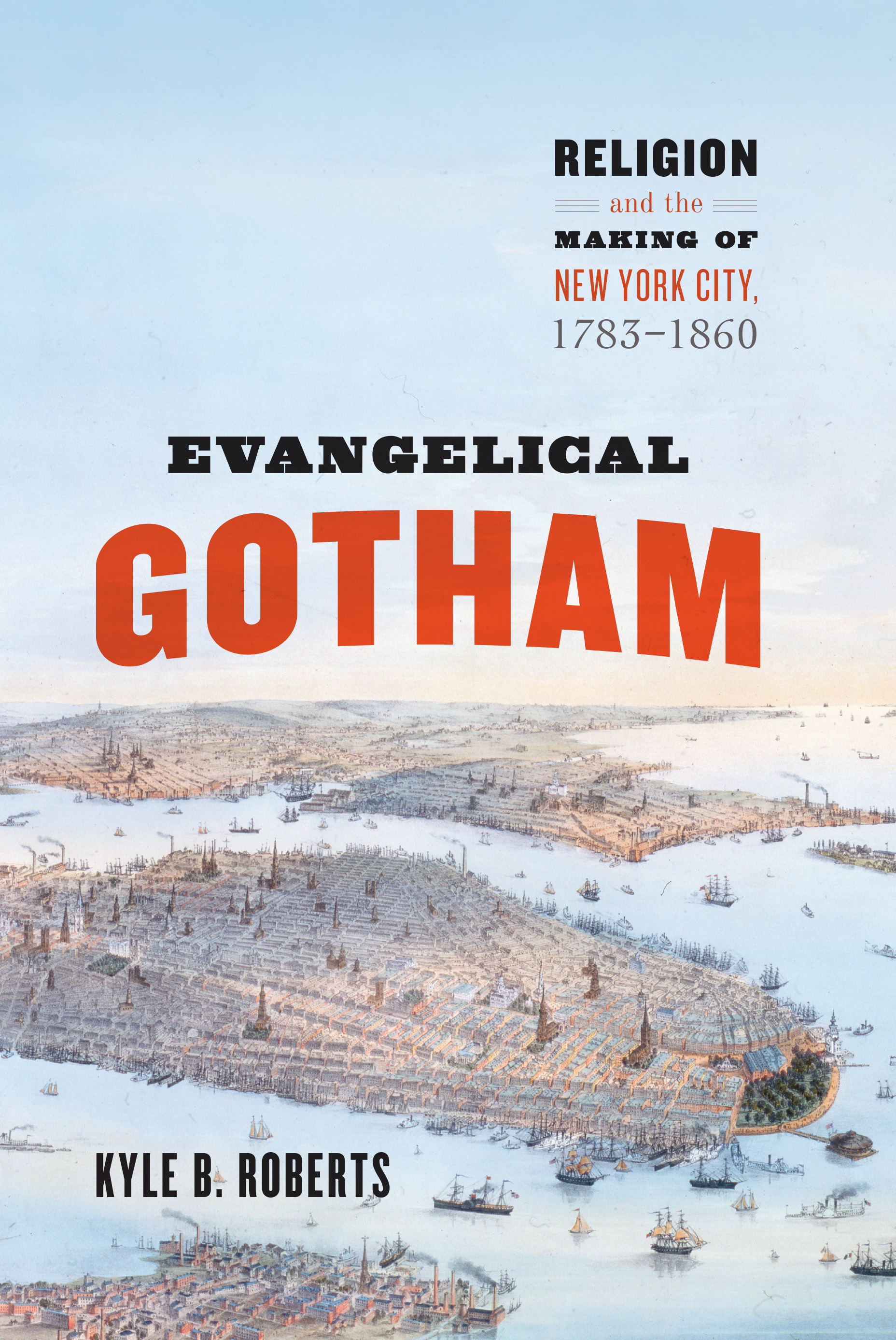
To conclude, I’ve always loved Michel de Certeau’s “Walking in the City” from The Practice of Everyday Life where he reminds us that to truly understand a city, we must go down from the height of steeple to the level of the street. It is in the daily movements and interactions of men and women, the “ordinary practitioners of the city,” that the city is constituted. I fully embraced that idea and spent much time looking closely at what I found down there. Catherine O’Donnell’s comments remind me however of my need to climb back up into the steeple, or better yet, to figure out where John Bornet secured his view of Manhattan in his panoramic birds’ eye view that adorns the cover of my book. John McGreevy, in his comments on the twenty-fifth anniversary of Parish Boundaries published in this blog a few months back, refers to this as the need to remember to come up for aid.  What can I say? Evangelical Gotham is a seductive place! But I wholeheartedly agree that pulling back to see the commonalities across time and space is essential. My journey through Evangelical Gotham has, in some ways, come to an end while it is just beginning for others. Fortunately for me, I am beginning my next journey with the rich reflections of four fellow travelers in my head and my heart.

spacer

On Maps, Faiths, and Works

This next post in our ongoing roundtable review of Kyle Roberts' Evangelical Gotham comes to us from Christine Croxall. A scholar of the religious histories of the Mississippi River Valley at the dawn of the nineteenth century, Crozall is a postdoctoral research associate at the John C. Danforth Center on Religion and Politics at Washington University in St. Louis. Her post is also the last in this series. Kyle Roberts' response will come tomorrow.

by Christine Croxall


Old St. Peter's Catholic Church
Huzzah for visuals! In Evangelical Gotham Kyle Roberts not only gives us woodcuts, drawings, and paintings of the meetings houses that dotted early Manhattan, but he also provides seven maps plotting New York houses of worship for the years 1790, 1810, 1823, 1828, 1834, 1845, and 1856. These maps and the series of congregation and membership tables in the appendix, I suspect, will become definitive data for early New York religion.

 The final chapter of Evangelical Gotham is, in my mind, the key to the entire project. The question it considers is not so much why did the stakeholders of a dwindling Methodist congregation come to fisticuffs in the street in 1856? but instead, what does the church's history tell us about evangelicalism's role in the expansion of New York City? Roberts traces how the members of John Street Methodist Episcopal Church rebuilt their meetinghouse in lower Manhattan, not once, but twice in the early 1800s, and then opted—after their public tussle—to stay rooted there rather than moving uptown with their Presbyterian and Baptist neighbors. In Roberts's telling, the John Street church is an exception that illumines a broader trend. By mapping congregations' proliferation and dispersal and contextualizing New York's church growth in relation to the city's economic and demographic expansion, Roberts offers a generative interpretation of religious developments in early New York.


One of the engines Roberts identifies for the burgeoning of urban evangelicalism in the early 1800s is revivalism—not a woodsy romp toward Zion (though camp meetings in rustic Long Island and up the Hudson at Sing Sing did energize some of the faithful), but instead a citified version featuring superstar preachers in local pulpits. Roberts argues these revivals propelled not only conversion and adherence but also urban reform and benevolence efforts. His analysis prompted me to wonder how we can determine causality in church membership. Did revivalism generate lasting religious commitments? Or was individual religious adherence based more on what a person did (or did not do) before and after the revival: going to prayer meetings, attending worship, reading devotional texts, collecting clothing for the indigent, being baptized? What kinds of experiences and practices most often fostered religiosity, and how might we measure and track these factors?

The interplay of actions and faithfulness connects to a refrain I noticed among New Yorkers who chose not to adhere to evangelicalism: a chorus of what the evangelicals would call works righteousness. The dying Deist who rationalized that he drank only moderately and honored the Sabbath by smoking with his neighbors instead of peacocking at church (74), the black man who believed his past sins wouldn't matter if he behaved better in the future (95), and the sick mariner who was "unconcerned about his soul" and had "always lived a moral life and needs nothing more" (106) frustrated their proselytizers by insisting that their behavior more than their beliefs were what mattered.

Catholics, of course, were the ones evangelical missionaries, preachers, and authors typically accused of prioritizing works over faith. Roberts describes the Catholic community in 1810 New York as "small, poor, and marginal, with only one parish" (74). (By 1855 they constituted eighteen percent of the total adult population, more than twice that of the evangelicals [Table A.4, 270-271].) This claim caught my attention. Yes, many of the Catholics were poor, particularly the Irish immigrants who constituted a majority of the parish of St. Peter's in 1810. But was the community so small or marginal? The priest of the parish estimated fourteen thousand Catholics in New York in 1808.  A social historian  mining the sacramental records from 1785-1815 has recovered a dynamic and engaged Catholic community comprised of Irish, French, German and African American residents.  As a scholar who studies how Catholics and Protestants in the early republic used the presence of religious competitors—that is, each other—to spur adherence among their own flocks, I am curious how viewing Catholicism as a true contender for the hearts and souls of early New Yorkers might shift Roberts's narrative of the first batch of evangelicals, the post-revolutionary generation.
spacer

Mapping the Women of "Evangelical Gotham"

We continue our series on Kyle Roberts' Evangelical Gotham with a post from friend of the blog and assistant professor of history at Colgate University Monica Mercado. Where prior posts honed in on the how cities and spaces fit into Robert's analysis, Mercado highlights the ways in which these concepts both mask and reveal gender.

by Monica L. Mercado

During the first weeks of my lecture course “Women in the City,” I introduce my undergraduate students to the complex geographies of lower Manhattan, or what the historian Kyle Roberts calls Evangelical Gotham. Sitting in a classroom in upstate New York, our windows facing the hills and valleys that made up the nineteenth century’s infamous “Burned-Over District,” we scrutinize early engravings of Five Points and other images of men and women navigating urban space in antebellum America.

The Five Points
With Evangelical Gotham: Religion and the Making of New York City, 1783-1860, Roberts reminds his readers that late eighteenth and nineteenth-century evangelical Protestantism -- so often understood as the rural camp meeting, a world away from the imagined depravity of the crowded, congested, “godless” city – was actually an urban phenomenon, deeply rooted in changing ideas of space and place. “Evangelicals,” he writes in the book’s Introduction, “positioned themselves well for the spiritual marketplace by rethinking what made space sacred and experimenting with new kinds of religious places.” Those places often lacked a steeple or set of pews -- recognizable markers of religious architecture in the expanding city grid. Instead, Roberts argues, his actors understood the sacred “to come not from the physical space itself but from the actions of believers.” Storefront churches, publishing houses, hospitals and orphanages could be, in Roberts’ words, reclaimed and reformed by men and women with evangelical agendas. (8)


Building on the foundational work of early women’s historians who located in postrevolutionary New York a new cast of characters reforming the city in their image, Roberts weaves the experiences of white evangelical women throughout this argument. [fn 1] In order to understand the world of Evangelical Gotham, Roberts suggests, we must pay careful attention to leaders such as reformer Isabella Marshall Graham -- whose Ladies’ Society for the Relief of Poor Widows with Small Children “transformed how evangelical New Yorkers thought about the women and men outside of their meetinghouses and inspired a rising generation to attempt to convert the city” (52) – and revivalist Phoebe Worrall Palmer, whose ministry embraced not only print and domestic missions, but also a weekly “Tuesday Meeting” for evangelical men and women held not at church, but in her own parlor on Rivington Street.

How might the historian of American religion visualize these spatial and spiritual conquests? In a series of carefully drawn maps of New York churches inserted throughout the text, beginning with 1790 and ending with an expansive 1856 city grid, Roberts marks only formal houses of workshop, and not the experiments with sacred space that are crucial to his narrative, such as Phoebe Palmer’s townhouse or the Ladies’ Society for the Relief of Poor Widows’ meeting rooms. If Evangelical Gotham is to rewrite the antebellum urban spiritual landscape, does the act of mapping obscure the spatial impact of religious women, whose ministries frequently took them outside of the church sanctuary? Evangelical women’s mobility – both real and imagined, in text and image – is nowhere to be seen when we place church addresses on a map. [fn 2]

 What would a more expansive mapping project look like? In many ways, our historical subjects have laid the groundwork with their extensive publishing operations. In my own research and teaching, for example, I have used the domestic missions of the American Female Moral Reform Society (AFMRS), founded in 1834, as an alternative map of nineteenth-century New York. In their own newspapers, tracts, and memoirs, the women of the AFMRS charted their involvement in new realms of responsibility and geography. My students are captivated by the memorial volume Walks of Usefulness: or, Reminiscences of Mrs. Margaret Prior, a collection of the activities of the Society’s first paid female missionary, who visited thousands of New York families and workplaces every year before her death in 1842. Prior’s vivid descriptions of urban life constitute a significant documentary history of antebellum New York, and the varied experiences of its working poor. Traipsing through “dark, filthy rooms,” “miserable abodes,” and “cold, damp basements,” Prior entered new neighborhoods, homes, prisons, brothels, and factories on a daily basis, determined to repair the degraded conditions of urban life with spiritual and material assistance. [fn 4]

Margaret Prior
 Like many of the other city missionaries Roberts chronicles in his book, Margaret Prior and the AFMRS exhibited an evangelical “mania for quantification. (86) Mobile and “scribbling,” women missionaries like Margaret Prior exemplify the Evangelical Gotham ethos, one that urges historians of American religion to expand our maps of the urban religious landscape. Could a reimagined map help us see how evangelical women missionaries experienced their mobility, and their calling, separate from men? What shape did their paths take – where did these men and women intersect, and where did they meet, outside of the churches? The missionary fervor of nineteenth-century voluntary societies adds new points on the maps of Evangelical Gotham, suggesting the creative possibilities of recentering the act of mapping around women’s movement through New York City. As Roberts writes, “Awakening often involved crossing out of one’s community and into another, which could happen as easily during a walk across the city as a voyage across the ocean.” (22)

Notes

[fn 1] See, for example (and as Roberts also cites), Carroll Smith Rosenberg, Religion and the Rise of the American City: The New York City Mission Movement, 1812-1870 (Ithaca, NY: Cornell University Press, 1971), Christine Stansell, City of Women: Sex and Class in New York, 1789-1860 (New York: Knopf, 1986), and Anne M. Boylan, On the Origins of Women’s Activism: New York and Boston, 1797-1840 (Chapel Hill: University of North Carolina Press, 2002).

[fn 2] Elsewhere, I have argued that evangelical Protestant missionaries and their voluntary societies found reason to portray Protestant women as special conveyors of the word. In tracts, missionary reports, and memoirs, images of evangelical women’s mobility circulated in print across the Protestant world, illustrating battles over religious literacy and women’s influence in nineteenth-century America.

[fn 3] Margaret Prior’s narratives are a terrific teaching tool in the undergraduate classroom. I often assign a selection of Walks of Usefulness reprinted as “A Moral Reformer Makes Her Rounds” in the women’s history collection Root of Bitterness: Documents of the Social History of American Women, second edition (Boston: Northeastern University Press, 1996), 198-203.
spacer

The Places of "Evangelical Gotham"

Today we continue our roundtable review of Kyle Roberts' Evangelical Gotham with a post from longtime RiAH blogger Lincoln Mullen. You can see the rest of the posts in this series here. 

by Lincoln Mullen

New York's churches 1845
from Roberts, Evangelical Gotham
 In his elegantly written account, Kyle Roberts takes his readers on a tour of Evangelical Gotham. The book has a strong chronological through line, explaining how evangelicals went through three distinct periods in bringing their message of conversion and reform to New York City (10--11). While the spatial organization of the book is less obvious from its table of contents, Evangelical Gotham is a book that is fundamentally organized around place. This may seem like an obvious point to make about a book that focuses on a single city, but my aim is to show how Roberts uses spatial concepts.
Evangelical Gotham is explicit in its debt to the concept of "crossing and dwelling" articulated by Thomas Tweed. Roberts makes this clear in his first chapter, where he writes about spiritual autobiographies at the end of the eighteenth and beginning of the nineteenth centuries. He takes a fresh approach to this topic by giving conversion narratives a meaning both in geographic and spiritual space. Evangelicals crossed religious boundaries by converting, but many of them did so at the same time that they were crossing the ocean or moving to the city. And once they arrived in New York, these newly converted evangelicals had to dwell not just in the city but also had to find a church or "community of faith" (27).

Geographic and spiritual space were thus experienced in mutually constitutive ways. This conjunction becomes a key to understanding much of the book, as does the emphasis on conversion. Conversion and other themes such as benevolence or reform recur throughout the book because they were perennial evangelical concerns. A real contribution of the book is the way that Roberts sets those concerns in relation to other questions such as denominational affiliation and worship practice. A key sentence comes in the conclusion, where he writes, "As denominational and sectarian choices proliferated, evangelicalism's appeal lay in the ease with which its small core of common principles could be incorporated into the matrix of beliefs and practices provided by them" (254). As any number of studies have told us, evangelicalism is a transdenominational movement focusing on conversion. Evangelical Gotham shows how people who held those evangelical convictions had to live them out in different churches competing within a single city. If most studies of evangelicalism are weighted towards crossing, then this book gives due emphasis to dwelling.
This book can also be understood in terms of the meaning of places. Geographers make a distinction between space and place. Space is abstract location: the island of Manhattan, or the latitude and longitude coordinates that identify it. Place is the meaning that humans make out of space. This book shows how evangelicals made, or attempted to make, the space of New York into a religiously meaningful place. As he points out, for evangelicals "sacredness was understood to come not from the physical space itself," as it might for Catholics or Episcopalians who consecrated worship spaces, "but from the actions of believers who gathered there to hear the gospel preached" (8).

Other scholars have used that same concept, but Evangelical Gotham applies it a great many kinds of places. Turning different kinds of spaces into places that had meaning for evangelicals is thus a kind of analysis common to each chapter. Doubtless I have left out some of these kinds of places or movements, but a non-exhaustive list includes immigration into and out of the city; the locations of churches within the city and their movement over time; the domestic space of the home; the architecture of churches and the use of storefronts and homes as worship spaces; "mixed use" spaces put to both religious and commercial uses, not least the homes of benevolent organizations like the American Tract Society and American Bible Society; "bethel" services held on board ships; the commercial space of both the religious marketplace and the financial and consumer marketplaces; the grid of New York streets that controlled the placement of new churches and the expansion of evangelicalism; riots in the streets targeting abolitionist evangelicals; and networks of commerce and mission, expressed not least in networks of print.

The discussions in the book are under-girded by Roberts's maps, in which he plots the locations of churches over time and categorizes them by denomination and whether or not they were evangelical, and by his appendix, in which he gives membership figures for various denominations over time. This empirical work lets him claim that "evangelical congregations emerged from the margins to the center of the urban spiritual marketplace," eventually constituting 59 percent of churches (264). And it lets him claim that "the percentage of New Yorkers who had a conversion experience and joined an evangelical church increased steadily from 4 percent of the city's adult population in 1790 to 15 percent in 1855." These figures are also put to good use in showing whether congregations attracted new members via converting the lost or merely attracting existing evangelicals (173). This quantitative work is pursued with a rigor seldom seen since the work of Terry Bilhartz or Paul Johnson,

I do not wish to give the impression that the book is as laden down with theory as this review, because it isn't. And for that matter, the book touches on a great many topics, from abolition to the financing of churches, which I do not have space to discuss here. This book is likely to become essential reading for anyone wishing to understand early nineteenth-century evangelicalism or how religion functions in urban spaces. It seems to me that all of the contributions in the book are aligned to these questions about crossing and dwelling, space and place---just as evangelical churches and organizations were once aligned to the grid of New York streets.
spacer