Showing posts with label teaching. Show all posts

Syllabus Season Pro Tips Part II: Active Learning

Syllabus writing season, for me, can be a bit of a bittersweet exercise. Sort of like Tom Hanks in the beginning of You've Got Mail, I love the beginning of fall and continue to be optimistic that this academic year will be better than the last. At the same time, in order to get there, I have to think about what worked and what didn't work in my classes. Reading student evaluations is a part of that process (more on that tomorrow). But so is my own self-assessment, which can be just as frustrating but for different reasons. I'm constantly wondering how I could have taught an event or idea better.

So active UNI Honors students and I left the classroom
to discuss the U.S. and Global Islam outside (Fall 2017)
Whether I'm teaching a new course or a course in my regular rotation, I like to try new things. This is a direct result of my time at FSU. Like any grad program with a strong institutional memory or social cohort, we shared teaching strategies and swapped stories about what worked and what didn't. At the time, trying new assignments (like Emily Suzanne Clark's use of the "unessay") or new points of reference (like Charlie McCrary and Mike Graziano's focus on law, parts I & II) was a helpful way to find my own style and preferred strategies. To me, this blog was an important extension of that community of shared discovery as, for example, Mike Altman, Paul Harvey, and Kelly Baker shared their use of Twitter and social media in the classroom or Monica Mercado shared her syllabus for a course on Sex and Sexuality in Modern U.S. History. Over time, seeking new ideas and approaches became a part of how I think about and approach teaching in general. It helps me see "old" courses in new ways and, hopefully, sharpen my teaching skills.

One way my teaching has changed since graduate school is that I have incorporated more "student-centered" active learning into my classes. What I've learned along the way is that this language is more intimidating than actually implementing it. Simply, I have an active learning classroom when my students do stuff during class time other than take notes of my lectures. I haven't abandoned lectures nor have I written them off as ineffective forms of teaching [I still find value in lectures], but I have yielded more lecture time to other learning activities in the classroom. It seems kind of counter intuitive, but the more I thought about it the more it made sense. In graduate school I preferred to lecture because I was developing my own mastery of the material, but giving up on content-delivery and giving up the front-and-center position in the classroom was one way I demonstrated greater mastery of the material and the classroom. My students and I didn't need my lectures like I thought we did. In fact, when I started to read more about it, I realized my students were already doing more active learning than I realized.

The hard part was merely deciding what to do instead of lecturing. So many things "count" as active learning, some useful and some I find to be pretty corny. But, you should decide for yourself. Here are some helpful lists:
  • Vanderbilt, Center for Teaching, Active Learning
    • Think-Pair-Share: This one is pretty straightforward. You ask the class a question and have them write it down or just think to themselves. Next, have students turn to a neighbor talk about their answer as pairs. Depending on the class size you can have the pairs find another pair to discuss as a small group. Then, have the pairs or groups share their response with the class. At UNI, students tend to be very shy and reserved so TPS is something I do from day 1. It can be near impossible for some of my students to feel brave enough to answer an open-ended question on their own, so TPS allows students to share their thoughts while delivering it as what the group talked about. Plus, once students talk to one another it's pretty clear that they weren't the only ones who came to a particular conclusion. Much less risk of being embarrassed.
    • Student Generated Test Questions: Again, pretty straightforward. As a part of a review day or review activity, have students write example questions for the exam. When I do this, I usually have students (working in groups) write a mid-term or final exam essay question based on what they think the major themes or questions of the class have been. It's a great assessment of your teaching and their learning. If everything is going well, then most students won't have a problem identifying major themes of a unit or the whole course. Plus, it can give you sense of how prepared they are to answer an essay question. Are they writing essay questions at a higher level of difficulty than you intended? lower? on par? Your assessment of their review session can give you a sense of class performance before students take the exam.
  • Yale Center for Teaching and Learning, Active Learning: 
    • Jigsaw: This is a favorite of mine, but it does take some planning, explanation, and practice, but once students "get it" they can move through the activity on their own. How's it work? Divide students into small groups. I often do this when I have multiple short readings (like different primary sources on the same event). As a small group, students discuss the readings (like "What happened?") with each student in the group focusing on something different (becoming an "expert" in one source's point of view). After a set amount of time, the designated "experts" leave their original group and discuss finer points with other "experts" in their topic ("What factors affected this source's POV?"). After a set amount of discussion time, students go back to their original groups and revisit the original question. This way students get an opportunity to examine the topic from a big picture and fine grain perspective.
      • Did that not make any sense? Watch this video instead.
      • Alternative: When I have a dense reading with multiple concepts I want students to know (e.g. a challenging journal article or chapter), I start class by dividing students into "expert" groups with their own retrieval/review question and set amount of time to discuss (eg. What is the argument? What is the source base? What's at stake? etc.). At the end of the allotted time, students form new groups so that there is an expert in each review question at the table and they inform each other of what they had talked about in their "expert" group (one person can talk about the thesis, the sources, what's at stake, etc.) After all that we have a full class discussion, moving beyond understanding the reading to analyzing it together.
  • NDSU, Active Learning Activities
    • Ticket to Leave: I don't do this one, but one of my colleagues does so I thought I'd include it. For this strategy, leave some time toward the end of class for students to reflect on the day's material or answer a question related to it. They have to hand it in order to leave. The idea is that you can have a quick assessment on your teaching and whether or not students go it. The main reason I don't do this is because I don't want the germs paper, but of course this is something a Google Form could fix (and there's a template that already exists).   
  •  last but not least, Cult of Pedagogy, The Big List of Discussion Strategies
    • If you're looking to spice up class discussion, I highly suggest Cult of Pedagogy's Big List, which is helpfully divided between high and low prep strategies. I also just recommend Cult of Pedagogy in general. It's geared toward elementary and secondary ed teachers, but many of the strategies and tips are applicable in higher ed (like for new teachers).
Now I certainly don't think everyone needs to incorporate active learning into their classroom. If you read and follow The Professor is In, then you know Karen Kelsky's first step to a strong tenure file is "understanding the economy of value at your specific institution." This makes a lot of sense beyond tenure-track faculty; adjuncts, grad students, independent scholars--all of us, really--should know what "counts" as doing well at work. Besides the fact that I genuinely like teaching and enjoy trying new teaching strategies, I work at a teaching-emphasis institution that values continuous teaching development, especially with regard to active learning. So, experimenting with new techniques in the classroom and reflecting on what worked and what didn't and why is valued where I work. That isn't necessarily the case for everyone. And that's OK.

In general, though, I would caution everyone--especially grad students who are instructors of record--not to try too many new things all at once. There are so many overwhelming things about teaching for the first time--or really, teaching until you develop your own "standard" approach, whatever that may be--that you want to give yourself the opportunity to develop a style before you start changing it. Judicious incorporation of the techniques above can be one way to figure it out. And, if you find yourself interviewing for a job at a teaching-emphasis university like mine, some familiarity with active learning--even if it is only something you tried once but are willing to learn more about--can go a long way in demonstrating that you "fit" as a teacher-scholar.

spacer

Syllabus Season Pro Tips

My bitmoji reacts to Back to School
products hitting the shelves
As July turns to August, it's approaching that time to recognize that summer is, in fact, ending and the fall semester is approaching again (always too quickly, ammirite?). In an effort to squeeze out as much summer time as possible, I'd like to share two syllabus writing tools I've come to know and love. Both come from the good people at Rice University's Center for Teaching Excellence.

On a ridiculously consistent basis, I botch my course schedule. I usually don't have a problem with organizing the content of my course schedule--that may take me awhile, but I enjoy piecing together readings, podcasts, lectures, and in-class activities to create a cohesive course. No, no, the part I regularly mess up is the calendar. As in the actual dates of my class meetings. I will inevitably use a Wednesday date for a Tuesday/Thursday class or, in one instance, just leave out an entire week. (Although that wasn't so bad because my when my wonderful students pointed it out to me it was a happy surprise to have another week of class. Or, at least, I thought so.) I could tell students those errors are there "to see if you were reading closely" but that would work approximately 0 times because a) I'm a terrible liar, b) I want my students to know we all make mistakes (See "What is the Error Climate of Your Course?"), and c) I find it hilarious at this point. What I've started doing instead is turning to the Rice Syllabus Maker created by Caleb McDaniel. Plug in what days your class meets, your preferred format, and viola!  

More importantly than the calendar, the tool I've been an evangelist for is the Course Workload Estimator. The CWE is the answer to one of the questions I as a teacher--and my students as, well, students--consistently ask: how much reading/writing is appropriate for this class? Students and instructors are likely to come to different answers, and many of us expect our students to always want as little work as possible. (I don't think that is accurate, but why is for another post.) Even so, it's important to ask, how do we know--or, ultimately, how do we decide when we don't know for sure--what's appropriate? I don't think it's enough, or good pedagogy, to assume the amount I read/wrote when I was student is the amount my students should be reading or writing. Not only has a lot changed about the way students read, access, or process information, but also--surprise!--my students are not me. Many, if not most, of my students are coming to college from a different background and context than me. I didn't exactly know what I was doing, but as a white woman with academic scholarships I did have well honed study habits, a sense of what a college-level essay looked like, and the economic and social security to treat my classes as my primary "job" and share that "reading" was my hobby during ice breakers. (If you are thinking "Nerd Alert!" you would be accurate.)

Fortunately, Drs. Elizabeth Barre and Justin Esarey have done the research for us. They scoured the literature pertaining to student reading and writing, which they review in their explanatory blog post about the CWE. Based on their synthesis of current research, they created a handy tool that gives educators a sense of how much time it takes students to do their coursework. What is particularly helpful is that the estimations are not just based on the page count of the readings or essays you're assigning. The CWE takes the difficulty level into account by prompting you to enter information about how many new concepts are found in the text or how closely you would like students to read (e.g. Is it a newspaper article written for a general audience or is it a journal article filled with jargon from the field?). Similarly for written assignments, the CWE accounts for the differences between assigning written reflections and thesis-driven essays as well as final essays that have received revisions and original drafts. Best of all, you can plug in details of your specific expectations or you can turn to their handy guidelines (found in the explanatory blog post linked above). If nothing else, by using the CWE you can gain a research-based sense of the workload you're requiring aside from any perceptions you, your students, or colleagues may have about the appropriate amount of work to assign students.

I even get out in front of potential student criticisms by telling my students that I used this tool when I crafted the course schedule. I say so on the very first day of class as we go over class expectations. Even if you're dubious about the utility of the CWE, I do so as a part of my effort to show students that the syllabus didn't fall from the sky. I put my intellectual labor into it. And, I did so based on my expertise and the expertise of colleagues. Its an effort, I hope, demystifies the role and purpose of a professor (I talk about that too). Additionally, based on what we know about student biases and other problems with student evaluations of their professors, the CWE can be one way that you as an instructor can professionally respond to criticisms of your teaching. For example, consulting CWE while planning your course can demonstrate a commitment to teaching effectiveness or attentiveness to current pedagogical development; alternatively, consulting CWE in response to student complaints or poor evaluation ratings could demonstrate responsiveness to criticism without the emotive language that makes teaching reflections unbearable. If your institution first values teaching effectiveness (which some schools won't) and if your institution encourages instructional reflection as a part of or separate from evaluation and promotion, then this might be something to consider for teaching development alongside teaching effectiveness.
spacer

Undergraduates Actually Want a Liberal Arts Education

Andrea L. Turpin

Undergraduate students actually want a liberal arts education—when presented with the arguments for it. How do I know?

First, some background: this year the College of Arts & Sciences at Baylor University approved a unified core curriculum for all of its students, from physics majors to English majors. Like all human products, this specific core has its strengths and weaknesses. But I love working for an institution that values the liberal arts enough to require a large proportion of its students to take courses across a fairly broad range of subjects. In fact, several of the courses in the core are straight-up required—all students must take exactly those courses. The rest of the core consists of the more common “distribution list” system whereby students select courses from among several options in each area. After fulfilling the core requirements, A&S students complete their degree with a combination of electives and additional requirements for their particular major.

In the town hall faculty meetings leading up to finalizing the content of the core, I shared an exercise I have done with students four times now, stretching over nearly a decade. This exercise has yielded uniform and, to me, surprising results: undergraduate students really want a large liberal arts core curriculum. Let me explain.

Given my research interests, I like to work the history of higher education into my courses. It always proves popular because students rarely get it in their other classes and they find it so obviously relevant to their lives. I have managed to work this particular exercise into a course I taught once at Notre Dame on American reform movements and a course I have taught three times at Baylor on the Gilded Age and Progressive Era. Because of enrollment policies at both institutions, these classes all included a large number of students who were not history majors.

James McCosh
During a week spent teaching the massive changes to American higher education that occurred in the decades around 1900, I hold an in-class debate on whether a college curriculum should consist primarily of required courses or primarily of electives. Before class, I have students read the respective arguments advanced by James McCosh, president of Princeton (1868-1888), and Charles William Eliot, president of Harvard (1869-1909).


In brief, McCosh defended a more traditional, largely required liberal arts curriculum by arguing that not all courses impart the same level of mental training and, human nature being what it is, most students would elect the easiest courses if given the opportunity. McCosh added that many students only discover their talent for and interest in a subject during a course they would never have elected to take. Finally, he asserted that full human development requires fostering several different types of mental capacities, and true education requires a certain breadth of knowledge about the world. Meanwhile, Eliot defended a “new departure” in college education by boldly arguing for an entirely elective curriculum. He argued that students enter college with exposure from high school to a wide variety of subjects and already know their tastes and talents. They would dedicate themselves more to classes that genuinely interest them, and would thereby better learn the sorts of reasoning skills that can be actually be gained through any number of widely varying courses. Simultaneously, they would thus better directly prepare themselves for work after graduation.
Charles William Eliot

For RiAH’s readership, I should note a similar argument between these educators over collegiate religion. As I discuss in more detail in my book (along with their views on women's education!), McCosh defended requiring students to attend chapel—although you cannot make a horse drink, you have a moral obligation to lead him to water—whereas Eliot made chapel voluntary and sought to induce students to attend by filling the pulpit with a rotating supply of famous ministers.

In class, I assign students to teams and have them draw on McCosh’s and Eliot’s respective arguments to debate the nature of an ideal college curriculum. I then force students into an all-or-nothing choice—entirely required courses vs. entirely elective courses—and have them vote what they really think (as opposed to speaking for the side to which I had assigned them for the debate).

I have been asking students this question since Fall 2009 (with the most recent poll being Fall 2017) and the result always is the same. Every. Single. Time. Here it is:

50% vote for entirely required, and 50% vote for entirely elective. Let this sink in for a minute. Fully half of my students believe so strongly in the value of a robust liberal arts education that they are willing to give up all choice in the curriculum to get it. And the half that voted for an entirely elective curriculum does not actually find that forced choice ideal—they would prefer that some of the curriculum be required. After the initial vote, I let students choose between “greater than 50% required” vs. “around 15% required,” and it still comes out 50-50, although some students switch camps. It’s important to note we were debating requiring specific classes, not merely requiring selecting from distribution lists. So students were voting for greater than 50% of their curriculum being exactly defined.

Moral of the story: When they have a chance to think through the best arguments from educators of the past, students buy into the idea of a liberal arts core more than we think they do...even to the point where half of them don’t think 15% is enough and are willing to go with greater than 50% to get more. And even to the point where half of the them would recommend an entirely required college curriculum over one where nothing was required.

Although I am considerably more in favor of majors and electives than was McCosh, I believe that overall students benefit from a comparatively larger liberal arts core, for the reasons he advanced. It should be an encouragement to those of us who teach in what may be the ultimate humanities discipline—history—that when students hear those arguments, so many of them agree. We just need to share that history with them. Fortunately, that’s what we do well.
spacer

Music and the Undergraduate Classroom

By: Emily Clark and Lauren Turek

In the middle of January, the wonderful Rachel Lindsey asked her Facebook community for their recommendations on songs for a playlist for her American Christianity course. This got Lauren and I (Emily) messaging each other about how we use music in our classrooms. Because we both believe in thoughtful teaching and collaborative work, we're posting together about the pedagogical value of music in the undergraduate classroom.

Emily: I use music everyday in my undergraduate classes. I get to my classroom early and as students come in, I have a song playing (with song title and artist posted on the screen) that intersects with the day's topic. (Full disclosure: I stole this idea from Chip Callahan.) The song plays as they come into the room and get settled into their desks. Some students chat while the song plays, others sit and listen. I think of it as the class mood music that sets the tone for the day. And, as some of my students have remarked on, the music gets at the topic in another way. As I wrote on the blog in a post on teaching with primary sources, "There's so much about The O'Jays' "Ship Ahoy" that sets the right atmosphere for a discussion of religion and the Atlantic slave trade. And Depeche Mode's "Personal Jesus" is just a fun way to begin a class on the Second Great Awakening." My favorite element about starting off with the mood music is that it sets apart the classroom as a different space. My classes are typically in the very busy main building on my institution's campus. The hallways are packed with students moving from one room to another or waiting for a class that's going over late to release. Playing music highlights the boundary between the hallway (a liminal space) and the classroom (another liminal space, but a very different one).

Lauren: In an effort to give my students a sense of the past, I also incorporate music into my classes, particularly in my modern U.S. history survey. Much like Emily, a few minutes before class begins, I start playing a song that in some way evokes the period or theme of the class (an idea that I poached from Bart Elmore). I then use the song lyrics to frame my brief introduction to the class topic of the day. For example, I play a recording of “The Old Chisholm Trail” to discuss enduring myths about the American West before my lecture on transcontinental expansion, the Indian Wars, and the Ghost Dance. Where the song relates humorous tales of rugged, lone cowboys conquering a wild, empty frontier, in class we talk about the significant role that federal policy played in transcontinental expansion as well as about the various strategies—including spiritual and religious strategies—that native Americans used to resist or cope with the change that expansion wrought. Religious themes also come out frequently in the music I play when covering the Cold War; there is lots of apocalyptic language in songs about atomic weaponry! I also like to bring in sheet music wherever possible. Being able to see the colorful cover art, the lyrics, and the notation as a song plays adds further context. Comparing the sheet music for World War I-era songs such as “I Didn’t Raise My Boy to Be a Soldier” to “What Kind of an American are you?” help students understand shifts in public opinion or understandings of international affairs, for example.

Emily: In James Lang's 2016 book Small Teaching: Everyday Lessons from the Science of Learning he describes the small changes we can make to our courses that can enhance student learning and make big differences. He defines small teaching is “an approach that seeks to spark positive change in higher education through small but powerful modifications to our course design and teaching practices” (5). When it comes to pedagogy, small things can be big things. In addition to marking the space of the classroom and encouraging reflection on the day's topic in a new way, playing music in the few minutes before class serves an additional and very practical pedagogical function. (I hope) It lessens student anxiety. Some students are outgoing, some aren't. Some students come into a class with friends, others come into the room knowing no one. It can be uncomfortable or overwhelming to sit quietly while feeling like you're surrounded by people who all know each other. My hope is that the music cuts across that. No one is just sitting in silence. One of our Deans of Student Life recently informed us that mental health issues are expected to soon eclipse all other student life concerns (including drinking and Title IX). If I can help students feel more comfortable in my classroom, then hopefully I can also help them feel more confident there too.

Lauren: In addition to the goals that Emily highlights, which I share, I also have specific pedagogical goals. Playing music (and even looking at sheet music) helps students connect with the people of the past in a different way. The students can connect with the music on an emotional level. Reminding them that many of the songs I play would have been part of the soundtrack of life for some of the very people we are talking about in class connects them with the past in a different way. Knowing that Americans in the past would have gathered around the piano to play the sheet music we’re studying in class, or might have heard the song I started the morning with on the radio or their Victrola is powerful. Making these connections and realizing that the people we read about in our books and primary sources were real people helps my students develop historical empathy. At the same time, the differences that students can identify in the sounds, daily activities, viewpoints, and language that comes through in the music also reminds them of the gulf that separates past and present. It also helps everyone settle in to my classes, which are in the mornings, and get ready to tackle the topics of the day.

Some Playlist Favorites from Emily and Lauren:

Emily: A class on Catholic immigration starts with "Rebels of the Sacred Heart," by Flogging Molly. A class on Father Divine kicks off with "Accentuate the Positive," performed by Bing Crosby and The Andrew Sisters. A class on Native American religions and colonialism starts with "My Land" by Litefoot. Any class discussing the civil rights movement can open with "Mississippi Goddam" by Nina Simone. A class on modern indigenous spiritualities starts with "Electric Pow Wow" by A Tribe Called Red. For a class on black Judaism in the Great Migration, "Burn Devil Burn" by the Soul Messengers gets the class in a good groove. A class meeting on European colonialism can open with "Great Nations of Europe" by Randy Newman. And if you're talking black power and religion, "Fight the Power" by Public Enemy is the only way to go.

Lauren: There are several songs that I play in my modern U.S. history survey that have a relation to American religion. Some, such as the Merry Macs song “Praise the Lord and Pass the Ammunition,” recorded at the height of World War II, Jackie Doll and his Pickled Peppers, “When They Drop the Atomic Bomb,” and The Buchanan Brothers “Atomic Power” speak to Christian nationalism in one way or another. There are many gospel songs and spirituals to play when discussing the civil rights movement; while I always play some of the songs that activists sang while marching I am also very partial to Sam Cooke’s “A Change is Gonna Come,” though it makes only a passing spiritual reference. I do play several Sister Rosetta Tharpe songs during the semester, many of which have gospel roots, and enjoy playing her classic “That’s All,” which touches on sin and religion, in the last class of the semester. I also wholeheartedly agree with Emily’s suggestion of playing “Fight the Power” when covering black power and religion.  

spacer

Faith in Black Power: Reflections on Teaching the Civil Rights Movement in My Place

What happens when you rearrange a civil rights movement class to prioritize the North? The long civil rights movement framework, which has greatly influenced my own writing, explodes the traditional southern-focused, 1954-1965, King-based narrative that has been so dominant in the general American psyche and helps students to see that race has not been just a southern problem (although there are things unique to the South), that Dr. King was not the only leader, that women’s activism and questions of gender are important, and that the movement was not just about integration.  The long movement framework, as Jacqueline Dowd Hall conceived it in 2005, does not adequately account for religion, but there are some great books that do explore religion in the classical and long movements (I have used Charles Marsh's God's Long Summer and Patrick Jones's The Selma of the North in my classroom).

Place matters, and I’m becoming more convinced that institutions of higher education - education which should shape people, not just minds - have a responsibility to help students learn to live well in a place, so they can work for the common good (which includes people and the environment, see Jack Baker and Jeffrey Bilbro on Wendell Berry and Higher Education).  This semester, I rearranged my civil rights movement general education class to prioritize race and movement activism in the North, and in Chicago and Wheaton (where I teach), specifically. 
I did so to help ground my students, quite literally, with the hope that doing so would help them see their current context more clearly.  We dug into the Wheaton College archives to construct a story of its racial history and relationship to the civil rights movement, and we read primary and secondary sources on the North in the course’s third unit, which led many students to write their midterm primary source research paper on questions grounded in the North.  A key question for our focus on the north was how religion – in this case evangelicalism (with Wheaton College) and Catholicism (using chapters from my forthcoming book, One in Christ: Catholics and the Quest for Interracial Justice in Chicago, shameless plug) – both reinforced and tore down racial hierarchies.

Our last major unit was on Black Power, but I failed to offer my students opportunities to really dig into how religion intersected with Black Nationalism in the movement.  Malcolm X and the Nation of Islam offered one entry point.  Marsh’s discussion of Black Power in his chapter on key SNCC leader Cleveland Sellers offered another.  Marsh argues that SNCC’s expulsion of white members in 1967 made SNCC the closed society writ small, a parallel to the white Mississippi religious culture that turned its back on the other, and a far cry from the beloved community that Fannie Lou Hamer helped foster in Mississippi (and that Marsh celebrates).  In keeping with my local theme, we explored the Chicago Police Department’s murder of Fred Hampton, fostered by the FBI’s COINTELPRO, and analyzed the Eyes on the Prize “Nation of Law?” episode, which is excellent but, like the series as a whole, lacks sustained attention to religious questions.  The episode shows an interview of Father George Clements (for the full interview transcript, go here) who talks about holding a mass for Hampton after his murder.  It also shows Hampton speaking in a church to an interracial group (you can see footage of Hampton in the church in the preview for The Murder of Fred Hampton).  But Clements as a Catholic is not a question the film digs into.

Overall, the iterations of Black Power I provided for my students to explore were either not religious (which for many activists was not), or if they were religious, they were anti- Christianity (as with NOI and SNCC’s black power phase).

And yet, I know that is not the case.  There is a powerful tradition of Christian faith, both Protestant and Catholic, in Black Power movements, whose adherents saw their efforts for black advancement as part and parcel with their Christian faith.  My own research on Catholic interracialism is bookended by black Catholic nationalism.  

I want to share some resources I'll be drawing on next time I teach this class to improve our study of the intersections between black nationalism and Christianity: Kerry Pimblott’s Faith in Black Power: Religion, Race, and Resistance in Cairo, Illinois and Matt Cressler’s Authentically Black and Truly Catholic: The Rise of Black Catholicism in the Great Migration.

Here’s the University Press of Kentucky’s summary of Pimblott’s Faith in Black Power:

In this vital reassessment of the impact of religion on the black power movement,Kerry Pimblott presents a nuanced discussion of the ways in which black churches supported and shaped the United Front. She deftly challenges conventional narratives of the de-Christianization of the movement, revealing that Cairoites embraced both old-time religion and revolutionary thought. Not only did the faithful fund the mass direct-action strategies of the United Front, but activists also engaged the literature on black theology, invited theologians to speak at their rallies, and sent potential leaders to train at seminaries. Pimblott also investigates the impact of female leaders on the organization and their influence on young activists, offering new perspectives on the hypermasculine image of black power.

And here’s New York University Press’s summary of Cressler’s Authentically Black and Truly Catholic:

The sweep of the Great Migration brought many Black migrants face-to-face with white missionaries for the first time and transformed the religious landscape of the urban North. The hopes migrants had for their new home met with the desires of missionaries to convert entire neighborhoods. Missionaries and migrants forged fraught relationships with one another and tens of thousands of Black men and women became Catholic in the middle decades of the twentieth century as a result. These Black Catholic converts saved failing parishes by embracing relationships and ritual life that distinguished them from the evangelical churches proliferating around them. They praised the “quiet dignity” of the Latin Mass, while distancing themselves from the gospel choirs, altar calls, and shouts of “amen!” increasingly common in Black evangelical churches. 

Their unique rituals and relationships came under intense scrutiny in the late 1960s, when a growing group of Black Catholic activists sparked a revolution in U.S. Catholicism. Inspired by both Black Power and Vatican II, they fought for the self-determination of Black parishes and the right to identify as both Black and Catholic. Faced with strong opposition from fellow Black Catholics, activists became missionaries of a sort as they sought to convert their coreligionists to a distinctively Black Catholicism. This book brings to light the complexities of these debates in what became one of the most significant Black Catholic communities in the country, changing the way we view the history of American Catholicism

Both books not only will complicate the relationship of religion and black power, but will also help me teach my students in Illinois, serving the dual purposes of helping them to learn about the place they live and exploring the myriad ways religion shaped race and civil rights activism – including Black Power, and vice versa.
spacer

End of the Semester Reflections

Jonathan Den Hartog

Back in September, I had reported I was kicking off my "American Religious History" class this semester with some changes. Now, with the semester almost done, I figured a look back would be appropriate.

Most importantly, I had promised some report on teaching Rick Kennedy's biography of Cotton Mather. I can attest that it taught well, and I thought it communicated a lot of complex ideas about 17th- and early 18th century Puritanism really gracefully. Several of the hooks in the book worked marvelously. My students were most impressed that Mather had shown up as part of the Marvel Comic Universe. They were also impressed that Mather had diagnosed the Babylonian King Nebuchadnezzar as a werewolf. In perhaps the best tribute, one of the students created a historical card game in which Cotton Mather featured prominently.

More generally, I was struck by several other features going through the class this semester.

First, the class really leant itself to making connections of the past with the present. This semester such concerns felt perhaps a bit more urgent, and the study paid off. This was helped by several students who kept bringing us back--appropriately--to how the study of the past could inform thinking about today. I hope the class gained some insights, some context, and some language to make sense of 2017. Such understanding is in short supply all around.

Second, in thinking about how "past" the past can be, I was struck by the shift in the feel of the course and of American culture once we hit the mid-1960s. This is no surprise to recent American historians who chronicle the later 1960s, but the shift was a bit jarring in the class. There were clear breaks from the 1950s and early 1960s to the cultural and religious upheavals of the later 1960s and 1970s. We recently illustrated this with the Jesus People movement and how it reoriented Protestant church life and worship. Although the clothes styles have (fortunately) moved on since that time, the larger issues resonated with the class.

Third, I was impressed by the on-going tensions in American religious life mapped out between poles of the individual, his or her religious community, and the broader American society. I found myself repeatedly underlining how this issue reappeared and how it shaped religious experience. This theme, again, felt more pointed this year than in years past. Still, I hope it proved useful, not only for understanding past American religious expressions, but for understanding the tensions of the current moment.

Finally, I can report that we're getting ready for a foray into Kate Bowler's history of the Prosperity Gospel Blessed. I'm interested to see how the class will connect it to earlier topics we've studied, to see what comparisons they might draw. I'm very curious to see if any parts of her description of the movement resonate with my students and what they make of the world she describes. And, if all else fails, I'll rave about the network analysis she provided to describe connections in the Prosperity world.

All in all, this proved to be a great class that I'll appreciate for a long time to come...or at least I will, after I finish the semester's grading!

For readers--how would you reflect on your semester's experiences? What worked well? What didn't?
spacer

Democracy, Higher Education, and the Problem of the Common Good

Andrea L. Turpin

A month ago I attended two national conferences on back-to-back weekends: the Society for U.S. Intellectual History (USIH) met October 26-29 in Dallas, TX and the History of Education Society (HES) met November 2-5 in Little Rock, AR. A week and a half of intensive immersion in the current scholarship of two overlapping fields made some common themes jump out. (And also produced fascinating insights into the variable quality of Marriott hotels. But I digress.)

Specifically, I was struck by historians' interest in two topics: the concept of the common good and the problem of how values are, or are not, transmitted to the next generation. I suspect these themes jumped out at me in part because they seem so salient in the current widespread breakdown of civil dialogue. Both of these lenses prove helpful for producing a clearer understanding of U.S. history, especially U.S. religious history—and for seeing how best to frame that history for our students today.

The question of the common good was raised most forcefully in a pair of book panels, one from each conference. USIH dedicated a plenary session to James Kloppenberg’s monumental work Toward Democracy: The Struggle for Self-Rule in European and American Thought (Oxford, 2016). A fair amount of the panelist and audience questions revolved around the role of religious beliefs, past and present, in forming and sustaining democracy. In answer to one of these questions, Kloppenberg articulated his conviction that some conception of the common good is necessary to ground democracy; otherwise politics becomes a zero-sum game. He asserted that historically democracy in the North Atlantic world grew in large part from Jewish and Christian roots—but that most religious and moral systems advocate some version of the golden rule that provides democracy’s necessary ethic of reciprocity. Therefore, democracy can certainly thrive in a climate of religious pluralism, but he fears it might not survive a devolution of belief in our responsibility as individual citizens to advance the common good. (Though Kloppenberg noted that he is by temperament a cautious optimist about our nation’s ability to rally around this ideal more robustly in the future.)


The question thus arises how past generations of Americans have successfully produced a commitment to the common good—and how we can do so again today. A partial answer comes from the book panel hosted by HES the next week on Charles Dorn’s For the Common Good: A New History of Higher Education in America (Cornell, 2017). Dorn’s book examines the different purposes higher education has served throughout American history—but notes that inculcating civic-mindedness has been present throughout. Instilling in students concern for the public welfare has, however, often been eclipsed by competing purposes. Those he details are the ideals of practicality, commercialism, and affluence. In other words, higher education has frequently been largely valued as an avenue to some sort of worldly success—which makes sense, considering how expensive it can be in terms of both money and time. Nevertheless, the existence of a through line of commitment to the common good among higher educational institutions throughout American history provides a rich heritage for contemporary colleges and universities to draw on.

Dorn also served as one of the commentators for the HES panel on my book, A New Moral Vision: Gender, Religion, and the Changing Purposes of American Higher Education, 1837-1917 (Cornell, 2016). He rightly noted that I too perceive the question of the nature of the public welfare to have loomed large in the educational debates that underlay our current college and university landscape. He put the question to me of whether the common good was solely in the eye of the beholder during the fractious discussions about the respective roles of gender, religion, and class in higher education that I analyze—or whether there was some criteria that educational founders, leaders, administrators, and boosters could have used to better adjudicate competing claims.

In many ways this is THE question I believe we have to answer as educators today. I responded that for past educators it seems to have been relatively easy to agree that colleges and universities should serve the public good, less easy to agree on the exact nature of that good, and harder still to agree on how to achieve it. Specifically, I think it is fair to say that both past and present Americans have agreed on many common goods plural, but that it has been much harder to agree on their ranking, and hence on which policies, both educational and political, best serve the nation. Additionally, my findings led me to conclude that it is nearly impossible for any one type of institution to do equally well by all types of students. The institutional pluralism of modern American higher education thus indeed seems best for a pluralistic nation. Yet if all these institutions seek to orient their students toward a common good—even if they do not agree on its exact nature—graduates will be primed for the process of democratic discussion.

But how can we know if students have internalized the moral vision their institutions have cast? I care about this question both as a historian and as an educator. I venture an answer in my book with respect to the institutional histories discussed there, but I also note that the question is notoriously difficult. I was therefore delighted to hear scholars at both conferences wrestling with the question of transmitting values. This theme was rarely the topic of an entire panel, but frequently appeared within individual papers. Collectively these papers indicate that attempts to transmit values to the next generation have often been mediated by educational institutions, religious institutions, or both. They have likewise been bound up in the tension between serving a particular religious community and serving the wider community:

Pete Cajka noted how the nineteenth-century U.S. Catholic school system sought both to preserve the faith and to form citizens. Benjamin Park noted how both Catholics and Mormons of that era shared a concern to stabilize American democracy by grounding Christian values in a religious hierarchy that could constitute a court of final appeal throughout time. I highlighted in my USIH presentation considerable concern within early twentieth-century mainline churches for how to retain the involvement of a new generation of college-educated women who were finding more opportunities for their talents outside the church. John Compton examined how J. Howard Pew’s father tightly controlled his education to inculcate in him a more conservative view of the relationship between Christianity and economics than characterized the bulk of his fellow Presbyterians. Daniel Williams noted how mid-twentieth century mainline apologists sought to defend Christianity not primarily for its own sake, but rather because they believed its values sustained the democratic political order.  Mario Rewers determined that students of the pioneer American studies classes actually valued and internalized their intended lessons in critical thinking. Elesha Coffman described how Margaret Mead wrestled with the problem of revising the baptismal liturgy of the Episcopal Church: if it changed too much, it wouldn't pass on the essence of the faith to the next generation, but if it didn’t change enough, that new generation would refuse to receive it. Matthew Bowman discussed how Robert Bellah’s concern with cults—very successful at transmitting their values and beliefs—focused on their separatist lack of interest in the common good. And Milton Gaither detailed what factors have correlated with successfully transmitting religious beliefs to the next generation and analyzed why the contemporary homeschooling movement did not actually succeed in doing so at a higher rate than average.

So where does all this leave me in my dual roles of historian seeking to understand changing American religious and moral values and educator seeking to instill in my students a desire to pursue the common good? I would say these conferences have challenged me to think more carefully in my own scholarship about how generational continuities and changes occur within educational and religious communities. And they have encouraged me to frame my teaching even more clearly around the pursuit of a common good throughout American history.

Perhaps there is hope: I stole an end-of-semester exercise from my colleague Elesha Coffman and asked students to list (anonymously) one thing they’ll do differently as a result of the class. Student answers included: “After this class, it will be easier for me to understand/appreciate others’ opinions,” “I cannot allow assumptions, fear, or ignorance to cloud my perspective,” “Be careful when discussing certain topics and always do my research first,” and, finally, “What I will do differently is analyze presidential candidates from a more unbiased, neutral perspective rather than putting them exclusively in the box of their political party.”
spacer

Teaching 9/11

Michael Graziano 

On the sixteenth anniversary of the September 11 attacks, I wanted to take a moment to learn more about how others teach 9/11. In my research, I’ve been thinking a lot about the relationship between U.S. national security and American religion. So much of that relationship, at least in the past sixteen years, has been determined by 9/11 and its aftermath.

Like many of you, I cover 9/11 in various courses: the event itself, what led to it, and what happened after it. Yet most of our current students have no memory of 9/11, and we’re entering a period where our incoming students will have been born after the attacks. This means they’ve spent their entire life in a post-9/11 world, and the things they take for granted—like the state of “forever war” brought about by 2001’s Authorization for the Use of Military Force—are the very same things we have to historicize. One way to do this is with comparisons to other American conflicts, as Paul Harvey does in his 2012 Religion Dispatches essay in which he asks if 9/11 really did “change everything” (spoiler alert: it did not).

There’s no shortage of reading about 9/11, of course. I tweeted about some here, but they’re not all strictly related to American religious history. I’m curious how others approach this topic, and what materials you use to do so. I’m interested in pieces that connect 9/11 to American religious history, especially those that take into account populations outside of the United States.

With that in mind, here are three examples I’ve assigned. First, I’ve had success teaching this essay on Father Mychal Judge, who was officially casualty #0001 at the World Trade Center. I’ve used this in classes before with good results. There’s a lot going on this essay: the changing nature of the Catholic Church, religion and sexuality, religion and the state, memorialization, secularization, and more. It’s a powerful story and a powerful piece of writing.

Another place to look is the recent volume edited by Sylvester Johnson and Steven Weitzman, The FBI and Religion. I’ve assigned two chapters from that in my courses this semester: Michael Barkun’s “The FBI and American Muslims after September 11” and Junaid Rana’s “Policing Kashmiri Brooklyn.” Both are sharp and accessible, should you be looking for something for the classroom.

How do you teach 9/11 and its consequences? I’d love to hear from others with suggestions or ideas.

Photo credit: 9/11 Memorial by Flickr user brewbooks

spacer

Back to School with Cotton Mather

Jonathan Den Hartog

With Labor Day past, the new semester has started in earnest, and I'm excited to be teaching "American Religious History" yet again

With this iteration of the class, I've aimed to shake things up a bit by changing out some of the readings. One new book adoption that I'm excited to teach is Rick Kennedy's The First American Evangelical: A Short Life of Cotton Mather.

Although in graduate school I enjoyed Kenneth Silverman's Pulitzer-Prize winning  Life and Times of Cotton Mather, it's not exactly an easy read to drop on students early in the semester.

By contrast, Kennedy's "short life" fits my teaching needs exactly. It reads well and presents a humane appreciation for Mather, while situating him in his religious environment.

I learned a number of interesting things from the book. Perhaps most important was the fact that Cotton Mather had shown up in the Marvel Comic Universe. As the time-traveling character Witch-Slayer, Mather brandished a burning cross to kill or control any witches he could find. The Marvel character Scarlet Witch would have been his next victim, had Spiderman not intervened. Now that's a connection I can teach with!

Even further, Kennedy points out that in his great work of scholarship, the Biblia Americana (now itself a scholarly project under the auspices of Reiner Smolinski and his team), Mather compared King Nebuchadnezzar's illness in Daniel 4 to "a lycanthropy"--the condition of werewolves. This, too, should get my students' attention.

Besides these great nuggets, Kennedy's book does several things well.

First, it helps exonerate Mather from the charge that he was responsible for the debacle of the Salem Witchcraft Trials. Kennedy serves for the Defense in showing that attacks on Mather came from groundless charges. Kennedy thus writes to dispel a potent American myth.

Second, Kennedy uses Mather to trace the shift from Puritanism to Evangelicalism. Mather's life not only spanned that transition, but Kennedy argues that Mather helped to promote it. Although the next generation would experience the Great Awakening, Mather, in his life and writings, came to be "The First American Evangelical."

Third, Kennedy describes well Mather's political orientation. Mather advocated for freedom within an orderly society. In political works and in his larger works like Magnalia Christi Americana and Biblia Americana, Mather laid out a form of godly republicanism operating within a constitutional framework. In this way, he carried on the Christian republicanism reflected in seventeenth-century New England (as documented by Michael Winship) and laid the groundwork for further political reflection in New England heading towards the American Revolution.

Finally, Kennedy articulated a compelling account of Mather's understanding of learning and scholarship. In his method, he gathered knowledge like a honeybee does pollen, to create a structure of knowledge. In so doing, he recognized the importance of traditions of scholarship and reliability. His sense of truth, built out of communities of discourse, could actually find postmodern echoes. In contrast to European enlightened thought emphasizing the solitary reasoner, Mather promoted a historical and communal understanding of truth.

In short, I found much to appreciate in Kennedy's account.

I'll report back with how the book works in class.

In the meantime, for commenters, are there any American Religious History books you're using for the first time this semester?

spacer

Incorporating Religion into the U.S. History Survey

Andrea L. Turpin

I’m trying something new this semester. After six years of teaching roughly the same books in my U.S. history survey class (1877-present), I’m changing most of them up. Yay for the time tenure provides! My motivation is two-fold. First, let’s be honest, I’m pretty sick of the ones I’ve got. They’ve worked great, but I teach this course every semester, and six years is a long time. But second, I also want to do a better job of incorporating religion into the course narrative.

This is perhaps an odd situation for someone who works at a religiously affiliated institution (Baylor). Nevertheless, while I’ve generally been happy with how I have integrated religious history into my upper-level courses, I’ve never quite found my groove with the survey. (So many topics! So little time!)

One problem is, of course, the textbook. I’ve noted in a previous post the surprising similarities I’ve found teaching fundamentalism and teaching feminism. Well, I’ve also found a similarity between how textbooks handle religion and how they handle women: the dreaded sidebar. (And don’t even get me started with how they (don’t) handle the history of education, or science….)
 
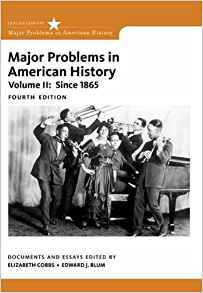
A notable exception is the most recent (4th edition) of the document reader Major Problems in American History, Vol. II: Since 1865, edited by Elizabeth Cobbs and Ed Blum. They purposefully incorporated more primary and secondary sources on the subject of American religious history into this edition with the result that the book is now one of the best for this topic. But I am experimenting with going without a document reader, so I was still left with the textbook problem.

I asked colleagues for their syllabi and discovered one main way to tackle the marginalization of religion in the American history survey is simply to assign a regular textbook and then use book-length primary or secondary sources on religious history as supplements. For example, I’ve heard positive reports from colleagues who have taught the U.S. history survey and assigned Barry Hankins' Jesus and Gin: Evangelicalism, The Roaring Twenties, and Today's Culture Wars, Charles Marsh’s God’s Long Summer: Stories of Faith and Civil Rights, or Darren Dochuk’s From Bible Belt to Sun Belt: Plain-Folk Religion, Grassroots Politics, and the Rise of Evangelical Conservatism.

In the end, I decided to experiment with a different direction. First, I’m trying out an unusual textbook, Unto a Good Land: A History of the American People, Vol. 2: From 1865, written with the explicit intention of incorporating religion well into the narrative of U.S. history. It employs sidebars, to be sure, but also weaves religious history into its treatment of other topics. A drawback is that it has not been updated since 2005, so needs to be supplemented with subsequent scholarship.

Second, I chose additional book-length readings that took a similar approach. They are not about religious history per se, but all incorporate it as a significant element: Timothy Gilfoyle's The Urban Underworld in Late Nineteenth-Century New York: The Autobiography of George Appo with Related Documents from Bedford St. Martin’s Series in History and Culture; Melton McLaurin’s Separate Pasts: Growing Up White in the Segregated South; and Donald Critchlow’s Phyllis Schlalfy and Grassroots Conservatism: A Woman's Crusade (which I’ve used before). Appo was the son of an Irish immigrant and a Chinese immigrant. He lived a life of crime before becoming a Progressive reformer, and he reflects on the place of religion in the lives of both prisoners and reformers. McLaurin similarly offers poignant reflections on the intersection of religious and racial ideals in his native North Carolina in the 1950s. And Schlafly’s Catholicism weaves throughout Critchlow’s narrative, though its focus is politics.

It should be noted that I’m also assigning various brief primary sources and Jill Lepore’s The Secret History of Wonder Woman. Because Wonder Woman.

I’m hoping that using this new collection of books will enable students to walk away with a sense of the connections between religious history and other aspects of American life. I will report back after this semester on how the experiment has gone! In the meantime, I’d love to hear from others what approaches you have found work well for incorporating religious history into the U.S. history survey.


spacer

Religion in American History: A Short Syllabus

Editor's Note:  As Jonathan and Chris have recently pointed out, July 2017 marks the beginning of Religion in American History's tenth year. Happy birthday to us! Throughout the month we'll be celebrating and reflecting upon the contributions shared and inspired through the blog...not to mention its intellectual and creative founding father, Paul Harvey. Today's post comes from another pillar of the RiAH community, Ed Blum, who--to the surprise of no one--models a longstanding RiAH value of sharing and highlighting the work of others.

Edward Blum

The blog always felt like a big classroom to me – where we could bring up books, ideas, evidence, and everything else. I routinely use posts from the blog in my class and so I thought it would be fun to put together a little list of materials for some main themes in American religious history. Please forgive my excessive focus on the twentieth-century … since students seem to like it the most that’s where I gravitate in the classroom.

Contact and Colonialism
The American War for Independence and Early Nationhood
Nineteenth-Century Bonanza
Modernism and Fundamentalism
Great Depression, WWII, and Cold War
Civil Rights Movements
Pluralism versus the New Right

spacer

Fundamentalism, Feminism, and Other Curse Words: Teaching Controversy with Civility

Andrea L. Turpin

Every semester I tell my history students the same bad joke: fundamentalism and feminism are actually a lot alike—they are both f-words that we hurl at our political enemies depending on which side of the spectrum we’re on. Which is to say that for the average American these words function not according to some dictionary definition but rather as a catch-all insult for someone too far to the right or the left, respectively.

In fact, my informal polls of students, friends, and random people who will answer my questions indicate that there is no widely agreed upon definition of either word in common parlance. I am one of those relatively rare Americans who runs in both blue and red circles, so while my polls aren’t scientific, they do actually capture a bit of the breadth of perspectives on these concepts. So I’ve learned that when teaching my feminist-leaning students about fundamentalism or my fundamentalist-leaning students about feminism, I first have to cut through a great deal of highly charged emotion. A few different approaches have proved fruitful.

First is simply helping students become aware of the functional definitions of these words that they are carrying around in their heads. For example, I will ask my classes for their associations with the word “feminism.” I get a lot of answers similar to the ones Kristin Kobes Du Mez enumerated in a recent blog post on common misconceptions about feminism. Most associations are negative, with “man-hating” leading the pack.

I then share with students some of the reforms that have been advocated by women and men who have identified as feminists and that I suspect students would all support—things like women’s suffrage and equal pay for equal work. (Most are shocked to learn that employers have only been required to pay men and women the same for the same work since 1963!) We talk about the fact that feminism itself is a wide spectrum encompassing many different viewpoints and attitudes. As Du Mez points out, there is as much variation among those who own the word “feminist” as among those who own the word “Christian.”

I have found that I need to address one particular issue directly: the contemporary association of feminism with the pro-choice movement. When proving to my students that the word “feminism” means different things to different people, I ask them to envision two hypothetical people, one of whom would say “I am a feminist” and one of whom would say “I am not a feminist.” Then I tell them that both people believe exactly the same things. They both believe that women are still at a social and legal disadvantage in this nation and that making the necessary changes should be both a personal and a national priority. They both believe, for example, that the United States should institute paid maternity leave and that more women should run for Congress so that women’s particular needs and interests are better represented among lawmakers.

Then I add that both of these hypothetical people are pro-life, perhaps believing that human life starts at conception, and thus viewing unborn women as deserving legal protections too. The first person thinks of himself or herself as a “pro-life feminist,” but the second rejects the feminist label entirely because of its association with the pro-choice perspective. And then I tell students that we could equally envision a person who holds all the preceding beliefs but is pro-choice, perhaps believing that to force a woman to carry a child would be intolerable state coercion—and who still rejects the label “feminist” because in his or her social circle it carries man-hating connotations.

A second approach to cutting through students’ instinctive emotional reactions is introducing them to the stories of real, flesh-and-blood, complicated people who identify as feminists or as fundamentalists. For the latter, probably the most helpful text I’ve found to use in class is James Ault’s Spirit and Flesh: Life in a Fundamentalist Baptist Church. Ault wrote up his experiences as a participant-observer sociologist in a fundamentalist church in the 1980s where he was seeking to understand why some women rejected the feminist movement. A feminist himself, Ault was not ready to chalk up these women’s perspective to false consciousness, so he wanted to better grasp their logic.

This book teaches really well because it reads like a novel, complete with plot twists and a surprise ending. But most importantly, Ault succeeds in portraying his subjects sympathetically, in all their human complexity. And he advances a theory that makes for good classroom debate: he claims that in certain types of communities women experience fundamentalist teaching on gender roles as improving their lives and perceive feminism to threaten those improvements, whereas in other types of communities the opposite proves true. (I also highlight for students that historically the term “fundamentalist” refers to someone who believes certain aspects of Christian doctrine are necessary for the eternal salvation of literally everyone. Thus, at their best, fundamentalists or other conservative Christians who fight to preserve those beliefs—or the gender roles they believe follow from those convictions—see doing so as an act of love.) A bonus to teaching Ault's book is that he further brings his subjects to life in the documentary film Born Again, which adapts readily to the classroom because the DVD contains both a 60- and a 90-minute cut.

Another book I’ve found helpful in the classroom is Donald Critchlow’s Phyllis Schlafly and Grassroots Conservatism. Critchlow does an excellent job of articulating the inner logic of both liberalism and conservatism in the second half of the twentieth century. Accordingly, he helps students understand how people of genuinely good will could reach opposite conclusions about how best to address the nation’s problems. Indeed, simply learning about Schlafly stretches the minds of both conservative and liberal students—conservative students see a woman who shares their views but worked more than 40 hours a week outside the home, and liberal students see a woman vehemently opposed to their views who nevertheless embraced the belief that women had a responsibility not only to the home, but also to the nation.

I sometimes supplement the relevant passages in Critchlow with Jonathan Haidt’s system for understanding liberal vs. conservative moral instincts, as laid out in The Righteous Mind. Haidt is particularly good at articulating how conservatives and liberals each more easily perceive different threats to the social order earlier than the other. Thus, regardless of which system we believe to be more effective overall at achieving the common good, liberals and conservatives are both wise to ask what the other camp may be seeing that we are blind to—and to tweak our own policies accordingly. I admit I’ve found it difficult to figure out which passages from Haidt to excerpt, so I typically just incorporate his insights into my lecture and refer interested students to the book for further reading (some take me up on it!).

As I tell my students, my ultimate goal is not necessarily for them to change their political convictions. Of course, I certainly have my own opinions on how best to achieve the common good, so I am not indifferent to what they believe! But for the purposes of the course, my goal is for class members to be able to sympathetically articulate the logic behind various political and religious positions.

I explain that by “sympathetic” I mean not that they necessarily agree with someone else’s position, but rather that they are able to articulate it in terms that person would agree with. Not only is doing so basic “golden rule” decency, I tell them, but it’s also ultimately the most effective technique for changing someone else’s mind. In political or religious debate, everyone is protecting something they perceive to be of value. Only by acknowledging the best in what the other person is trying to protect can we hope to persuade our conversation partner that there might be a better way to accomplish that goal, one that does not simultaneously threaten other goods.

And just in case I haven’t sufficiently sold students on the benefits of tabling their emotions long enough to listen carefully to those with whom they disagree, I casually mention that explaining each controversial position will be on the final. Whether they have indeed expanded their mental worlds, or whether they just want the A, I am pleased to report they do pretty well.
spacer