Showing posts with label grants and fellowships. Show all posts

Funding Opportunities from the Cushwa Center

Maggie Elmore

The Cushwa Center for the Study of American Catholicism is pleased to announce the annual deadline to apply for travel grants from the Cushwa Center. The Center offers five different grants for projects related to the study of American and global Catholicism:


The deadline for applying for each of these grants is December 31, 2018. More information can be found at https://cushwa.nd.edu/grant-opportunities/. Please direct any questions to cushwa@nd.edu.
spacer

New and Improved ACHA Graduate Student Summer Research Grants

 At its Jan 2018 meeting, the Executive Council of the American Catholic Historical Association, under the leadership of President Kathleen Sprows-Cummings, approved an increase in the number of Graduate Student Summer Research Grants to be awarded each summer and the Council authorized an increase in the amount of money per award.

The ACHA is happy to offer 4 grants for the summer of 2018, each for a total of $2500.


In taking this measure, the Executive Council wished to continue the ACHA’s long-standing commitment to graduate student research. The increased amount of support per award was also designed with the goal of funding more graduate student research in archives and libraries abroad.
Dr. Carolyn Twomey conducts research with a
Graduate Student Summer Research Grant from the ACHA
at the Parker Library at Cambridge University, Corpus
Christi College.

Graduate students who have completed their coursework and are researching topics related to the history of Catholicism broadly defined are encouraged to apply.

Applications are due on April 30. More details can be found here.


Many thanks,
Carolyn Twomey and Peter Cajka 


spacer

Women's History/Catholic History: New Initiatives at the Cushwa Center

Benjamin J. Wetzel

Although women's history is inseparable (or should be!) from our national narratives, the month of March serves as a time to reflect specifically on women's contributions to American history.  Even more specifically, this month provides a special occasion to reflect on the history of women religious, and to announce some current and forthcoming scholarly initiatives from the Cushwa Center in this area.

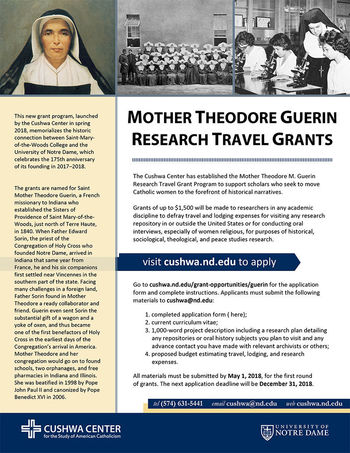
Theodore Guerin Travel Grant Flyer 05

1) The center has launched the Mother Theodore Guerin Research Travel Grant Program.  This program memorializes the historic connection between Saint Mary-of-the-Woods College and the University of Notre Dame by supporting researchers whose projects seek to feature Catholic women more prominently in stories of the past.  Grants of up to $1,500 will be made to scholars seeking to visit any repository in or outside the United States, or traveling to conduct oral interviews, especially of women religious.  An inaugural round of grants will be awarded in late spring 2018 (application deadline: May 1, 2018).  Thereafter, applications will be due December 31 each year for research in the subsequent calendar year.  More info here!

2) Please find a call for papers for the Eleventh Triennial Conference on the History of Women Religious here.  The conference theme is "Commemoration, Preservation, Celebration," and will take place June 23-26, 2019 at Saint Mary's College (Notre Dame, IN).  All details can be found here.  The deadline to submit a paper or panel proposal is June 1, 2018.

3) The Center recently concluded a conference at Kylemore Abbey, Ireland, entitled "A Pedagogy of Peace: The Theory and Practice of Catholic Women Religious in Migrant Education."  For more context on the history of Kylemore's Benedictine nuns, see this article by Jack Rooney.

4) Watch for a new edition of the American Catholic Studies Newsletter, to be published soon.  For now, here is a sneak peek at the most recent article in the series, "Why I Study Women Religious," by Marie Marmo Mullaney (Caldwell University).

Finally, the Cushwa Center will be hiring an in-residence postdoctoral research associate for academic year 2018-2019.  Find the job ad here!  Applications due April 15!
spacer

Cushwa Center Spring Events (and grant deadlines reminder!)

Benjamin J. Wetzel

As final exams wind down and the fall semester ends, the Cushwa Center would like to announce several public events it will be hosting and/or sponsoring at the University of Notre Dame during spring 2018.

1) The Seminar in American Religion | March 24
This semester the seminar will discuss Judith Weisenfeld, New World A-Coming: Black Religion and Racial Identity During the Great Migration (New York University Press, 2017).  In addition to Professor Weisenfeld, commentators will include RiAH founder Paul Harvey (University of Colorado) and Jennifer Jones (University of Notre Dame).  Details available here.  The book seminar will be held in conjunction with...

2) "Enduring Trends and New Directions: A Conference on the History of American Christianity in Honor of Mark Noll" | March 22-23
This conference will honor the career of Mark Noll by reflecting on his work in the history American Christianity while also looking forward to new directions in the field.  More info here.

3) "Centering Black Catholics, Reimagining American Catholicism" | April 11
This lecture by Matthew Cressler (College of Charleston) will honor the fiftieth anniversary of the founding of the National Black Catholic Clergy Caucus.

In addition, two other events will take place at international locations.

1) "'A Pedagogy of Peace': The Theory and Practice of Catholic Women Religious in Migrant Education" | March 14-17, Kylemore Abbey, Ireland
The Cushwa Center will gather scholars from around the world at the Kylemore Abbey Global Centre for a conference on the theme of Catholic women religious in migrant communities. The conference will feature both Catholic sisters and lay scholars.

2) Book Launch of Matteo Binasco, Roman Sources for the History of American Catholicism, 1763-1939 (Notre Dame, 2018) | May 24, Notre Dame Rome Global Gateway, Rome, Italy


The Cushwa Center would also like to remind everyone that applications for funding opportunities are due in ten days, December 31!  Specifically, we offer four kinds of grants:


  • The Theodore M. Hesburgh Research Travel Grant (to use the Hesburgh Papers at Notre Dame)
  • The Research Travel Grant (to use Notre Dame archival resources)
  • The Hibernian Research Award (for projects related to Irish experiences in Ireland and the United States)
  • The Peter R. D'Agostino Research Travel Grant (to use Roman archives for an American Catholic-focused project)

  • For more information about our funding opportunities, visit our website or email cushwa@nd.edu.


    spacer

    Funding Opportunities from the Cushwa Center AND Five Questions with Katherine Dugan

    Benjamin J. Wetzel

    The Cushwa Center for the Study of American Catholicism is pleased to announce the annual deadline to apply for travel grants from the Cushwa Center.  The center offers four types of grants for projects related to the study of American and transnational Catholicism. Specifically:


    The deadline for applying for each of these grants is December 31, 2017.  More information can be found at http://cushwa.nd.edu/grant-opportunities/.  Please direct any questions to cushwa@nd.edu.

    Last year, Katherine Dugan, assistant professor of religion at Springfield College, received one of these grants for a project on millennial Catholic missionaries.  Recently, Catherine Osborne, a former postdoctoral fellow at the Cushwa Center, sat down with Dugan to discuss her work.  You can find the text of the interview here.

    spacer

    Adventures in the Archives: Tips for Minimizing Expenses, Maximizing Time, & Having Fun

    Andrea L. Turpin

    “It takes a village to nurture a book into being, and I have been privileged to be part of one that stretches from coast to coast.” This is the opening sentence of my book's acknowledgments section, and I thought of it recently when a Baylor history colleague solicited archive stories to share with her graduate class on archival research (wish I’d had one of those!). The stories that jumped to my mind related to creative ways to fund archival visits and maximize time there—which for me very much depended on a network of friends and supporters.

    As it happens, I write this from Philadelphia, where I am spending two weeks at the archives of the Presbyterian Historical Society researching for my next book project. Stay tuned next month for my “Know Your Archives” post on this excellent resource for American religious history. In the meantime, here’s an adapted version of the tales and tips that I passed along to our graduate students on how I conducted my dissertation research.

    As a single woman, I made a great American road trip and did all my archival research in one year. Then I processed and wrote it up the following two years, rather than alternately researching and writing. During my research year, I visited 12 archives housed in 10 cities, from Boston to Berkeley. I had a blast, came home with some great finds, and managed to spend almost none of my own money above regular expenses. I admit luck and the nature of my topic played a role, but this is the advice I would give graduate students just diving into archival research:
    Schlesinger Library at the Radcliffe Institute for Advanced Study

    1. Apply for grants. Lots of them. I tell students they can write a strong travel-to-collections grant proposal with a formula something like this: “I am writing on X, which has been overlooked. We need to rectify the fact that X has been overlooked because it will significantly change our understanding of Y (which should be something a reasonable number of people care about). Your specific archives are essential for this project because Z. I am the right person to undertake this research because ABC.”

    When selling my students on the glories of researching the history of higher education, I note that choosing that topic for my dissertation/first book meant that it was easy to make the case that a college or university archive should give me a grant: I wanted to write on their institution, which is always flattering, and their institution is always the sole place that houses the archives of their institution. I would add that college archives are excellent—and often overlooked—sources for American religious history, with relevant sources ranging from curricular records, to faculty and administration papers, to the records of student organizations. I found that Princeton University, the University of Michigan, and the Radcliffe Institute for Advanced Study all offer unusually generous travel-to-collection grants.

    2. Be shameless. In addition to making use of external grants (and an internal grant from the graduate school at Notre Dame), I employed what I admit were a lot of unusual and occasionally risky housing arrangements that often involved me shamelessly asking people—sometimes complete strangers—if I could stay with them. Examples of the incredibly generous people I stayed with for free, in many cases for up to three weeks each, include: (A) a leader of one of my undergraduate student organizations (and her husband and daughter), (B) my mother’s best friend’s friend’s sister and her husband, (C) a woman I had met only once at a conference (and her two roommates and four cats), (D) my brother’s dorm mate’s parents’ friends. Examples of places I stayed for cheap: (A) the extra bedroom of a couple at the church a friend from seminary was pastoring, (B) a Bed and Breakfast that gave me a discounted rate for staying so long, (C) a Motel 6 where I’m pretty convinced there were drug deals going on.

    3.  Let archivists help. I have found archivists all over the country to be extremely helpful; it’s literally their job to assist you with your research by suggesting collections and helping you track down materials. Plus, all archivists I have encountered genuinely enjoy seeing their collections get used (well, in the United States, at least; I understand from colleagues this can sometimes be different abroad!) Supreme helpfulness award goes to the archivist who just straight up gave me multiple reels of microfilm (admittedly they had backups) so I could use them outside of archive hours at the library microfilm readers, and simply trusted me to return them. I wasn’t associated with the institution so there was no way to “check them out,” as it were.

    4. Tailor your research style to the nature of the archives. Some are extremely informal; others are extremely formal. I used one archive that I’m pretty sure would not have noticed if I’d decided to chew gum and take notes in pen (don’t worry; I didn’t). On the other end of the spectrum, at Princeton’s Rare Books and Special Collections held in Firestone Library they make you wash your hands with their soap, where they can see you, before you go in. And I experienced this range even though almost all of the archives I have used have been housed at universities or colleges!  Similarly, while most archives allow digital photography, some do not.

    My research techniques vary depending on whether I can take digital photographs and how long I am able to stay there. For an ultra fast trip that allows digital photography, I just skim to see if something might be useful, take as many pictures as possible, and then process them at home. For a long trip, or one that doesn’t allow digital photography, I spend more time in the archives actually reading the material and taking notes/deciding what photocopies to request. Even if I am going quickly, I back up my records of the source of the documents I’m using by keeping a running list in Word of the Record Group, Box, and Folder I’m viewing, the basic sort of information it contains, key quotes, and thoughts on research directions that the material is spawning. I also always photograph the box and folder before photographing the documents so that it is easy to go back and find folder breaks in a photo sequence. Other historians I know use a scanning app like Genius Scan or TurboScan.

    Many archives close in the late afternoon, so if I’m on a tight schedule, I’ll use the time after hours to read through some of the key documents I’ve photographed, search the archive’s online catalogues, or scour the footnotes of relevant books. But it’s still important to…

    5. Have fun, both inside and outside the archives. Like most historians, I love the sheer joy of piecing together a story no one has ever uncovered or told before. I think of being a historian as a cross between being a detective and being a story-teller. When I was little, I wanted to be an FBI agent, and in the end I guess I just found a safer way to do that. I’ll add that a close second for fun in the archives is probably reading snarky correspondence where certain people you’re researching say what they really think about other people you’re researching. This fact may say bad things about me.

    Strangers always want to know
    where I got my portable book stand.


    While on my great American tour, I entertained myself outside archive hours by trying out ethnic restaurants, because college towns tend to have great ethnic restaurants. Except at one institution where I entertained myself by going to Target on Friday night because there was literally nothing else to do in the area. And watching Big Love on the free cable at the Motel 6, which I’ll admit later became useful for teaching Mormon history. My last piece of concrete advice: if you’re traveling alone, buy a portable book stand and read while you eat!

    In summary, embrace the adventure. You never know what you might find within the archives or without: While I was researching at the University of Michigan, Minnie Driver was filming a movie on campus and I walked right past her. Turns out she’s really short. Now you know.







    spacer

    Five Questions with Eladio Bobadilla on Immigration and Catholic History

    Catherine R. Osborne (for the Cushwa Center for the Study of American Catholicism, University of Notre Dame)

    Eladio Bobadilla
    Eladio Bobadilla is a Ph.D. candidate in U.S. History at Duke University. His dissertation is entitled "'One People Without Borders': The Chicano Roots of the Immigrants Rights Movement, 1954-1994," and explores how Mexican-Americans, long ambivalent and even opposed to undocumented immigration, came to see themselves and the undocumented as "one people." He was awarded a 2016 Theodore M. Hesburgh Travel Grant to consult Fr. Hesburgh's papers related to his work on the Commission on Immigration and Refugee Policy. (The next grant applications will be due October 1, so start thinking of topics now!)

    CO: What got you interested in this topic?

    EB: My interest in this topic is largely autobiographical. Immigration is part of my story and has shaped me and my worldview since I was a child. My father was, at various points in his life, a bracero, an undocumented immigrant, a permanent resident, and a U.S. citizen. I, too, was undocumented until the age of 19. So questions about immigration—and about shifting and unstable identities—were always part of my experience. Similarly, growing up in Delano, CA, home of the farm labor movement, inspired me to ask questions about the relationship(s) between labor, immigration, capitalism, and social movements.


    CO: After spending some time at the archives, what do you see as Fr. Hesburgh's relevance to your overall project?

    EB: Father Hesburgh possessed a rare set of qualities that are seldom found so neatly packaged in one human being alone: he was compassionate, but he was pragmatic. He had equal measures of moral vision and political will. He was interested in social justice and in rational debate. He could get people who disagreed fundamentally with each other to sit in a room and actually listen to one another, and crucially, to compromise in fruitful ways. Father Hesburgh understood that neither pure isolationism nor fully open borders were sensible or workable positions, and he worked really hard to ensure that what ultimately became policy was both in the national interest and as humane as possible.

    CO: What would you still like to know that you weren't able to answer through the Hesburgh archives?

    Reagan signs the Immigration Reform and Control Act of 1986
    EB: There is so much that archives alone cannot answer. That is why I am interested in oral history. Much of what I found in the Hesburgh archives has led me to ask new questions and to seek answers in other ways. For example, it is clear from my work at the Hesburgh archives that no one was truly happy with the outcome of the Immigration Reform and Control Act of 1986, and I think it’s fair to say, that just about everyone has considered it a failure in some way or another. Hispanics thought it was a racist piece of legislation. Businesses interests felt like they weren’t given enough access to labor. Conservative hard-liners thought it was too lenient and permissive. But what about the immigrants themselves, those whose status was normalized by IRCA? What did they think? Well, we don’t really find their voices in the archives. But, it seems to me, from talking to them, that they would hardly see IRCA as a failure. This piece of legislation changed millions of lives for the better, in tangible and discernible ways: they were able to finally work and live without fear, to sponsor family members—or at the very least to visit them without risking their lives on the return trip. They were able to buy homes, to start businesses. Sometimes, even the best archives cannot adequately capture the human experience. This is why I combine oral history and other methods with archival research. Often archives leave researchers with more questions than answers, but that’s not a bad thing. It’s important to know what we don’t know, so to speak, and to find other ways to answer important historical questions.

    CO: What's your favorite document you found at the ND archives?

    EB: One of my favorite finds in the archives at Notre Dame was an Air Force manual detailing the processing of Vietnamese refugees. Specifically, the manual outlined how to properly welcome and assist those refugees in the United States. This was an interesting find for a number of reasons. It wasn’t directly related to my research topic, but it allowed me to think—and in some ways challenged me to think—differently about immigration. The manual was a two hundred-plus page document that enthusiastically welcomed Vietnamese refugees fleeing the Vietnam War, and for me, it was a document that clearly and starkly highlighted the complicated nature of immigration policy. At the same time that American officials were trying to limit immigration from Latin America, regularly describing it as a crisis and a social problem, thousands of Vietnamese were being relocated, housed, and provided with jobs and legal status. What this reveals is that immigration has often been, more than an issue in itself, what I call a “filter issue,” one that is really a placeholder for other, broader concerns, from economic anxiety to questions about war and imperialism.

    CO: This is obviously a topic with a lot of salience today -- maybe more than you could have guessed when you set out to write about it. Do you see today's American church leaders continuing their role, or is it different? Any lessons today's Catholic immigrants-rights' activists could learn from their predecessors?

    EB: The Catholic Church and people of faith have a tremendous role to play today in today’s immigration debate. The debate about immigration has, in many ways, devolved into little more than an emotional shouting match. The rhetoric one hears today, even in supposedly reputable sources, is based on dangerous premises that rely less on logic and more ugly, racial undertones. It seems to me that what we’re lacking today is empathy. The dehumanization of human beings, whose humanity is often reduced to illegality, has dangerous precedents in history. This isn’t to say that immigration doesn’t have real consequences for Americans, or that the answer should be simply to open the borders, though I think in reality globalization has already done this. But the stereotypes and scapegoating that we hear in today’s immigration debates are dangerous and frightening to those of us who study history. The Church, I think, has a role in mediating these discussions, just as Father Hesburgh did in the 1980s, and in reminding people of faith there are real human beings, often poor and vulnerable, behind the heated rhetoric—and that they are here because they are desperate and poor, often because of corporate greed and inhumane trade and social policies. In other words, the church can help remind people that the problem isn’t “illegals,” but vast economic interests that create poverty and drive immigration, as well as power-hungry political forces eager to exploit people’s very economic real anxieties and cultural fears. I have been impressed, and putting aside any notion of objectivity, grateful and inspired to hear Pope Francis speak to this issue with tremendous moral clarity and courage. He has repeatedly reminded his flock and the world that human lives and human welfare should always come before profit. That is a remarkably radical and necessary message at a time when capitalist orthodoxy has sought to render compassion obsolete.
    spacer