Showing posts with label 19th Century. Show all posts

Jews on the Frontier, a Roundtable: Rabin response

Today we conclude our roundtable on Jews on the Frontier with a response from the author, Shari Rabin. See Parts I, II, and III here. Shari is Assistant Professor of Jewish Studies and the Director of the Pearlstine/Lipov Center for Southern Jewish Culture at the College of Charleston.

Shari Rabin
This book was in many ways motivated by a frustration and a hope. A frustration with what I felt was a disconnect between American religious history and American Jewish history and a hope that I might be able to create conversations between those two fields. Given that origin story, I really could not be more delighted to be having this conversation, first in person in Atlanta and now on the USReligion blog. Thank you to Charlie for orchestrating the conversation and to Andy McKee, Kate Rosenblatt, and Kati Curts for their close readings of the work.

I am going to start by attending to Kate and Andy’s questions about my subjects: who are they, why are so many of the men, and what about the mobility of women? I went looking for records of ordinary Jews moving throughout the American hinterland and their religious inclinations and expressions. I went to archives and basically tried to look at anything that dealt with American Jews before 1880 on the off chance that there would be something shedding light on mobility and/or religion. It really was needle in a haystack research and I was not able to find a whole lot of women’s materials.

Of course women are central to American Jewish history and American religious history – women’s history is American religious history, in Ann Braude’s famous formulation, and when you look to the congregations, women are absolutely present.[1] Karla Goldman’s wonderful book on this period, Beyond the Synagogue Gallery: Finding a Place for Women in American Judaism (Harvard University Press, 2000), draws attention to this, and in fact one of my favorite findings was that women were being counted in a minyan in the 1850s, for pragmatic reasons. As some of you have noted, however, one of the main interventions of the book was to decenter the congregation as a unit for understanding American Judaism. So, this is one possible reason for the dearth of evidence. There were, however, some intriguing hints of women’s autonomy – an ad for Jewish governesses in the 1870s and examples of Jewish women operating Jewish boardinghouses, in the process effectively commercializing the Jewish home and family. Jewish women were subject at the end of the day to the same constraints as other American women, for whom individual travel was socially suspect if not prohibitively expensive or potentially dangerous. And here it is worth noting that the bulk of my subjects are not only male but also young and economically precarious – two categories of Jews that are not often the subject of scholarly attention.

For the work on religious corporations, I must tip my hat first to Sarah Barringer Gordon for her wonderful work on African American congregations in the early republic.[2] The fact that Jews now gathered in legal corporations was significant –this was the only place where they were identified as Jews by the state. They had to write charters – which they saw as documents of great significance – create boards, and set about the work of communal governance. This also meant that they could end up in the courts – I’ve actually been working on an article for a while about this. It seems to me that some amount of transformation happens in religious life just through the process of adapting to the corporate form, and in court cases in particular, you can see how this encouraged Jews to make Judaism and its peculiarities legible to a Protestant-inflected legal system.

Both Kate and Andy raise questions about interactions between Jews and the non-Jews who surrounded them. Kate raises, in so many words, the question of anti-Semitism. To what extent were the restrictions of the moral establishment really oblivious to their implications for Jews? There were cases – most egregiously California in the 1850s – where explicit anti-Jewish motivations for Sunday closing laws were expressed, but my sense is that most non-Jews were simply too unfamiliar with Jews to directly target them. Jews were small in number and widely dispersed – they remained sufficiently individual and invisible to go un-thought of. One proposed chapter from the dissertation prospectus that I never wrote was explicitly about representations of Jewish mobility in American culture, especially literature and the press, and that kind of study would likely produce different results; but from looking at the state and at everyday life, I did not see a lot of anti-Jewish sentiment. When non-Jews did take notice, more often it was marked by curiosity and even fascination.

Andy: thank you for digging into the example of Solomon Nunes Carvalho, who, by the way, was from Charleston, and is the subject of a recent documentary called Carvalho’s Journey.[3] A few other interesting notes about him: he was traveling on behalf of the American state – looking for a route for the transcontinental railroad, and he wrote his memoir in support of the presidential aspirations of John C. Fremont, who had led that expedition. At the end of the trip he went to Los Angeles, where he helped local Jews organize the first Hebrew Benevolent Society there. So he encompasses a number of the themes of the book really nicely. As Andy noted, Carvalho was no fan of polygamy, but interestingly, he was somewhat sympathetic to Brigham Young, writing, “I received a good deal of marked attention from his excellency, Governor Young; he often called for me to take a drive in his carriage, and invited me to come and live with him, during the time I sojourned there.”[4] Far more common, however, were interactions with Protestant neighbors, however, including in churches where some Jews attended worship.

Jews regularly interacted with individual non-Jews, but they also did keep an eye on other religious communities. They mostly thought that everyone else had things figured out, and they looked to their models of doing things and debated what would work for them. For instance, we see Isaac Leeser complaining about the confusion within American Jewry, “this circumstance will not be met with in any other religious denomination in the country; for they all have statistics.”[5] A version of the denominational model was appealing to him and to Wise, but there also is one example of a Jew looking to the Mormons as a model for solving the chaos of American Jewish life, suggesting the creation of a Jewish territory and eventual state, where the Sabbath – and all of the other resources of Jewish life – could be kept. Furthermore, it would rescue Jews from being a minority and prevent conversion, intermarriage, and/or assimilation.[6]

This brings me to Andy’s questions about feelings of loss, which were real, as were feelings of anger and bewilderment when Jews denied or ignored Jewish practice or affiliation. For instance, the editor of the Jewish Messenger impugned the masculinity of Jewish who denied or ignored their Jewishness and family members in Europe wrote frantic letters to their children in America (see the Loewner family in chapter 3). And there were Jews who did convert to Christianity. For instance, on page 90 I write about a man whose brother-in-law had been converted on Isaiah chapter 53, and was desperately seeking guidance from Isaac Leeser. I think some of the flexibility within congregational life, comes from the pragmatic realization that at least these people were willing to participate. I am also glad you picked up on the history of emotions that the book details. Jewish lives were shaped not only by economic factors or by religious principles, but by visceral feelings that united and commingled the two.

Along with Kate Rosenblatt, Kati Curts pushes me on the question of contemporary relevance. She points to the final line of the book, which in some drafts I deleted, but that ultimately, in a fit of bravery, I chose to keep. I think that the book shows that American religious life has always been eclectic and confusing and outside of as much as within religious congregations. The health of Judaism – or any religious community – is in the activities of those who claim that religious identity, not in the membership rolls of congregations or the proclamations of clergypeople.

The stakes, for me, are about dropping the normative valences in our studies of American religious life – or at the very least, disentangling our operative definitions and boundaries from those of religious elites and institutions. I also want to point to the complexity of religious identity in practice and its embeddedness in the operations of capitalism and the state. At the end of the day, it is not useful to reduce people to denominational identities. They are first and foremost situated subjects navigating everyday life by using a range of resources, religious and otherwise.

In terms of theorizing concepts like “progress” and civil religion, I think I would first point to their geographic valences. These kinds of political and religious projects are appealing in part because they are mobile and capable of continental pervasiveness. Two other notes: I think it is important to recognize that these concepts and terms can be used to many different ends and can have different entry points and meanings for people. It may say more about us than about our past or our subjects if we describe something like “progress” as only and exclusively Protestant. The case of minhag further points to constructedness of geographic identities: minhag America was preceded by and continued to coexist and overlap with other minhagim, which had varying geographic and historical origins.

I think part of what I am doing in this book is leaning on the American in American religious history. I read a lot of social history in writing it, because I wanted to think about the United States not only as a neutral backdrop to the religious histories taking place there, but as a distinctive (though not exceptional!) economic and political matrix within which religious formations emerge, and to which they respond. Jews offered one set of reactions based on their own set of traditions and concerns, but other groups certainly did too. I am curious to find out if people think that I’ve described, to paraphrase Kati Curts, a religious then that is recognizable for other groups. And does it describe the religious now that she invokes? I wanted to provocatively gesture to the present-day implications in the book, but ultimately I wrote a study of the nineteenth century, and my readers are as expert as I in diagnosing the religious now. For now, I will end by thanking these particular readers for their careful and enthusiastic engagement.


[1] “Women’s History is American Religious History,” in Thomas Tweed, Retelling U.S. Religious History (Berkeley: University of California Press, 1997).

[2] Sarah Barringer Gordon, “The African Supplement: Religion, Race and Corporate Law in Early National America,” William and Mary Quarterly 72, no. 3 (July, 2015): 385-422.

[3] See also http://juvenileinstructor.org/from-the-archives-a-jewish-perspective-on-mormon-undergarments-and-more-circa-1853/

[4] Incidents of Travel and Adventure in the Far West (New York: Derby & Jackson, 1860), 213.

[5] "What Can be Done," Occident 10, 1852, 371.

[6] On the Establishment of a Jewish Colony in the United States, Occident 1 (1843), 28.

spacer

Jews on the Frontier, a Roundtable: Curts

This is Part III of our forum on Shari Rabin's Jews on the Frontier. See here for Part I and Part II. Today's post is from Kati Curts, who is Assistant Professor of Religious Studies at Sewanee: The University of the South.

Kati Curts

I am an avid and long-standing fan of the project that became Shari Rabin’s award-winning book. Readers will find it to be a brisk, engaging text that is rich with fascinating historical details about otherwise unknown, often overlooked, and sometimes rather surprising sources. It recounts the lives, labors, loves, and losses of men (and, occasionally, a few women) who have not often surfaced in our histories of religion in America.

Readers of this blog have already learned about several of these figures from Kate Rosenblatt and Andrew McKee in their previous posts on Parts I & II of this book, respectively. Though I won’t spend much time myself delving into specific archival anecdotes that appear in the final section of this text, there are a great many more such men that you’ll want to read about for yourself—including Edward Rosewater, a telegraph operator who opens and helps close the book and is remembered in Rabin’s history not only for being the man who wired the text of the Emancipation Proclamation across the continent but also for founding a newspaper and Jewish benevolent society in Omaha, Nebraska. So too we meet here even less prominently positioned historical pioneers, like one Mr. Kusel, who settled on Menominee Indian land in 1851 and shortly thereafter wrote in to a Jewish periodical in order to publicly cheer and discursively map the presence of his co-religionists “in the backwoods country” who had gathered together on the Day of Atonement (1-2, 123). Indeed, it is figures like these who frequently receive pride of place in Rabin’s telling, and this is true too in the final section of the book, where an array of Jewish leaders also receive special attention. Even those rather well-known leaders we have met in other studies of American Jewish history—including prominent figures like Rabbi Isaac Mayer Wise and Isaac Leeser—come alive anew in this book as we learn to consider them not only as prominent founders of emerging Jewish congregations and denominations but also as mobile Jews themselves, negotiating the challenges and chances afforded them in frontier contexts and across an increasingly westward moving U.S. nation-state. Fortunately, you’ve already gleaned much about this part of Rabin’s narrative from previous posts. So, part of what I want to do here is to help draw us all yet further into key aspects and argumentative interventions of this text—particularly as they relate to the final portion of this book and contribute to debates in the broader study of religion in American history.

As we move into Part III of this book, Rabin trains our eyes upon the ways that Jewish leaders aimed to unify and address the relational challenges of fast-moving and far-flung Jews across the American continent. For leaders like Wise and Leeser, the absence of authoritative rabbis and definitive, geographically-determined rites seemed an unsettling flip-side to the new-found freedom that many Jews, including themselves, found in the U.S. Consequently, we learn in this section how American mobility meant not only the chance to respond creatively to this new continental context but also how it obliged Jews to confront new kinds of problems—problems they had not encountered elsewhere, including, notably, those that concerned the formation and maintenance of Jewish community.

Religious leaders and ordinary Jews felt themselves increasingly thrust into what they referred to as a “congregation of strangers,” a setting that prompted feelings of alienation and estrangement, loneliness and distrust, uncertainty and anxiety, even as they sought affiliation with their coreligionists and others on the American frontier (103). This is a history, then, not only of physical mobility but also of the (e)motional terrain Jews in America traversed and transformed. “Unfettered mobility” was never just the removal of obstacles for movement across space, it also provoked and compelled new kinds of concerns for Jewish Americans about identity, trustworthiness, expertise, and community. Among the prevailing questions they asked themselves and one another was how important it was, or should be, to be a member of a formal religious congregation. How was being a member of a benevolent society—for example B’nai B’rith—really all that different than being a member of a particular congregation, especially if no such congregation really even existed in the frontier locales these men inhabited? Likewise, they wondered what to do about religious leaders and functionaries—rabbis and hazanim—who might have uncertain, maybe even suspicious, identities. Did this require some kind of official credentialing process to adjudicate the credible from the con-man? And what kind of individual or organization had, or should have, that kind of licensing authority? Furthermore, they wondered, was it even possible (let alone desirable) to organize or standardize the “dizzying array of Jewish practices” that so many of these 19th-century Americans encountered and developed for themselves in America (113)? And was it ever possible to organize without also standardizing?

In Rabin’s analysis we see many different ways in which mobile Jews in the early and mid-19th century answered these questions. For some, including Wise and Leeser, congregational affiliation was central. Yet, for many others, including many of those Jews-on-the-move who corresponded regularly with leaders like Wise and Leeser, other bureaucratic and technological means proved to be far more significant in how they found and sustained community. It is for this reason that personal correspondence and its transport by way of an improving postal service, the printed press and an expanding railroad system, and statistical collection and the development of increasingly sophisticated census data, among other things, all prove to be more central to the analysis Rabin offers in this final portion of the book than whether one was a member of a formal congregation.

Jews on the Frontier attests to the ways that the tools and technologies of American political and social life made up what Rabin refers to as the “infrastructure” of 19th-century American Judaism, and she suggests, perhaps also of American religion more broadly. Rabin demonstrates how and why denominations and congregations were (and should be) less significant to understandings of 19th century religious life than previous scholarship has tended to recognize. This is one of the key interventions of the text as a whole. In this final section of the book, Rabin brings this crucial observation together with a broader argument about the structures of religion in American life—how both institutions and individuals get networked into a broader infrastructure of mobility in America. It is those institutions and individuals who best facilitated and helped other Jews negotiate their opportunities and obligations of mobility that proved to be most vital in Jewish Americans’ lives. Circulating newsprint, statistical collection, circuit-riding preachers, rail-riding rabbis, and the contingent labor of hazanim are all shown here to be central to the story of how mobile Jews sought to transform themselves from strangers into friends in 19th-century America.

It was only later and never inevitable that congregations were formalized as central unifying constructs among many Jewish Americans. If scholars have tended to emphasize those later congregational affiliations, this is because, Rabin argues, historians have tended to focus too much on later periods of American Jewish history, explaining how that later 19th & early 20th-century moment was the time when “a rising tide of institutionalization and denominational identity…would peak” (144). In this book, Rabin instead presses readers back in the chronology of American Jewish history in order not only to better see that earlier time for the more institutionally messy and mobile history it offers us, but also because, she insists, this earlier moment actually offers us a better way to understand and make sense of the patterns of our own historical present. For Rabin, what is sometimes told as a story of religious declension, de-institutionalization, assimilation, or secularization is better understood as part of long-standing movement(s), particularly those built upon and structured around the realities and relational dynamics of mobile Jewish life in America.

Indeed, Jews on the Frontier teaches us to see a considerably more complex rendering of all of American religious life – which brings me to the second intervention this book makes that I want to emphasize here. That is, how Rabin not only situates Jewish life in relation to its extra-institutional infrastructure but also connects it to a central ideological narrative or what she refers to as the “mobile imaginary” of 19th-century America: the relationship of the discourse of unfettered mobility with that of Manifest Destiny (124). It was in and through this unique mobile imaginary that Jews helped situate, stabilize, and strengthen their own particular religious forms as part of broader American movement. Indeed, mobile Jews joined other 19th-century Americans in making assumptions about and contributing to racial, social, and political projects centered upon the idea that whiteness and westward expansion were signs of “civilizational progress.” If Protestants advanced progressive theologies in support of Manifest Destiny, Jewish Americans too contributed to such imaginaries. “As Americans deemed white, they too were to replace the Spanish Catholics and Native Americans who had previously ruled and occupied the land,” Rabin explains. “They benefited from Manifest Destiny and they applied its language and concepts toward their own religious ends, mixing and matching it with Jewish diasporic and messianic traditions” (124). This part of Rabin’s argument is rather brief, offering her and other scholars the chance to expand upon it in research yet to come, but it nonetheless manages to play an important role in Rabin’s larger analysis not least because it is one place where she shows specifically the ways in which concepts of “progress” were never solely promotions of Protestantism, and demonstrates how racial and religious imaginaries in this mobile American context were never innocently rendered. Certainly Protestant Christianity contributed to Manifest Destiny’s many ideological forms in important and influential ways. This is something we know—and we’ve come to know it well from previous studies in American religious history. But we learn from Rabin here that 19th-century Jews, too, were agents of and discursively implicated subjects in the imperial project of Manifest Destiny’s racial, geographical, and sociopolitical expansion.

This striking aspect of Rabin’s argument also allows us to see one way this book confidently responds to scholarship that, she argues, tends to orient too much and too often upon an analysis of Protestant hegemony. In contrast, Rabin teaches us that too often Protestantism has served as simultaneously the documentary finding of our archival studies and the prevailing interpretive presumption of what we will find there. This is a bold provocation, but it is based not on a simple assumption that lived practice or pluralist provision is necessarily equal to or even somehow manages to exceed structural constraints. Instead, Rabin builds this argument upon a study of the creative but contingent lives of mobile Jews amid the infrastructures and imaginaries they found themselves and that they labored to reproduce. For Rabin, then, an appeal to “lived religion” isn’t a simple interpretive counter-pose to narratives of hegemonic Protestantism. One might wonder whether she just wants to have it both ways, but that does not seem quite right either. Instead, Rabin suggests that such an oppositional approach to the study of American religious life reduces the complexity of both interpretive positions. She, perhaps like the subjects of her history, moves readily, if not entirely resistantly, between and amid both. Any narrative tendency toward Protestant consensus in histories of religion may “rightly emphasize the power dynamics and social structures shaping American religions,” she writes, but “go[es] too far in declaring Protestantism to be the first cause of them all.” This is an important nuance. Rabin wants to challenge what she sees as the Protestant/pluralist binary manifest in much of the historiography of religion in America, turning instead to a different kind of diagnosis. “Beginning with Jews instead of Protestants and turning to the unexpected and unauthorized religious formations of the road,” she argues, “we can see that the United States is not primarily Protestant or pluralist; rather, it is mobile” (142). Re-centering studies of American religion on the vast array of Jews moving around and about 19th century America, as Rabin has done here, urges those of us who have learned well the narrative of Protestant hegemony to confront historical complexities otherwise belied in our presumptions about Protestantism and its legacies of domination in Christonormative conception.

The argument Rabin advances in this book contends that what is particularly American about the wide array of historical figures we meet in this text is not their tendencies to assimilate or resist patterns of Protestantism or pluralism but rather their characteristic mobility amid these interpretive prototypes. It is the opportunity and obligation to move—physically, structurally, ideologically—that best characterizes all religious life, including Jewish life, in America. Rather than create what she describes as “overwrought divisions between what is Jewish and what is Protestant,” Rabin argues that to see American Judaism for what it was (and is), historians must recognize the “commonalities, overlaps, parallels, and internal complexities” of religious lives forged and reformed on the move. In this final portion of the text—titled “Creating an American Judaism”—we see how that mobility, as infrastructure and imaginary, “as both a product of political dynamics and as a set of challenges that all religious communities must confront,” facilitated the ways in which American Judaism and American religion itself was (and, she says, is) imagined and interpreted—by historical subjects like those she uncovers in the archive but also by all of us as scholars and students, who endeavor to make sense of that documentary record (142).

As an example of that imaginative, interpretive work by both historical figures and historians, Rabin emphasizes three discursive tropes that each contributed to this broader mobile, American imaginary she describes. Concepts of “the Jewish pastoral ideal,” the motif of the “Jewish heart,” and the “progressive” appeal of a “continental minhag” are crucial components of her analysis in Part III. Some might see in the success of these three tropes the powerful press of Protestantism upon Jewish ideation in the U.S. context, but such an interpretive move is, Rabin suggests, to misunderstand the mobile dynamics of Jewish life. Instead, she explains how these ideals and imaginaries required no specific or hard-to-acquire material resources nor did they necessitate formalized institutional congregations, aspects that proved to be beneficial for many of these mobile Jews as they moved around and about the continent. Together, they helped advance a new set of forms in and for American Judaism, a set of forms and transformations that proved influential because they furthered the mobility of Jews in America and helped Jews manage the particular challenges they faced in this new continental context. Ultimately, Rabin asserts: “Hand wringing about the consequences of mobility was not a sideshow to more pressing concerns, it was the engine of the era’s transformations” (139). This book describes, particularly in this last section, how mobile Jews were not just subject to these transformations but served as crucial and creative agents of them, crafting and reconceiving American social and political life while forming an important place for themselves within its imperial contours.

These are compelling and critical contributions not only to the historiography of American Jewish life but also to the study of religion in America more broadly. To conclude, I want to hone in on two sets of lingering questions I have about the stakes of the historical rendering Rabin has offered here. First: what made an institution particularly successful in facilitating or negotiating American mobility? That is, what made an institution something more, something extra, something infrastructural? We learn, for instance, that benevolent societies like B’nai B’rith were particularly well-suited to this task, partly because they coincided with and collided less with a culture of voluntarism than other denominational institutions tended to. But I can imagine an argument that suggests this very aspect of voluntarism cannot and should not be understood outside its Protestant contours. And yet, as I write this, I am also reminded by Rabin that we too often and too easily find Protestantism in just these kinds of interpretive moves. So, how does Jews on the Frontier help us answer that question differently than we otherwise might when focusing not on those ever-present Protestants in American religious historiography but on the mobile, 19th-century Jewish Americans of this book?

Second: if prior scholarship has tended to help us recognize the ways we reinscribe and re-enact forms of Protestant subjectivity in our historiography by suggesting we are somehow all Protestant (or post-Protestant) today, Rabin counters with the firm assertion that “we are all mobile Jews, grappling religiously—in all kinds of configurations—with the uncertainties, possibilities, and limits of American life.” We—all of us—she argues, find ourselves in a world that is “best described as lonely, isolating, … suspicious, and above all, mobile.” Our world—like that earlier 19th-century one—is also shaped, she says, by chaotic geographic movement, vast technological change, and lots of new ways to seek stability, identity, and community…not only in congregations and denominations but perhaps more so “through social media, consumer products, family practices, and multiple traditions” (145–146). Among the things this book does best is to invite discussion and debate about this kind of historical description and genealogical ascription. Are we all today, as Rabin claims, mobile Jews? What are the stakes of this kind of diagnosis—of a 19th-century past rendered in and for our 21st-century present? What does it urge us to recognize—about ourselves, about the role of our institutions, about the tenuousness of our relations, (or perhaps instead our relational resiliency in the face of increasing mobility), just to name a few possibilities?

Or, to ask this second question in a slightly different register, what must we theorize differently, now that we have begun to learn how to better recognize the important contributions of mobile Jews to the historically-generated categories that we scholars and students of religion have too often tended to ascribe too quickly or too easily to Protestantism? The question of voluntarism may offer one such possibility. Another might be the concept of “progress” she (and we) continue to grapple with today. Knowing now the contested ways in which it has been imagined, not only by the Protestants of our typically-told histories, but also the ways in which 19th-century Jews debated among themselves and imagined it rather differently, how might we rethink or reinterpret “progress” as an historically-derived category of and for our own now? Or, to take another quick example, I wonder how ideas about and projects for a “continental minhag” (whether the “American” minhag proposed by Wise or the Sephardic-influenced version of shared rites described in relation to Leeser’s writings) might prompt us to re-think or re-theorize concepts of what we have otherwise referred to as “civil religion” in America (136). These are just riffs, though—random examples I’m throwing out here as points of departure for discussion and debate. I imagine Rabin and those who follow in the wake of her important book can imagine many other, and better, areas for us to re-think and re-theorize. How might we all now trek a bit more adventurously into the theoretical frontier into which Rabin has led us with such historical sure-footedness? I, for one, look forward to seeing where else she and others might take us, particularly now that we have such an archivally rewarding text with which to begin plotting our paths and for which to begin recognizing new patterns of movement and motive.

spacer

Jews on the Frontier, a Roundtable: McKee

This is Part II of our forum on Shari Rabin's Jews on the Frontier. See here for Part I. Today's post is from RiAH's own Andy McKee, a PhD candidate in American Religious History at Florida State University.

Andy McKee

I’ve been tasked with providing a commentary on part two of Jews on the Frontier, titled “The Lived Religion of American Jews,” which contains chapters three and four of the book. These are, respectively, titled “I Prefer Choice Myself: Family and the State” and “Tis in the Spirit Not in the Form: Material Culture and Popular Theology.” Part two of the book, as Rabin explains in the introduction of the book, “explores the consequences of mobility in distinct but intersecting spheres of religious life – family and the life cycle (chapter 3), and material culture and Popular theology (chapter 4).” In this section of the book, she shows how Jews lived their lives outside of strictures of traditional Jewish law. While some have written about this as a process of assimilation, Rabin argues that a “more expansive standards of Jewish authenticity on the road, in the market, and in relationship to the American state” developed.

Rabin traces the history of “lived religion” through the usual suspects: Orsi, Tweed, Hall. Crossing, Dwelling, Faith, Community, 115th, they all make an appearance in the book’s introduction and early footnotes. Rabin notes that both Tweed and Orsi argue that the lived experiences of Catholics in America challenges the dominant Protestant narratives our field of American religious history loves to give. Indeed, as Rabin contends, in line with this scholarship on lived (as opposed to dead?) Catholicism, the study of nineteenth-century Jews in America reveals the “larger structures of race, economics, and the law” highlighting how a small percentage of the total population showed the power dynamics of America’s religious orientations.

And yet, at least by my count, there are more references to oysters in the footnotes of these chapters than to Orsis. The only citation of Hall, Orsi, or Tweed in Part Two on “Lived Religion” is footnote 8 in chapter 4, which mentions Hall’s edited volume alongside histories of capitalism and critiques of church history. This is not to say that Rabin’s use of lived religion is incorrect or fraudulent, but instead, I think, points to the ways in which the field of American religions, at least how I like to imagine it, has integrated these studies successfully. In Rabin’s work, lived religion signals, perhaps, less of a historiographical concern (though that is certainly present), and instead points us to the ways in which Jews attempted to, or not, remain Jewish when they should have been unable to. Being Jewish in the nineteenth century American West was a creative process. As Rabin so puts it, maybe “we should set aside the raucous evangelical preacher, the pious Christian mother, or the fervent Mormon pioneer,” and look at the “mobile Jew” as an archetypal religious American.

Rabin asks us therefore to consider how Jewish lives were lived Jewishly on the frontier of American life. Traditional birth, marriage, burial, and nearly everything in between challenged the lived Jewish experience of maintaining “Jewishness.” Access to proper foods, marriage partners, family life, and religious rituals determined how successfully Jews could retain their Jewishness, should they wish to. Chapter three subtitled “Family and the State” for instance, considers how “Jewish resources” were accessed, or not. Rabin examines birth, marriage, child rearing, and death in this chapter to argue that as Jews were shaped by the spaces of mobility, they to shaped how the West was shaped by Jews. While Jewish writers and later historians lamented the loss of community, Rabin moves to show how a narrative of Jewish assimilation fails to show how Judaism was lived and experienced in the nineteenth century.

If mobility, or the promise of mobility, drove Jews westward, the search for stability eventually seems to have taken over. Jews, Rabin argues, embraced the challenges of distance, worked to fulfill tradition Jewish practices but changed the meaning of Jewishness in various ways. Travel allowed far-flung Jews to get a Jewish education in large, mostly east coast cities. Rabin shows how Jews navigated funerary practices by buying plots of land to open Jewish cemeteries, but death often brought difficultly in securing proper burial grounds. Even in death, these Jews were mobile. People were mourned by friends and family, both Jews and non-Jews. Corpses were buried only to sometimes be unburied and then reburied when they could be taken to Jewish cemetery plots. Death practices, like nearly every facet of Jewish lives, were shaped by the freedoms allowed by the state, and made it possible for Jews to engage or ignore nearly every facet of their obligations to their faith.

Chapter four shows how theology was reconfigured to fit shortages of “Jewish stuff” for rituals, worship, and social relations. I like this categorization of “stuff” as an academic tool for thinking about how materials were moved, created, exchanged, and made meaningful to certain people. Rabin traces the development of information networks of knowledge, intellectual resources, and materials to show that attempts at remaining Jewish changed the boundaries of what it meant to be authentically Jewish. Mobility fueled new, creative Jewish ideologies. Sometimes, this was done from necessity. The lack of materials, knowledge, and Jewish bodies present at a gathering limited certain practices.

Mobile nineteenth-century Jews were constantly thinking about their next meals. Or, at least according to some, they should have been paying better attention. One of the main ways Rabin shows how Jewish challenges of authenticity occurred around food preparation practices and eating habits. Often hamstrung by inability to procure kosher foods, mobile Jews ate pork, shellfish, and joked, to paraphrase Rabin, about the chasm between their diets and their religion. One traveler, the Charleston, South Carolina-born artist Solomon Nunes Carvalho went hungry when in the Far West because he refused to take part in eating a porcupine that was prepared for dinner one night. He wrote “The meat was white, but very fat, it looked very much like pork. My stomach revolted at it, and I sat hungry around our mess, looking at my comrades enjoying it.” He wrote that the porcupine weighed about thirty pounds.

Jews also pop up in unexpected places. Or, at least until you finish this book, they are unexpected. Sure, we know that Jews lived in cities like Cincinnati and San Francisco, but Rabin moves us to places like Apalachicola, Florida; Silver City, Idaho; and Quincy, Illinois, to name but a few of the many, many examples given in these chapters. She also moves us between locations, and takes us on the trails of nineteenth century America, as shown in the porcupine incident of 1853. While Cincinnati and Isaac Meyer Wise pop up in this narrative, the focus is mostly on lesser known mobile Jews and the spaces of Judaism they inhabited. The specter of Wise does haunt the pages of this section, as the tension between individual practices and communal obligations were ever present and rarely ever settled. The stuff of American Judaism Rabin contends, rightly of course, were consumer choices, no longer primarily communal products.

A central theme to this section, and I think the book as a whole, is the idea of using mobility as a trope for American religious history. I really like thinking about this conception as American religion in the nineteenth century as something focused on movement. New settlements, new railroads, confidence in a future marked by new cities, opportunities, and changes. I want to return to Carvalho briefly because I found his account so interesting and in many ways he embodies the “unfettered mobility” of the lived religion of nineteenth century Jews. Though he only appears on two pages in this book, his writing in Incidents of Travel and Adventure in the Far West, published in 1860, raised questions for me about how Jews imagined their religion against others in this mobile period.

In the preface to his book, Carvalho, writes about his engagement with Mormons in Utah. He writes, “While the Latter-Day Saints publicly adopt every opportunity to openly avow and zealously propagate the System of Polygamy – in direct opposition to the established and acknowledged code of morality, as practiced by all civilized nations – I bu (?) exercise my prerogative in exposing some of its abuses, which consider destructive to morality, female delicacy, and the sanctity of marriage.” The abuses of a polygamous life occur, Carvalho wrote later in the book, “when human passions are allowed free scope, and not subjected to laws, either social or moral.” Quoting the book of Genesis, Carvalho refutes the biblical premise of polygamy. He then spends several pages of his book giving a practical explanation of the evils polygamy writing that in a community of 50,000 men and 50,000 women, polygamy practices would leave some 27,000 men wifeless. For Carvalho, society basically collapses in on itself from there.

So my question for Rabin is this: how did mobile Jews imagine themselves in relationship to other American religions? If they viewed their religion as possessing practical tools for changing to fit the challenges of the American landscape, did they think other religious groups could do the same? Or were others less religious, however measured, compared to the adaptations Jews were able to make?

Mobility certainly affected other North American religious groups in the nineteenth century. As Jews stretched their legs and moved across the frontier, I wonder what more could be said about the lived experience of limited mobility. The idea of frontier, the west, and the promises of mobility pulled Jews across the continent. Freedom is everywhere in this book for its actors. So, which Jews could not move freely? The network of correspondence that developed during this period and connected Jews to families across the country reflects a fear by some that their relatives would be less Jewish as they moved. Of course, we all know that distance makes the heart grow fonder, but I’d love to hear more about Jews who feared that other Jews would lose their Jewishness. How did this feeling of loss reflect onto those who chose to remain Jewish? The emotional ties created, sustained, and sometimes lost during this time show how the idea of a stable Jewish identity was inherently unstable, sometimes on purpose, sometimes due to messy circumstances.

Focusing on Jews in this narrative allows Rabin, and the reader, to think through the processes of mobility over long distances, were shaped, and shaped space, place, geography, and the environment. Travel and settlement in the nineteenth century was never easy, let alone trying to remain loyal to an ever-shifting definition of authentic religion. I’ve been thinking about the issues raised within this book as I teach religion in American history this semester. This book is built from a wonderfully vast archive, both geographically and temporally, and I’d love to hear you talk about how you choose your actors. Who got cut out? Why? Rabin asks us to consider what it meant to live as Jewish person in the nineteenth century. The story told in part two, of a quest “for authenticity on the road, in the marketplace, and in relationship to the American state,” gives us a means to understand the tests, fears, and being forced to face a lived religion built from “unfettered mobility.” In this, Rabin’s work promises to challenge scholars of American religion to journey beyond our standard narratives of stable religious actors, and to explore the unruliness and the untidiness of the everyday.
spacer

Jews on the Frontier, a Roundtable: Rosenblatt

This week at RiAH, we're featuring a roundtable of reviews of Shari Rabin's Jews on the Frontier: Religion and Mobility in Nineteenth-Century America (NYU Press, 2017). The book has three sections, so each of the contributions will focus on one section. On Thursday we will publish a response from the author. These presentations were originally delivered at the AAR-Southeast annual meeting in March. We start with Kate Rosenblatt on Part I. Kate is Visiting Professor at the Tam Institute for Jewish Studies at Emory University.

Kate Rosenblatt

Rabin begins her account by correcting the deep imbalance in American Jewish historiography that has focused much of our attention on the masses of Eastern European Jews who arrived beginning in the 1880s. Rabin highlights that the migrations of earlier Jews, largely but not exclusively from German lands, and, importantly, Jews outside of New York City. It is in this period, she argues, that many if not most American Jewish communities were created, and in which American Jews created the infrastructure of American Jewish life.

From the vantage point of the nineteenth century, away from the Lower East Side, Rabin sees the interactions – or, perhaps, the lack thereof – between Jews and the American state. Rabin notes that historians of race have long argued that American Jews became white only in the early twentieth century as the result of protracted social and cultural processes. And while Jews sometimes described themselves as a race, Rabin importantly argues that, from the vantage point of the American state, Jews were always white. Their racial categorization as white thus enabled what she calls “unfettered mobility.”

This was distinctly different from the history of Jews in Europe, which was marked by a “intense, if uneven, regulation.” Into the 19th century, European governments continued to regulate mobility and to make differentiations between Jews and others. Nationalism reinvigorated these processes, motiving states to “reinforce borders, monitor movement, and identify and surveil citizens, residents, and foreigners alike through internal passes, external passports, and a variety of other documents.” And even as many governments enacted emancipatory laws and gave Jews some rights of citizenship, they continued to classify them as Jews. In practice, this meant that Jews were tracked into certain occupations and forbidden from others; their religious lives were conducted through government-supported Jewish communities; and they faced severe limitations on landownership, residence, and travel.


The American context was radically different, given the American state’s deep disinterest in classifying Jews as Jews. The federal government had no religious affiliation, gathered no data about the religious affiliation of its citizens, and those individual states with religious establishments did away with them over the course of the 19th century. Race, rather than religion was the operative category: citizenship was open to “free white persons” who resided in the country for a number of years, declared their intention to be naturalized, and renounced foreign allegiances. And, indeed, from the vantage point of the American state, Jews were, from the beginning, white and as such had access to what Rabin terms “unfettered mobility”: the guarantee that free white men could move as they pleased.

And, indeed, in America, Jewish men had the ability to move freely across the continent, as the United States expanded both geographically and economically across the continent. In the absence of any visible difference from other white Americans (native born or immigrant), Jewish movement in the United States was neither monitored nor organized, as it was in Europe. As Rabin argues, “the mobile American was a white, individually pious male whose primary affiliation was with his fellow citizens on the move.” Indeed, as Jewish men moved into newly-acquired territories, the salient details were not their identity as Jews but rather their ability to perform “proper manners and middle-class gentility” in their interactions with strangers and customers.

It was in the context of their interactions with strangers, however, that some Jews experienced what Rabin calls the “re-fettering of mobility.” Unlike the federal government, which resisted any oversight of mobility or residence of citizens, states and local governments passed “countervailing legislation” to impose order in economic life. This was particularly onerous for the large number of Jewish peddlers. As Rabin notes, peddlers served an important function in bringing goods to far-flung places, but, at the same time, they were also “mysterious strangers whose goods promised instant self-transformation, eliciting consumer and even sexual seduction.” Thus, many cities and states sought to regulate and even limit peddling through licenses that varied in cost and requirements. Further, local authorities objected to Sabbath-breaking, passing laws that made working on Sunday illegal.

This re-fettering was amplified during the Civil War, when Jews, suspected of war profiteering, were subject to General Grant’s infamous General Order No. 11, which accused Jews as a class of violating trade regulations and expelled them from lands under his command (Mississippi and large parts of Western Tennessee and Kentucky). Jews successfully appealed to President Lincoln, who rescinded the order. In the Confederacy, General Lee refused a rabbi’s request to grant Jews a two-week furlough to travel during the fall holidays, arguing that he could not grant such permission to a class of citizens and that Jews would have to make their own individual application for travel. In other words: both the US and the Confederacy refused “to make Jewish mobility a matter of state interest,” either in service to economic regulation or religious observance.

Rabin’s account of the vast new opportunities for ambitious Jewish immigrants on the move in unfettered ways is an important intervention into the literature, one that takes seriously the legal structures of the American state with relation to 19th century American Jews. And she compelling recounts the trials and travails that come along with such opportunity for the many Jewish men who sought new opportunities in the context of America’s growing market economy and territorial expansion. But it also raises questions about the possibilities of movement for Jewish women, whose mobility was tied to family rather than to economic or geographical opportunity. Is there a Jewish female “unfettered mobility,” divorced from a woman’s relationship to a man recognized by the American state as white? Do you have any archival sources that speak to women’s mobility outside of the context of family relocation? In this respect, are Jewish women’s patterns of mobility more akin to those of Christian women, rather than to their male Jewish counterparts?

Further, Rabin interprets attempts to restrict mobility – such as peddling licenses and Sunday closing laws – as efforts to curtail mobility on the basis of time or occupation. Yet some of her own evidence suggests that Jews are being or behaving in ways that are problematic beyond their occupational or temporal patterns. As white persons, Jews had access to mobility from which African Americans and Native Americans were barred, but they remained Jewish migrants “awash in a sea of Christian faith,” to use Jon Butler’s phrase, which marked them as different even if racial categories granted them access to the spaces and privileges of white America. In other words, to what extent can or should we see this regulation as an attempt to regulate Jews as Jews whose practices and patterns run up against a deeply engrained Christian moral establishment and its concomitant anti-Jewish politics (even if the latter was mild compared to that of Europe)? And while it certainly benefitted Jews to be understood as white by the state, did this really mean that other Americans were unable to differentiate among white ethnics in day to day interactions?

In her second chapter, Rabin connects the issue of regulation – or lack thereof – to the emerging patterns of American Jewish institutional life. Monitored and regulated mobility for Jews in Europe brought with it official Jewish institutions and communities; in America, in the absence of regulated mobility, there were no such official bodies to provide access to the necessities of Jewish life and worship. Over time, Jews built ties to other coreligionists on the move – through family and hometown ties, kosher boardinghouses, the Jewish press, and informal worship gatherings – and created institutions including benevolent, mutual aid, literary and debate societies; fraternal lodges such as the Independent Order of B’nai Brith, and congregations. Indeed, in the historiography of nineteenth-century American Jews, historians have carefully tracked the emergence of institutions – most frequently synagogues – that appear, at least outwardly, as stable and coherent. Further, historians have assumed that congregational membership is a good indicator of religious commitment.

Importantly, however, Rabin reorients our approach to these institutions. Congregational membership, she argues, was “far from a decisive measure of religious commitment,” and indeed, these congregations created as many conflicts as they solve. Indeed, she notes, though rarely noted in institutional studies, “evidence of outsiders, conflicts, and misbehavior is abundant” within the archival record. Drawing on the “lived religion” history/ethnography methodologies of religious scholars such as Robert Orsi, Rabin thus provides a dramatically different account of American religion in this period by beginning not with “congregations or sectarianism, but with the many lonely migrants seeking community, identity, and stability on the road.”

On the road, these migrant Jews faced not only a sense of impermanence but the realities of religious scarcity in far-flung places with few family members, coreligionists, or institutions. Upon arriving in a new place, a migrant would often first seek out friends or relatives who had preceded them; these networks provided not only companionship and sociability but also economic assistance, including credit, capital, work, and recommendations. In the absence of such opportunities to create ties to other Jews, migrants made Christian friends and joined fraternal orders and non-Jewish voluntary associations; some Jews even attended church.

Yet such ties did not preclude Jewish associations. Importantly, as Rabin notes, while other Americans might only see white immigrants, Jews on the move often had the ability to recognize fellow Jewish bodies, names, languages, practices, and stories, and once Jews recognized each other, they could create more stable ties. Jews might, for example, choose boardinghouses overseen by Jewish women, or forge connections through the circulation of Jewish newspapers, sabbath meals, or observance of the autumnal high holidays.

Jews who had settled created a range of voluntary institutions where Jews could “more reliably and regularly locate one another,” a feat helped along by incorporation. This relatively new legal technology not only granted such institutions tax exemptions but also the ability to hold property and capital, enter into courts, and outlive individual members. Through the American state, therefore, American Jews could thus transform their institutions into “visible forms of social life that offered recognition and some promise of stability.” Thus they formed mutual aid, literary, debate, and benevolent societies; fraternal lodges; and, ultimately, congregations.

Congregations were formed once “there was a critical mass of local Jews who were geographically and financially stable,” and usually progressed from assemblages of local Jews to formal congregations in order to gather resources and routinize Jewish life. Importantly, however, Rabin argues, their success was not inevitable, and these congregations struggled to survive amidst the poverty and mobility of their constituencies. And, importantly, unlike in Europe, these congregations relied entirely on voluntary membership that presumably consisted of “sovereign individuals who shared beliefs, commitments, and religious support.” On the ground, however, it was much messier business. The stresses of mobility made it difficult for congregations to police questionable religious behavior or to entice payment of membership dues. For example, some congregations attempted to levy fines for delinquent members; others struggled with how to deal with increasing numbers of Jewish men who married non-Jewish women but wished to remain a part of Jewish communities; still more developed careful policies governing mourning and seating rites, resulting in some cases in ticket systems for high holiday worship attendance. Congregations were not along; fraternal organizations and newspapers similarly faced “wavering commitment and support.” In all, Rabin argues, membership may have been an alluring path to stability, but it was “not as supple or mobile as Jewish identity.”

Further, American congregations had to negotiate the nature of Jewish practice, particularly with respect to plans for reform and minhagim (geographically distinct rites that governed customs of pronunciation, prayer, and practice). What, in other words, would worship, ritual, and other interactions look like? Given the wide range of places of origin and practice of congregants, this was not always an easy question to work out. Would a congregation use a Polish minhag? An Ashkenazi minhag? Would services be conducted in Hebrew, and if so, could sermons or lectures be delivered in English and/or German? Rabbi Isaac Mayer Wise’s program and prayer book, “Minhag America,” published in 1856, sought to achieve some uniformity of practice, but diversity persisted not only in the same places but even within individual congregations.

All together, Rabin argues, congregational affiliation would remain “a haphazard and temporary mode of religious identification, one that was secondary to informal ties, newspapers, societies, charity, fraternal orders, and family life,” not as a reflection of apathy but instead because these forms of belonging “simply worked better in their mobile and sometimes lonely, American lives.”

As a historian of American capitalism, I’m intrigued by Rabin’s move to understand Jewish congregations not only as an emergent model of American Jewish institutional life but also as corporations. American Jews used the relatively new legal technology of incorporation to build stable institutions charted under state laws. How did such incorporation change the relationship between congregations, its members, and the American state? Does the turn to incorporation change the practices and behaviors of American Jews within the spaces of these congregations? I’m particularly interested in which mechanisms of the state enter the spaces of Jewish affiliation, if at all, and how individual Jews understand those mechanisms.

And finally, if indeed congregational and/or institutional affiliation was a poor indicator of religious commitment, it begs questions about the parallels between the lives of 19th century American Jews and their late 20th and 21st century coreligionists. The story she is telling here – of emerging and unstable institutions, expansion in understandings of Jewish authenticity, and a realignment of Jewish beliefs, behaviors, and senses of belonging – very much parallels the efforts of Jews to expand, broaden, and reform the contours of post-World War II American life. Scholars have often followed the lament of rabbinical authorities and others who have insisted that such changes is tantamount to decline. Indeed, part of what is so powerful about her account is the ways in which it avoids the oft-retold narratives of anxiety of assimilation. How, then, can the history presented enrich our understandings of contemporary American Judaism? Can the eclecticism, the do-it-yourself sensibilities, the decline in institutional affiliation be seen as signs and symptoms of generative and creative reformations and expansions rather than as assimilatory and problematic?

spacer

Historiographic Saints


Isaac Hecker, circa 1890
In the spirit of RiAH's 10 year anniversary, we welcome a guest post from historian William Cossen. You can follow him at www.williamscossen.com and on Twitter @WilliamCossen.

What do historians of Catholicism owe to the saints about whom they write?

This question has been on my mind since the American Catholic Historical Association’s Annual Meeting in Denver this past January.  Two moments at the conference together served for me as the genesis of this question.  The first moment took the form of a comment from Thomas Rzeznik during his presentation for the ACHA’s presidential roundtable, about which I have written in more detail on John Fea’s Way of Improvement Leads Home blog.  Rzeznik noted that scholars of Catholicism should remain mindful of the multiple audiences they serve through their research and writing: the academy, the institutional church, and interested laypeople.

The second moment emerged following my own panel on Catholicism and Americanism.  I had a conversation on the state of the field of Catholic history with the panel’s organizer, Erin Bartram.   Both of our papers dealt with Isaac Hecker, a central figure in the study of mid- to late nineteenth-century U.S. Catholic history, and we briefly pondered the nature of writing about an individual such as Hecker, who is presently being investigated for potential canonization.

It is obviously not uncommon for historians of Catholicism to write about men and women who have been recognized as saints by the Catholic Church.  This may be somewhat rarer in scholarship on U.S. Catholicism, which reflects the fewer canonized saints from the United States than from other countries with longer histories of an extensive Catholic presence.  There are, however, several fine examples of recent historical scholarship that include canonized (or soon-to-be canonized) Catholics as central figures in their narratives.


Why this has been on my mind is that my research on Hecker could have the potential to turn up what may be, at least to present-day observers, unflattering information on this Servant of God (an initial step in the process of canonization).   While Hecker’s life has been examined as part of the history of transcendentalism, the religious conversion experience, and the Americanist controversy within late nineteenth-century Catholicism, my research on Hecker explores how his writings and their intellectual legacy intersected with ideologies of race and growing American imperialism during the same period.  Remaining mindful of the multiple audiences of a scholar of Catholicism, I want to employ a rigorous methodology befitting an academic historian.  I also want to provide a more detailed picture of Hecker that is neither hagiographical nor exaggeratedly critical, recognizing that the institutional church and Hecker’s canonization promoters may be undertaking the simultaneous process of writing their own histories of Hecker.  Following Pope John Paul II’s reform of the canonization process in 1983, religion journalist Kenneth L. Woodward writes, the Catholic Church’s saint-makers began “employ[ing] the academic model of researching and writing a doctoral dissertation.  Hereafter, causes would be accepted or rejected according to the standards of critical historiography.”   In contemporary saint-making, individuals involved with the formal canonization process as well as academic historians operating outside the church’s institutional structures are all involved in creating saintly historiographies that may or may not exist at odds with one another.

Subsequent to the ostensible historicizing and de-hagiographizing of the saint-making process, can non-church-affiliated, academic historians now function as unofficial and even unwitting promoters of a would-be saint’s canonization (if the history produced depicts saintliness) or as devil’s advocates (if the narrative produced depicts something else entirely)?   To what extent should (or even can) academic historians of Catholicism, when aware of an ongoing sainthood investigation for one of their scholarly subjects, let this knowledge play a role in shaping their narratives?  Can such a consideration be avoided once this knowledge has been attained?

It can be easy to lose sight of the constructedness of saints and especially of historians’ roles in the work of such construction.  Sociologist Pierre Delooz argues that “all saints are more or less constructed in that, being necessarily saints for other people, they are remodelled in the collective representation which is made of them.”   This project, though, did not cease in some remote past when the stories of saints were being written by hagiographers but rather continues to the present with the stories of saints being written by historians.  Saint-making and saint-unmaking are not discrete moments with discernible temporal boundaries but are rather ongoing projects of which historians are a part.  “Hagiography,” religion scholar Robert A. Orsi writes,” is best understood as a creative process that goes on and on in the circumstances of everyday life.”  It is not just devotees of the saints, however, who participate in this “creative process.”  Historians also play a central role in contextualizing the saints, separating myth from fact, revising the narratives of their lives, and at times recreating their hagiographies.  This scholarly production of saints is a reason why, as Orsi describes, “holy figures get caught up and implicated in struggles on earth.  They bear the marks of history.”   In describing the emergence in the early modern period of professional medical expertise as a required component of canonization investigations, historian Bradford Bouley explains, “[J]udging a prospective corpse during a canonization proceeding was not a simple act where the evidence at hand was easily reduced to a comprehensible category.  Rather, it was a process of negotiation in which the various demands of the community, the faith, and the practice of medicine conditioned the ways in which the truth of the saintly body was understood.”   The ongoing practice of saint-remaking is similarly a negotiated undertaking carried out as a dialogue between historians, their subjects, and their various audiences.

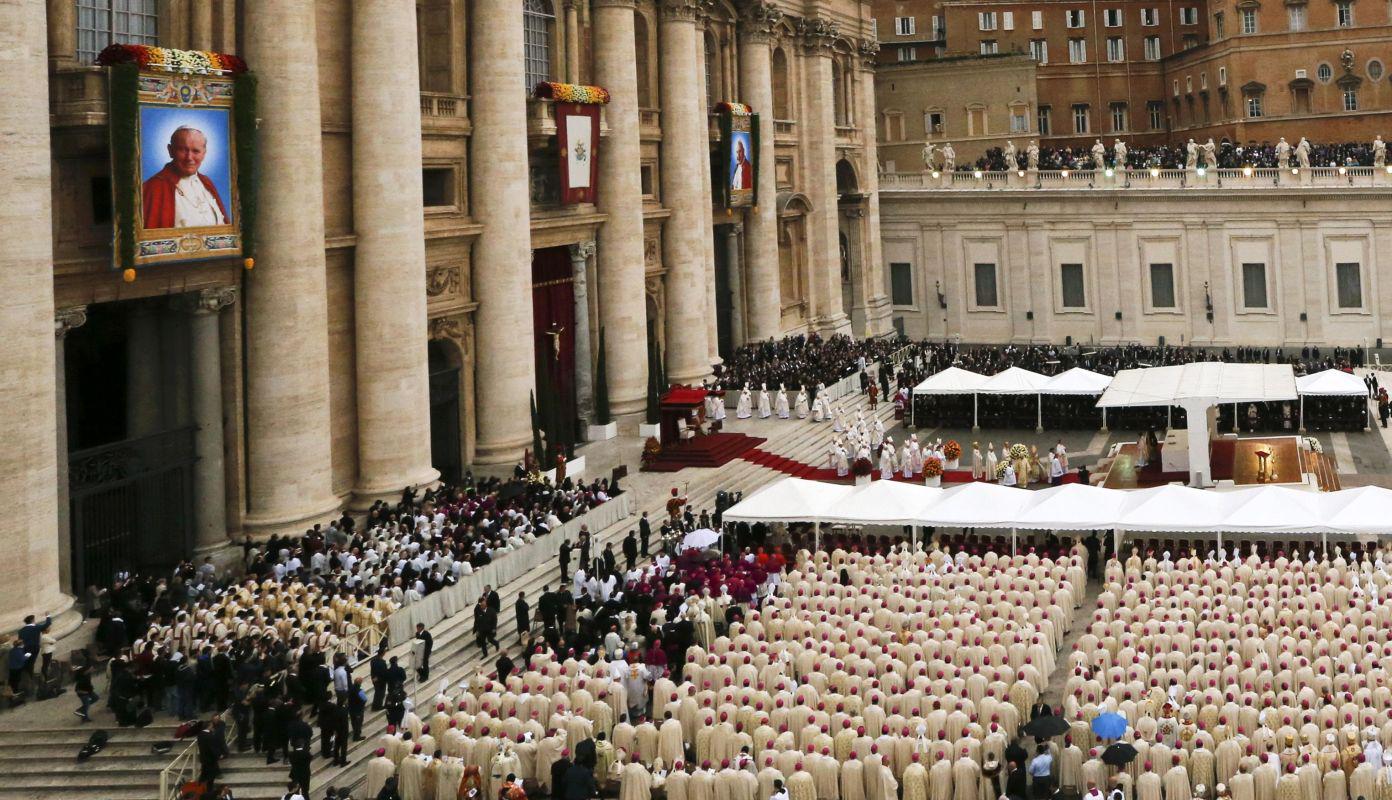
Related image
The canonizaiton of John Paul II and John XXIII


And what about that third audience that Rzeznik mentioned?  Interested laypeople.  Not only does the religious order Hecker founded, the Paulist Fathers, still operate actively, but Hecker must remain for some a figure of veneration with a fama sanctitatis (reputation for holiness) that would justify his cause for canonization.  The balance I am trying to strike between respect for Hecker the historical figure, respect for lay and clerical Catholics who may venerate him, and respect for the historical method, is a tenuous one.  I do not want to alienate this third audience if my scholarship casts Hecker in a negative light, but I also owe this audience, my other audiences, and Hecker an honest review of the primary sources wherever they may lead.  This consideration gives me pause to think about why a religious figure and their present-day admirers should command any more historical respect than their secular counterparts.  Is this just an unconscious blinder worn by historians of explicitly religious figures?  That is, do we ever adopt an additional degree of caution when analyzing religious subjects compared to non-religious subjects, even though the categories of religious and non-religious are themselves continually made and remade historically and historiographically?

In 1918, a piece in The Catholic Historical Review reflected on the effect of techniques of higher criticism being brought to bear on the histories of saints.  The unnamed author wrote that “American Catholic history thus far is largely biographical, and it is from the published lives of the leaders of the Church here that the future historian will be compelled to gather the larger part of his materials.”  They maintained that “if American Catholic history is to be protected against historiasters of the future,” historians of Catholicism must adopt a modern, rigorous, “technical method of research, of criticism, and of composition.”  This methodology applied equally to the lives of avowedly religious figures as it did to ostensibly non-religious figures.  The author argued that such a scientific method of historicizing necessarily entailed “criticism,” which, although “not the chief end of historical research,” was essential for the creation of an accurate narrative of the history of American Catholicism.”

This Progressive Era methodology of historical criticism of the church and its leading lights, however, was fraught with dangers to the historian.  Jesuit author Hippolyte Delehaye, a specialist in the study of hagiography, wrote in his 1907 book The Legends of the Saints: An Introduction to Hagiography, that “[r]eligious-minded people who regard with equal veneration not only the saints themselves but everything associated with them,” were appalled by historically critical interpretations of saints’ lives.  Delehaye was aware, then, of the multiple audiences of a historian of Catholicism; in this case, these audiences were academics practicing critical analysis and religious readers disturbed by an apparent undermining of saints’ cults.  The historian writing from a critical perspective about a saint or potential saint is therefore open, Delehaye argued, to charges of irreligiosity and of harboring an anti-saint attitude.  Delehaye thought this to be most unfortunate since many such historians, seeking only to treat their subjects and their discipline with respect, had been painted as “iconoclasts.”

Contemporary historians engaging in critical readings of figures regarded by some or many Catholics to be saints or at least saintly may face a difficult double bind: writing too positively about these individuals could lead to charges from fellow academics that they are writing hagiographies, and writing too negatively about them may lead to charges from these figures’ institutional and lay promoters that the historian has insufficiently respected the lived religious experiences of their subjects and their subjects’ devotees.  This is essentially the challenge facing any scholar, historian Jill Lepore explains, when he or she is “[f]inding out and writing about people, living or dead.”  In her 2001 article “Historians Who Love Too Much: Reflections on Microhistory and Biography,” Lepore writes, “It is necessary to balance intimacy with distance while at the same time being inquisitive to the point of invasiveness.  Getting too close to your subject is a major danger, but not getting to know her well enough is just as likely.”   For scholars of Catholicism, these difficulties may be rooted in the sense that hagiography and history can be neatly dichotomized, a position which would reveal a somewhat hubristic view of modern historians operating above hagiography and older hagiographers being incapable of writing accurate history.  I would like to suggest that there exists a finer line between the two narrative forms than may be acknowledged at first glance.  Jesuit scholar Michel de Certeau argues in The Writing of History that hagiography’s “combination of acts, places, and themes indicates a particular structure that refers not just primarily to ‘what took place,’ as does history, but to ‘what is exemplary.’”   From this perspective, the hagiographer is grappling just as much as is the historian with the challenge of creating for readers a usable past.

Whether a scholar of religion approaches her or his subjects from a position of methodological atheism or agnosticism or out of the belief that the presence of the supernatural in the world is a historical fact, this same scholar must reckon with the reality and associated responsibility that her or his scholarship can play a role, whether directly or indirectly, in shaping the historical memory, the prospects for canonization, and the nature of the veneration of a figure regarded by people of faith as a saint transcending history.


Bill graduated with a PhD in history from Penn State University in December 2016. He serves as the book review editor for H-SHGAPE (Society for Historians of the Gilded Age and Progressive Era) and is a member of the faculty of The Gwinnett School of Mathematics, Science, and Technology. His articles have been published in American Catholic Studies, The South Carolina Historical Magazine, and U.S. Catholic Historian, and he has an article on Catholic labor schools forthcoming in The Catholic Historical Review. Cossen is currently revising his first book manuscript, which is titled Making Catholic America: Religious Nationalism in the Gilded Age and Progressive Era.


--------

Notes

 Dr. Bartram gave me permission to mention this conversation.  See author’s personal correspondence, June 23, 2017.

Examples include Anne M. Boylan, The Origins of Women’s Activism: New York and Boston, 1797-1840 (Chapel Hill: The University of North Carolina Press, 2002), 101-109, 118-124 [on Elizabeth Ann Bayley Seton]; Allan Greer, “Natives and Nationalism: The Americanization of Kateri Tekakwitha,” The Catholic Historical Review 90, no. 2 (April 2004): 260-272; Greer, Mohawk Saint: Catherine Tekakwitha and the Jesuits (New York: Oxford University Press, 2005); Robert A. Orsi, Between Heaven and Earth: The Religious Worlds People Make and the Scholars Who Study  Them (Princeton, NJ: Princeton University Press, 2005), 110-145 [on Gemma Galgani].

On the historical development of the saint-making process, see Pierre Delooz, “Towards a Sociological Study of Canonized Sainthood in the Catholic Church,” in Saints and Their Cults: Studies in Religious Sociology, Folklore and History, ed. Stephen Wilson (Cambridge, UK: Cambridge University Press, 1983): 189-216; Kenneth L. Woodward, Making Saints: How the Catholic Church Determines Who Becomes a Saint, Who Doesn’t, and Why (New York: Simon and Schuster, 1990); Fernando Vidal, “Miracles, Science, and Testimony in Post-Tridentine Saint-Making,” Science in Context 20, no. 3 (Sept. 2007): 481-508; Bradford Bouley, “Negotiated Sanctity: Incorruption, Community, and Medical Expertise,” The Catholic Historical Review 102, no. 1 (Winter 2016): 1-25.

Woodward, Making Saints, 91.

The formal power of the promotor fidei (popularly known as the devil’s advocate) was substantially diminished by the 1983 reform.

 Delooz, “Towards a Sociological Study of Canonized Sainthood in the Catholic Church,” 195 [emphases in original].

Orsi, Between Heaven and Earth, 4, 113.

Bouley, “Negotiated Sanctity,” 25.

“Historical Criticism,” The Catholic Historical Review 3, no. 3 (Oct. 1917), 368.

Hippolyte Delehaye, The Legends of the Saints: An Introduction to Hagiography, trans. V.M. Crawford (London: Longmans, Green, and Co., 1907), vii, viii.  Delehaye defines “hagiography” as a form of writing of “a religious character” that “aim[ed] at edification” (2).

Jill Lepore, “Historians Who Love Too Much: Reflections on Microhistory and Biography,” The Journal of American History 88, no. 1 (June 2001), 129.

Michel de Certeau, The Writing of History, trans. Tom Conley (New York: Columbia University Press, 1988), 270.

On methodological atheism and agnosticism, see Michael A. Cantrell, “Must a Scholar of Religion Be Methodologically Atheistic or Agnostic?,” Journal of the American Academy of Religion 84, no. 2 (June 2016): 373-400.

On historical presence, see Orsi, Between Heaven and Earth; Orsi, History and Presence (Cambridge, MA: The Belknap Press of Harvard University Press, 2016).  This scholarly reckoning represents an example of “abundant historiography,” which Orsi describes as “approaching events that are not safely cordoned off in the past, that are not purified, but whose routes extend into the present, into the writing of history itself.”  See Orsi, History and Presence, 71.

spacer

Thomas Jefferson, Slavery, and Religion: Rethinking an American Icon

The Cushwa Center would like to introduce one of its new postdoctoral research associates, who will be overseeing the center's monthly blogging at RIAH.  Benjamin J. Wetzel specializes in American religious, political, and intellectual history in the period from 1860 to 1920.  Ben looks forward to working with fellow postdoc Pete Cajka (already well-known to readers of this blog) at the Cushwa Center in the coming academic year.

Benjamin J. Wetzel

Thomas Jefferson's reputation has suffered in recent years.  In 2015, at the College of William & Mary (his alma mater), students covered Jefferson's campus statue with post-it notes reading "racist" or "slave owner."  Last month, the University of Virginia began plans to honor the labor of slaves who literally built the university, reminding the public again of Jefferson's own life-long ownership of slaves.  At a more trivial level, the reputation of Jefferson's rival Alexander Hamilton has witnessed a stunning revival thanks to the popularity of Lin-Manuel Miranda's extraordinary musical.


In this context, then, comes John B. Boles's new biography of the third president.  At 626 pages, Jefferson: Architect of American Liberty (Basic, 2017) is, in the words of Gordon Wood, "the fullest and most complete single-volume life of Jefferson" since 1970.  Indeed, Boles offers a sprightly narrative that illuminates most facets of Jefferson's life.  This review will focus on only two elements of the book, however: Boles's interpretation of Jefferson's relationship with slavery, and Boles's treatment of Jefferson's religious views.


From the beginning of the book, Boles (Rice University) tries to complicate the image of Jefferson as merely a hypocritical racist.  In this he has some work to do, for it is not immediately clear to many people today how Jefferson could write that "all men are created equal" while holding hundreds of people in bondage and freeing very few upon his death.  Nevertheless, Boles does an admirable job of putting Jefferson in context: he inherited a good deal of debt (and accumulated some more of his own), making widespread emancipation financially difficult; he labored under the strictures of a 1793 Virginia law that allowed manumitted slaves to be seized as payment for their former owner's debts; and he had to deal with an 1806 state law requiring any freed slaves to leave Virginia within a year.  One might argue that Jefferson could have found a way around each of these problems, but Boles's point is that emancipation would have been more difficult than commonly imagined.

Boles also is at pains to show what he perceives as Jefferson's true anti-slavery beliefs.  In 1770, for example, Jefferson did pro bono legal work on behalf of a young mixed-race slave suing for his freedom.  Four years later, he could write that "the abolition of domestic slavery is the great object of desire in these colonies where it was unhappily introduced in their infant state."  (Whether this was accurate or not is beside the point.)  As president, he used his 1806 annual message to Congress to call on that body to prohibit the transatlantic slave trade (which it did).  Most famously, in his Notes on the State of Virginia (1787), he expressed a desire that the United States might abolish slavery completely.

Boles also assesses Jefferson's relationship with his slave Sally Hemings.  Today, based on DNA and other kinds of evidence, historians think it almost certain that Jefferson fathered six children through Hemings after the death of his wife Martha.  Naturally, some observers have alleged that Jefferson was nothing more than a rapist.  While acknowledging the common practice of slaveowners using their power to force themselves on slave women, Boles thinks the Jefferson-Hemings relationship was an exception: "mutual affection between individuals of unequal status can develop in certain circumstances" (154).  Among other evidence, Boles points out that Hemings could have gained her freedom in France (when Jefferson brought her there in 1787) but instead chose to return to Virginia with him.

In all of this, Boles does not attempt to pardon Jefferson's behavior.  An advocate of colonization and the inferiority of blacks (his description of African Americans in Notes on the State of Virginia makes for truly nauseating reading), Jefferson held views that can only be described as unambiguously racist.  Boles does not shy away from these facts but tries to present Jefferson in context--and tries to help modern readers understand why Jefferson thought the way he did.  Boles explains, but he does not excuse.  Still, not all will be convinced, especially of his treatment of the Hemings-Jefferson relationship.  It is worth pointing out that Hemings was thirty years younger than Jefferson, and that she was only sixteen when she theoretically had the opportunity to gain her freedom in France.  Both of these facts make it hard to believe that she really chose love over freedom.

Perhaps of even more interest to readers of this blog is Boles's treatment of Jefferson's religion.  Like most of the Founding Fathers, Jefferson cannot be described as an orthodox Christian; indeed, among the major founders he probably strayed the farthest from traditional Christianity.  Boles notes his "emerging skepticism toward orthodox Anglicanism" (19) as a teenager and describes his youthful rejection of the Trinity, Christ's divinity, and the atonement.  A decade later, Jefferson had grown more respectful of Christianity although he would never wholeheartedly take part in Virginia's Anglican establishment.  His rumored heterodoxy (or even atheism) would haunt him in the 1800 election, when Federalists put those charges to good political use.  In 1804, and then again in 1820, he edited the New Testament gospels, removing sayings of Jesus he thought inauthentic.  The result was a work stripped of the supernatural, leaving only (in Boles's words) "the simple, unadorned ethical principles of Jesus" (452).  Despite this, Jefferson still thought himself "a real Christian, that is to say, a disciple of the doctrines of Jesus" (452).

He refused to proselytize for his beliefs, however, claiming "I am of a sect by myself" (452).  He agreed with John Adams that the restoration of the Jesuits in 1814 bode evil for the nation, arguing that it was "a retrograde step from light towards darkness."  Thus, while Jefferson mostly stood against the religious trends of the early nineteenth century, the individualism and anti-Catholicism on display here help us see how he also partook of the spirit of the age.  Historians might think more about how religious outliers like Jefferson nevertheless maintained commonalities with larger trends.

Perhaps Jefferson's greatest achievement was his lifelong advocacy for religious freedom.  Too radical for its day, Jefferson's draft of a 1776 Virginia Constitution would have provided for "full and free liberty of religious opinion" with a disestablishment of the Anglican Church.  What did ultimately gain acceptance (although not until 1786) was Jefferson's Virginia Statute for Religious Freedom, which Jefferson meant to grant religious liberty even to non-Christian religions.  The statute would be one of three accomplishments he insisted must be included on his tombstone.

Overall, Boles's biography illuminates Jefferson's life in profound ways.  One does not have to agree with all of Boles's perspectives to gain greater insight into Jefferson, American religion, and the early national period.  While the book is a bit repetitive in places (Boles tells us no fewer than three times that Jefferson diluted his wine with water, for example), it succeeds as an astute, judicious assessment of our third president.  While it certainly falls into the unfashionable category of "great man biography," Jefferson: Architect of American Liberty engages themes of live interest to all kinds of historians.  The book will undoubtedly be the definitive biography for the foreseeable future.

spacer

Reflections on SHAFR @ 50 Annual Meeting

Lauren Turek

This past weekend, the Society for Historians of American Foreign Relations celebrated its fiftieth anniversary (as well as the fortieth anniversary of the journal Diplomatic History) at its annual meeting in Arlington, VA. Just as I reported last year, the conference included a number of panels and roundtable discussions on the topic of religion in American history and foreign relations. There were, in fact, so many good panels on religion that I could not even attend all of them owing to my unfortunate inability to be in multiple places at once! As such, in addition to providing my own overview of the exciting work that scholars showcased at the SHAFR meeting this year, I have included some reflections from other attendees as well.

Most of the panels that I attended reflected in some way on missionaries and missionary work, though the listing of panels that I have included at the end of this post does make clear that there were many panels at the conference that examined religion and foreign relations beyond missionary work (and that there were papers on a diverse array of faith traditions, including Judaism and Islam).


The first religion-themed panel that I attended was a roundtable discussion about David Hollinger's forthcoming book Protestants Abroad: How Missionaries Tried to Change the World but Changed America, which is due out in October. Daniel Immerwahr organized the roundtable, with Hollinger offering an overview of the project, Melani McAlister, Madeline Hsu, and Andrew Preston providing commentary on the book, and David Engerman moderating. Hollinger outlined his argument that the mainline Protestant missionary project played a key role in "deprovincializing" America, fostering multiculturalism in American life and ecumenicism in American churches in the years between 1890 and the Vietnam war. He suggested that missionaries, the children of missionaries, and the organizations that supported missionary endeavors created what he termed "missionary cosmopolitanism," which contributed to a nascent embrace of other cultures and a strong critique of colonialism—a critique which spurred debates about the missionary project itself and a turn toward more humanitarian aid. Hollinger also revealed how the missionary project, and the cosmopolitanism it inspired among the groups he examined, led these missionaries to engage in debates over the role of the United States in the world in this period. He argued that the alliances some of these Protestants developed with colonized peoples through their missionary work pushed them to embrace an idealism about the potential for U.S. foreign policy to act as a force of morality in international relations, advancing humanitarian and anti-colonialist goals. Hollinger shared a number of wonderful, engaging anecdotes about missionaries such as Kenneth Landon, who ended up briefing Franklin D. Roosevelt and working for the OSS during World War II because he was one of the only experts on Thailand the State Department could find, and about the role some missionaries played in enforcing humane interrogations of POWs in the Pacific theater. Yet, as he concluded, the Vietnam war "shattered their idealism" about the "morality of American policy."


Melani McAlister (and indeed all of the panelists) praised Hollinger's book, and dove into a deeper discussion of the critique these particular Protestants leveled against the missionary project. She noted that Hollinger's argument about how the de-emphasis of proselytism and focus on humanitarian aid in the post-World War I era provided the "fuel" in the split between modernists and fundamentalists not only placed this split in a global context, but that it also contributed to decline in the mainline churches. Madeline Hsu discussed the power dynamics that existed between missionaries and those peoples that they evangelized, particularly in China, which Hollinger explores in the book. Andrew Preston closed out the commentary by describing how the Protestants Hollinger discusses challenged and complicated the typical image of "missionaries as the tip of the imperial spear," due to the critiques of imperialism they leveled. Preston also highlighted Hollinger's emphasis on the relationship between ecumenicism and internationalism. In his response, Hollinger picked up on the thread that McAlister and Preston raised about the significance of the ecumenical movement, arguing that even though he believes that much of the historiography on American Protestantism has sought to "diminish the gap between evangelicals or fundamentalists and ecumenicals," the divide grew extreme in the period he covers in his book and that divide emerged because of the missionary project itself. All in all, a very exciting glimpse at what promises to be a defining book.

Later, I attended a panel entitled "Faith and Foreign Affairs: Religion, Non-State Actors, and U.S. Foreign Relations in the Early Twentieth Century," which featured three exciting papers. Kelly Shannon shared research from a brand new project on U.S. relations with Iran in the nineteenth and early twentieth centuries. The project is to be about a range of non-state actors, not just religious actors, but for this panel she gave a fascinating paper that explored the crucial role American Presbyterian missionaries played in developing official diplomatic relations between the two states. She also shared the wonderful story of Howard Baskerville, a Presbyterian missionary who resigned his post to join in the Persian Constitutional Revolution of 1909, as part of a larger exploration of how missionaries shaped perceptions that the American public developed about Iranians and that Iranians developed about Americans. Jonathan Chilcote gave a paper on the efforts that American missionaries in Bombay engaged in to spur contributions to help those suffering from the Spanish influenza in India in 1918-1920. In this compelling piece, Chilcote suggested that these missionaries "saw the flu as an opportunity to remake India in America's image." Denise Jenison rounded out the panel with a presentation of research from her dissertation, giving a paper on Arab-American efforts to influence official U.S. policy towards Palestine in the aftermath of World War II. Her excellent paper delved into the creation of the Institute of Arab-American Affairs, which sought to win support for Palestine by convincing American Christians of the link between Christian missionary work and Arab nationalism, as well as by stressing the close relationship that Palestinian Christians and Muslims shared.

I was also really excited for the "Foreign Religions and Foreign Relations: U.S. Engagements with the World in the Nineteenth Century" panel, in part because SHAFR does not feature nearly enough panels on pre-twentieth century foreign relations. The three papers on this panel, which Tisa Wenger chaired, were exceptional. Kathryn Gin Lum started out with a paper on mapping and geographic imaginings of the "heathen world" as lands that were "wild and overgrown because of the sin/heathenism of their inhabitants." She linked this tendency to view the regions of the world populated by non-Christians as undifferentiated and wild to the development and propagation of racist ideologies, including scientific racism, and to the belief that Westerners should intervene in these regions in particular ways. Emily Conroy-Krutz also examined maps in her fascinating paper on what she termed "missionary intelligence," or the information that missionaries shared about the countries they evangelized. She noted that the maps and information that missionaries discussed at monthly prayer concerts "contributed to the creation of a mental map of the world" for nineteenth century Americans, acting as a "source of knowledge production" about the wider world. Kate Moran turned her focus to late nineteenth century Protestant travelogues to examined the changing depictions of the Pope and Catholic authority in Rome during a period of bewildering social change in the United States and upheaval in Italy. She compared the positive descriptions of Pope Pius IX to the negative depictions of earlier Popes and the virulent anti-Catholicism of antebellum travelogues, making a riveting argument that in recasting their views of the pope in light of the Risorgimento, "Catholic power became a way [for Protestants] to understand their own concerns about social order in [their] present." This panel spurred excellent discussion of the role of religion in society and of the interrelationship of race and religion.

Dan Hummel also attended SHAFR (he presented on a fantastic new open source online U.S. foreign relations primary source reader, Voices & Visions, that he helped develop), and sent in the following report on one of the panels he attended, "American Zionism and U.S.-Israel Relations from the 1950s to the 1990s.":

"This excellent panel explored numerous facets of the U.S. relationship to Israel and the development of Jewish Zionism. Salim Yaqub aptly summarized that the panelists overlapped precisely in their study of the changing relationship between American Jews and Israel. Doug Rossinow traced the origins of the American Israel Public Affairs Committee (AIPAC, originally American Zionist Committee for Public Affairs) to a crisis in Israel’s public image after the IDF’s massacre of civilians in the village of Qibya in October 1953. He examined how AIPAC’s founder, I.L. Kenan, sought to unite American Zionists and Jewish non-Zionists. Rossinow concluded that the staunch support of the Israel lobby since 1953 is unsurprising given its origins in defending Israel’s largely indefensible actions at Qibya. Sara Hirschorn spoke about American Jews who have become leaders in the settlement movement in the West Bank. As her recently-published book, City on a Hilltop (Harvard Press, 2017), expounds upon, American Jews make up a large and ideologically potent segment of the current settler movement and hold more diverse religious, political, and economic motivations than we normally assume. Seth Anziska recounted the history of the opening of dialogue between the U.S. and the PLO in December 1988 and emphasized the role of American Jewish actors breaking with organized American Jewish attitudes toward the PLO. While the Reagan administration opened dialogue with the PLO, its intent was not necessarily to pave the way for independent Palestinia statehood. The differing agendas of American Jews, Israelis, the U.S. government, and the PLO poin to the ways that the U.S. government and PLO were pursuing incommensurate policy goals, even as they began to talk to one another."

Clearly, the religious turn in U.S. foreign relations history over the past decade has led to a proliferation of exciting work in this area. SHAFR is an incredibly welcoming place for scholars of religion (scholars of a wide variety of historical subfields, actually, as U.S. foreign relations history intersects with many aspects of domestic and international history as well as a number of methodological approaches) and the presentations are always of the highest quality. I am very much looking forward to next year's annual meeting, which will be held in Philadelphia in June 2018. Happy 50th Anniversary to SHAFR and here is to the next 50!


Below, I have listed all of the panels and individual papers that reflected in some way on religion and American diplomatic history, broadly defined. A link to the full program is available here.


Panel 12: Roundtable: Wilson and World War I: New Perspectives

Paper of Particular Interest:
Beyond Belief: Religion in Woodrow Wilson's Internationalism

Cara Burnidge, University of Northern Iowa


Panel 18: Christian Mission, U.S. Power, and Domestic and Foreign Publics from
the Early Republic to the Cold War

Chair:
Emily Conroy-Krutz, Michigan State University

Papers:
Protestant Mission, American Empire, and the Uses of History in Hawaii and the
Philippines, 1880-1920
Tom Smith, University of Cambridge

Foreign Missionaries and the “Spirit of Benevolence” in the Early Republic
Ashley Moreshead, University of Central Florida

Contending Christianities: U.S. Catholic and Protestant Missions in Central America
and Political Advocacy at Home during Henry Luce’s American Century, 1941-1960
Charles T. Strauss, Mount St. Mary’s University

Comment:
Emily Conroy-Krutz


Panel 37: Black Internationalism and Black Freedom Struggles

Paper of particular interest:
Bishop Ralph Dodge: Africa’s Unwanted Missionary
Luke Shief, University of Missouri


Panel 40: Roundtable: David Hollinger’s Protestants Abroad

Panelists:
Daniel Immerwahr, Northwestern University
Melani McAlister, George Washington University
Madeline Hsu, University of Texas, Austin
Andrew Preston, Clare College, University of Cambridge
David Engerman, Brandeis University
David Hollinger, University of California, Berkeley


Panel 52: Faith and Foreign Affairs: Religion, Non-State Actors, and U.S. Foreign
Relations in the Early Twentieth Century

Chair:
Cara Burnidge, University of Northern Iowa

Papers:
“I am Persia’s”: Howard Baskerville, American Presbyterian Missionaries, and U.S.-
Iranian Relations during the First Iranian Revolution
Kelly Shannon, Florida Atlantic University

The Principles of Relief: American Missionaries and the Remaking of Indian Lives after
the Spanish Influenza Pandemic
Jonathan Chilcote, Florida College

Arab-American Efforts to Influence U.S. Policy on Palestine, 1944-1948
Denise Laszewski Jenison, Kent State University

Comment:
Cara Burnidge


Panel 73: The United States and Right-Wing Dictatorships, a Retrospective:

Promoting Democracy in the Cold War

Paper of particular interest:
“A Human Rights Policy Means Trouble”: Ecumenical Activism, Civil Religion, and the
Forging of Ronald Reagan’s Human Rights Policy
Shannon Nix, University of Virginia


Panel 76: Beyond State Power: Non-State Actors, Aid, and Development Programs
and the U.S. in the World in the Twentieth Century

Paper of particular interest:
A “Little Cuba” in the Jungle: Priests in Ixcán, Guatemala, 1965-1976
Sarah Foss, Indiana University


Panel 80: Foreign Religions and Foreign Relations: U.S. Engagements with the
World in the Nineteenth Century

Chair:
Tisa Wenger, Yale University

Papers:
Heathen Geographies in the Nineteenth Century
Kathryn Gin Lum, Stanford University

Foreign Missions and Foreign Information in the Early Republic
Emily Conroy-Krutz, Michigan State University

Reimagining Catholic Power in the Wake of the Risorgimento
Katherine Moran, St. Louis University

Comment:
Tisa Wenger


Panel 85: American Zionism and U.S.-Israel Relations from the 1950s to the
1990s

Chair:
Peter Hahn, Ohio State University

Papers:
The Origins of America’s Israel Lobby, 1951-1956
Doug Rossinow, University of Oslo

City on a Hilltop: American Jews and the Israeli Settler Movement since 1967
Sara Yael Hirschhorn, Oxford University

American Jews and Arafat: Citizen Diplomacy and the PLO Recognition of Israel
Seth Anziska, University College London

Comment:
Salim Yaqub, University of California, Santa Barbara


Panel 88: Missionaries, Technicians, and Tourists: Cold War Public and Cultural
Diplomacy in Action 

Paper of particular interest:
Mormons in the Lion City: Religious Cultural Exchanges, 1968-1990
Keshia Lai, Ohio State University


spacer