Showing posts with label evangelcalism. Show all posts

Do Catholic Historians Need to Define Catholicism?

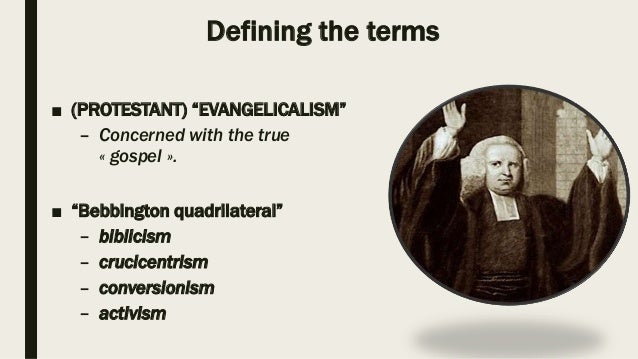
Image result for bebbington quadrilateralHistorians of evangelicalism are very interested in defining evangelicalism. It would seem obvious that scholars of a certain field would be dedicated to defining their object of study, but historians of evangelicalism go about this task with an admirable gusto. The act of defining is central to the field. Historian David Bebbington’s famous definition, the Bebbington Quadrilateral – evangelicalism as biblicism, crucicentrism, conversionism, and activism – has framed the conversation since 1989. As I listened to the excellent papers delivered by historians at the Noll Conference in March 2018, I began to wonder why Catholic historians do not seem so interested in defining their object of study, Catholicism.

Certainly we do not have quadrilateral. But should we have one?


Two answers to the question about the lack of enthusiasm for defining Catholicism pop up immediately. First, Catholicism does not appear to be as controversial in American politics, and as a result, the stakes of defining it are not as high. The conference suggested there is a pressing need to define evangelicalism in order to understand present day voting patterns. The second factor easing any pressure to define Catholicism is the structure of the Church itself. The centralized nature of the Church relieves scholars of the need to define Catholicism. At the conference I asked two colleagues who study evangelicalism why historians of Catholicism are not interested in definitions. Basically, the response I received was that the structure of the Catholic Church – a Pope and a hierarchy – means that less is up for grabs.

We should pause to ask if having a debate about the definition of Catholicism would be productive. I imagine some will think that having such a conversation would only serve as a distraction. But I found the debate about evangelicalism at the Noll Conference to be fascinating and generative. Is it a theology? Is it a politics? Is evangelicalism the media you consume? Is it a set of ideas? Is it worship? Is everyone who likes Billy Graham an evangelical? Is the scandal of the evangelical mind still scandalous?

It is possible to conclude that Catholic historians have been debating the definition of Catholicism implicitly in their books for years. The closest our field comes to The Scandal of the Evangelical Mind might be William Halsey’s classic study, The Survival of American Innocence: Catholicism in an Era of Disillusionment, 1920-1940. Halsey argued that a neo-scholastic worldview allowed Catholics to imagine themselves as existing outside the tragedy of twentieth century American history (the rise of ethical relativism, psychoanalysis, and subjectivity). It is tragic in Halsey’s tale, and rather a scandal, because the static mentality of Catholicism made it obtuse. Other scholars followed his lead and defined Catholicism as static because of the intellectual freeze brought on by the condemnations of Americanism and Modernism. But Halsey makes the important point that Catholicism could be construed as a set of mental categories. He does define his object of study. Jay Dolan’s work implied that only the methods of social history could move scholars of Catholicism closer to a useful definition of what they study. John McGreevy’s Catholicism and American Freedom would say Catholicism is an assent to a set of ideas. His Parish Boundaries would locate institutionalism at the center of what it means to be Catholic. His latest work on the Jesuits suggests any definition of Catholicism must consider the global. Robert Orsi’s work defines Catholicism as a religion of practice replete with longings for connections to the “real presence.” Relationships between heaven and earth are also at the heart this Catholic identity. As is gender, as works by Amy Koehlinger, Kathleen Sprows-Cummings, and Mary J. Henold make clear. The essays in Habits of Devotion on confession (James O’Toole), the Eucharist (Margaret McGuiness), prayer (Joseph Chinnici), and Marian devotion (Paul Kane) identify Catholicism as profoundly ritualistic and sacramental. Peter D’Agostino argues that Rome and trans-nationalism are key to defining American Catholicism. Younger scholars are contributing to this debate and taking it in new directions. Matthew Cressler has raised the question of how the definition of American Catholicism changes when we locate black Catholics at the center of our story. Catherine Osbourne’s new book suggests professionalism and professional identities are important to Catholic life in the twentieth century. Jack Downey makes the point that Americanization of Catholicism and its entrance into mainstream of American life should not stand as the ultimate end point for defining the men and women of the Old Faith. Not all Catholics wanted mainstream status because such an “achievement” entailed an ensnarement in modern materialism.

Catholic historians debate definitions of Catholicism without a central framing device.


This blog post raises the question of whether Catholic historians need a device like a quadrilateral to shape this debate and give it some structure. The question assumes, perhaps incorrectly, that scholars can, in fact, define Catholicism. It also pushes past any reservations about debating a definition rather than figuring out how Catholics shaped American History. But what if we synthesized the works in the field to produce a four-pronged definition?  What would rise to the surface if we made it goal to boil it all down to four categories? Or could we define Catholicism with a broader categorical move? Is it a theology? Is it a set of institutions? Is it an imagination? We might return to some classic sources written by theologians and social scientists. David Tracy’s Analogical Imagination or Andrew Greely’s The Catholic Imagination both spring to mind. Historians might walk the path hewn by the editors of the recently published The Anthropology of Catholicism: A Reader. Scholar of religion Kate Dugan, in her useful review, teases out the questions asked across the volume’s essays: “What counts as a Catholic idea and a Catholic person? Why does Catholicism continue to have influence the twenty-first century? If there is a Catholic imagination, or Catholic imaginations, who acts in it?” Historians of Catholicism might follow the lead of evangelical historians and these anthropologists and then ask a pack of similar questions. Then, of course, we should deliver a satisfying answer.


spacer

Six Questions With Kyle Roberts: The Rise of Evangelical Gotham


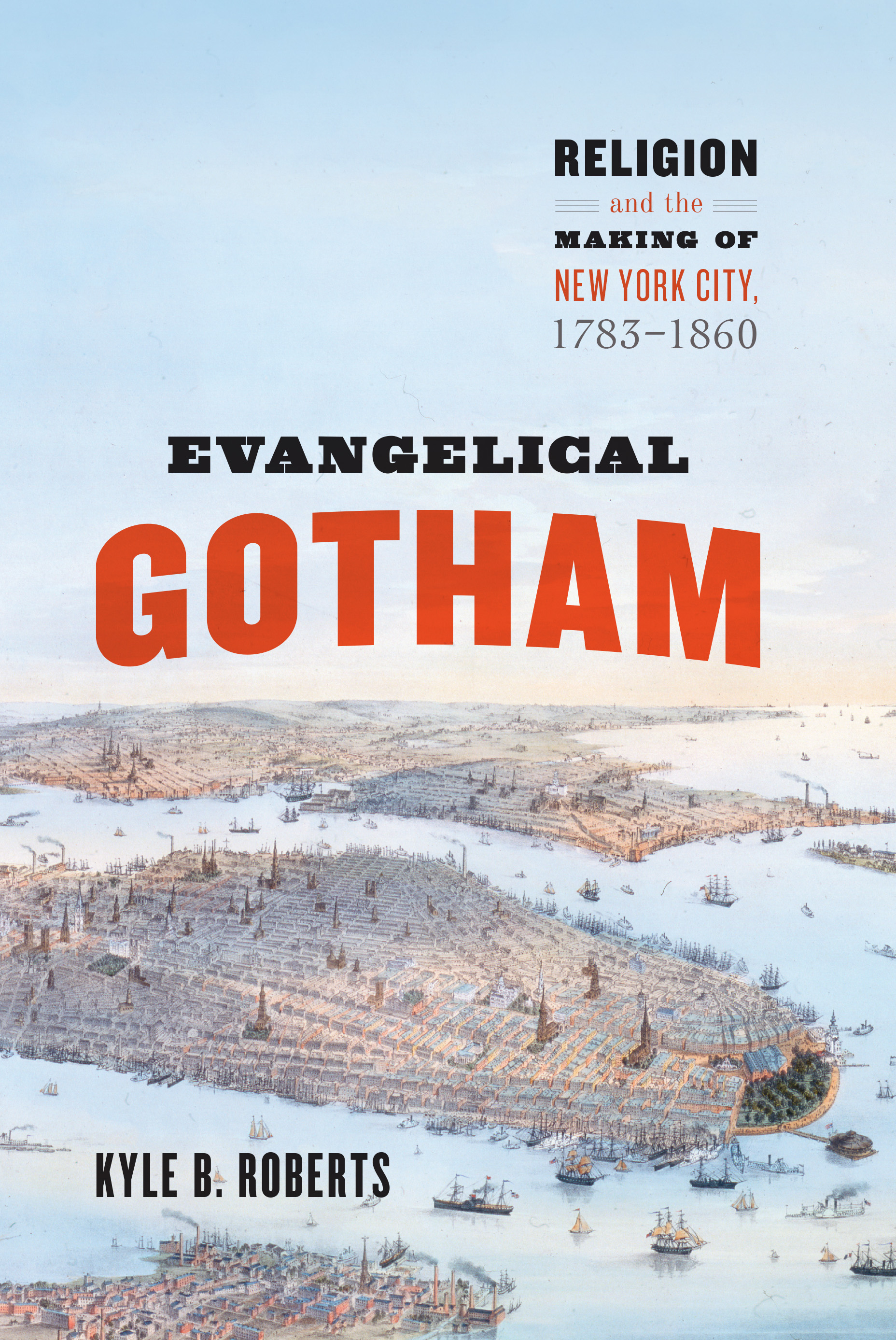
Kyle Roberts is Associate Professor of public history and new media at Loyola University Chicago and director of the Jesuit Libraries Provence Project. I recently interviewed Kyle about his new book, Evangelical Gotham: Religion and the Making of New York City, 1783-1860 (University of Chicago Press).


PC: What happens to early American Religious History – and American history – if we locate evangelical revivals in New York City rather than at Cane Ridge? What should we rethink?

KR: In graduate school in the early 2000s, the scholarship that I found most engaging was about evangelicalism and urban religion. Yet the two rarely overlapped. Antebellum evangelicalism was often told as a rural story – more likely to focus on camp meetings on the frontier than on outpourings of the spirit in urban churches. We knew more about Cane Ridge in 1801 than Allen Street in 1832. Works of urban religion tended to be post-Civil War studies of religious groups moving into urban environments created by others and trying to make them their own. I wanted to know what role the religious played in building the modernizing city in the first place. No city grew at a more transformational rate than New York in the first half of the nineteenth century, so I thought I would look there.


New York City turned out to have played a significant role in the expansion American evangelicalism. It became a national, and later international, center for evangelical cultural production. The printing presses of the American Bible Society, the American Tract Society, the Methodist Book Concern and other evangelical ventures produced the materials that were read across the country. Every May, the leaders of these societies came together in the city to plot their strategies for the coming year. New York’s place as the nation’s commercial center opened up access to both funding and distribution routes that brought these works across the country and around the world. 

These institutions, while nationally supported, would not have existed without the growing evangelical community in New York. They provided the financial resources, wrote the tracts, and ensured the distribution of these works. As the writings of Michael Floy, Phoebe Palmer, and others show, urban revivals energized evangelical New Yorkers in their national – even international – project.

My hope in Evangelical Gotham is ultimately to recover the vibrancy (and the tensions) within New York’s urban religious community, but also to restore its place to the larger national and international story that we tell about the spread of evangelicalism.


PC: Your work brings a cast of fascinating characters to our attention: Isabella Marshall Graham (widow activist), Ezra Styles Ely (urban missionary and social reformer), Phoebe Palmer (theologian and missionary), and Michael Floy (prolific reader of urban evangelical texts). Tell the blog about your favorite character and explain how he or she illumines the broader story you tell in Evangelical Gotham.

KR: Phoebe Palmer was, perhaps, the story that surprised me the most. I remember going to major research libraries and finding so few of her works in their collections. How is it that someone who had such an impact on mid-nineteenth century evangelical theology been so forgotten? 

What fascinates me about Palmer’s story is the question of what happens when you get your wish. The post-revolutionary generation of evangelical New Yorkers had the chance to create in the city a world that certainly wasn’t there when they arrived from destinations around the Atlantic World following the American Revolution. Palmer represents the first real generation of native-born evangelical New Yorkers. She grew up in a world where evangelicals put into practice their ideals for promoting conversion and social activism. Yet rather than easing the course of their spiritual journeys, this world created new anxieties for the rising generation, especially about their inability to live up to what was expected of them. In Palmer’s case, it proved to be a remarkably productive tension, inspiring her to reach back to early generations to recover ideas about holiness that set the theological agenda for many evangelicals of her generation and those who followed.

There is far more to be written about the children of nineteenth-century evangelicals!

PC: In addition to a roundtable on your own book, the Religion in American History blog recently celebrated the twentieth anniversary of John T. McGreevy’s Parish Boundaries. Do the urban evangelicals you study have a “idiom” about space? Or are they defined by a constant crossing of space into other spaces?  How does evangelical theology clash or sync with urban spaces in a rapidly expanding city?

KR: Great question. On the one hand, I would argue that the evangelical approach to urban space was dynamic and flexible. Evangelicals thought very creatively about the ways in which secular urban spaces could be put to sacred uses. What made a space sacred was the preaching of the Word to a gathering of engaged people. All they need for that was a place for the preacher to stand and some benches. This allowed storefronts to become churches without much trouble. When they encountered a new kind of space, they thought about what it meant to the audiences that inhabited it. For example, when they preached on board a ship, they respected the meaning ascribed to different places on a deck and positioned people relative to them (see the illustration of the Bethel Meeting on the Receiving Ship Fulton in the New York Navy Yard). In boardinghouses, a different dynamic (and hence type of participation) unfolded. For urban evangelicals, spaces could move easily between sacred and secular uses and meanings.

On the other hand, evangelicals certainly understood the importance of branding and marking the landscape within the urban marketplace. The first John Street Methodist church in lower Manhattan (erected 1768; seen in the illustration here) is exemplary of what I call the evangelical vernacular that proliferated across not only New York, but much of the East Coast in the late eighteenth and early nineteenth-century. These structures are often three-bays wide, one-and-a-half stories tall, their gable ends face the street, and they purposely do not have steeples (although they might have a cupola).  This is an extraordinarily effective urban form, one that can be built as easily at the back of lots as on the corner of an intersection, as large or small, with as expensive or as cheap materials they could afford. But most of all, it all those unfamiliar with the city (which was most people in New York in the nineteenth-century) to quickly identify an evangelical congregation.

PC: One of the key areas where your book helps us to see the dynamism of the city in stoking religion is print culture. How did the city promote religious reading? How did the city help evangelicals as readers and producers of print? How does Evangelical Gotham fit in with the history of print culture in the early republic?

KR: Evangelical New Yorkers appreciated that they lived in a city that was competing with Philadelphia for supremacy in the growing nation. The race to be a national center for print production was one of many such competitions. At the turn of the nineteenth century, London evangelicals had suggested the efficacy of the organized production and distribution of religious print through associations like the Religious Tract Society and the British and Foreign Bible Society. Within a decade or so, New Yorkers followed their lead.

By the second quarter of the nineteenth century, evangelical print was being produced by non-denominational, denominational, and even commercial printers across New York. Non-denominational societies such as the American Tract Society and American Bible Society relocated to the city and made it their base of operations. Denominational publishing houses, such as the Methodist Book Concern, also set-up shop. Both sought to produce as much print and to make it as affordable as possible. Realizing the money to be made from the evangelical market, commercial publishers also began to publish a range of religious works. Harper Brothers, for example, was founded by four brothers who had grown up in the John Street Methodist Church. Commercial publishers kept their secular titles, but also profited from the religious ones they sold. Evangelicals made it very difficult to avoid their printed works; they even distributed tracts to every household in the city in 1835! 

Not only were evangelical New Yorkers surrounded by religious print, but they also had the opportunity to contribute their own voices to it. A small tract written by the nurseryman and Sunday school teacher Michael Floy was picked up and printed in the national Methodist magazine, The Christian Advocate and Journal, soon reaching audiences across the nation.  

I think we have underappreciated the extent to which evangelical adoption of new printing technologies, their experiments with the organization of wide scale production, and their innovative thinking about distribution not only benefited their own objectives, but also advanced printing more broadly in the city and nation.


PC: Explain for the blog what you meant on page 7 of the introduction: “Evangelicals did not just live in New York; they lived through it.”

KR: Early on I took to heart Robert Orsi’s admonition that urban religion was not simply religion that took place in cities, but religion that existed at the intersection of religion and the city. Taking seriously that intersection opens up the realization that the faith of evangelical New Yorkers was dependent, in both conscious and unconscious ways, on the city around them. Every walk through city streets, experience in the marketplace, and interaction in the workplace had the potential to be just as formative as services in their churches and Bible reading in the family parlor. 

As I note at the end of the first chapter, at some point in the construction of their spiritual autobiographies, evangelical New Yorkers invariably reflected on the place of New York in their journeys. For the Baptist preacher Charles Lahatt, New York was just one of many stops along a lifetime’s journey that began in the German states and ended as a missionary in western New York. Freed slave George White saw New York City as a land of deliverance, especially compared to the Virginia of his enslavement. And for Divie Bethune, New York was the Celestial City, to which the Lord had directed him “from that sink of iniquity, that blackness of darkness, Tobago” where he had been a clerk on a plantation. New York was many things to many people: a safe harbor in a storm, a conflicted land of deliverance, and even a heavenly reward. To tell the story of urban evangelicals we need to focus on both the urban and the evangelical.

PC: What’s next?

KR: I’m just back from a research trip across the Midwest to a variety of nineteenth-century Catholic settlements. My Loyola students and I have been working on the Jesuit Libraries Provenance Project (https://jesuitlibrariesprovenanceproject.com/) for several years now, and as I move towards writing a book about what we’ve uncovered, I feel the need to see their churches, communities, and homes. As you’ve noted in your questions about my focus on space, I find it difficult to write about a subject if I haven’t seen the physical place in which they lived, moved, and had their being. Writing about New York while a graduate student in Philadelphia and living in Boston was relatively easy: I could hop on a bus or train and be there in a few hours. The Catholic world of the Missouri, Mississippi, and Ohio River valleys is a much broader space.  Westphalia, Hermann, Perryville, and Teutopolis are a little more difficult for me to ordinarily reach from my academic home in Chicago. But it was worth it. Logging over 2000 miles in a rental car gave me plenty of time to reflect on how the landscape of the Midwest might shape not only the economic, political, and social worlds of Catholics, but also inform their spiritual worlds as I gear up to start writing about them.

spacer

Walking the City

We conclude our roundtable review on Kyle Roberts' Evangelical Gotham with a reflection from the author himself. Thanks to everyone who contributed to the conversation, and please do chime in below to continue the dialogue.


What a genuine pleasure it has been this week to have four thoughtful scholars of American religion share their journeys through Evangelical Gotham. I can’t think of better traveling companions. I have admired their scholarship and benefited from their conversation over the past decade. As with the best walks through a city, they have allowed me to point out the sites that most interest and excite me and, in return, have shared my enthusiasm, asked for clarification, and drawn my attention to things that I have missed.

This book began as an excuse to get off the Amtrak at Penn Station during my regular commute in graduate school between Boston and Philadelphia. The books that intrigued me the most at that time (and which helped me while away the six-hour train ride) were the new histories of evangelicalism that sought to understand not only what evangelicals did, but why they did it. What would make an enslaved woman join the Moravian Church? How did a slaveholder reconcile his need for independence with the conversion of his wife and slaves? How could a “crazy” itinerant melt hearts?  With notable exceptions, these new histories were often stories of camp meetings in the rural hinterland, of circuit preachers riding to an early grave. What happened to evangelicals when they went to the city? 

Nassaus St. Then.
There were, of course, wonderful books on religion in cities, whether it be Italian Catholic mothers in Harlem or Salvation Army lasses downtown, but these were stories about what the religious did to make their own place in cities that other people had made. What about those who had built the city in the first place? New York certainly did not emerge fully formed. Between 1780 and 1860 settlement raced up Manhattan Island from (what is now) City Hall Park to the base of Central Park. Someone had to do all that building. Certainly, the religious, maybe even evangelicals, played a part? As it turns out, they had quite an influential role. My contention in Evangelical Gotham is that evangelical investment in the spiritual marketplace, church building, cultural production, and moral reform, to give just a few examples, shaped the development of the modernizing city and the experience of life within it. In the process, evangelicalism came to be decidedly shaped by the experience of urban life.

Nassau St. Now
Evangelical ability to turn space into place was key to that strategy, as Lincoln Mullen points out. Reading the work of Henry Glassie, Dell Upton, Bernard Herman, and Robert Blair St. George, I knew that I had to get off the train and take in the urban built environment. How different New York looked from all the maps and illustrations that I had uncovered in the archive! But I couldn’t just look at buildings for their own sake. My reading of the vast trove of surviving evangelical diaries, autobiographies, newspapers, and tracts reminded me of the generative and constitutive role that space plays in nearly every facet of evangelical life. At a crucial moment in my thinking, Tom Tweed’s Crossings and Dwellings helped me to understand the centrality of placemaking to the urban religious.  The places evangelicals inhabited could be real or imaginary. They saw New York through many lens – some sacred, some secular - and, in turn, sought to transform it, often just temporarily, to their own ends. No stable, storefront, or ship’s deck was safe.

Digital mapping gave me a means to try to make sense of the massive amount of data about place that I was uncovering. Without Google Earth and (later) Google Fusion Tables, it would have been hard to see the patterns in evangelical emplacement strategies that make up the maps in my book. While mapping software is good at conveying some kinds of spatial information, it doesn’t work as well with others. How might I convey Margaret Prior’s conversion experience as the Word wafted on the wings of a breeze out the window of the Methodist meeting house across the adjoining yard to her “unperceived” ear as she sat beneath a shade-tree?  My programming skills weren’t (still aren’t) that good. I hope Monica Mercado will invite me to sit in on her class one day as she and her students follow Prior through the city. I would share my own clumsy attempts at mapping Henry Chase’s journeys in 1821-22 through what is now the Lower East Side when he first became a missionary to mariners. At first, he followed the systematic landscape of the grid, calling at every house up one street and then down another. Within a matter of weeks those carefully laid plans were jettisoned by the demands of the women of the neighborhood who wanted his time and attention. Zipping back and forth from one house to another to offer spiritual and temporal support to these women certainly reminded him that the promise of the linear grid was illusory (and that urban evangelicalism was a women’s religion). As a scholar who chose the medium of a book to tell this story, I strive to demonstrate those journeys of faith through the city in other ways – through text and image. I have, however, deposited all my mapping data with the New York Public Library for those who want to recreate the past journeys of others. 

Could Catholics have been contenders for the souls of evangelicals in Gotham’s spiritual marketplace? Christine Croxall asks a great question. By utilizing a broad definition of evangelicalism, I could see a much wider array of actions and strategies in the city’s spiritual marketplace than if I had focused on a single denomination. While evangelicals dominated the city’s spiritual marketplace through mid-century, they were certainly never alone. Some of the scholarship that most interests me these days is by Croxall and Bridget Ford that take seriously the ways in which evangelicals and Catholics fed off each other’s strategies.  That became clear as I looked at how John Hughes approached parish building in the later 1840s. Did that imitation/emulation extend to their beliefs as well? Fear and hatred of Roman Catholicism was deeply engrained in Protestant DNA by this point. Perhaps what the examples of the almshouse residents that Croxall points to tell us less about a battle for doctrinal understandings than for the rich and varied modes of popular religiosity, pulling from Protestant, Catholic, and other belief systems that existed in early national and antebellum New York. Theirs is a world now largely lost to us.

To conclude, I’ve always loved Michel de Certeau’s “Walking in the City” from The Practice of Everyday Life where he reminds us that to truly understand a city, we must go down from the height of steeple to the level of the street. It is in the daily movements and interactions of men and women, the “ordinary practitioners of the city,” that the city is constituted. I fully embraced that idea and spent much time looking closely at what I found down there. Catherine O’Donnell’s comments remind me however of my need to climb back up into the steeple, or better yet, to figure out where John Bornet secured his view of Manhattan in his panoramic birds’ eye view that adorns the cover of my book. John McGreevy, in his comments on the twenty-fifth anniversary of Parish Boundaries published in this blog a few months back, refers to this as the need to remember to come up for aid.  What can I say? Evangelical Gotham is a seductive place! But I wholeheartedly agree that pulling back to see the commonalities across time and space is essential. My journey through Evangelical Gotham has, in some ways, come to an end while it is just beginning for others. Fortunately for me, I am beginning my next journey with the rich reflections of four fellow travelers in my head and my heart.

spacer