Showing posts with label Lauren Turek's posts. Show all posts

CFP: Graduate Student Conference on Democracy and Religion

Lauren Turek

I would like to share the following call for papers that I received. This conference looks fantastic and would be an excellent opportunity for graduate students of all levels.

Call For Papers:
Graduate Student Conference on Democracy and Religion

University of Virginia, April 12, 2019

The UVA Department of Religious Studies’ Forum on Democracy and Religion invites paper proposals for a graduate student conference to be held on April 12, 2019. Graduate students at any level and in any disciplinary field are welcome to apply.

Our focus will be on the relationship between democracy and religion. We are particularly interested in such issues as: the current contest between free exercise and human dignity; the shifting sites of the “public square,” including its market dimensions; the relationship between neoliberalism and international religious freedom; how discussions of religious minorities, race, and gender shape what we mean by religion and democracy; and whether democracy needs religion or what kind of religion needs democracy.

Paper proposals should be no less than five pages long, exclusive of notation. Full papers are preferred. Panel proposals are welcome but not necessary. Panel participants will receive a $500 honorarium.

Paper selection will begin January 25th, 2019, and continue until the program is announced and panelists notified, no later than March 15. Please send all proposals by email attachment to Spencer Wells, Executive Assistant for the Forum on Democracy and Religion, at spencerwells@virginia.edu

spacer

Religious Internationalism at the Conference on Faith and History

Lauren Turek

To follow on Andrea L. Turpin's helpful recent post about Women & Gender presentations at the upcoming Conference on Faith and History, I would like to highlight presentations that will have some bearing on religion and international relations, broadly conceived. This includes panels or papers that touch on U.S. foreign policy, diplomacy, religious internationalism, foreign missionary work, war and society, and the like.

The Conference on Faith and History will hold its 31st biennial meeting on October 4-6, 2018 in Grand Rapids, MI. The theme of the conference is “History and the Search for Meaning,” and the full conference schedule is available here.

Panels and papers of particular interest to scholars of religion and internationalism include the following:


Thursday, October 4

Session 2: War, the Environment and the Fallout of Violence
Chair: William Katerberg, Calvin College

Papers:

  • “Environmental Impact of the Civil War in Syria," Kincaid Wurl, Southern Adventist University
  • “The National Park Service and the Story of the Buffalo National River: A Social Case Study of Environmentalism,” Coplea Donley, John Brown University
  • “The Inhibitions of War and Violence on Sustainable Development,” Karyn Ashley Spirek, Huntington University
  • “Khmer Rouge: A Traumatized Kingdom,” Jamie Conrad, Huntington University


Session 3: Making Peace and Ending Wars
Chair: Douglas Howard, Calvin College

Papers:

  • “Pol Pot’s Cambodia and Social Mechanism Used for Genocide,” Ellie Lawson, Huntington University
  • “The Iraqi High Tribunal’s Disruption of Nuremberg Legacy of Post-Conflict Justice,” Adele Duval, Eastern Nazarene College
  • “Peace for Cambodia?” Alexandra Seleyman, Huntington University

Session 8: Rebuilding in Europe from Rome to the Cold War

Papers:

  • “Controlling Their Emotions: How the Political Establishment Felt About Churchill,”Holly Holton, Huntington University
  • “The Practicality of Morality in International Politics: Vaclav Havel and the Larger World,” Paige Hungar, Covenant College
  • “Vaclav Havel: Building Democracy in a Post-Communist World,” Madison Morin, Eastern Nazarene College
  • “For the Good of Res Publica: Civic Virtue in the Roman Republic,” David Engstrom, Trinity International University


Session 10: Building and Rebuilding through Development, Human Rights, and Diplomacy
Chair: Kelli McCoy, Point Loma Nazarene University

Papers:

  • “Rethinking Models of International Development,” Malachi Wise, Huntington University
  • “The Failure of Diplomatic Relations between the United States and Japan,” Alana Bates, Huntington University
  • “A Communist Economic Miracle?” Alec Boyd-Devine, Huntington University
  • “Effectiveness of HUMINT in the Middle East,” Jordan Hayley, Liberty University


Session 14: American Foreign Policy and the Cold War
Chair: William Katerberg, Calvin College

Papers:

  • "Neither Saints nor Simpletons: Harry Truman, Anti-Catholicism, and the Nomination of a Vatican Ambassador," Christopher Estep, Eastern Nazarene College
  • “FDR, Churchill, and the Future of Postwar Indochina, 1940-1943,” Taylor Holliday, Huntington University
  • “Before Vietnam: Understanding the Initial Stages of US Involvement in Southeast Asia,” Jacob Mach, Bowling Green State University & Cedarville University
  • “India’s Complications with the Cold War,” Sarah Nelson, Point Loma Nazarene University

Session 15: History, War and Politics in England
Chair: Lisa Clark Diller, Southern Adventist University

Papers:

  • “The Steel Wall of England: The Curious Case of the English Knight during the Hundred Years’ War,” Mitchell Gehman, Liberty University
  • “Churchill’s Reign of Regrets: A Study of Wartime Leadership,” Claire Harvey, Huntington University
  • “The Politics of Terror: The British Cabinet and the Strategic Bombing Campaign of 1918,” Perry Colvin, Auburn University


Friday, October 5

Session 13: Christian Mission in the Non-Western World
Chair: Joel Carpenter, Calvin College

Papers:

  • "E.H. Broadbent and Brethren Missions to Russian Turkestan, 1900 and 1908," William Wood, Point Loma Nazarene University
  • “Faith and Friendship: The ‘affective cosmopolitanism’ of Charles Freer Andrews (1871-1940),” Bernardo Michael, Messiah College
  • “Harriet Newell’s Conversion to Usefulness: Understanding the Memoir that Contextualized American Women in Mission,” Hannah Nation, Gordon-Conwell Theological Seminary

Comment: Joel Carpenter, Calvin College

Session 14: Missionary Anxieties: Doubt, Empire, and Commerce in Nineteenth-Century British Missions
Chair: Jason Bruner, Arizona State University

Papers:

  • “‘Extending a Superior Light Farther than the Roman Eagles Ever Flew’: The Clapham Sect’s Influence in India," Ryan Butler, Baylor University
  • “‘Why Doest Thou Thus?’ Suffering, Failure, and Providence in Nineteenth-Century British Missionary Documents,” Kelly Elliott, Abilene Christian University
  • “Python Buys Sheep’s Farm: Using Non-British Sources on West African Christianity, 1850-1900,” Paul Grant, University of Wisconsin–Platteville

Comment: Jason Bruner, Arizona State University


Saturday, October 6

Session 34: “And He Must Win the Battle”: God and Nation in Twentieth Century England, Germany and the United States
Chair: Erik Benson, Cornerstone University


  • “The Power of a Hymn: Choral Singing Defining National Identity,” Ruth Dewhurst, Georgia State University
  • “Theodore Roosevelt’s Religious Support for World War I,” Benjamin Wetzel, Taylor University
  • “'Massive Retaliation’: Power and Morality in John Foster Dulles’ World,” John Wilsey, Southern Baptist Theological Seminary

Comment: Erik Benson, Cornerstone University


Session 38: Roundtable on Dale Van Kley's Reform Catholicism and the International Suppression of the Jesuits in Enlightenment Europe
Chair: Katherine van Liere, Calvin College

Participants:
Jeffrey D. Burson, Georgia Southern University
Andrea Smidt, Geneva College
Daniel Watkins, Baylor University
Comment: Dale Van Kley, Ohio State University Emeritus

Session 44: Christianity and Secularism in the Twentieth-Century United States
Paper:  "Catholic Conscience Language in the Secular Human Rights Revolution, 1970-1985"
Peter Cajka, University of Notre Dame

Session 50: Roundtable: New Perspectives on Religion in American Internationalism
Chair: Gale Kenny, Barnard College

Participants:
Emily Conroy-Krutz, Michigan State University
Mark Edwards, Spring Arbor University
Lauren Turek, Trinity University
Daniel Hummel, University of Wisconsin-Madison

Comment: Audience


Looking forward to seeing those of you who be attending the conference next week!


spacer

Finds from the Far East Broadcasting Company Digital Archives: Missionary Radio and the Cuban Missile Crisis

Map showing potential ranges of Soviet MRBM and IRMB
missiles from Cuba. Source: JFK Library
For thirteen days in October 1962, the world stood on the precipice of disaster as the United States and the Soviet Union faced off over the placement of Soviet missiles on the island of Cuba. The construction of nuclear missile sites just 90-miles off of the coast of the United States posed an existential national security threat and brought the Cold War superpowers to the brink of nuclear war. After days of tense discussions with his advisors about how to handle the unfolding crisis, President John F. Kennedy announced to the world that he would impose a naval “quarantine” to keep Soviet ships from delivering weapons to Cuba and demanded that Soviet Premier Khrushchev remove the missile sites from the island. The October 22 speech was broadcast to televisions and radios across the United States, but it also reached radios in Cuba—thanks in part to missionary radio station networks such as the Far East Broadcasting Company (FEBC). Documents and images from the FEBC International digital archive provide some fascinating insight into this important moment in the crisis.


President Kennedy requested ten radio stations with the range to reach Cuba, including FEBC shortwave station KGEI in San Carlos, California, to broadcast hours of Voice of America (VOA) programming throughout the crisis as well as his October 22 speech. This speech included a direct message to the Cuban people:
Finally, I want to say a few words to the captive people of Cuba, to whom this speech is being directly carried by special radio facilities. I speak to you as a friend, as one who knows of your deep attachment to your fatherland, as one who shares your aspirations for liberty and justice for all. And I have watched and the American people have watched with deep sorrow how your nationalist revolution was betrayed-- and how your fatherland fell under foreign domination. Now your leaders are no longer Cuban leaders inspired by Cuban ideals. They are puppets and agents of an international conspiracy which has turned Cuba against your friends and neighbors in the Americas--and turned it into the first Latin American country to become a target for nuclear war--the first Latin American country to have these weapons on its soil.

These new weapons are not in your interest. They contribute nothing to your peace and well-being. They can only undermine it. But this country has no wish to cause you to suffer or to impose any system upon you. We know that your lives and land are being used as pawns by those who deny your freedom.

Many times in the past, the Cuban people have risen to throw out tyrants who destroyed their liberty. And I have no doubt that most Cubans today look forward to the time when they will be truly free--free from foreign domination, free to choose their own leaders, free to select their own system, free to own their own land, free to speak and write and worship without fear or degradation. And then shall Cuba be welcomed back to the society of free nations and to the associations of this hemisphere. [1]
The speech reflected the anti-communist stance of the Kennedy administration. Drawing links between democratic governance, liberal capitalism, and support for religious freedom, American leaders such as Kennedy sought to highlight the differences between the United States and the atheistic, communist Soviet Union and its client states. In an atmosphere of Cold War competition—which included the arms race as well as the ideological battle for "hearts and minds" in Latin America, Africa, Asia, and the Middle East—such rhetoric took on considerable importance.

The missile crisis ended on October 28, when Khrushchev agreed to remove the missiles from Cuba. In early December 1962, Kennedy invited the station owners who had broadcast the speech and VOA programs to the White House to receive a special commendation for their patriotism and contributions to national security. Robert Bowman, the president of the Far East Broadcasting Company was one of the ten station owners who received this commendation.

Robert H. Bowman, president and co-founder of the FEBC, receives a handshake and award from U.S. President John F. Kennedy, on behalf of KGEI, at a ceremony following the successful blockade of ships during the Cuban Missile Crisis. Image used with permission from the FEBC Archives.


Associated Press article in a Danville (Virginia) newspaper on the award ceremony in which President Kennedy honored KGEI and nine other broadcasters for their communication service during the Cuban Crisis of September-October of 1962. Photos and the award can be viewed in images #200, 201, 205. Venue: White House, Washington, D.C. Newspaper: The Register: Danville,VA., December 5, 1962. Image used with permission from the FEBC Archives.


The certificate that President John F. Kennedy presented to FEBC President Robert H. Bowman in a special ceremony at the White House. Image used with permission from the FEBC Archives.


Aside from highlighting an interesting moment in the history of the roles that evangelical Christian organizations have played in U.S. foreign relations, the story also reveals the tremendous growth that American missionary radio stations had experienced by the 1960s. FEBC had begun broadcasting Christian programming from the Philippines in 1948, using a small 1000-watt transmitter with a limited range. Eager to share the Gospel with the millions of unreached people throughout the world, the FEBC and other similar missionary radio stations expanded their operations considerably throughout the decades that followed. By the 1960s, FEBC was broadcasting evangelistic programming in dozens of languages and dialects on transmitters that could reach radios across Latin America, Asia, and the Soviet Union. The story of this expansion is one that blends the histories of missionary work with the histories of technology, globalization, informal empire, and international relations during the Cold War.

Since these stories make up part of my book manuscript, I was delighted to come across the digital archive that the FEBC maintains. The archive includes a fascinating array of photographs, documents, and radio programs that have been digitized. According to the site, “The Archive consists of digital representations of audio, scanned photographs, documents, objects, and copies of digital images which represent the life of FEBC, including images of events influencing its founding in 1946 to the present. This archive was originally compiled and designed by Jim Bowman of International Christian Radio Associates after his retirement from FEBC. Not only is Jim the son of Robert Bowman, co-founder of Far East Broadcasting Company, he held a number of positions within FEBC including president of FEBC USA. The initial focus of the archive by Jim Bowman was collecting documentation from the first twenty years of FEBC's development, 1946 to about 1965." It is keyword searchable but also fascinating to browse. For historians of religion interested in the history of missionary radio, this is a really exciting resource.


[1] John F. Kennedy, Public Papers of the Presidents of the United States: John F. Kennedy; Containing the Public Messages, Speeches, and Statements of the President, 1961-1963 (Washington: U.S. G.P.O., 1962), 486. For the text of the full speech, follow this link.

Note: since some of the material in the archive is sensitive, I strongly encourage anyone interested in using the materials for publication to contact the FEBC for permissions.

spacer

American Religion at the SHAFR 2018 Annual Meeting

Lauren Turek

Although this year's annual Society for Historians of American Foreign Relations meeting featured fewer panels and roundtables addressing American religion than previous conferences, there were still a number of noteworthy presentations.

Particularly exciting was Panel 64: Terms of Endearment: U.S. Sympathies towards Israel, 1960s-1980s, which Melani McAlister chaired. This panel included two papers that shed light on American religious leaders and the dynamics of the U.S. relationship with Israel: “Rabbi Balfour Brickner and the Interreligious Challenge to American Zionism, 1967-1982," by  Doug Rossinow and "Israel, Lebanon, and the Conservative Politics of Religious Persecution, 1978-1983," by Daniel Hummel. Rossinow's paper used Rabbi Balfour Brickner's activism and writing as a means for exploring how liberal Jewish Zionism grew more contested in the shadow of the Six Day War in 1967 and the Vietnam War. Rossinow suggested that Rabbi Brickner and other Jewish liberals faced a seeming paradox of being dovish on Vietnam yet hawkish on Israel, and that the hawkishness on Israel in time created friction with their erstwhile liberal Christian allies in anti-war organizations such as Clergy and Laity Concern about Vietnam (CALCAV). While this in time pushed some supporters of Israel into closer alignment with the political right, Rossinow revealed that Brickner came to define himself as a "dove Zionist" and an advocate for a two-state solution, charting a distinctive path for himself as a liberal. Hummel pushed the story of U.S.-Israeli relations into the early 1980s, exploring the increasing commitment to Christian Zionism by the religious right after the 1982 Lebanon War. Moving beyond more well-known analyses of eschatology, Hummel argued that Israel garnered support from the Christian right for its invasion of Lebanon by claiming that it was defending religious liberty by seeking to protect a persecuted religious minority (in this case Lebanese Christians/the Maronite Phalange party). Jerry Falwell and other Christian Right stalwarts seized on this defense of international religious liberty, and, as Hummel argued, also used their growing connection with Israel as a means for countering domestic allegations that they were anti-semitic. This panel was fascinating and I look forward to seeing how these conference papers evolve into published work.

I had the pleasure of presenting a paper on Panel 84: Missionary Politics and U.S. Foreign Policy, which Carol Chin chaired. Emily Conroy-Krutz started off the panel with a tremendous paper entitled, "'The Political Values of the American Missionary'?: Making Sense of the Missionary-Consul Connection in the 19th Century," which considered the fascinating life and work of Divie Bethune McCartee, a medical missionary and diplomat to China and Japan in the mid-19th century. Conroy-Krutz used his dual missionary-diplomat identity to discuss the significance of extraterritoriality in this period as well as to consider ideas of empire and U.S. relations in this era. Eva Payne followed this with a paper on American missionary accounts of the brutal sexual violence that Korean women and girls (especially Korean Christians) faced from the Japanese during the Korean Independence Movement in 1919.  “Our Girls Are in the Hands of Savages”: American Missionaries and the Korean Independence Movement," demonstrated the efforts of American missionaries to export their notions of morality and sexual purity abroad, as well as the links they drew between modesty/sexual purity and the capacity for self governance. These views contributed to the critiques these missionaries leveled against the State Department for its stated policy of neutrality in its dealings with Korea. I finished out the panel with a paper entitled "The 'Voice of Salvation': Missionary Radio as Spiritual Warfare behind the Iron and Bamboo Curtains," which examined how evangelicals used communications technology to support their persecuted brethren in the communist world and build a sense of global evangelical community.

There were several other papers and posters of note on the SHAFR program, which I unfortunately did not see in person but nevertheless would like to highlight. These include:

Panel 5: Beyond Western Expansion: U.S. Empire in the 19th Century
"Kingdoms Come: Visions of Transimperial Mission in the Antebellum Protestant Episcopal
Church" by Skye Montgomery, University of Missouri

Poster Session #1
"American Educators, Missionaries, and Cultural Pluralism in the Middle East after World War I," by Francis Bonenfant-Juwong, University of Notre Dame

Panel 34: Influencing U.S. Foreign Policy in the 19th-Century Pacific World
"Vatican Influence in the United States: The Roman Catholic Church’s Attempt to Retain Power in the American Philippines," by Matthew Veith, University of Texas, Dallas

Poster Session #2
"Renegotiating Muslim and Turkish Identities in the Ottoman Empire, 1918-1920," by Turgay Akbaba, University of North Carolina

As always, the annual SHAFR conference was a wonderful and intellectually-stimulating weekend. The conference and society is very welcoming to scholars who study culture (including but not limited to religion) and I hope to see more religion on the program next year. I encourage RiAH readers whose work intersects with empire, foreign relations, or international politics broadly conceived to consider putting in a proposal for SHAFR 2019!


spacer

CFP: Call for Proposals for edited volume on Religion and Black Feminist Public Intellectuals

Lauren Turek


Ida B. Wells
I recently came across this call for chapter proposals for a new edited volume tentatively entitled Religion and Black Feminist Public Intellectuals from the Nineteenth Century to the Present. The deadline for proposals is on June 25, 2018. More details below:

Since the nineteenth century, Christian black female public intellectuals have called attention to and protested against the discrimination of African American women on the basis of their race, class, and gender, and particularly in the twentieth and twenty-first centuries, their sexual orientation. Drawing on their spiritual authority, many of these black feminists, including Maria Stewart, Anna Julia Cooper, Ida B. Wells-Barnett, Pauli Murray, bell hooks, Maya Angelou, Oprah Winfrey, and Renita Weems, have attempted to dislodge the normative thinking that has occluded the presence of these injustices. Whether marching, writing, preaching, or speaking, their goal has been to challenge and undermine discriminatory practices in all areas of social and political life and spur the public into action.


Specifically, these public intellectuals have relied on their Scriptural knowledge and spiritual strength to build alliances and forge partnerships with others dedicated to social justice. Not simply confined to the academy, these religious feminist advocates for equality have made a space for themselves in the public eye to reach general audiences, most of whom were and are affected by a system designed to maintain their oppressed status.

The volume’s goal is to present an historical and rhetorical trajectory of black female religious public intellectuals from the nineteenth through twenty-first century and thus seeks papers that will demonstrate these women’s efficacy in creating a movement for social change. The editor welcomes proposals from scholars in various fields whose interests are aligned with the issues outlined above. These include African American Studies, English studies, feminist (and eco-feminist), gender, and sexuality studies, political science, religious studies and womanist theology, rhetorical history and theory, and so on.

The book will be divided into three major sections, organized chronologically by century:  19th, 20th, and 21st.

Successful proposed chapters will do the following:

Approach the subject from a black feminist and/or womanist critical framework
Focus the discussion on the intersection of their activism, their religious identity, and their role as public intellectuals
Analyze their oral and/or written work (sermons, speeches, essays, blogs [no analyses of fiction and fictional characters])
 Possible subjects of analysis include but are not limited to the following:

Pauli Murray
Toni Cade Bambara
bell hooks
Maya Angelou
Alice Walker
Oprah Winfrey
Renita Weems
Michelle Obama
Proposals for twenty-first century women with the aforementioned attributes are especially encouraged.

Edited chapters should be about 20 pages in length (5,000 words). Submit typed, double-spaced papers using 12-point Times New Roman font and adhere to the latest updates according to MLA style conventions.

Interested authors should submit to jami.carlacio@yale.edu the following for consideration, by June 25, 2018:

A 300-word abstract and proposed title
A 100 to 150-word biography
A two-page version of their CV (graduate program, employment, relevant recent
publications)
A sample of no more than five pages of a previously published chapter or
article
Proposers will be notified about whether their submissions are accepted for the book by June 28, 2018.
For accepted proposals, first drafts of full chapters (5,000 words) are due by August 25, 2018, and final versions are due a month after you receive your edited draft from me.  (If the deadlines change, all contributors will be notified immediately.)

Accepted chapters include the following:

Maria Stewart and Frances Elllen Watkins Harper
Anna Julia Cooper
Anna Arnold Hedgeman
Betty Jean Thompson
Ida B. Wells and Sister Thea Bowman
Nannie Helen Burroughs
Coretta Scott King
Madame Azalia Hackley
Monica Coleman
Contact Info:
Jami Carlacio, PhD

Yale University

email: jami.carlacio@yale.edu

cell: 917-817-4468

Contact Email:
jami.carlacio@yale.edu
URL:
https://english.yale.edu/people/full-part-time-lecturers/jami-carlacio
spacer

Call for Applications: Jewish Studies Institute for Graduate Students

Lauren Turek

I recently came across this call for applications for an exciting looking summer school intended for graduate students working on Jewish history and cultural studies, broadly defined:

Out of This World
The Supernatural in Jewish History and Culture
Advanced Summer School for Graduate Students in Jewish Studies

June 24–28, 2018 in Philadelphia

Presented by the Herbert D. Katz Center for Advanced Judaic Studies in partnership with the Jack, Joseph and Morton Mandel School for Advanced Studies in the Humanities, Hebrew University of Jerusalem

“Out of This World” is devoted to the magical, the miraculous, and the monstrous in Jewish history and culture. Its subjects include humans gifted with supernatural powers—miracle-workers, magicians, and messianic saviors—as well as superhuman beings like ghosts, golems, and God. The week will range across disciplines, including history, anthropology, literary study, and the study of religion, with the goal of modeling various ways to make sense of supernatural beings and otherworldly interactions as a part of Jewish experience, culture, or thought. The week will have a this-worldly focus as well, featuring sessions devoted to professional development and scholarly network building, and other group activities and excursions.

The Summer School brings graduate students together in a small group for an immersive experience in interdisciplinary Jewish studies, exposing them to innovative scholarship, broadening their intellectual perspectives, and allowing them to engage with internationally recognized scholars as well as their peers from around the world. Graduate students at any institution worldwide, in any subfield of Jewish studies, past or present, are eligible to apply. Admission is selective and preference will be given to students at an advanced stage of their graduate careers, and to earlier-stage students whose research interests align closely with the stated theme. The cost of tuition, lodging, excursions, and most meals is covered by the program. Fellowships to cover transportation are available for students who do not have applicable funding from their home institutions. See our FAQ for additional details.

Directors
Steven Weitzman, Katz Center for Advanced Judaic Studies & Elisheva Baumgarten, Hebrew University of Jerusalem

Faculty Include
Leora Batnitzky, Princeton University
Maya Barzilai, University of Michigan
Julia Watts Belser, Georgetown University
Yoram Bilu, Hebrew University of Jerusalem
Gideon Bohak, Tel Aviv University
Jeremy Dauber, Columbia University
Shai Held, Mechon Hadar
Martin Lund, Linnaeus University, Sweden
Justin McDaniel, University of Pennsylvania
Robert Orsi, Northwestern University
Annette Yoshiko Reed, New York University
David Shyovitz, Northwestern University
Elsie Stern, Reconstructionist Rabbinical College
Hamza Zafer, University of Washington
Application Deadline: March 1, 2018

To apply, please visit: katzcenter.fluidreview.com

For additional information, please contact Anne Albert at aoalbert@sas.upenn.edu.
spacer

Music and the Undergraduate Classroom

By: Emily Clark and Lauren Turek

In the middle of January, the wonderful Rachel Lindsey asked her Facebook community for their recommendations on songs for a playlist for her American Christianity course. This got Lauren and I (Emily) messaging each other about how we use music in our classrooms. Because we both believe in thoughtful teaching and collaborative work, we're posting together about the pedagogical value of music in the undergraduate classroom.

Emily: I use music everyday in my undergraduate classes. I get to my classroom early and as students come in, I have a song playing (with song title and artist posted on the screen) that intersects with the day's topic. (Full disclosure: I stole this idea from Chip Callahan.) The song plays as they come into the room and get settled into their desks. Some students chat while the song plays, others sit and listen. I think of it as the class mood music that sets the tone for the day. And, as some of my students have remarked on, the music gets at the topic in another way. As I wrote on the blog in a post on teaching with primary sources, "There's so much about The O'Jays' "Ship Ahoy" that sets the right atmosphere for a discussion of religion and the Atlantic slave trade. And Depeche Mode's "Personal Jesus" is just a fun way to begin a class on the Second Great Awakening." My favorite element about starting off with the mood music is that it sets apart the classroom as a different space. My classes are typically in the very busy main building on my institution's campus. The hallways are packed with students moving from one room to another or waiting for a class that's going over late to release. Playing music highlights the boundary between the hallway (a liminal space) and the classroom (another liminal space, but a very different one).

Lauren: In an effort to give my students a sense of the past, I also incorporate music into my classes, particularly in my modern U.S. history survey. Much like Emily, a few minutes before class begins, I start playing a song that in some way evokes the period or theme of the class (an idea that I poached from Bart Elmore). I then use the song lyrics to frame my brief introduction to the class topic of the day. For example, I play a recording of “The Old Chisholm Trail” to discuss enduring myths about the American West before my lecture on transcontinental expansion, the Indian Wars, and the Ghost Dance. Where the song relates humorous tales of rugged, lone cowboys conquering a wild, empty frontier, in class we talk about the significant role that federal policy played in transcontinental expansion as well as about the various strategies—including spiritual and religious strategies—that native Americans used to resist or cope with the change that expansion wrought. Religious themes also come out frequently in the music I play when covering the Cold War; there is lots of apocalyptic language in songs about atomic weaponry! I also like to bring in sheet music wherever possible. Being able to see the colorful cover art, the lyrics, and the notation as a song plays adds further context. Comparing the sheet music for World War I-era songs such as “I Didn’t Raise My Boy to Be a Soldier” to “What Kind of an American are you?” help students understand shifts in public opinion or understandings of international affairs, for example.

Emily: In James Lang's 2016 book Small Teaching: Everyday Lessons from the Science of Learning he describes the small changes we can make to our courses that can enhance student learning and make big differences. He defines small teaching is “an approach that seeks to spark positive change in higher education through small but powerful modifications to our course design and teaching practices” (5). When it comes to pedagogy, small things can be big things. In addition to marking the space of the classroom and encouraging reflection on the day's topic in a new way, playing music in the few minutes before class serves an additional and very practical pedagogical function. (I hope) It lessens student anxiety. Some students are outgoing, some aren't. Some students come into a class with friends, others come into the room knowing no one. It can be uncomfortable or overwhelming to sit quietly while feeling like you're surrounded by people who all know each other. My hope is that the music cuts across that. No one is just sitting in silence. One of our Deans of Student Life recently informed us that mental health issues are expected to soon eclipse all other student life concerns (including drinking and Title IX). If I can help students feel more comfortable in my classroom, then hopefully I can also help them feel more confident there too.

Lauren: In addition to the goals that Emily highlights, which I share, I also have specific pedagogical goals. Playing music (and even looking at sheet music) helps students connect with the people of the past in a different way. The students can connect with the music on an emotional level. Reminding them that many of the songs I play would have been part of the soundtrack of life for some of the very people we are talking about in class connects them with the past in a different way. Knowing that Americans in the past would have gathered around the piano to play the sheet music we’re studying in class, or might have heard the song I started the morning with on the radio or their Victrola is powerful. Making these connections and realizing that the people we read about in our books and primary sources were real people helps my students develop historical empathy. At the same time, the differences that students can identify in the sounds, daily activities, viewpoints, and language that comes through in the music also reminds them of the gulf that separates past and present. It also helps everyone settle in to my classes, which are in the mornings, and get ready to tackle the topics of the day.

Some Playlist Favorites from Emily and Lauren:

Emily: A class on Catholic immigration starts with "Rebels of the Sacred Heart," by Flogging Molly. A class on Father Divine kicks off with "Accentuate the Positive," performed by Bing Crosby and The Andrew Sisters. A class on Native American religions and colonialism starts with "My Land" by Litefoot. Any class discussing the civil rights movement can open with "Mississippi Goddam" by Nina Simone. A class on modern indigenous spiritualities starts with "Electric Pow Wow" by A Tribe Called Red. For a class on black Judaism in the Great Migration, "Burn Devil Burn" by the Soul Messengers gets the class in a good groove. A class meeting on European colonialism can open with "Great Nations of Europe" by Randy Newman. And if you're talking black power and religion, "Fight the Power" by Public Enemy is the only way to go.

Lauren: There are several songs that I play in my modern U.S. history survey that have a relation to American religion. Some, such as the Merry Macs song “Praise the Lord and Pass the Ammunition,” recorded at the height of World War II, Jackie Doll and his Pickled Peppers, “When They Drop the Atomic Bomb,” and The Buchanan Brothers “Atomic Power” speak to Christian nationalism in one way or another. There are many gospel songs and spirituals to play when discussing the civil rights movement; while I always play some of the songs that activists sang while marching I am also very partial to Sam Cooke’s “A Change is Gonna Come,” though it makes only a passing spiritual reference. I do play several Sister Rosetta Tharpe songs during the semester, many of which have gospel roots, and enjoy playing her classic “That’s All,” which touches on sin and religion, in the last class of the semester. I also wholeheartedly agree with Emily’s suggestion of playing “Fight the Power” when covering black power and religion.  

spacer

"Exploring the Global History of American Evangelicalism": A Special Issue of the Journal of American Studies

Lauren Turek

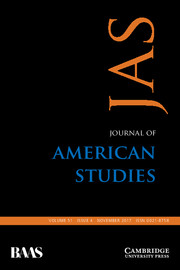
The Journal of American Studies recently ran a special issue entitled "Exploring the Global History of American Evangelicalism." According to organizers Kendrick Oliver, Uta A. Balbier, Hans Krabbendam, and Axel R. Schäfer, the collected articles aim to "explore the changes over time in American evangelical conceptions of the 'global," "document the diversity of means used by American evangelicals in their efforts to make the world one in Christ," examine "the role played by the politics of affection in relations between American evangelicals and the outside world," and "identif[y] the overseas work of US evangelicals as making an integral contribution to the expansion and perpetuation of their nation’s influence as exercised across a global horizon through the long twentieth century" (1038-41). With essays by Heather Curtis, Axel R. Schäfer, Hans Krabbendam, David R. Swartz, Timothy Stoneman, Uta A. Balbier, Melani McAlister, Kendrick Oliver, and John Maiden, the issue does not disappoint. These articles will be of great value for those interested in the history of American evangelical internationalism. 

The special issue features the following articles:


spacer

5 Questions with Ronit Stahl

Lauren Turek


Ronit Y. Stahl, a historian of modern American religion, law, and politics, is currently a fellow in the Department of Medical Ethics & Health Policy at the Perelman School of Medicine at the University of Pennsylvania. She earned her Ph.D. in history from the University of Michigan and was a Postdoctoral Research Associate at the John C. Danforth Center on Religion and Politics at Washington University in St. Louis from 2014-2016.

The following is a brief conversation we had about her excellent new book, Enlisting Faith: How the Military Chaplaincy Shaped Religion and State in Modern America, which came out this month on Harvard University Press.


Q1. Can you tell our readers a little bit about your book? What is your core argument?

Enlisting Faith tells the story of how the federal government, through the military chaplaincy, struggled with, encouraged, and regulated religious pluralism over the twentieth century. It traces how the United States shifted from a chaplaincy that consisted of only mainline (white and African American) Protestants and Catholics to one that counts Jews, Mormons, Muslims, Christian Scientists, Buddhists, Seventh-day Adventists, Hindus, and evangelicals and, as of spring 2017, recognizes over 200 different faith groups and denominations among military personnel. This evolution was uneven—neither accidental nor fully envisioned. Blurred religious and racial categories confounded a military that, for decades, remained invested in racial segregation and race has always complicated government oversight of religion. Nevertheless, changes in the chaplaincy emerged through a combination of incremental top-down decisions made by government officials and grassroots agitation from civilians.

My core argument is that despite the constitutional separation of church and state, the government managed religion in the military and religion has played a significant role in state administration. As a result, it’s important to think about religion-state influence as bidirectional: the state has shaped religion as much as religion has shaped the state.

Enlisting Faith also makes two related arguments about periodization and the institution of the military. First, I argue that the idea of “tri-faith America” emerged in World War I, not World War II or the Cold War, and the military initially cultivated religious pluralism for pragmatic, rather than ideological, reasons. By World War II, when consensus around “tri-faith America” achieved public prominence, it had already begun fracturing. More religious groups wanted recognition, some who fell outside the Protestant-Catholic-Jewish fold, like Buddhists, and some who rejected the pluralist ethos, like Protestant fundamentalists. This divide has grown, and it continues to challenge the military and American society writ large.


Second, and relatedly, the military became a major arena of inter- and intra-religious politics over the twentieth century because it is as much a social and cultural institution as it is a martial one. The military can be conservative and hierarchical and, simultaneously, progressive and innovative. In recognizing the value of diversity and enabling civil rights, it often led the way (imperfectly, to be sure) and hastened change. I show how the military has served as a laboratory for state policy and a bellwether of change in American society—and this holds for race, gender, and sexuality as much as it does for religion.

Q2. Why did you decide to research and write this book about the military chaplaincy?

I’ve long been interested in the relationship between religion and the state, and I wanted to examine a space of extended interaction, rather than brief flashpoints of conflict. Similarly, I’m fascinated by the intersection of pragmatism and ideology in state administration and wanted to think about politics outside of elections and legislatures. Early on, I briefly considered a comparative study of chaplains in different spaces – the military, prisons, hospitals, and universities. However, I quickly realized that the military is such a rich and complex institution to explore (complete with incredible archival records) that it was better to focus. Moreover, it’s a space in which federal oversight of religion has been constant. Despite occasional efforts to civilianize the chaplaincy, the government continues to commission and pay clergy to serve as chaplains rather than contract out religious services.

Q3. How does your book fit in to other recent scholarship on religion and politics, religion and foreign relations, and religion and twentieth-century U.S. history?

There’s been a wonderful outpouring of scholarship on religion of late, and Enlisting Faith enters a number of these discussions in a number of ways. A lot of scholarship in religion and politics tends toward either religion and conservatism or religion and liberalism. Enlisting Faith braids these strands together by looking at a space where values collide and what counts as “conservative” and what counts as “liberal” is sometimes less obvious. It’s also part of the rich conversations—among scholars and in the public sphere—about religious freedom and religious liberty in the United States. Whereas Tisa Wenger’s new book, Religious Freedom: The Contested History of an American Ideal, unravels ideas and rhetoric, Enlisting Faith takes a social history approach and examines the practice(s) of religious freedom, tracking successes and failures on the ground over the twentieth century.

In terms of religion and foreign policy, my book makes two central contributions. First, it decenters the Cold War as the singular moment in which the American state discovers religion as an instrument of foreign policy. Like Anna Su’s Exporting Religious Freedom, it argues for a broader twentieth-century history of the engagement between American religion and global politics. Second, it documents how chaplains engage in soft diplomacy. In the aftermath of World War II, chaplains shift from working exclusively with American troops to serving Americans and participating in relief work and relationship-building abroad. In postwar Europe and Asia, chaplains acted as brokers, ethnographers, and translators between the military and foreign populations. These roles blended missionary work and State Department outreach efforts in pursuit of military objectives, so they’re conduits between military and civilian, public and private spheres.


Finally, Enlisting Faith makes an argument for taking religion seriously as part of twentieth-century American history and showing how integral religion has been to American politics and social change through a key institution of government and governance. We’ve come a long way since Jon Butler’s “Jack-in-the-Box Faith: The Religion Problem in Modern American History” (2004) and Kevin Schultz and Paul Harvey’s “Everywhere and Nowhere: Recent Trends in American Religious History and Historiography” (2010). Nevertheless, there’s still some foot dragging about the importance of religion outside of narratives about the rise of the right and Islamophobia, especially in histories of the American state.

Q4. I know you did extensive archival research for this project - what was your favorite archival discovery? What made this find so surprising or interesting?

It’s so hard to choose, so I’ll quickly note two:
1. The full set of transcripts for the World War II radio show, “Chaplain Jim.” Crafted through a public-private partnership, broadcast on NBC’s Blue Network, and intended for women on the homefront, the show brought the ecumenical and pluralist worldview of the chaplaincy into American domestic spaces during the war. What was particularly exciting was that the transcripts bear the red pencil corrections of Chief of Chaplains William Arnold, who worked assiduously to make Chaplain Jim “anonymous”—that is, not identifiably Protestant, Catholic, or Jewish. The show is a soap opera filled with intentional messaging about religious pluralism as an American value, and thus offers a wonderfully rich artifact of popular culture in which religion and the state met. The show bridged military-civilian worlds and highlights how the chaplaincy’s gaze included women. The gender politics of the show are unsurprising for the time, but it’s a good reminder that women are not absent from all-male spaces.
2. A post-World War II petition requesting that the military add a “B” for Buddhist on dog tags. Religion was added to dog tags in World War II, but there were only three choices: P for Protestant, C for Catholic, or H for Hebrew. This meant that everyone who wasn’t Catholic or Jewish was labeled Protestant, which (very reasonably!) bothered many minority religions. After the war ended, Japanese-American Buddhists organized to lobby for change, and the signature sheets take up an entire unmarked box in the National Archives. What I mean by this is that that War Department used a decimal classification system to file and label records, and every other box in the Army chaplaincy record group bears a number indicating the topic of its content. Researchers can request, for example, all the records related to “marriage” or “photographs” or “meetings” by pulling boxes by decimal code. But this box had no decimal. This suggests that the chaplaincy had no idea how to label it. It also means the only way to find it is to pull every box in the record group. The petition is a really important document on its own: it gave me great material to think about the meaning of limited religious options for dog tags and how excluded Americans responded to the religious categories created by the state. It’s also a useful reminder that classification systems beget classification systems, and archives often replicate bureaucratic logic that needs to be analyzed.  

I could go on, but instead I’ll leave it to readers to discover tri-faith hymnals, records of courts-martial, and other fun sources in the book!

Q5. What do you plan to research for your next project?

I’m still thinking a lot about how religious freedom and religious pluralism operate in institutional spaces, but I’ve pivoted from the military to medicine. I’ve started a project researching the origins, creation, and impact of institutional and corporate conscience rights in health care. It’s a project that raises a lot of questions about what it means for an institution to be “non-sectarian,” how and when federal funds can flow to religious institutions, how religious freedom and discrimination intersect, and how individuals and institutions negotiate competing moral claims.  

Thank you so much for sharing these great details on your new book and future research, Ronit! I look forward to seeing further discussion unfold in the comments section and hope that everyone checks out Enlisting Faith!


spacer

The Oxford Research Encyclopedia of Religion Now Available for Subscription

Lauren Turek

The Oxford Research Encyclopedia of Religion, a massive compendium of peer-reviewed essays on a range of topics in religion and religious history, is now available for subscription from Oxford.

The "Religion in America" heading features essays on a range of key themes, including race, gender, class, foreign relations, politics, culture, and art.

A number of RiAH bloggers contributed essays to this project, which the editors intend to serve as an ever-evolving online resource.


Some of the contributions from RiAH folks that have already been published include:

"Bibles and Tracts in Print Culture in America," by Lincoln Mullen

"Race, Class, Religion, and American Citizenship," by Janine Giordano Drake

"Gender, Marriage, and Sexual Purity in American Religious History," by Seth Dowland

"Race, the Law, and Religion in America," by Michael Graziano

"Civil Rights Movements and Religion in America," Paul Harvey

"Race, Culture, and Religion in the American South," by Paul Harvey

"Alternative Religious Movements and Race in America," Emily Suzanne Clark


Forthcoming essays from RiAH contributors include:

"U.S. Foreign Relations and American Religious Liberalism," by Cara Lea Burnidge

"Race and Protestantism in America," by Lauren Frances Turek

"Culture, Entertainment, and Religion in America," by Randall J. Stephens


Plus there are dozens of articles on religion in American history from other well-known scholars such as Matthew Avery Sutton, Sylvester Johnson, Kathryn Gin Lum, John Corrigan (one of the editors), and Dianne Kirby.

This is an exciting resource that will be beneficial for graduate students studying for their comprehensive exams, for teaching, and for scholars eager to explore new areas within the field of religion and religious history.

For more details on the genesis of this project, see the video below:


spacer

CFP: U.S. Catholic Historian theme issue on War and Peace

Lauren Turek


The U.S. Catholic Historian recently shared this call for papers for a future issue on the theme of "War and Peace." Here is the announcement with all of the details for proposing a contribution:


"For thirty-five years the U.S. Catholic Historian has published theme-based issues relevant to the history of American Catholicism.  An upcoming issue will address the theme of war and peace. Contributions could include, but are not limited to, studies of the following:


  • Catholic involvement in conflicts as officers, soldiers, nurses, and chaplains.
  • U.S. efforts at humanitarian aid during war: War Relief Services/Catholic Relief Services, etc.
  •  The approach of the U.S. Catholic hierarchy or certain bishop(s) to particular conflicts.
  • Catholic responses to documents including Pacem in Terris (1963), The Challenge of Peace (1983), etc.
  •  Catholic peace movements and activism such as the Catholic Peace Fellowship, Catholic Worker, etc.
  • Catholic conscientious objectors
  • Catholic press/magazines/newspapers and war
  • Theologians, philosophers, and intellectuals on war and peace
  • Catholics on the home front during war


Scholars considering a submission are asked to contact the editor, Fr. David Endres at DEndres@Athenaeum.edu before preparing a contribution. Approximate length is 7,000-10,000 words. We ask for submissions by August 1, 2018 and look forward to hearing from potential contributors."
spacer

Roundtable Interview on Mirror on the Veil: A Collection of Personal Essays on Hijab and Veiling

Lauren Turek

Let me add my voice to the chorus of congratulations to the blog on its 10 year anniversary. I have learned so much from reading everyone's contributions and it was very meaningful for me when Cara asked me to begin contributing about three years ago. Blogmeisters Paul Harvey, Cara Burnidge, and Michael Hammond provide our multidisciplinary field with such a tremendous service by hosting and tending to this project.

One of my favorite aspects of the blog is the diversity of subjects covered under the general heading of religion in American history. I have enjoyed contributing posts and reading posts from others that reflect in some way on the transnational dimension of this history, as well as on more contemporary religious issues in historical perspective.

The religious dynamics of current international conflicts, including the refugee crisis, and ongoing cultural change in the United States, Europe, and elsewhere receives regular comment in national and international news. These dynamics also influence U.S. foreign relations. We as scholars of religion and religious history have much to bring to the table in terms of a deeper analysis of how religion and religious identity intersects with global politics, both currently and historically.

For this reason, I am pleased to share a roundtable interview I conducted recently with the editors of and some of the contributors to a new edited volume, Mirror on the Veil: A Collection of Personal Essays on Hijab and Veiling, which addresses questions of religious and personal identity (and outward expressions of it) through an examination of the hijab. Nausheen Pasha-Zaidi, a lecturer at the University of Houston-Downtown, and Shaheen Pasha, an assistant professor of international journalism at the University of Massachusetts Amherst, edited the volume, which is a mix of academic and personal reflections from men and women of different faith traditions discussing their relationship with the hijab. It is a fascinating read and provides something of a collection of primary sources for our current moment on this important issue. I have posed seven questions to Nausheen and Shaheen, as well as to two of the contributors, Reverend Nell Green, a Cooperative Baptist Fellowship field personnel worker, and Saadia Faruqi, an author and interfaith activist. These questions provide a sense of the personal and academic accounts the book shares, as well as its relevance for those of us who teach or research more recent American religious history.


1. First, for editors Nausheen Pasha-Zaidi and Shaheen Pasha, can you tell us a little bit about the goals of the book and what inspired you to put the book together? For the contributors, what inspired you to contribute to this volume and what message(s) did you hope to convey to readers?

Shaheen: As a co-editor, my goal was to really take the conversation about hijab and veiling beyond the normal rhetoric. The concept of veiling crosses cultures and religions, yet Muslims are often the only individuals that seem to be involved in the dialogue. And often, hijab is primarily associated with Arab or South Asian Muslims. My goal is for readers to understand that there is so much more to the concepts of veiling and hijab than the limited view that we see in the media. Our contributors are Muslim and non-Muslim, men and women and of all nationalities.

Nausheen: We really wanted to go beyond the one-dimensional portrayals that are common in discussions on this topic. My goal as a social scientist was to give a voice to diverse viewpoints that were reflective and took into consideration the subjective experiences of each of the contributors.

Saadia: When I heard about Nausheen’s call for essays for a hijab anthology I was really intrigued. There is so much misconception about hijab, and I spend so much time in my interfaith work answering questions about this little piece of fabric on my head, that I thought it would be helpful to have a variety of perspectives together in one book. My message was simple: to offer people an understanding of not only why I wear the hijab, what my personal journey was, and what drew me to this important but misunderstood part of my faith.

Nell: I had such a variety of experiences with hijab in my work cross culturally. As I pondered whether or not or what to contribute, I reflected deeply on those experiences and my own research over the years where covering was concerned. I realized, if it took me this long and this depth to even begin to understand what it means to my Muslim friends, then how much more difficult must it be for my constituents to understand. The importance of delving into it and sharing these stories is so that covering no longer stereotypes a Muslim woman or initiates a reaction of fear by those who encounter her.


2. The book is divided into five thematic sections (Becoming Visible, The Distribution of Normal, Choices in Belonging, A Lesser Muslim?, and The Pursuit of Sentience). How did these themes emerge and how do you see them fitting together?

Nausheen: We used a qualitative approach to developing the themes that started with our initial impressions and moved forward through the reading, editing, and back-and-forth discussion with contributors. Although there are many ways of looking at the stories, these were the overarching messages that we felt most clearly in the collection.  Some contributors also provided their feedback on the themes and how they felt their essay fit.

Shaheen: I think these themes really address overarching similarities of experience that our contributors had. I think that by dividing the book into these themes, we could also touch a wide variety of readers who may not have always felt that their experiences were represented in other works about hijab and veiling.


3. One particularly interesting aspect of the essays in the volume is the tremendous diversity of experiences that they represent. Some of the authors are Muslim women and women who converted to Islam from other faith traditions (and within those groups, some who veil and some who do not and some who used to but no longer do) as well as non-Muslim women and even some men. Did you seek out this diversity in your original call for contributions, and if so, why? How does this diversity help readers to understand the significance of the hijab, not just in Muslim culture but also in global culture?

Nausheen: When I first started this project, I was looking for only Muslim women’s voices (those who veil and those who don’t) but we quickly realized that this was too narrow a focus for the diversity of thought on this topic.  So, in the call for submissions, I really tried to reach out to as many people as possible—those who had been touched in some way by the veil and who could speak to their individual experiences with it.  Some people were afraid to discuss it, given its politically-charged nature in different countries, while others had plenty to say but no real experiences other than what they had read or heard in media. Given the monolithic portrayal of Muslims in Western media, it is imperative that we show the diversity of expression and practice of the 1.6 billion people who consider themselves Muslim.

Shaheen: The diversity of stories and experiences really drew me into the project. Many Muslim women do not veil and yet they often feel left out of the conversation about hijab. I think this anthology provides them with a voice and that's extremely important. It also helps to break with this stereotype that Muslims are a monolith.


4. For Reverend Nell Green: In your chapter you briefly discuss the tradition in early Protestant churches of women covering their hair, as well as your missionary work in Senegal, Brussels, and other communities with large Muslim populations. You discuss how complicated the question of covering or wearing the hijab became not only for you as a visitor but also for some of the women you encountered in your work—was the hijab a symbol of oppression, an outward expression of faith (one that the wearer fully embraced, but also one which some governments in Europe viewed as offensive), or something else entirely?—and you conclude by noting that you advocate for women to exercise "their right to decide whether to hijab or not to hijab." (131). As a Baptist, how did your faith and understanding of your faith tradition's history shape your understanding of these divergent perspectives on the hijab?

Nell: I became a Christian and chose to be a Baptist when I was 18. If we could take that girl and put her beside the woman I am today, you would meet seemingly two entirely different people. My faith has been a journey. That journey has led me to do things that some people thought over zealous or extreme, such as living and ministering in the third world or high risk places while raising two children. That journey has led me to do things that my earlier Baptist world would not endorse, such as seeking ordination and becoming a woman minister. That journey has led me to a devotion to God that some find difficult to comprehend. I have learned that for many Muslim women their journey with faith and with the idea of hijab is not much different. As they grow and change they are led to hijab or not to hijab. They might be identified as over zealous or outside the societal norm. They may be misunderstood and stereotyped. Yet it is their journey, their faith, their practice. In the Baptist tradition, we talk about something called “the priesthood of the believer.” It is basically the right (and the responsibility I might add) of each believer to read the scriptures, to interpret for themselves what God is saying/asking and to be obedient to that. If that is something I uphold and teach in my faith, then I must be willing to uphold the same ideology for those in other faith traditions. I would advocate this for Muslim women in all parts of the world.

Of course in the Baptist world we have “societal norms” and social pressures to conform and do things a certain way. Often as believers, we are called to be counter cultural. Sometimes we are counter the culture surrounding us and sometimes we are counter the culture of our own community. Nevertheless, we must be true to ourselves and to what we believe God is asking of us. Muslim women who choose to hijab or not to hijab encounter the same counter cultural pressures when going against societal mores.


5. For Saadia Faruqi: Your essay blends your early personal history with the hijab, which you began wearing in college against the wishes of your parents, with the more recent history of Pakistan. It also discusses your life in the United States before and after 9/11, and your (temporary) decision to stop wearing the hijab. How did political changes in Pakistan in the 1970s and 1980s shape your understanding of the hijab? Similarly, how did the cultural and political dynamics of life in the United States after 9/11 contribute to your decision to begin wearing the hijab again? 

Saadia: My first real exposure to the hijab was when General Zia, the Pakistani dictator responsible for the birth of religious extremism in that country began promulgating laws that required women in certain public spheres to cover themselves. I saw female newscasters on television wearing the dupatta, women on the streets covering themselves gradually. I would wonder at this when I saw pictures from my own mother’s youth wearing sleeveless, tight-fitting dresses. Later, after Zia’s death, when Benazir Bhutto (the first female Muslim head of state in the world) was elected as Pakistan’s Prime Minister, I saw her begin to cover by the ceremonial dupatta once she came into office. As a result, the concept of women in public spheres adhering to cultural expectations stuck in my mind and gave me a less than positive feeling about the hijab. Of course all that changed in the late 1990s when I became more religiously inclined and started to wear the dupatta myself. In the U.S. after 9/11 I pretended to be Mexican for a long time, but slowly a sense of religious identity grew within me. It was personally offensive to me that my fellow Americans were judging me – and others like me – based on what we wore. This went against everything I knew and loved about America and I thought that if I didn’t have pride in my own beliefs then nobody else will either. So the hijab became a form of religious identity that I wanted to wear in spite of the cultural and political discourse of that time. In a way it was interesting that both times I donned the hijab, I did so out of a sense of rebellion: first towards my family and later towards the political establishment.


6.  Nausheen, in the introduction to the volume you write about the experience of becoming "a visible Muslim," noting that "a visible Muslim appearance became increasingly popular in Western countries such as the United States during the 1990s when Muslim women began to shift away from Western norms of dress. This was and continues to be partly a response to Western secular feminism. It also entails the development of a religious identity as a way of dealing with the stress of acculturation that Muslim immigrants faced." (10) Can you discuss this historical development in more detail? What was it about this time period that contributed to this development? Why did this shift occur and what was the experience of Muslim women in the United States prior to this period?

Nausheen: There was a shift in the cultural make up of American Muslims in the 1970s as a result of increased immigration from Middle Eastern and Asian countries. The 1990s corresponded with the coming of age of many of the first generation immigrant children who had either been born or raised in the United States.  There was a great deal of acculturation stress involved in balancing the home identity (which often emulated the culture of the immigrant parents) and a public identity that reflected mainstream American norms. America was moving away from the “melting pot” analogy, which implies that people of different cultures mesh into one, to a “salad bowl” philosophy where cultural traditions are emphasized and add to the flavor of the country. Young Muslim women, in particular, faced a great deal of pressure to conform to either the culture of their parents’ country to the culture of mainstream America. In response to this, many Muslim women (and men) found freedom in creating their own culture, an American Muslim culture, which was often manifest in a visible identity. For many Muslim women, this identity was captured and enhanced by the hijab.


7. Finally, since most of the readers of this blog are in some way engaged with learning or teaching about religion in American history, how do you think historians and religious studies scholars might incorporate this anthology into their teaching or research on religion in American history?

Shaheen: This anthology crosses disciplines. It tackles feminism, intersectionality, cultural communication, sensuality as well as religious studies. By better understanding the complexity that surrounds hijab and veiling, I think scholars can use this book to address the common threads of experiences of individuals throughout American history.

Nausheen: Given that the United States was built on the notion of religious freedom, the collection can be used to have discussions about power, privilege, intersectionality, and the ways in which feminism is expressed and espoused by different people.

Nell: during the early days of settling the US particularly the puritan settlers, the communities sought uniformity...uniformity in faith practice, in belief, in dress. They left a place that had tried to place those sorts of restrictions on them. In this new world, they endeavored to do the same but with their idea of right and normal. It was a failure. What if instead of uniformity they had sought unity in diversity? As globalization becomes more and more complex what would it look like for our society (all faiths and all nationalities) to seek not uniformity but uni-diversity?

Saadia: I think this is a great addition to religions courses, as well as women studies courses. I took a couple of classes in my master’s program which discussed the hijab as an antithesis of the feminist movement, and it was very painful to me. I remember participating in discussions when I was the only one trying to negate the stereotypical images of Muslim women presented in our textbook. This anthology, with its wide array of perspectives, offers a very realistic and valuable picture of feminism, women’s role in Muslim societies and overall religious studies.


Thank you all! 

spacer

Reflections on SHAFR @ 50 Annual Meeting

Lauren Turek

This past weekend, the Society for Historians of American Foreign Relations celebrated its fiftieth anniversary (as well as the fortieth anniversary of the journal Diplomatic History) at its annual meeting in Arlington, VA. Just as I reported last year, the conference included a number of panels and roundtable discussions on the topic of religion in American history and foreign relations. There were, in fact, so many good panels on religion that I could not even attend all of them owing to my unfortunate inability to be in multiple places at once! As such, in addition to providing my own overview of the exciting work that scholars showcased at the SHAFR meeting this year, I have included some reflections from other attendees as well.

Most of the panels that I attended reflected in some way on missionaries and missionary work, though the listing of panels that I have included at the end of this post does make clear that there were many panels at the conference that examined religion and foreign relations beyond missionary work (and that there were papers on a diverse array of faith traditions, including Judaism and Islam).


The first religion-themed panel that I attended was a roundtable discussion about David Hollinger's forthcoming book Protestants Abroad: How Missionaries Tried to Change the World but Changed America, which is due out in October. Daniel Immerwahr organized the roundtable, with Hollinger offering an overview of the project, Melani McAlister, Madeline Hsu, and Andrew Preston providing commentary on the book, and David Engerman moderating. Hollinger outlined his argument that the mainline Protestant missionary project played a key role in "deprovincializing" America, fostering multiculturalism in American life and ecumenicism in American churches in the years between 1890 and the Vietnam war. He suggested that missionaries, the children of missionaries, and the organizations that supported missionary endeavors created what he termed "missionary cosmopolitanism," which contributed to a nascent embrace of other cultures and a strong critique of colonialism—a critique which spurred debates about the missionary project itself and a turn toward more humanitarian aid. Hollinger also revealed how the missionary project, and the cosmopolitanism it inspired among the groups he examined, led these missionaries to engage in debates over the role of the United States in the world in this period. He argued that the alliances some of these Protestants developed with colonized peoples through their missionary work pushed them to embrace an idealism about the potential for U.S. foreign policy to act as a force of morality in international relations, advancing humanitarian and anti-colonialist goals. Hollinger shared a number of wonderful, engaging anecdotes about missionaries such as Kenneth Landon, who ended up briefing Franklin D. Roosevelt and working for the OSS during World War II because he was one of the only experts on Thailand the State Department could find, and about the role some missionaries played in enforcing humane interrogations of POWs in the Pacific theater. Yet, as he concluded, the Vietnam war "shattered their idealism" about the "morality of American policy."


Melani McAlister (and indeed all of the panelists) praised Hollinger's book, and dove into a deeper discussion of the critique these particular Protestants leveled against the missionary project. She noted that Hollinger's argument about how the de-emphasis of proselytism and focus on humanitarian aid in the post-World War I era provided the "fuel" in the split between modernists and fundamentalists not only placed this split in a global context, but that it also contributed to decline in the mainline churches. Madeline Hsu discussed the power dynamics that existed between missionaries and those peoples that they evangelized, particularly in China, which Hollinger explores in the book. Andrew Preston closed out the commentary by describing how the Protestants Hollinger discusses challenged and complicated the typical image of "missionaries as the tip of the imperial spear," due to the critiques of imperialism they leveled. Preston also highlighted Hollinger's emphasis on the relationship between ecumenicism and internationalism. In his response, Hollinger picked up on the thread that McAlister and Preston raised about the significance of the ecumenical movement, arguing that even though he believes that much of the historiography on American Protestantism has sought to "diminish the gap between evangelicals or fundamentalists and ecumenicals," the divide grew extreme in the period he covers in his book and that divide emerged because of the missionary project itself. All in all, a very exciting glimpse at what promises to be a defining book.

Later, I attended a panel entitled "Faith and Foreign Affairs: Religion, Non-State Actors, and U.S. Foreign Relations in the Early Twentieth Century," which featured three exciting papers. Kelly Shannon shared research from a brand new project on U.S. relations with Iran in the nineteenth and early twentieth centuries. The project is to be about a range of non-state actors, not just religious actors, but for this panel she gave a fascinating paper that explored the crucial role American Presbyterian missionaries played in developing official diplomatic relations between the two states. She also shared the wonderful story of Howard Baskerville, a Presbyterian missionary who resigned his post to join in the Persian Constitutional Revolution of 1909, as part of a larger exploration of how missionaries shaped perceptions that the American public developed about Iranians and that Iranians developed about Americans. Jonathan Chilcote gave a paper on the efforts that American missionaries in Bombay engaged in to spur contributions to help those suffering from the Spanish influenza in India in 1918-1920. In this compelling piece, Chilcote suggested that these missionaries "saw the flu as an opportunity to remake India in America's image." Denise Jenison rounded out the panel with a presentation of research from her dissertation, giving a paper on Arab-American efforts to influence official U.S. policy towards Palestine in the aftermath of World War II. Her excellent paper delved into the creation of the Institute of Arab-American Affairs, which sought to win support for Palestine by convincing American Christians of the link between Christian missionary work and Arab nationalism, as well as by stressing the close relationship that Palestinian Christians and Muslims shared.

I was also really excited for the "Foreign Religions and Foreign Relations: U.S. Engagements with the World in the Nineteenth Century" panel, in part because SHAFR does not feature nearly enough panels on pre-twentieth century foreign relations. The three papers on this panel, which Tisa Wenger chaired, were exceptional. Kathryn Gin Lum started out with a paper on mapping and geographic imaginings of the "heathen world" as lands that were "wild and overgrown because of the sin/heathenism of their inhabitants." She linked this tendency to view the regions of the world populated by non-Christians as undifferentiated and wild to the development and propagation of racist ideologies, including scientific racism, and to the belief that Westerners should intervene in these regions in particular ways. Emily Conroy-Krutz also examined maps in her fascinating paper on what she termed "missionary intelligence," or the information that missionaries shared about the countries they evangelized. She noted that the maps and information that missionaries discussed at monthly prayer concerts "contributed to the creation of a mental map of the world" for nineteenth century Americans, acting as a "source of knowledge production" about the wider world. Kate Moran turned her focus to late nineteenth century Protestant travelogues to examined the changing depictions of the Pope and Catholic authority in Rome during a period of bewildering social change in the United States and upheaval in Italy. She compared the positive descriptions of Pope Pius IX to the negative depictions of earlier Popes and the virulent anti-Catholicism of antebellum travelogues, making a riveting argument that in recasting their views of the pope in light of the Risorgimento, "Catholic power became a way [for Protestants] to understand their own concerns about social order in [their] present." This panel spurred excellent discussion of the role of religion in society and of the interrelationship of race and religion.

Dan Hummel also attended SHAFR (he presented on a fantastic new open source online U.S. foreign relations primary source reader, Voices & Visions, that he helped develop), and sent in the following report on one of the panels he attended, "American Zionism and U.S.-Israel Relations from the 1950s to the 1990s.":

"This excellent panel explored numerous facets of the U.S. relationship to Israel and the development of Jewish Zionism. Salim Yaqub aptly summarized that the panelists overlapped precisely in their study of the changing relationship between American Jews and Israel. Doug Rossinow traced the origins of the American Israel Public Affairs Committee (AIPAC, originally American Zionist Committee for Public Affairs) to a crisis in Israel’s public image after the IDF’s massacre of civilians in the village of Qibya in October 1953. He examined how AIPAC’s founder, I.L. Kenan, sought to unite American Zionists and Jewish non-Zionists. Rossinow concluded that the staunch support of the Israel lobby since 1953 is unsurprising given its origins in defending Israel’s largely indefensible actions at Qibya. Sara Hirschorn spoke about American Jews who have become leaders in the settlement movement in the West Bank. As her recently-published book, City on a Hilltop (Harvard Press, 2017), expounds upon, American Jews make up a large and ideologically potent segment of the current settler movement and hold more diverse religious, political, and economic motivations than we normally assume. Seth Anziska recounted the history of the opening of dialogue between the U.S. and the PLO in December 1988 and emphasized the role of American Jewish actors breaking with organized American Jewish attitudes toward the PLO. While the Reagan administration opened dialogue with the PLO, its intent was not necessarily to pave the way for independent Palestinia statehood. The differing agendas of American Jews, Israelis, the U.S. government, and the PLO poin to the ways that the U.S. government and PLO were pursuing incommensurate policy goals, even as they began to talk to one another."

Clearly, the religious turn in U.S. foreign relations history over the past decade has led to a proliferation of exciting work in this area. SHAFR is an incredibly welcoming place for scholars of religion (scholars of a wide variety of historical subfields, actually, as U.S. foreign relations history intersects with many aspects of domestic and international history as well as a number of methodological approaches) and the presentations are always of the highest quality. I am very much looking forward to next year's annual meeting, which will be held in Philadelphia in June 2018. Happy 50th Anniversary to SHAFR and here is to the next 50!


Below, I have listed all of the panels and individual papers that reflected in some way on religion and American diplomatic history, broadly defined. A link to the full program is available here.


Panel 12: Roundtable: Wilson and World War I: New Perspectives

Paper of Particular Interest:
Beyond Belief: Religion in Woodrow Wilson's Internationalism

Cara Burnidge, University of Northern Iowa


Panel 18: Christian Mission, U.S. Power, and Domestic and Foreign Publics from
the Early Republic to the Cold War

Chair:
Emily Conroy-Krutz, Michigan State University

Papers:
Protestant Mission, American Empire, and the Uses of History in Hawaii and the
Philippines, 1880-1920
Tom Smith, University of Cambridge

Foreign Missionaries and the “Spirit of Benevolence” in the Early Republic
Ashley Moreshead, University of Central Florida

Contending Christianities: U.S. Catholic and Protestant Missions in Central America
and Political Advocacy at Home during Henry Luce’s American Century, 1941-1960
Charles T. Strauss, Mount St. Mary’s University

Comment:
Emily Conroy-Krutz


Panel 37: Black Internationalism and Black Freedom Struggles

Paper of particular interest:
Bishop Ralph Dodge: Africa’s Unwanted Missionary
Luke Shief, University of Missouri


Panel 40: Roundtable: David Hollinger’s Protestants Abroad

Panelists:
Daniel Immerwahr, Northwestern University
Melani McAlister, George Washington University
Madeline Hsu, University of Texas, Austin
Andrew Preston, Clare College, University of Cambridge
David Engerman, Brandeis University
David Hollinger, University of California, Berkeley


Panel 52: Faith and Foreign Affairs: Religion, Non-State Actors, and U.S. Foreign
Relations in the Early Twentieth Century

Chair:
Cara Burnidge, University of Northern Iowa

Papers:
“I am Persia’s”: Howard Baskerville, American Presbyterian Missionaries, and U.S.-
Iranian Relations during the First Iranian Revolution
Kelly Shannon, Florida Atlantic University

The Principles of Relief: American Missionaries and the Remaking of Indian Lives after
the Spanish Influenza Pandemic
Jonathan Chilcote, Florida College

Arab-American Efforts to Influence U.S. Policy on Palestine, 1944-1948
Denise Laszewski Jenison, Kent State University

Comment:
Cara Burnidge


Panel 73: The United States and Right-Wing Dictatorships, a Retrospective:

Promoting Democracy in the Cold War

Paper of particular interest:
“A Human Rights Policy Means Trouble”: Ecumenical Activism, Civil Religion, and the
Forging of Ronald Reagan’s Human Rights Policy
Shannon Nix, University of Virginia


Panel 76: Beyond State Power: Non-State Actors, Aid, and Development Programs
and the U.S. in the World in the Twentieth Century

Paper of particular interest:
A “Little Cuba” in the Jungle: Priests in Ixcán, Guatemala, 1965-1976
Sarah Foss, Indiana University


Panel 80: Foreign Religions and Foreign Relations: U.S. Engagements with the
World in the Nineteenth Century

Chair:
Tisa Wenger, Yale University

Papers:
Heathen Geographies in the Nineteenth Century
Kathryn Gin Lum, Stanford University

Foreign Missions and Foreign Information in the Early Republic
Emily Conroy-Krutz, Michigan State University

Reimagining Catholic Power in the Wake of the Risorgimento
Katherine Moran, St. Louis University

Comment:
Tisa Wenger


Panel 85: American Zionism and U.S.-Israel Relations from the 1950s to the
1990s

Chair:
Peter Hahn, Ohio State University

Papers:
The Origins of America’s Israel Lobby, 1951-1956
Doug Rossinow, University of Oslo

City on a Hilltop: American Jews and the Israeli Settler Movement since 1967
Sara Yael Hirschhorn, Oxford University

American Jews and Arafat: Citizen Diplomacy and the PLO Recognition of Israel
Seth Anziska, University College London

Comment:
Salim Yaqub, University of California, Santa Barbara


Panel 88: Missionaries, Technicians, and Tourists: Cold War Public and Cultural
Diplomacy in Action 

Paper of particular interest:
Mormons in the Lion City: Religious Cultural Exchanges, 1968-1990
Keshia Lai, Ohio State University


spacer