Showing posts with label Kyle Roberts. Show all posts

Walking the City

We conclude our roundtable review on Kyle Roberts' Evangelical Gotham with a reflection from the author himself. Thanks to everyone who contributed to the conversation, and please do chime in below to continue the dialogue.


What a genuine pleasure it has been this week to have four thoughtful scholars of American religion share their journeys through Evangelical Gotham. I can’t think of better traveling companions. I have admired their scholarship and benefited from their conversation over the past decade. As with the best walks through a city, they have allowed me to point out the sites that most interest and excite me and, in return, have shared my enthusiasm, asked for clarification, and drawn my attention to things that I have missed.

This book began as an excuse to get off the Amtrak at Penn Station during my regular commute in graduate school between Boston and Philadelphia. The books that intrigued me the most at that time (and which helped me while away the six-hour train ride) were the new histories of evangelicalism that sought to understand not only what evangelicals did, but why they did it. What would make an enslaved woman join the Moravian Church? How did a slaveholder reconcile his need for independence with the conversion of his wife and slaves? How could a “crazy” itinerant melt hearts?  With notable exceptions, these new histories were often stories of camp meetings in the rural hinterland, of circuit preachers riding to an early grave. What happened to evangelicals when they went to the city? 

Nassaus St. Then.
There were, of course, wonderful books on religion in cities, whether it be Italian Catholic mothers in Harlem or Salvation Army lasses downtown, but these were stories about what the religious did to make their own place in cities that other people had made. What about those who had built the city in the first place? New York certainly did not emerge fully formed. Between 1780 and 1860 settlement raced up Manhattan Island from (what is now) City Hall Park to the base of Central Park. Someone had to do all that building. Certainly, the religious, maybe even evangelicals, played a part? As it turns out, they had quite an influential role. My contention in Evangelical Gotham is that evangelical investment in the spiritual marketplace, church building, cultural production, and moral reform, to give just a few examples, shaped the development of the modernizing city and the experience of life within it. In the process, evangelicalism came to be decidedly shaped by the experience of urban life.

Nassau St. Now
Evangelical ability to turn space into place was key to that strategy, as Lincoln Mullen points out. Reading the work of Henry Glassie, Dell Upton, Bernard Herman, and Robert Blair St. George, I knew that I had to get off the train and take in the urban built environment. How different New York looked from all the maps and illustrations that I had uncovered in the archive! But I couldn’t just look at buildings for their own sake. My reading of the vast trove of surviving evangelical diaries, autobiographies, newspapers, and tracts reminded me of the generative and constitutive role that space plays in nearly every facet of evangelical life. At a crucial moment in my thinking, Tom Tweed’s Crossings and Dwellings helped me to understand the centrality of placemaking to the urban religious.  The places evangelicals inhabited could be real or imaginary. They saw New York through many lens – some sacred, some secular - and, in turn, sought to transform it, often just temporarily, to their own ends. No stable, storefront, or ship’s deck was safe.

Digital mapping gave me a means to try to make sense of the massive amount of data about place that I was uncovering. Without Google Earth and (later) Google Fusion Tables, it would have been hard to see the patterns in evangelical emplacement strategies that make up the maps in my book. While mapping software is good at conveying some kinds of spatial information, it doesn’t work as well with others. How might I convey Margaret Prior’s conversion experience as the Word wafted on the wings of a breeze out the window of the Methodist meeting house across the adjoining yard to her “unperceived” ear as she sat beneath a shade-tree?  My programming skills weren’t (still aren’t) that good. I hope Monica Mercado will invite me to sit in on her class one day as she and her students follow Prior through the city. I would share my own clumsy attempts at mapping Henry Chase’s journeys in 1821-22 through what is now the Lower East Side when he first became a missionary to mariners. At first, he followed the systematic landscape of the grid, calling at every house up one street and then down another. Within a matter of weeks those carefully laid plans were jettisoned by the demands of the women of the neighborhood who wanted his time and attention. Zipping back and forth from one house to another to offer spiritual and temporal support to these women certainly reminded him that the promise of the linear grid was illusory (and that urban evangelicalism was a women’s religion). As a scholar who chose the medium of a book to tell this story, I strive to demonstrate those journeys of faith through the city in other ways – through text and image. I have, however, deposited all my mapping data with the New York Public Library for those who want to recreate the past journeys of others. 

Could Catholics have been contenders for the souls of evangelicals in Gotham’s spiritual marketplace? Christine Croxall asks a great question. By utilizing a broad definition of evangelicalism, I could see a much wider array of actions and strategies in the city’s spiritual marketplace than if I had focused on a single denomination. While evangelicals dominated the city’s spiritual marketplace through mid-century, they were certainly never alone. Some of the scholarship that most interests me these days is by Croxall and Bridget Ford that take seriously the ways in which evangelicals and Catholics fed off each other’s strategies.  That became clear as I looked at how John Hughes approached parish building in the later 1840s. Did that imitation/emulation extend to their beliefs as well? Fear and hatred of Roman Catholicism was deeply engrained in Protestant DNA by this point. Perhaps what the examples of the almshouse residents that Croxall points to tell us less about a battle for doctrinal understandings than for the rich and varied modes of popular religiosity, pulling from Protestant, Catholic, and other belief systems that existed in early national and antebellum New York. Theirs is a world now largely lost to us.

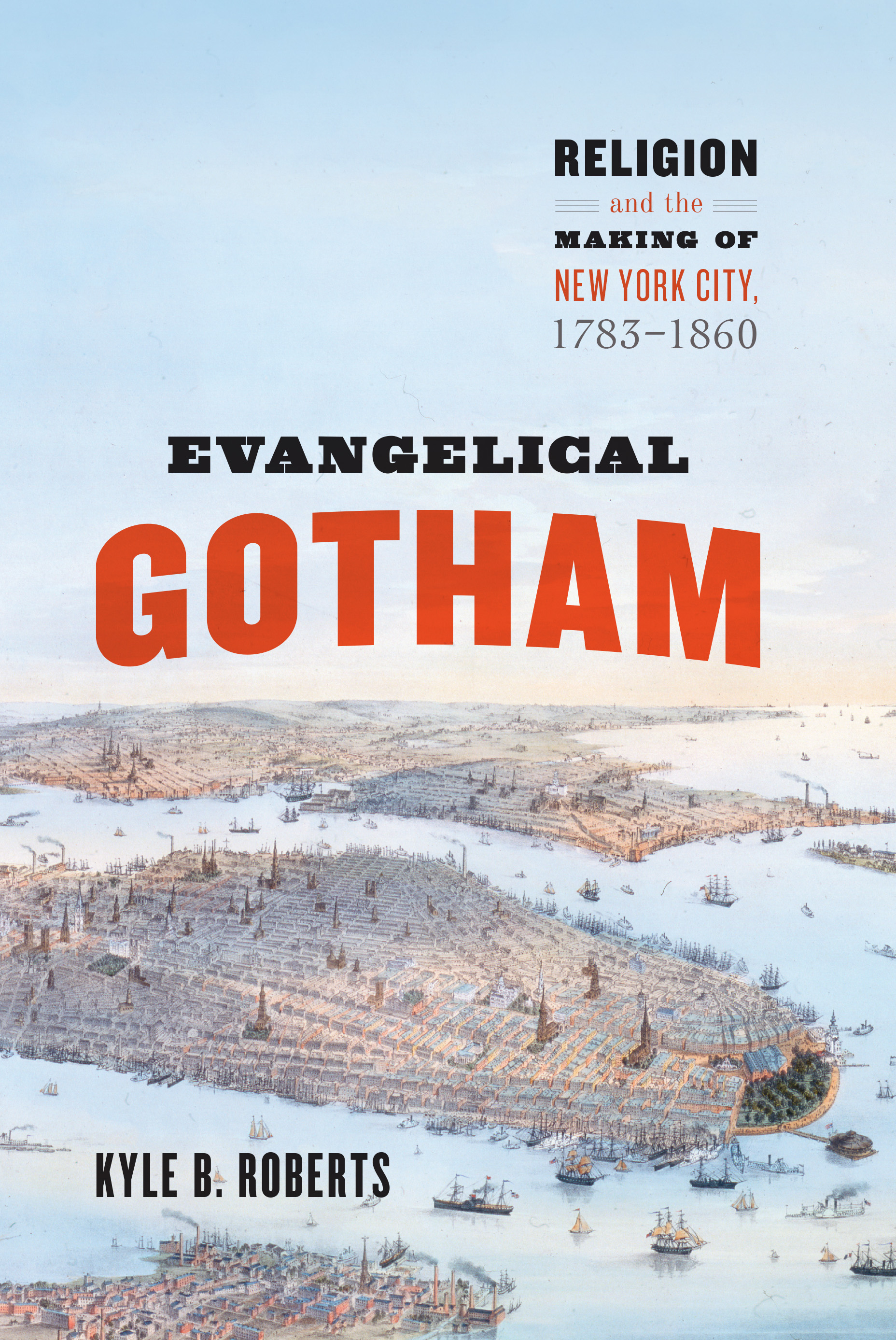
To conclude, I’ve always loved Michel de Certeau’s “Walking in the City” from The Practice of Everyday Life where he reminds us that to truly understand a city, we must go down from the height of steeple to the level of the street. It is in the daily movements and interactions of men and women, the “ordinary practitioners of the city,” that the city is constituted. I fully embraced that idea and spent much time looking closely at what I found down there. Catherine O’Donnell’s comments remind me however of my need to climb back up into the steeple, or better yet, to figure out where John Bornet secured his view of Manhattan in his panoramic birds’ eye view that adorns the cover of my book. John McGreevy, in his comments on the twenty-fifth anniversary of Parish Boundaries published in this blog a few months back, refers to this as the need to remember to come up for aid.  What can I say? Evangelical Gotham is a seductive place! But I wholeheartedly agree that pulling back to see the commonalities across time and space is essential. My journey through Evangelical Gotham has, in some ways, come to an end while it is just beginning for others. Fortunately for me, I am beginning my next journey with the rich reflections of four fellow travelers in my head and my heart.

spacer

On Maps, Faiths, and Works

This next post in our ongoing roundtable review of Kyle Roberts' Evangelical Gotham comes to us from Christine Croxall. A scholar of the religious histories of the Mississippi River Valley at the dawn of the nineteenth century, Crozall is a postdoctoral research associate at the John C. Danforth Center on Religion and Politics at Washington University in St. Louis. Her post is also the last in this series. Kyle Roberts' response will come tomorrow.

by Christine Croxall


Old St. Peter's Catholic Church
Huzzah for visuals! In Evangelical Gotham Kyle Roberts not only gives us woodcuts, drawings, and paintings of the meetings houses that dotted early Manhattan, but he also provides seven maps plotting New York houses of worship for the years 1790, 1810, 1823, 1828, 1834, 1845, and 1856. These maps and the series of congregation and membership tables in the appendix, I suspect, will become definitive data for early New York religion.

 The final chapter of Evangelical Gotham is, in my mind, the key to the entire project. The question it considers is not so much why did the stakeholders of a dwindling Methodist congregation come to fisticuffs in the street in 1856? but instead, what does the church's history tell us about evangelicalism's role in the expansion of New York City? Roberts traces how the members of John Street Methodist Episcopal Church rebuilt their meetinghouse in lower Manhattan, not once, but twice in the early 1800s, and then opted—after their public tussle—to stay rooted there rather than moving uptown with their Presbyterian and Baptist neighbors. In Roberts's telling, the John Street church is an exception that illumines a broader trend. By mapping congregations' proliferation and dispersal and contextualizing New York's church growth in relation to the city's economic and demographic expansion, Roberts offers a generative interpretation of religious developments in early New York.


One of the engines Roberts identifies for the burgeoning of urban evangelicalism in the early 1800s is revivalism—not a woodsy romp toward Zion (though camp meetings in rustic Long Island and up the Hudson at Sing Sing did energize some of the faithful), but instead a citified version featuring superstar preachers in local pulpits. Roberts argues these revivals propelled not only conversion and adherence but also urban reform and benevolence efforts. His analysis prompted me to wonder how we can determine causality in church membership. Did revivalism generate lasting religious commitments? Or was individual religious adherence based more on what a person did (or did not do) before and after the revival: going to prayer meetings, attending worship, reading devotional texts, collecting clothing for the indigent, being baptized? What kinds of experiences and practices most often fostered religiosity, and how might we measure and track these factors?

The interplay of actions and faithfulness connects to a refrain I noticed among New Yorkers who chose not to adhere to evangelicalism: a chorus of what the evangelicals would call works righteousness. The dying Deist who rationalized that he drank only moderately and honored the Sabbath by smoking with his neighbors instead of peacocking at church (74), the black man who believed his past sins wouldn't matter if he behaved better in the future (95), and the sick mariner who was "unconcerned about his soul" and had "always lived a moral life and needs nothing more" (106) frustrated their proselytizers by insisting that their behavior more than their beliefs were what mattered.

Catholics, of course, were the ones evangelical missionaries, preachers, and authors typically accused of prioritizing works over faith. Roberts describes the Catholic community in 1810 New York as "small, poor, and marginal, with only one parish" (74). (By 1855 they constituted eighteen percent of the total adult population, more than twice that of the evangelicals [Table A.4, 270-271].) This claim caught my attention. Yes, many of the Catholics were poor, particularly the Irish immigrants who constituted a majority of the parish of St. Peter's in 1810. But was the community so small or marginal? The priest of the parish estimated fourteen thousand Catholics in New York in 1808.  A social historian  mining the sacramental records from 1785-1815 has recovered a dynamic and engaged Catholic community comprised of Irish, French, German and African American residents.  As a scholar who studies how Catholics and Protestants in the early republic used the presence of religious competitors—that is, each other—to spur adherence among their own flocks, I am curious how viewing Catholicism as a true contender for the hearts and souls of early New Yorkers might shift Roberts's narrative of the first batch of evangelicals, the post-revolutionary generation.
spacer

Mapping the Women of "Evangelical Gotham"

We continue our series on Kyle Roberts' Evangelical Gotham with a post from friend of the blog and assistant professor of history at Colgate University Monica Mercado. Where prior posts honed in on the how cities and spaces fit into Robert's analysis, Mercado highlights the ways in which these concepts both mask and reveal gender.

by Monica L. Mercado

During the first weeks of my lecture course “Women in the City,” I introduce my undergraduate students to the complex geographies of lower Manhattan, or what the historian Kyle Roberts calls Evangelical Gotham. Sitting in a classroom in upstate New York, our windows facing the hills and valleys that made up the nineteenth century’s infamous “Burned-Over District,” we scrutinize early engravings of Five Points and other images of men and women navigating urban space in antebellum America.

The Five Points
With Evangelical Gotham: Religion and the Making of New York City, 1783-1860, Roberts reminds his readers that late eighteenth and nineteenth-century evangelical Protestantism -- so often understood as the rural camp meeting, a world away from the imagined depravity of the crowded, congested, “godless” city – was actually an urban phenomenon, deeply rooted in changing ideas of space and place. “Evangelicals,” he writes in the book’s Introduction, “positioned themselves well for the spiritual marketplace by rethinking what made space sacred and experimenting with new kinds of religious places.” Those places often lacked a steeple or set of pews -- recognizable markers of religious architecture in the expanding city grid. Instead, Roberts argues, his actors understood the sacred “to come not from the physical space itself but from the actions of believers.” Storefront churches, publishing houses, hospitals and orphanages could be, in Roberts’ words, reclaimed and reformed by men and women with evangelical agendas. (8)


Building on the foundational work of early women’s historians who located in postrevolutionary New York a new cast of characters reforming the city in their image, Roberts weaves the experiences of white evangelical women throughout this argument. [fn 1] In order to understand the world of Evangelical Gotham, Roberts suggests, we must pay careful attention to leaders such as reformer Isabella Marshall Graham -- whose Ladies’ Society for the Relief of Poor Widows with Small Children “transformed how evangelical New Yorkers thought about the women and men outside of their meetinghouses and inspired a rising generation to attempt to convert the city” (52) – and revivalist Phoebe Worrall Palmer, whose ministry embraced not only print and domestic missions, but also a weekly “Tuesday Meeting” for evangelical men and women held not at church, but in her own parlor on Rivington Street.

How might the historian of American religion visualize these spatial and spiritual conquests? In a series of carefully drawn maps of New York churches inserted throughout the text, beginning with 1790 and ending with an expansive 1856 city grid, Roberts marks only formal houses of workshop, and not the experiments with sacred space that are crucial to his narrative, such as Phoebe Palmer’s townhouse or the Ladies’ Society for the Relief of Poor Widows’ meeting rooms. If Evangelical Gotham is to rewrite the antebellum urban spiritual landscape, does the act of mapping obscure the spatial impact of religious women, whose ministries frequently took them outside of the church sanctuary? Evangelical women’s mobility – both real and imagined, in text and image – is nowhere to be seen when we place church addresses on a map. [fn 2]

 What would a more expansive mapping project look like? In many ways, our historical subjects have laid the groundwork with their extensive publishing operations. In my own research and teaching, for example, I have used the domestic missions of the American Female Moral Reform Society (AFMRS), founded in 1834, as an alternative map of nineteenth-century New York. In their own newspapers, tracts, and memoirs, the women of the AFMRS charted their involvement in new realms of responsibility and geography. My students are captivated by the memorial volume Walks of Usefulness: or, Reminiscences of Mrs. Margaret Prior, a collection of the activities of the Society’s first paid female missionary, who visited thousands of New York families and workplaces every year before her death in 1842. Prior’s vivid descriptions of urban life constitute a significant documentary history of antebellum New York, and the varied experiences of its working poor. Traipsing through “dark, filthy rooms,” “miserable abodes,” and “cold, damp basements,” Prior entered new neighborhoods, homes, prisons, brothels, and factories on a daily basis, determined to repair the degraded conditions of urban life with spiritual and material assistance. [fn 4]

Margaret Prior
 Like many of the other city missionaries Roberts chronicles in his book, Margaret Prior and the AFMRS exhibited an evangelical “mania for quantification. (86) Mobile and “scribbling,” women missionaries like Margaret Prior exemplify the Evangelical Gotham ethos, one that urges historians of American religion to expand our maps of the urban religious landscape. Could a reimagined map help us see how evangelical women missionaries experienced their mobility, and their calling, separate from men? What shape did their paths take – where did these men and women intersect, and where did they meet, outside of the churches? The missionary fervor of nineteenth-century voluntary societies adds new points on the maps of Evangelical Gotham, suggesting the creative possibilities of recentering the act of mapping around women’s movement through New York City. As Roberts writes, “Awakening often involved crossing out of one’s community and into another, which could happen as easily during a walk across the city as a voyage across the ocean.” (22)

Notes

[fn 1] See, for example (and as Roberts also cites), Carroll Smith Rosenberg, Religion and the Rise of the American City: The New York City Mission Movement, 1812-1870 (Ithaca, NY: Cornell University Press, 1971), Christine Stansell, City of Women: Sex and Class in New York, 1789-1860 (New York: Knopf, 1986), and Anne M. Boylan, On the Origins of Women’s Activism: New York and Boston, 1797-1840 (Chapel Hill: University of North Carolina Press, 2002).

[fn 2] Elsewhere, I have argued that evangelical Protestant missionaries and their voluntary societies found reason to portray Protestant women as special conveyors of the word. In tracts, missionary reports, and memoirs, images of evangelical women’s mobility circulated in print across the Protestant world, illustrating battles over religious literacy and women’s influence in nineteenth-century America.

[fn 3] Margaret Prior’s narratives are a terrific teaching tool in the undergraduate classroom. I often assign a selection of Walks of Usefulness reprinted as “A Moral Reformer Makes Her Rounds” in the women’s history collection Root of Bitterness: Documents of the Social History of American Women, second edition (Boston: Northeastern University Press, 1996), 198-203.
spacer

The Places of "Evangelical Gotham"

Today we continue our roundtable review of Kyle Roberts' Evangelical Gotham with a post from longtime RiAH blogger Lincoln Mullen. You can see the rest of the posts in this series here. 

by Lincoln Mullen

New York's churches 1845
from Roberts, Evangelical Gotham
 In his elegantly written account, Kyle Roberts takes his readers on a tour of Evangelical Gotham. The book has a strong chronological through line, explaining how evangelicals went through three distinct periods in bringing their message of conversion and reform to New York City (10--11). While the spatial organization of the book is less obvious from its table of contents, Evangelical Gotham is a book that is fundamentally organized around place. This may seem like an obvious point to make about a book that focuses on a single city, but my aim is to show how Roberts uses spatial concepts.
Evangelical Gotham is explicit in its debt to the concept of "crossing and dwelling" articulated by Thomas Tweed. Roberts makes this clear in his first chapter, where he writes about spiritual autobiographies at the end of the eighteenth and beginning of the nineteenth centuries. He takes a fresh approach to this topic by giving conversion narratives a meaning both in geographic and spiritual space. Evangelicals crossed religious boundaries by converting, but many of them did so at the same time that they were crossing the ocean or moving to the city. And once they arrived in New York, these newly converted evangelicals had to dwell not just in the city but also had to find a church or "community of faith" (27).

Geographic and spiritual space were thus experienced in mutually constitutive ways. This conjunction becomes a key to understanding much of the book, as does the emphasis on conversion. Conversion and other themes such as benevolence or reform recur throughout the book because they were perennial evangelical concerns. A real contribution of the book is the way that Roberts sets those concerns in relation to other questions such as denominational affiliation and worship practice. A key sentence comes in the conclusion, where he writes, "As denominational and sectarian choices proliferated, evangelicalism's appeal lay in the ease with which its small core of common principles could be incorporated into the matrix of beliefs and practices provided by them" (254). As any number of studies have told us, evangelicalism is a transdenominational movement focusing on conversion. Evangelical Gotham shows how people who held those evangelical convictions had to live them out in different churches competing within a single city. If most studies of evangelicalism are weighted towards crossing, then this book gives due emphasis to dwelling.
This book can also be understood in terms of the meaning of places. Geographers make a distinction between space and placeSpace is abstract location: the island of Manhattan, or the latitude and longitude coordinates that identify it. Place is the meaning that humans make out of space. This book shows how evangelicals made, or attempted to make, the space of New York into a religiously meaningful place. As he points out, for evangelicals "sacredness was understood to come not from the physical space itself," as it might for Catholics or Episcopalians who consecrated worship spaces, "but from the actions of believers who gathered there to hear the gospel preached" (8).

Other scholars have used that same concept, but Evangelical Gotham applies it a great many kinds of places. Turning different kinds of spaces into places that had meaning for evangelicals is thus a kind of analysis common to each chapter. Doubtless I have left out some of these kinds of places or movements, but a non-exhaustive list includes immigration into and out of the city; the locations of churches within the city and their movement over time; the domestic space of the home; the architecture of churches and the use of storefronts and homes as worship spaces; "mixed use" spaces put to both religious and commercial uses, not least the homes of benevolent organizations like the American Tract Society and American Bible Society; "bethel" services held on board ships; the commercial space of both the religious marketplace and the financial and consumer marketplaces; the grid of New York streets that controlled the placement of new churches and the expansion of evangelicalism; riots in the streets targeting abolitionist evangelicals; and networks of commerce and mission, expressed not least in networks of print.

The discussions in the book are under-girded by Roberts's maps, in which he plots the locations of churches over time and categorizes them by denomination and whether or not they were evangelical, and by his appendix, in which he gives membership figures for various denominations over time. This empirical work lets him claim that "evangelical congregations emerged from the margins to the center of the urban spiritual marketplace," eventually constituting 59 percent of churches (264). And it lets him claim that "the percentage of New Yorkers who had a conversion experience and joined an evangelical church increased steadily from 4 percent of the city's adult population in 1790 to 15 percent in 1855." These figures are also put to good use in showing whether congregations attracted new members via converting the lost or merely attracting existing evangelicals (173). This quantitative work is pursued with a rigor seldom seen since the work of Terry Bilhartz or Paul Johnson,

I do not wish to give the impression that the book is as laden down with theory as this review, because it isn't. And for that matter, the book touches on a great many topics, from abolition to the financing of churches, which I do not have space to discuss here. This book is likely to become essential reading for anyone wishing to understand early nineteenth-century evangelicalism or how religion functions in urban spaces. It seems to me that all of the contributions in the book are aligned to these questions about crossing and dwelling, space and place---just as evangelical churches and organizations were once aligned to the grid of New York streets.
spacer

A Roundtable on Roberts, "Evangelical Gotham"

Cities have long haunted this history of American evangelicalism. They are sites evangelicals either fear or feel the need to control. But in Evangelical Gotham: Religion and the Making of New York City, 1783-1860 (University of Chicago Press, 2016), Kyle Roberts highlights the ways in which evangelicalism was uniquely suited to urban forms of expression. Roberts, an associate professor of history and new media at Loyola University in Chicago, has long been a friend of the blog. He's written at length about his digital project on the development of America's Jesuit university libraries. So for this week, we're turning RiAH over to a roundtable reflecting upon Roberts' new book.

Our first post comes from Catherine O'Donnell, an associate professor of history at Arizona State University. In her post, O'Donnell lays out what's at stake in writing an urban history of evangelicalism. Future posts throughout this week will hone in on other matters. And on Friday, Roberts himself will respond.

by Catherine O'Donnell

Lewis Tappan
 What a marvelous idea it was to explore evangelicals, a big and messy group, in New York City, a literal and bounded space. Drawing on a range of sources across a number of decades,  Kyle Roberts shows us buildings rising, filling with worshippers, and falling into disuse; pamphlets being printed, read, and set aside; and congregations forming and coming apart.  Like time-lapse photography, Gotham offers a view of historical change that feels both intimate and grand.

Roberts starts, as historians love to do, by telling us we’ve got something all wrong. New York City was not a godless place, he explains, nor was evangelicalism a rural phenomenon. Instead, evangelical congregations, benevolent societies, and printing enterprises flourished in New York City and helped to create its physical and cultural landscapes. Roberts may understate the extent to which historians such as Anne M. Boylan have, by exploring women’s benevolent work, already helped us to see evangelicalism in an urban context. Nonetheless, his work is invaluable. Gotham provides  a careful accounting of the growth of evangelicalism in absolute and relative terms, Roberts’ precision offering a welcome reminder of scholars’ need to count as well as read. Yet  -- mirabile dictu! -- Roberts reads brilliantly, too, both texts and architectural blueprints; he wants not only to demonstrate that evangelicalism flourished in Gotham, but to explain why it did. He attends to instrumental uses of religion – it creates community services – and its intangible ones.  “Unsure of their place in the world and no longer able to rely on the security of their place in tight-knit communities,” he argues, evangelicals needed “a faith not of adherence but of active piety” (18).  Roberts also contends that New Yorkers valued evangelicalism because of “the premium it placed on personal discovery of an individuated experience” (19). His analyses of individual evangelicals such as Elizabeth Palmer movingly demonstrate the way faith spurred anxiety and achievement, creating and unsettling relationships and institutions as it did.


St. Catherine of Siena
 Now for a slightly contrarian moment (another thing historians love to do). Exactly because Roberts writes so ambitiously about the distinctive appeal of evangelicalism to New Yorkers, I found myself  wondering just how distinctive some of what he describes really was. New York’s evangelicals undoubtedly faced uncertainty and found solace in their faith, but human beings have always faced uncertainty, and religions of all varieties – including the communal and the individuated -- have helped them withstand it. Moreover, because I study Catholics in early America, I can’t help musing that Catholicism, a religion both Roberts and his subjects contrast starkly to evangelicalism, also flourished in New York. Granted, this was partly due to the mass immigration of Catholics.  But immigrants’ arrival as Catholics did not necessitate their persistence within the faith, and the flowering of schools, community organizations, and publications suggests that more than passive inheritance was at work. The combination of social services and spiritual solace that evangelical women provided in fact seems a cousin to Catholic orders such as the French Filles de la Charité, the community of vowed women who first served the poor in ancien régime Paris.

I don’t mean to behave like a latter day English Puritan, triumphantly pointing out the lurking popery in Protestant practices. Nor do I mean to become a latter day phenomenologist insisting that all human religion is reducible to a single form.  Instead, I’d like to draw attention to what was for me an unexpected gift of Roberts’ work. By attending so carefully to evangelicals in New York City, and by doing so in a way informed by scholars such as Thomas Tweed and Robert Orsi, Roberts places his subjects in unmistakable if implicit conversation with people from other centuries and traditions. When Roberts writes that evangelicals “deployed artifacts across the landscape to ‘anchor the tropes, values, emotions, and beliefs’ of their community, marking their own social location and prescribing expectations for proper use” (27), I think of the richness of Catholic material culture and practice as well as of antebellum evangelicals.  Conversely, when I read of evangelicals’ congregation-founding practices and innovative uses of space, I want to learn whether nonevangelicals, including Catholics, began to do anything similar.

Thanks to Gotham, I’m left persuaded that evangelicalism and New York built each other, and that evangelical New Yorkers pondered questions that kept their rural cousins and transatlantic ancestors awake, too.  Should a faith community try to discern and attack social injustice, or should it look away from the world? When do objects connect humans to the divine, and when do they tether them to earth?  These are questions that are distinctively tied to issues such as racial slavery and rapid urban growth, but not exclusively so.  Thus Roberts’ work exemplifies what can be a useful creative tension in historical writing, the twin desires to explain why a thing happened when it did, and to demonstrate how that same thing possesses an importance that transcends its specifics.  The history of religion is a particularly fertile field for the latter kind of claim; a colleague once caught me looking thoughtful as I perused a Sister of Charity’s memoir and asked jokingly, “Pondering the meaning of life?”  “I think so,” I replied.  Yet when writing about religion, I also feel a need (and I think I’m not alone in this) to link my subject very tightly to American events and people, flirting with exceptionalism in order to avoid having religion seem irrelevant to What Was Really Going On: economic growth and exploitation, territorial expansion, political conflict, and the rest.  Kyle Roberts’ Gotham shows that it is possible to draw our attention to the specific while inspiring us also to ponder the enduring, another generous gift of this terrific book.

spacer